Inflation Unit 6 Flashcards
What is inflation and how is measured?
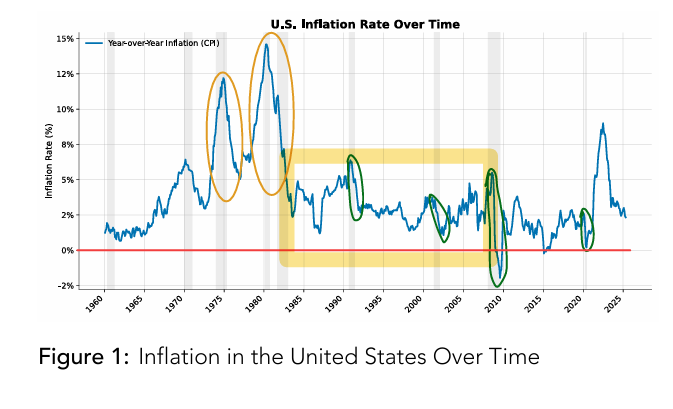
Inflation: Inflation is defined as an overall increase in the price level within an economy.
Deflation: Deflation is the opposite of inflation, characterized by an overall decrease in the price level.
Measuring the Price Level: Inflation is typically measured using the price level, which is effectively the average level of prices in the economy.
Price Variation within Inflation: Experienced inflation does not require that every single price in the economy must rise. It is common for individual prices of specific goods to fall even while the general price level is increasing.
Units of Measurement Analogy: From a classical economic perspective, inflation is seen as changing the units of measurement.
Moving from one price level to another is compared to moving from measuring in feet to measuring in inches.
The total distance (real value) does not change; only the numbers used to represent it change.
How do we measure Inflation: The Consumer Price Index (CPI)
Definition of the CPI: The Consumer Price Index is a price index computed monthly by the Bureau of Labor Statistics (BLS) using a bundle that is meant to represent the “market basket” purchased monthly by the typical urban consumer.
This is a measure of the price level in the economy relative to prices in a base year.
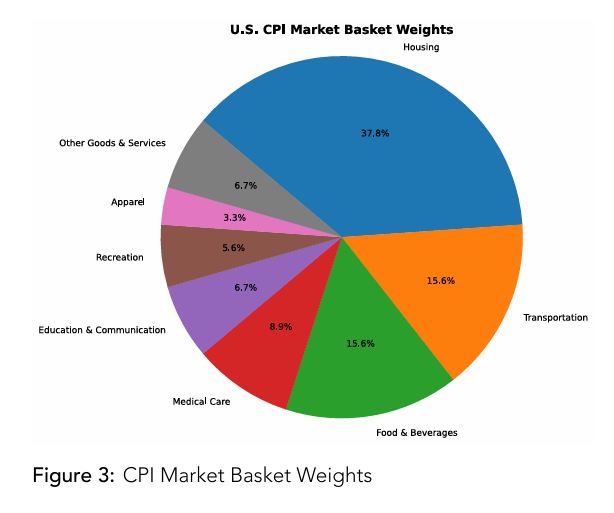
The Market Basket: a collection of various goods and services that are commonly purchased by an average urban consumer within a month. This basket is used to track changes in the price levels over time, allowing economists to measure inflation by comparing the current cost of this basket to its cost in a base year.
- It includes a wide range of items, such as food, housing, clothing, and transportation, to give a comprehensive picture of consumer spending patterns.
Comparative Measurement: The CPI serves as a measure of the price level in the economy relative to the prices in a specific base year.
Formula for Calculating CPI:
Steps for Calculation:
Data Collection: Every month, the BLS (Bureau Labor Statistics) collects data on the prices of all items included in the basket.
Determine Base Year: A base year is selected to fix the quantities. For example, if is the base year, the quantities purchased in constitute the "fixed basket."
Example with CPI/Base Year
Suppose:
2020 is chosen as the base year
CPI in 2020 = 100
Then:
CPI in 2025 = 120
This means that prices in 2025 are about 20% higher than they were in the base year (2020).
Calculating Basket Cost:
To find the cost for any year, use the quantities from the base year and multiply them by the prices of the year being analyzed.
CPI of Base Year: The CPI for the base year itself is always exactly .
Calculating the Inflation Rate: Since inflation is the percentage change in the price level, the following formula is used (where "new" refers to the current year and "old" refers to the previous year):
Practical Example: CPI and Inflation Calculation
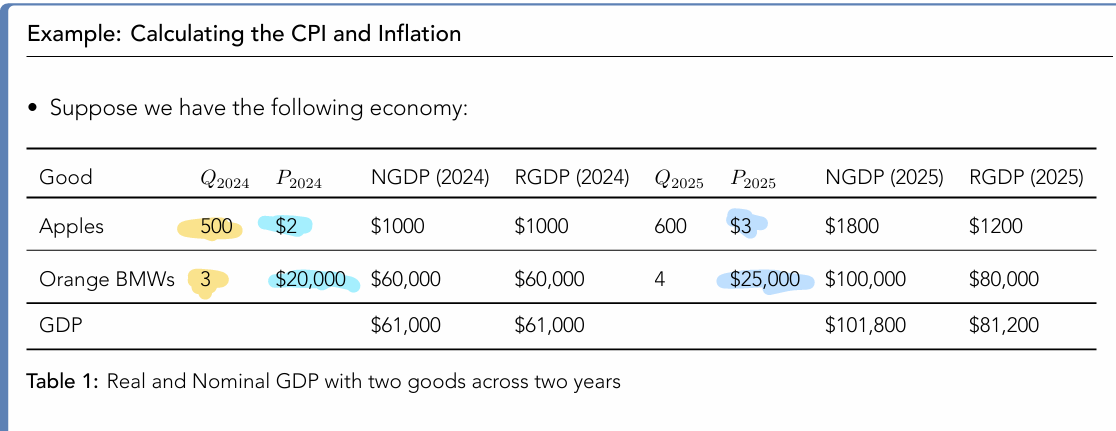
Economy Data provided (Table 1):
(Q = Quantity of product)
(P = Price of product)
Apples for 2024: ,
Apples for 2025: , .
BMWs: , \text{; } , .
Calculation Steps (Base Year = 2024):
Basket consists of apples and BMWs.
.
.
.
.
Potential Problems with the CPI
Substitution Bias: when inflation is measured too high because the price index does not fully account for consumers switching from expensive goods to cheaper substitutes.
Since the Consumer price index (CPI) uses a fixed basket, it cannot reflect the fact that consumers often substitute toward goods whose relative prices have fallen. This tends to overstate the cost of living.
Introduction of New Goods: When new products enter the market, they make consumers better off and even increase the value of the real dollar. However, because the basket is fixed, the CPI does not capture this increase in purchasing power until the basket is updated.
CPI connection
Suppose a smartphone costs $800.
Economists can't compare its price to a smartphone from 20 years earlier because smartphones didn't exist then.
As a result, CPI may not fully capture the benefit consumers receive from new products and technologies.
Unmeasured Quality Changes: Improvements in the quality of goods increase the value of the dollar. For example, if a smartphone now has a better camera, it's worth more than an older model.
While the BLS tries to account for these improvements when calculating inflation, many quality improvements are not fully measured as they often miss some changes when calculating. Leading to an overestimation of inflation. As it the official rate of inflation might be higher than it really is because we’re not seeing all the benefits in the prices we pay.
Alternative Price Level Measures: GDP Deflator and PCE Deflator
GDP Deflator: This is another measure of the price level calculated using the ratio of Nominal GDP to Real GDP.
Example from Table 2:
Comparison: CPI vs. GDP Deflator:
Capital Goods: Included in the GDP deflator (if produced domestically) but excluded from the CPI.
Prices of Imported Consumer Goods: Included in the CPI but excluded from the GDP deflator.
The Basket: The CPI uses a fixed basket of goods, whereas the GDP deflator uses a basket that changes every year (the group of currently produced goods).
PCE Deflator (Personal Consumption Expenditures): This is the ratio of nominal consumer spending to real consumer spending.
How the PCE is similar to CPI:
It only includes consumer spending
Includes imported consumer goods.
Similarity to GDP Deflator: The "basket" utilized in the PCE deflator changes over time rather than remaining fixed.
The Federal Reserve's Preference: The Fed prefers the PCE deflator because it combines the positive attributes of both CPE (includes consumer spending) and the GDP deflator.
Core Inflation and Volatility
Problem with Food and Energy: The prices of food and energy are highly volatile (its price can change a lot and very quickly) and tend to fluctuate significantly.
Impact on Measurement: Because food and energy make up a large portion of the CPI basket, this can create volatility in our measure of inflation.
Definition of Core Inflation: To address this volatility, economists use Core Inflation, which excludes the prices of food and energy to provide a clearer view of long-run underlying inflation trends.
The Relationship Between Inflation and Interest Rates
Purchasing Power Scenario: If you deposit $100 into a savings account with an interest rate, in one year you will probably have . As the $100 will turn into $108. Are you $8 richer than you were a year ago?
Whether you are truly richer depends on the inflation rate.
If inflation was during that year, goods that cost , would now cost .
While you have , your purchasing power has only increased by as you are only $3 richer in this case.
Nominal vs. Real Interest Rates:
Nominal Interest Rate (): The stated interest rate on a loan or investment, not adjusted for inflation.
For example, if a loan has a 6% nominal interest rate, the borrower owes 6% interest per year on the amount borrowed, regardless of whether prices in the economy are rising.
Real Interest Rate (): The percentage increase in purchasing power that a lender receives or a saver earns after inflation is taken into account. It reflects the true cost of borrowing money and the true return on savings.
Example
Suppose:
Nominal interest rate = 6%
Inflation rate = 2%
Then:
Even though you earned 6% more dollars, prices also rose by 2%, so your actual gain in purchasing power is only 4%.
Real Interest Rate Equation:
Real Interest Rate ≈ Nominal Interest Rate−Inflation Rate
Where is the real interest rate
, is the nominal interest rate
is the inflation rate.
The Social Costs of Inflation
The Layman’s View: The average person believes inflation is harmful because it "eats away" at their raises.
The Classical Response: However, economists argue that real wages are tied to marginal productivity, not just the amount of money printed. Inflation eventually raises both prices and nominal wages.
All inflation is really doing is changing the units of measurement. Think of it as moving from feet to inches. The distance doesn’t change, just the numbers. Economists do NOT agree on social cost of inflation.
Costs of Expected Inflation:
Shoe leather Costs: The inconvenience and cost of reducing money holdings (e.g., more frequent trips to the bank because cash loses value quickly).
Menu Costs: The literal costs of changing prices, such as reprinting menus or updating systems.
Relative Price Variability: Costs arise when prices are changed infrequently, leading to distortions in market signals.
Tax Distortions: Many tax laws do not account for inflation. For example, capital gains taxes may tax nominal gains that are not actually real gains in purchasing power.
General Inconvenience: The general difficulty of living and planning in a world where prices are constantly changing.
Costs of Unexpected Inflation:
Redistribution between Borrowers and Lenders: High unexpected inflation helps borrowers and hurts lenders because the debt is paid back in less valuable dollars. Unexpectedly low inflation or deflation does the opposite.
Fixed Pensions: Individuals on fixed nominal pensions are harmed by high inflation as they receive a fixed retirement payment, but the cost of living is increasing.
One Benefit of Inflation: It can prevent a "false notion" of raises. A wage cut in a world with no inflation is functionally equivalent to a raise in a world with inflation, but the latter may be more psychologically acceptable to workers.
The Implications and Costs of Deflation
Historical Context: Around , many developed nations experienced very low inflation, so governments began to become worried about deflation.
Unanticipated Deflation: If prices fall unexpectedly, lenders will gain at the expense of borrowers. And those on fixed pensions will gain at the expense of governments and firms paying those pensions. This also means those paying fixed pensions (governments and firms) lose while the pensioner’s gain.
Impact on Firms: Unexpected deflation harms firms because they receive less money than expected for their output.
Market Distortions: If profit margins are small, deflationary pressures can cause large distortions in market activity, particularly within labor markets.