Topic 2 People in business
Methods of communication
Verbal |
|
|
Non- Verbal |
|
|
Written |
|
|
The use of IT in communication
Video conferencing
Email
Instant messge and chat applications
The importance of good communication
Benefits of effective communication
Increases worker motivation | More likley to be engages and committed | It enables feedback among employees creating a collaborative environment |
Improves efficiency | Clear and complete communication supports better decision making as decisions are based on more accurate information | Employees who understand their roles and tases thoroughly can work more efficiently and productively |
Encourage innovation | Open communication helps individuals understand their roles and responsibilities | Also encourages teamwork and cooperation contributing to a supportive workplace atmosphere |
Reduces costs | Effective communication minimizes errors which in turn reduces costs | Communication tools such as email or messaging platforms are often low - cost and easy to implement |
Promotes customer satisfaction | Maintaining regular and meaningful communication with customers helps build strong relationships which can lead to increases sales and bran loyalty |
Problems of ineffective communication
Less motivated employees | If workers feel less informed about their role or tasks they may feel less motivated |
Increasing costs | Delayed projects, increasing defects and lack of co-operation amongst staff are all examples of factors that can cause rising costs for a business |
Inefficiency | If messge are delayed or not sent to the right person decision making and process will be slowed down this could also lead to missed opportunities and a rise in costs to fix mistakes. |
Inaccuracy | Inaccurate information can lead to mistakes being made such as products or a poor quality or a compromise to customer saftey. |
Barriers to communication & How to fix them
Hierarchical and structural barriers | Encourage to way feedback so employees feel comfortable talking to multiple people in the work place |
Language and Jargon | Agreed upon language and avoid using terms that could be hard to understand |
Noise and distractions | Chose locations for communication and hours and limit distractions |
Lack of feedback | Where appropriate select methods that allow feedback |
Cultural differences | Build culture of teamwork and respect amoungest eachother |
Lack of time | Schedule meetings and amend workloads |
Technological barriers | Invest in good quality ICT systems |
Types of employment
Full time | Working a 35 - 40 hours a week. Costs more money but they are reliable for the business |
Part time | Someone who works less than 35-40 hours a week and is more flexible. Costs less money but might not be motivated to work |
Job sharing | Breaking the role between two part time contractors Costs more but is more efficient for the project |
Temporary/ Casual worker | Someone who works temporarily shows up for work whenever the business needs them this may be seasonal and is useful for busy days Costs less and can be used on busy days Might not be as motivated to complete tasks |
Recruitment documents
Person Specifications: A document that captures the essentials and desired characteristics of an ideal candidate
Job description: A document which lists the key duties and responsibilities that the employee will preform
Application form: A customized document that all applicants have to anser. The customization makes it easier to compare candidates to chose who is best for the job
Curriculum vitae (CV): A document that contains the applicants educational and work experience history
Internal & External recruitment
Internal Recruitment: Is the appointment of suitable candidate who alredy wors for the business
External recruitment: Is where a new employee is appointed from outside the business
Advertising Internally |
|
Advertising externally |
|
Shortlisting |
|
Interviews |
|
Legal controls over employment
Legal controls are the laws and regulations passed by governments that require businesses to conduct their behaviors in a particular manner
These laws effect
Pay
Hours and conditions of work
Safety
Discrimination
Rights to paid and unpaid absence
Dismissals
Equal opportunities
Age
Gender
Race
Religion
Disability
Sometimes business must not allow equal opportunities depending on the job such as bus drivers cannot be blind
Benefits of complying with employment laws
Improve its reputation
Keep employees happy and motivated
Prevents serious or legal issues arising, such as bullying harassment and discrimination
Better serve a diverse range of customers
Improve ideas and problem - solving
Attract and keep good staff
Minimum wages laws
A minimum wage is the lowest legally allowed wage, with variations across countries based on industry, region, and skill level.
Some countries have no minimum wage laws, relying instead on collective agreements.
Impacts of Implementing a Minimum Wage
For Employers:
Increases variable costs, potentially leading to higher prices.
May encourage training investments for unskilled workers.
Some may struggle to meet wage requirements, leading to negotiations for higher pay among skilled workers.
For Employees:
Reduces exploitation and improves pay.
Attracts more workers due to better wages.
Raises living standards and boosts motivation and productivity.
May result in job losses as businesses adapt to higher labor costs.
The importance of training
Productive staff: Employees work enthusiastically at the things they’re good at
Valued Staff: Well- trained employees are likely to be satisfied. They recognise that their employers is spending money and investing time in their development
Loyal and flexiable staff: Labour retention should increase as employees feel they are becoming better at their job and want to keep developing
Advantages of Induction Training
Clarifies job roles and responsibilities for new employees.
Boosts employee confidence and motivation.
Reduces the time needed for new employees to become productive.
Disadvantages of Induction Training
Can be time-consuming and costly to organize.
May not address all aspects of the job.
Effectiveness can vary, potentially leading to employee dissatisfaction and higher turnover rates.
Training
On the job training
Advantages | Disadvantages |
|
|
Off the job training
Advantages | Disadvantages |
|
|
The importance of motivation
Definition: Motivation drives individuals to achieve goals.
Productivity: Motivated employees are more productive and proactive.
Profitability: Higher productivity leads to increased profits.
Retention: Well-motivated employees have lower turnover rates, cutting recruitment costs.
Reliability: Motivated workers are more reliable and foster a positive organizational culture.
Motivation Theories
Motivation theories explore how money and non-financial factors influence employee effort and performance. Key theories include:
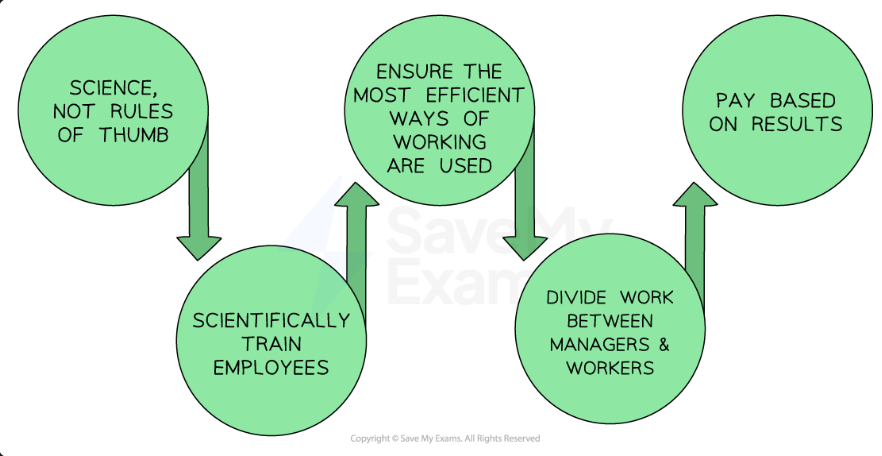
Taylor's Scientific Management: Emphasizes that workers are primarily motivated by pay and require clearly defined tasks and close supervision.
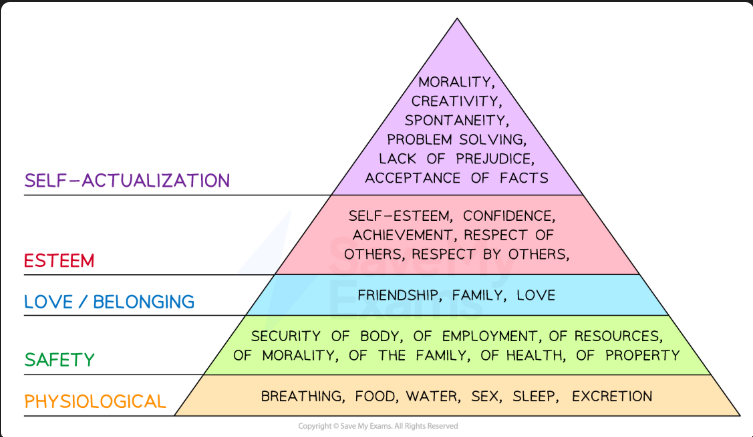
Maslow's Hierarchy of Needs: Suggests that individuals progress through levels of needs, with each level motivating them until it is fulfilled.
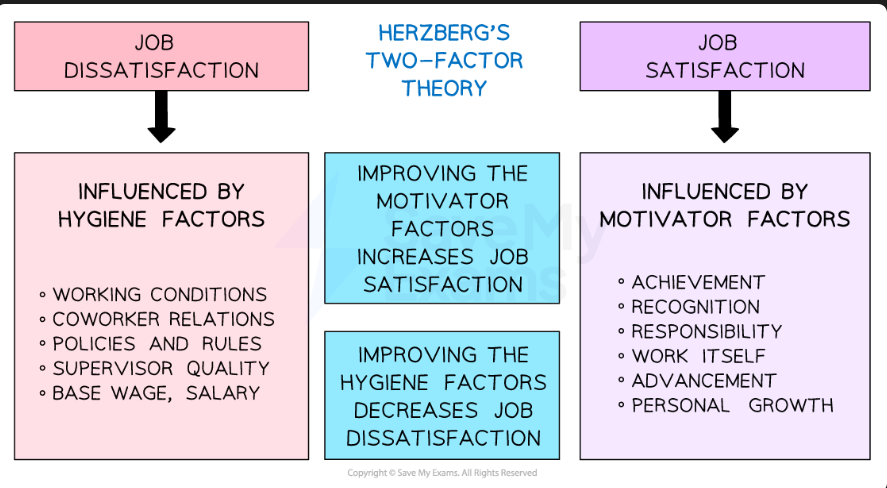
Herzberg's Two-Factor Theory: Argues that money is not a true motivator; instead, a lack of it causes dissatisfaction. Motivation comes from factors like opportunities for skill development.
Taylor’s theory of motivation
Maslow’s theory of motivation
Herxberg’s theory of motivation
How businesses motivate employees
Financial Motives
Basic Wages/Salary:
Paid for labor; hourly workers receive wages with benefits like annual leave.
Salaries are fixed for full-time employees, often accompanied by benefits.
Commission:
A percentage of sales revenue paid to employees, primarily in sales roles.
Designed to motivate staff to increase sales and upsell.
Bonus:
Additional payments for achieving specific goals or exceeding expectations.
Incentivizes employees to work harder for better results.
Promotion:
Involves increased responsibilities and typically higher pay.
Clear promotion pathways can motivate employees to enhance productivity.
Fringe Benefits:
Extra perks for salaried employees, such as company cars or healthcare.
Motivates employees to work hard to retain their job and benefits.
Non Financial Motives
Autonomy:
Grants staff the authority and resources to make decisions independently.
Enhances ownership and responsibility, leading to increased productivity.
Job Enrichment:
Adds more challenging or meaningful tasks to a job.
Increases motivation and engagement, resulting in improved productivity.
Job Rotation:
Involves moving staff between similar but varied roles.
Provides new challenges and experiences, boosting motivation, understanding, and skills.