atoms
an atom is made up of protons, electrons and neutrons.
electron
the electron was discovered by j.j. thomson. an electron is negatively charged. the mass of an electron is considered to be negligible and its charge is minus one.
proton
the proton was discovered by e. goldstein in 1886. a proton is positively charged. its mass is approximately 2000 times as that of the electron. the mass of a proton is taken as one unit and its charge as plus one.
thomson’s model of an atom
thomson’s model of an atom can be compared to a christmas pudding or a watermelon. in his model, negatively charged electrons were embedded in a positively charged sphere.
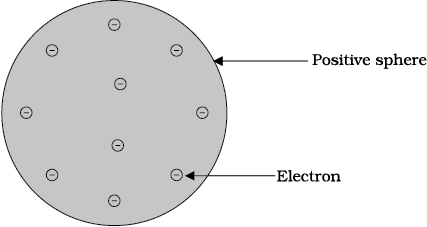
thomson proposed that:
- an atom consists of a positively charged sphere and the electrons are embedded in it.
- the negative and positive charges are equal in magnitude. so, the atom as a whole is electrically neutral.
although, thomson’s model explained that atoms are electrically neutral, the results of experiments carried out by other scientists could not be explained by this model.
rutherford’s model of an atom
ernest rutherford conducted an experiment to know how the electrons are arranged within an atom.
- he selected a gold foil because he wanted as thin a layer as possible. this gold foil was about 1000 atoms thick.
- alpha particles are doubly-charged helium ions. since they have a mass of 4 u, the fast-moving alpha particles have a considerable amount of energy.
- it was expected that alpha-particles would be deflected by the sub-atomic particles in the gold atoms. since the alpha-particles were much heavier than the protons, he did not expect to see large deflections.
the following observations were made:
- most of the fast moving alpha particles passed straight through the gold foil.
- some of the alpha particles were deflected by the foil by small angles.
- surprisingly one out of every 12000 particles appeared to rebound.
the conclusions of this experiment were:
- most of the space inside the atom is empty because most of the alpha particles passed through the gold foil without getting deflected.
- very few particles were deflected from their path, indicating that the positive charge of the atom occupies very little space.
- a very small fraction of alpha particles were deflected by 180 degree, indicating that all the positive charge and mass of the gold atom were concentrated in a very small volume within the atom.
he also calculated that the radius of the nucleus is about 10^5 times less than the radius of the atom.
features of this model were:
- there is a positively charged center in an atom called the nucleus. nearly all the mass of an atom resides in the nucleus.
- the electrons revolve around the nucleus in circular paths.
- the size of the nucleus is very small as compared to the size of the atom.
drawbacks of rutherford’s model of an atom
rutherford's atomic model failed to explain the stability of electrons in a circular path. he stated that electrons revolve around the nucleus in a circular path, but particles in motion would undergo acceleration and cause energy radiation.
bohr’s model of an atom
features of bohr’s model of an atom are:
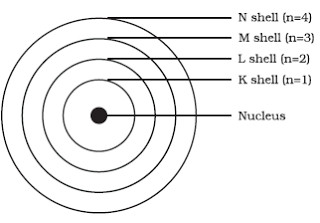
- only certain special orbits known as discrete orbits of electrons, are allowed inside the atom.
- while revolving in discrete orbits the electrons do not radiate energy. these orbits or shells are called energy levels.
neutrons
in 1932, j. chadwick discovered another sub-atomic particle which had no charge and a mass nearly equal to that of a proton. it was called the neutron. neutrons are present in the nucleus of all atoms, except hydrogen. the mass of an atom is therefore given by the sum of the masses of protons and neutrons present in the nucleus.