Energy and Enviroment
The need for power
Scientists agree that burning oil, coal, and gas contributes to climate change. Governments worldwide are considering whether to use these fuels to combat global warming. While oil is valuable, it could be left untapped. Human activity is a significant cause, and governments recognize a 2°C global temperature rise as sufficient to prevent severe impacts. The question remains: could the world ignore unexplored resources, adapt to alternative energy sources, and work together?
Fossil Fuels
The world's energy is primarily used through direct combustion, with fossil fuels like natural gas, coal, and oil being more energy-dense. These fuels are produced from the decay of plants and animals, which form organic matter covered in sediment layers. The exact conditions and type of material determine the production of coal, oil, or natural gas. The extraction of these fossil fuels requires deep underground digging or drilling, leading to a limited supply.
Fossil Fuels - A carbon-based fuel, formed over many millions of years from the decay of living matter.
Energy Resources
The global energy demand is increasing due to -
population growth
industrialization and urbanization
improved living standards.
To meet this, existing sources need efficient use, and new opportunities may arise from advancements in engineering and technology.
Types of Energy sources
Different types of energy sources can be described by whether they are limited resources or available in unlimited supplies.
Non-renewable — an item or resource that exists in a finite amount that cannot be replaced
Examples —
Oil
Coal
Natural gas
Nuclear power
Renewable — an item or resource that will not be used up or can be replaced
Examples —
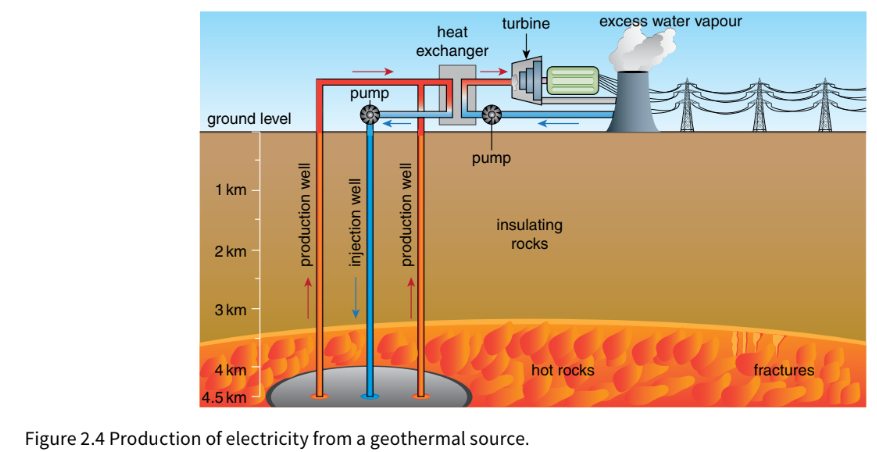
Geothermal power
Hydroelectric power
Tidal power
Wave power
Wind power
Solar power
How energy sources are used
Electricity is the main use of energy sources, with electromagnetic induction being the most efficient method. This process transforms kinetic energy into electrical energy using copper coils and a magnet. A power source, a turbine, is needed to rotate the coils, which are powered by a stream of gas or liquid passing over the blades. The water is heated up in a boiler, which is converted to steam. This steam passes through the turbine blades, causing the copper coils to move and produce electricity. Efficiency can be increased by fitting more blades or increasing the flow of gas or liquid. Other energy sources, such as wind, wave, tide, and hydroelectric power, can also be used directly without producing steam.
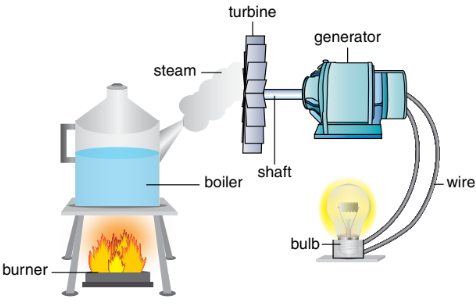
Electromagnetic induction — a process used for generating electricity that uses the movement of a metal coil and a magnet
Generator — a machine that converts mechanical energy (such as movement) into electrical energy
Turbine — a machine, often containing fins, that is made to revolve by the use of gas, steam or air
Burner — a receptacle used to hold fuel as it is burned
Boiler — a vessel used to heat water to convert it into steam
Solar power — uses photovoltaic cells, which produce small electric charges when exposed to light. Although technological advances make them more efficient, rare and expensive metals are used. Wave and tidal power systems use the sea or large rivers, but their technology and availability differ. Despite these differences, solar power remains a significant source of electricity.
Tidal power — Tidal barrages and wave power are two methods of generating water power. Tidal barrages use natural water levels to hold back water, while wave power uses smaller differences caused by wind, using turbines and generators to generate electricity.
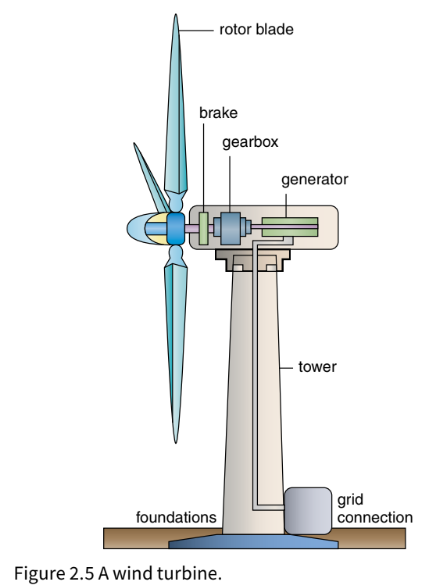
Wind power — Wind turbines rotate shafts due to wind, with a gearbox maximizing rotation and brakes preventing blade damage. The generator produces electricity as the turbine rotates, ensuring efficient power generation.
Solar power — harnessing energy from sunlight
Tidal power — the use of tides (the natural change in sea levels) to generate electricity
Tidal barrage — a small dam used to hold back a tide
Wave power — the use of changes in the height of a body of water to generate electricity
Nuclear Power — Uranium, a radioactive element, releases significant energy during nuclear fission, which is utilized to heat water, generate steam, and rotate turbines.
Using the different energy sources
Choosing the right energy source is challenging due to its economic, social, and environmental impacts, and may have both advantages and disadvantages.
Economic Factors — Energy supply is expensive due to increasing demand and limited sources. Countries with their own fuel supply often use it more cheaply than importing other sources. Countries like the Middle East, Russia, and the USA rely on their local fuels, while others use natural sources like sunlight or geothermal energy. However, some countries face barriers like high investment costs, preventing them from adopting certain energy sources.
Social Factors — The impact of fuel sources on local areas and industries depends on factors such as land availability, employment, infrastructure improvements, and political relationships. Mining for coal or oil may lead to land loss for agriculture, while new industries may create local employment and demand for other businesses. Large-scale projects can improve infrastructure, but may also cause displacement or disadvantage for workers in declining sectors. Investments in certain energy sources may also have health effects for the local population.]
Environmental factors — Renewable sources like wind, solar, and wave power do not produce carbon dioxide emissions, which contribute to climate change. Biofuels and plant growth also use carbon dioxide during photosynthesis. Fossil fuels contribute significantly to carbon dioxide. Other environmental impacts include pollution, ecosystem changes, and visual impact. Spillage of fuel can damage wildlife, produce toxic gases, and disrupt ecosystems. Renewable sources can also impact natural beauty and local ecosystems.
advantages and disadvantages of different fuel types.
FUEL TYPE | ADVANTAGES | DISADVANTAGES |
|---|---|---|
Fossil fuels (oil, coal, natural gas) | Plentiful supply in some locations. Extraction provides jobs Existing technology: the fuel is available for most countries to use | Carbon dioxide and toxic gases when burnt (impacting on climate change) Extraction causes damage to local area Limited supply: prices will rise as the supplies get smaller |
Nuclear power (using uranium) | Does not produce carbon dioxide (impact on climate change) Small amount of fuel produces large amounts of energy Power plants employ lots of people | Risk of radiation leakage (impact on human health and environment) Waste products cannot be recycled as radiation active for centuries Limited supply |
Biofuels (bioethanol, biogas, wood) | A renewable source: bioethanol and wood are both obtained from growing plants, biogas from the recycling of waste products Growing more plants uses carbon dioxide Potentially a plentiful supply | Carbon dioxide and other toxic gases produced when burnt A lot of land is needed to grow crops for fuel Potential removal of natural ecosystems to grow fuel crops |
Geothermal power | Does not produce carbon dioxide Unlimited supply as uses the heat from the Earth as the power source | Can be expensive to install Only certain areas have suitable conditions |
Hydroelectric power | Does not produce carbon dioxide Water can be reused for other purposes | Building of dams impacts the natural flow of water Villages and ecosystems may be destroyed when dams and reservoirs are built |
Tidal power | Does not produce carbon dioxide Tidal movements not dependent on weather conditions | Limited to specific coastal areas Impacts on the tourist industry and local fishers |
Wave power | Does not produce carbon dioxide A renewable source of power | Limited to specific areas Currently not very efficient, so large amounts of resources needed |
Solar power | Does not produce carbon dioxide Sunlight is not a limited resource | Only efficient under certain weather conditions Generation only occurs in daylight hours Visual impact and potential damage to local ecosystems |
Wind power | Does not produce carbon dioxide Uses a renewable resource | Not all locations are suitable Generation only occurs in certain conditions (at certain wind speeds) Visual impact Uses a large area |
Bioethanol — the creation of ethanol from fermentation
Biogas — the creation of methane from the breakdown of organic materials in an anaerobic digester
The demand for energy
Experts predict that human energy use will increase over the next 40 years due to a limited supply of non-renewable resources. The exact duration of these supplies remains uncertain. Predictions have been inaccurate due to new deposits and increased material prices. The world price of non-renewable energy sources will rise with increased demand.
Industrial demand
Traditional farming communities use less energy per head than industrialized ones, as manufacturing requires large quantities of energy in all stages. Iron and steel production requires fuel for melting and refining, and additional heat for shaping. Advances in manufacturing have made items more affordable and necessary, leading to increased energy needs.
Domestic demand
Efficient manufacturing processes have made goods more affordable, leading to increased domestic demand for items like televisions, cars, and mobile phones. This demand is driven by affordability and the need to keep up with neighbors, increasing the demand for reliable energy supplies. Additionally, consumers in some countries expect to have access to non-local produce, which can be produced in controlled conditions or grown in a more favorable climate, but incurs significant energy costs.
Transport demand
The development of efficient production systems has led to manufacturers supplying customers globally, reducing production costs but increasing transportation costs. Over the past 20 years, shipping journeys and air transport have increased, requiring large fossil fuels. Despite the cost, cost savings in manufacturing remain attractive.
Economic factors
Economic factors influence domestic energy demand and purchasing of manufactured goods. Good economic conditions lead to higher employment and more money for luxury items, while poor conditions result in less money and savings, leading to reduced fuel use and electricity consumption. A poor economy reduces manufacturing, goods to transport, and foreign energy supplies. A reduction in manufacturing can impact the global economy, as seen in China's mid-2010s economic downturn.
Climate
Climate change has led to extreme weather events, such as extreme cold and heat, resulting in increased energy consumption, especially in urban areas. People in temperate climates experience colder winters, higher heating demand, and fewer daylight hours, resulting in increased use of electric lighting.