THE CONSTITUTION P2
What is a constitution?
A constitution is a set of laws and guidelines establishing how a political system will function. It says where power lies within the system and helps guarantee citizens’ rights.
The world’s oldest constitution is the UK’s, established in 1215
Key Historical Documents
Magna Carta (1215): No one should be deprived of liberty or property against the law.
Bill of Rights (1689): Set out limits of royal power, establishes free and fair elections to Parliament, the fundamental rights of citizens and the supremacy of Parliament.
Act of Settlement (1701): Set out Parliament’s right to decide the throne’s succession.
Acts of Union (1707): Scotland and England were now united, and a single parliament now exists in Westminster.
Parliament Acts (1911 and 1949): The House of Lords could not delay financial bills, and vetoing legislation was replaced by delaying it by one year.
European Communities Act (1972): EU law would take precedence over UK law as the UK joined the European Community.
The European Union (Withdrawal) Act (2020): Took the UK out of the European Union, meaning new EU laws and treaties no longer applied to the UK.
Parliament Acts (1911 and 1949)
reduced the powers of the House of Lords
1911: Lords could not delay financial bills, and the power of veto was replaced by a two-year delaying power.
1949: The 2-year delay was reduced to one year.
Types of Constitution
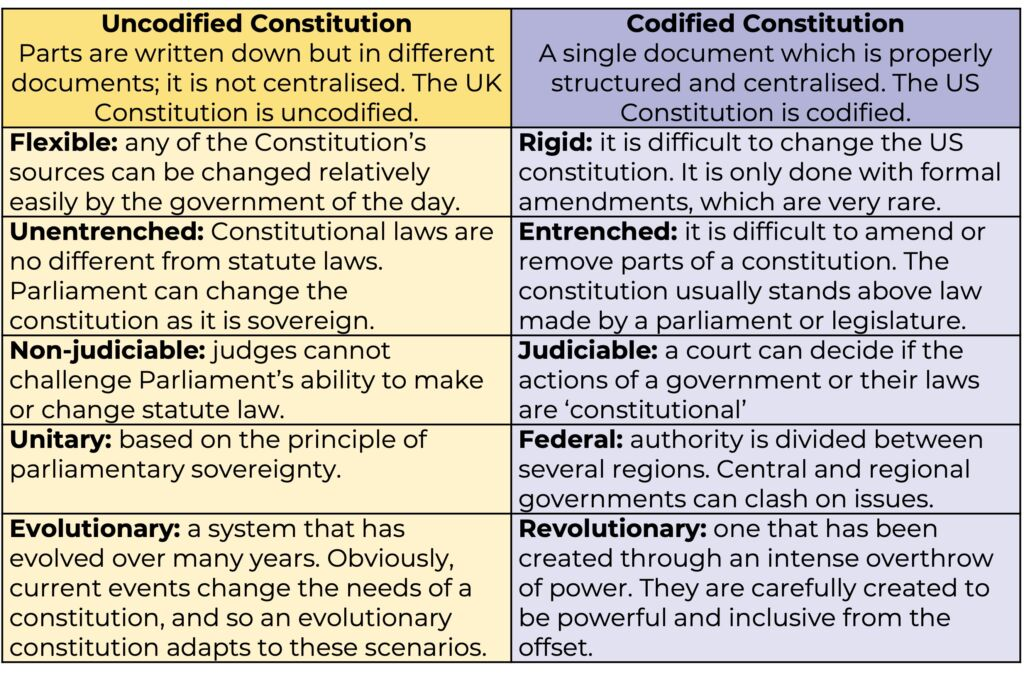
Statute Law
laws passed by Parliament. Since Parliament is sovereign, statute laws are sovereign. An example of statute law is the 2015 Recall of MPs Act, which allowed MPs to be recalled under certain circumstances. A by-election is called if at least 10% of constituents sign the petition.
Common Law and Case Law
The UK judiciary uses a principle of precedence; once a decision has been made on a case, similar cases will be considered similarly.
Works of Authority
Works of Authority are books that have been written to help explain the Constitution and its content. An example is ‘Parliamentary Practice’ by Erskine May. These books, however, lack legal standing.
Conventions
These are not laws but traditions that have developed through generations.
Examples of conventions in the UK include collective responsibility and the Salisbury Convention
EU Treaties & laws
The Lisbon Treaty (2009) and Maastricht Treaty (1992) are examples of agreements with other EU nations. Since Brexit, EU treaties and laws no longer automatically become UK law.
Constitutional reform since 1997
There are four main ways in which reform since 1997 has affected UK politics:
Enhancing democracy
Decentralising power
Enhancing rights
Modernising the system
Enhancing democracy
The House of Lords Act (1999) removed all but 92 hereditary peers from the House of Lords
Decentralising Power
Devolved assemblies established in Scotland, Wales and Northern Ireland —> gave local representation to these areas.
major urban areas had elected mayors, such as in London and Manchester.
The decision to leave the EU is also constitutional reform, as power is given back to the British people.
Enhancing Rights
Human Rights Act (1998)
Enshrined the European Convention on Human Rights (1950) into UK law.
Citizens can now challenge laws in UK courts instead of going to the European Court of Human Rights (ECHR).
The Supreme Court can issue a ‘declaration of incompatibility’ if any actions go against the Human Rights Act —> pressures the government to back down on a particular issue, but the court cannot force them to.
Freedom of Information Act (2000)
The government looks more transparent, letting citizens know who and how decisions are made. + Anyone can access files from any government body unless it affects national security
The Equality Act (2010)
This made it illegal to discriminate on the basis of nine “protected characteristics” e.g religion and race
Modernising the System
The 2005 Constitutional Reform Act established a Supreme Court and removed Law Lords from the House of Lords.
The 2011 Fixed Term Parliaments Act fixed the date of general elections to every five years unless a two-thirds majority was passed in the House of Commons. However, this law has since been repealed (2022)
Devolution
refers to transferring legislative powers from a central parliament to a regional legislature. Power was devolved to Scotland and Wales in 1997 and Northern Ireland in 1998 following a referendum on the Good Friday Agreement.
All three countries received powers over agriculture, employment, social services, culture, environment, sport, tourism, education, health and transport
none of the three acquired powers over defence, energy, foreign policy and nationality (reserved power)
As a result of the UK’s uncodified constitution and parliamentary sovereignty, the power of devolved bodies rests with Westminster, and the bodies can be made more powerful, less influential or removed entirely at the wish of parliament.
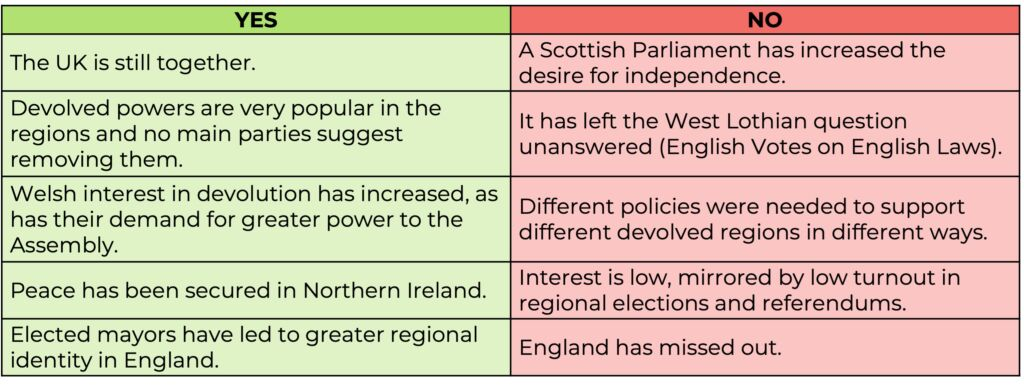
Has devolution been successful?
EVEL
English Votes for English Laws was a principle established in parliament regarding law that solely affected England. A bill can be vetoed by a majority of MPs representing English constituencies+This prevents Scottish, Welsh and Northern Irish MPs voting on the issue as well
EVEL was established in 2015 but was suspended in 2020 and ultimately withdrawn in July 2021. Now, there is no procedure for legislation that affects only England.
Metro Mayors
Power is being extended down from Westminster to city regions with large populations. These have resulted in directly elected mayors who have power over some areas of legislation. There are directly elected mayors in cities such as Bristol and Doncaster
London Assembly was established in 2000, with 25 members to discuss various issues, including policing, housing and transport + they scrutinise the work of the London Mayor.
Devolution in Scotland
129 Members of the Scottish Parliament (MSPs) are elected every four years using the Additional Member System.

The Scottish government is the most powerful devolved government in the world, with powers over areas such as Elections, Education and Tourism
Devolution in Wales
The Welsh Parliament has 60 members elected every five years using the Additional Member System.

Wales has fewer devolved powers than Scotland but still has a range of areas it can legislate e.g Education, Health and Housing
Devolution in Northern Ireland
Devolution in Northern Ireland was established following the signing of the Good Friday Agreement in 1998. This groundbreaking agreement ended ‘The Troubles’ that saw violent conflict among Unionists and Nationalists in Northern Ireland.
The Northern Ireland Assembly (legislature) elects its 90 members using the Single Transferrable Vote system, meaning that it is almost impossible for a single party to hold a majority in the Assembly.
In the most recent election in 2022, Sinn Fein (nationalists) became the largest party in the Northern Ireland Assembly, the first time a nationalist party became the largest party.
The Northern Ireland Executive has powers such as Agriculture, Housing and Environment

The Northern Ireland Executive has not been running smoothly in recent years. After an energy scandal in 2017, Deputy First Minister Martin McGuinness resigned, and the Executive collapsed. Part of the Good Friday Agreement stated that the Executive cannot function unless there is both a First Minister and Deputy First Minister. The Executive was re-established in 2020 but subsequently collapsed again in 2022 when First Minister Paul Givan resigned over concerns regarding the Northern Ireland Protocol, part of the Brexit agreement regarding trade between Northern Ireland and the rest of the UK.
A codified constitution

Further English devolution

House of Lords reform

House of Commons reform
