Seperation techniques
Mixtures are easily separated, no chemical bond.
Paper chromatography:
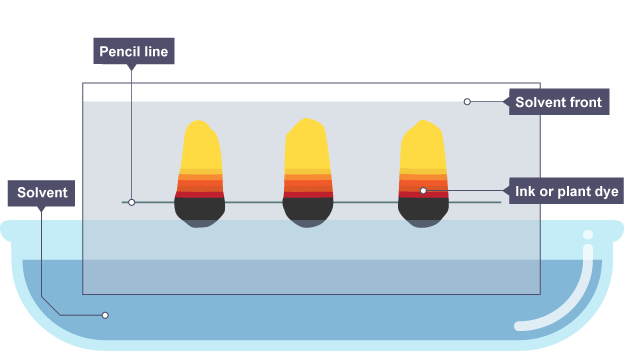
Draw a line (pencil) near bottom of a sheet of filter paper
Add spot of ink to the line and place sheet in a beaker of solvent (water)
Make sure the ink spot is above the water
Place a lid on top to stop evaporation
The solvent will seep up the paper and carry the ink with it
Each different dye in the ink will move up at a different rate and will thus separate
When the solvent is almost at the top of the paper remove it from the beaker
Filtration
Can be used if your product is an insoluble solid that needs to be separated from a liquid
Also can be used in purification.
Evaporation
Used to separate soluble solids from solutions
Pour the solution into an evaporating dish
Slowly heat the solution using a Bunsen burner. The solvent will evaporate and the solution will get more concentrated
Eventually the solution will evaporate and you will be left with dry crystals
Crystallisation
Separate soluble solids from solution
Pour solution into evaporating dish and gently heat, some solvent will evaporate and solution will be more concentrated.
When you see crystals start to form (point of crystallisation), remove the dish from heat and leave solution to cool.
Should start to form crystals as it becomes insoluble in the cold, highly concentrated solution.
Filter out the crystals and leave them in a warm place to dry.
Distillation
Simple distillation
Used to separate mixtures which contain liquids
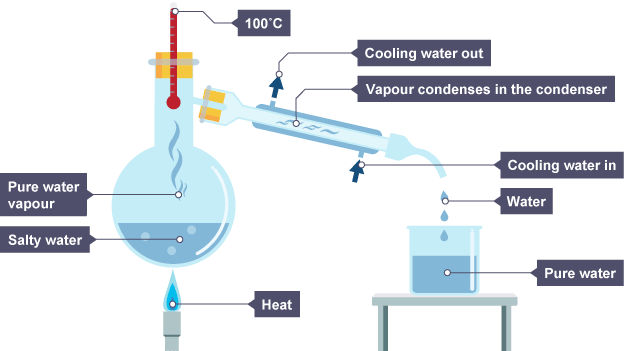
Solution is heated using a Bunsen burner, the liquid in the solution with the lowest boiling point will start to evaporate first
As it evaporated it will enter a condenser, the vapour is cooled here and turned back into a liquid
It then exits the condensing tube into a beaker, where the solutions are separate.
Fractional Distillation
Used to separate mixtures with liquids which have similar boiling points
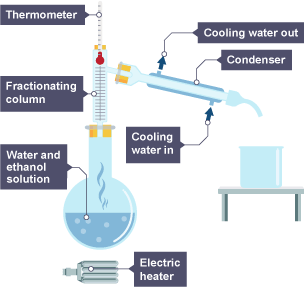
Put your mixture in a flask and put a fractionating column on top and then begin to heat it up
As it heats the liquid with the lowest boiling point will evaporate first, when the temperature on the thermometer matches its boiling point it will reach the top of the column and then enter a condensing tube and separate into another beaker
Liquids with higher boiling points may also start to evaporate but the column is cooler near the top so they will only get part of the way up before condensing and running back down into the flask.