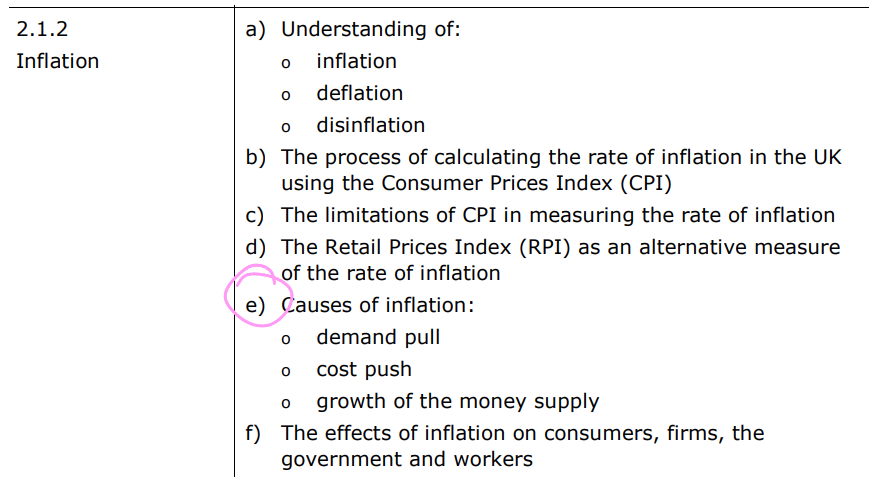
2.1.2 Inflation
A) Understanding Inflation, Deflation, and Disinflation
1. Inflation
A sustained increase in the general price level over time
Must be long-term, not a one-off rise
Refers to many goods/services, not just one
Leads to a fall in purchasing power of money
2. Deflation
A sustained decrease in the general price level
Increases purchasing power
Can discourage spending and investment (people delay purchases)
3. Disinflation
A fall in the rate of inflation
Prices are still rising, but more slowly
B) Calculating the Rate of Inflation Using CPI
1. Consumer Price Index (CPI)
Main measure of inflation (UK)
Based on a weighted basket of goods and services
Represents spending of an average household
Weights reflect importance of items
2. CPI Formula
CPIt=CtC0×100CPI_t = \frac{C_t}{C_0} \times 100CPIt=C0Ct×100
CtC_tCt = cost of basket in current period
C0C_0C0 = cost of basket in base year
3. Inflation Rate Formula
Inflation Rate=CPIcurrent−CPIpreviousCPIprevious×100\text{Inflation Rate} = \frac{\text{CPI}_{current} - \text{CPI}_{previous}}{\text{CPI}_{previous}} \times 100Inflation Rate=CPIpreviousCPIcurrent−CPIprevious×100
4. Key Notes
Everyone experiences different inflation rates
Government target: ~2% ± 1% (not 0%)
5. Real vs Nominal
Real = adjusted for inflation (true purchasing power)
Nominal = not adjusted (just the number)
C) Limitations of CPI
1. Population Average
Same basket for everyone
Ignores individual differences in spending
2. Substitution Bias
Assumes people buy the same goods every year
In reality, consumers switch to cheaper alternatives
e.g. pasta → rice
Leads to overestimation of inflation
3. Quality Changes
Doesn’t fully account for improvements in products
Higher prices may reflect better quality, not inflation
Causes overestimation
4. Time Lag
Consumer habits change faster than CPI updates
D) The Retail Price Index (RPI)
1. Definition
Alternative measure of inflation
2. Key Features
Includes housing costs (e.g. mortgages)
Uses a different calculation method
Usually shows higher inflation than CPI
3. Uses
Pensions
Index-linked bonds
Wage negotiations (sometimes)
E) Causes of Inflation
1. Demand-Pull Inflation
Occurs when aggregate demand (AD) > aggregate supply (AS)
AD shifts outwards
Causes:
Higher consumer spending
Increased investment
Government spending
Example: Economic boom
2. Cost-Push Inflation
Caused by rising costs of production
SRAS shifts inwards
Causes:
Higher raw material prices (e.g. oil)
Rising wages
Supply chain issues
Effects:
Higher prices
Lower output (bad for GDP)
3. Growth of Money Supply
Too much money chasing too few goods
Leads to excess demand → inflation
F) Effects of Inflation on Economic Agents
1. Consumers
Reduced purchasing power
Savings lose value
Fixed-income earners worse off
Pensioners struggle to maintain living standards
2. Firms
Rising costs of production
Lower profit margins
May increase prices to compensate
3. Government
Higher cost of servicing debt
Less money for public services
Bracket creep → higher taxes without real income increase
4. Workers
Nominal wages may rise
But real wages may fall
Trade unions may push for higher wages
✅ Final Summary
Inflation is a key macroeconomic issue affecting:
Living standards
Business costs
Government policy
Understanding:
How it’s measured (CPI/RPI)
Its causes (demand-pull, cost-push, money supply)
Its impacts