Neuron Quiz
- classified by the number of process**==es==** off of the cell body
- Unipolar neurons- have on the process
- Bipolar neurons- have two processes
- Multipolar neurons- have many processes
- Cell body- made up of the nucleus, cytoplasm, and organelles
- Dendrites- on the cell body, bring impulses toward the cell body, pointy looking, like branches
- Axon- runs from the bottom of the cell body to the axon terminal, sends impulses away from the body
- Axon terminal- at the end of axons, knobby, release neurotransmitters to pass an impulse to the next neuron
- Synapse- the space between an axon terminal of one neuron and dendrites of another
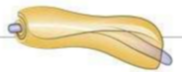
- Myelin sheath- made up of Schwann cells, covers the axon, insulates and protects, helps nerve impulses travel quicker
- Nodes of Ranvier- gaps in the myelin sheath, exposed axons, impulses can only travel in these areas
%%Neuroglia%%
- found in the CNS or PNS
- In the central nervous system
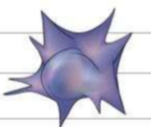
- Astrocytes: support and anchor neurons to surrounding capillaries
- \
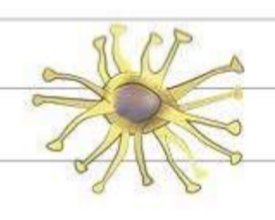
- Microglia- Provide immune response to the central nervous system
- \
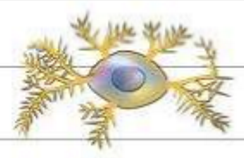
- Ependymal cells- secrete and circulate cerebrospinal fluid
- \
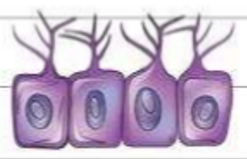
- Oligodendrocytes- provides myelin insulation to neurons in the central nervous system
- \
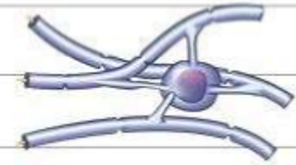
- In the peripheral nervous system
- Satellite cells- support and anchor neurons in the peripheral nervous system
- \
- Schwann cells- provide myelin insulation to neurons in the peripheral nervous system
- \
^^Nerve Impulses^^
- Action Potential- voltage change across the cell wall as a nerve impulse is transmitted
- A nerve impulse is an electrical signal that travels along the neuron
- arises from the movement of ions causing a change in electrical charges
- Resting potential- a neuron’s intracellular space is negatively charged and the extracellular space is positively charged
- neurons are stimulated by the environment or other neurons
- action potential- depolarization, sodium rushes into the neuron and quickly reverses the charge
- impulse moves down the neuron
- Repolarization- as an impulse passes potassium diffuses out of the neuron
- Sodium pump- restores the ion concentration to normal and the resting potential returns
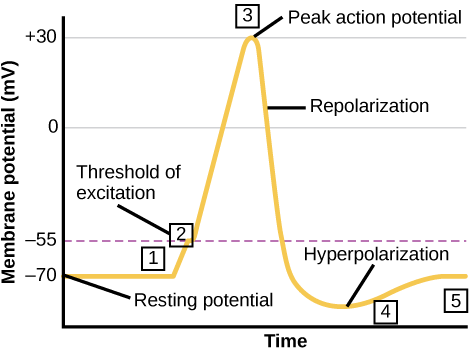
- impulse arrives and the threshold is met
- voltage gated sodium channels are opened
- Voltage-gated potassium channels are opened and the potassium leaves the cell
- sodium channels begin to rest
- voltage-gated potassium channels are still open
- sodium channels are still resting
- sodium and potassium pump restores original levels of voltage in cells
==Channel types==
- Membrane potential- the charge of the membrane
- Voltage-gated channels- open and close in response to changes in the membrane potential, -55 charge
- Ligand- gated channels- only open when a specific chemical (ligand), such as a neurotransmitter, binds to the channel, -70 charge
- Mechanically gated channels- only open if the membrane is stretched or physically deformed
- -70 charge- sodium moves through ligand- gated channels into the cell
- -55 charge-Voltage- gated channels open and sodium continues to move into the cell
- +35 charge- sodium voltage gated channels close and voltage- gated potassium gates open, potassium exits the cell
- all of nothing function, if the threshold isn’t met than the action potential doesn’t occur
- for big reactions action potentials are met and carried out more quickly and more times
- Na/K Pump- active transport, moves K and Na to area of high concentration, 3 sodium ions more out as 2 potassium ions move in