Project Management CAPM
1/12 CAPM TRAINING 1-2
Predictive versus Adaptive
Predictive: predicting what’s going to happen
Adaptive: iterative, completed in increments
Scrum: Everyone comes together with a shared goal to get to the finish line (connects to Rugby)
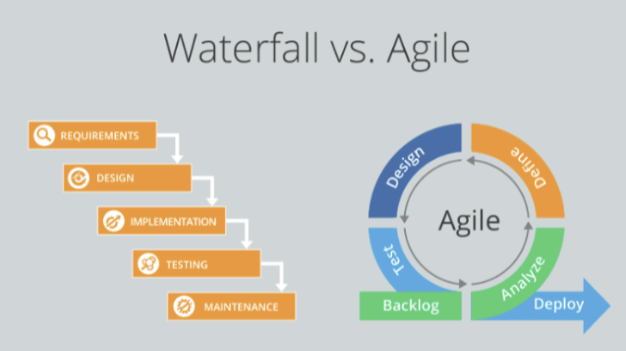
Waterfall Model(Predictive):
Conception
Initiation
Analysis
Design
Construction
Testing
Deployment
It’s sequential
Agile(Adaptive):
Same thing but it doesn’t “fall” through the stages like the waterfall does
It is more of a loop, constantly reevaluating what is on the back log
S2, Part 5: Project, Program, Portfolio
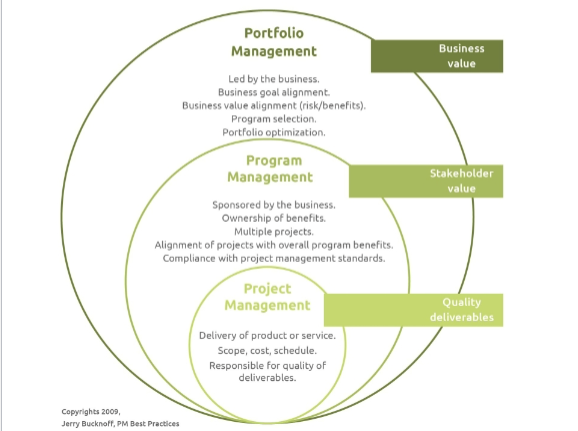
Portfolio: collection of work, strategic alignment, broad scope
Program: multiple projects, common objective, larger scope
Project: temporary, specific goal, deliverables
S2, PART 6: PROJECTS VS OPERATIONS
Projects: temporary, unique, have a start and end, defined budget
Operations: NOT temporary, indefinite, ongoing activities
S2, PART 8: P.M. LIFE CYCLE
IPECC
Initiating
Set up goals, expectations, and scope of the project
Planning
Develop a specific plan for the tasks and activities to be completed, including schedule and budget
Executing
Carry out the plan
Controlling
Respond to changes, adjust the schedule, goals, and expectations as needed
Closing
Deliver the final project and assess the project and the process
Any documentation of the project is called a project artifact
S2 PART 9: ISSUES, RISKS, ASSUMPTIONS, CONSTRAINTS
Risks: uncertain event, scales of probability and impact
Pure risk: someone could get hurt, always negative
Business risk: loss of ROI, time or cost savings, could be positive or negative
Kind of related to sports betting, you spend money on a bet and you could win or lose
Issues: a risk that has already happened, issue log, issue owner, etc.
Assumptions: believe to be true, not proven to be true
Constraints: anything that limits your options
S2, PART 10: PROJECT SCOPE
Scope: defines boundaries of a project, outlines what’s included and excluded
Project scope and project quality go hand-in-hand
Customer defines quality
When scope becomes bigger it is called scope creep
S2, PART 11: P.M. PROCESSES
Project _____ Management
Schedule
Cost
Quality
Resource
Communications
Risk
Procurement
Stakeholder
(49 total processes)
S2, PART 12: ETHICS
Project managers are committed to doing what’s right and honorable
Aspirational versus mandatory conduct
Mandatory conduct comes from the law
CAPM SECTION 3
Project Management Lifecycle
IPECC
Initiating
Planning
Executing
Monitoring/Controlling
Closing
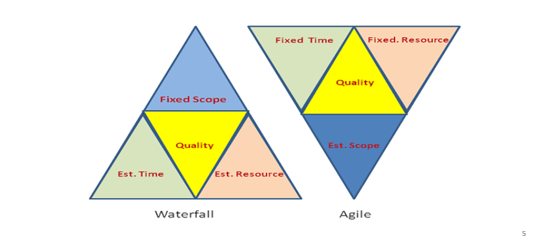
Iron Triangle
FINAL QUESTION ^^^
Waterfall
Building a house
Fixed scope in that you have to finish the house
Time and resources are not easily determined or predicted
Agile
Think of an ice cream cone
Don’t put the sprinkles first
Most important things first and them see if you can fit the less important things
QUALITY IN PM
Quality is defined as:
“conformance to requirements”
“fit for use” or “fitness for use”
Totality of an entity, satisfies needed abilities, stated or implied needs
Don’t confuse quality with grade
Quality processes:
Quality planning
Quality assurance about prevention
Quality control about inspecting afterwards to prevent “escape defects”
You have to “build in” quality
PMI theme - Quality requires:
A plan
Implementation
Measurement
Reaction
Documentation
DOD: Definition of Done
A plan - Standards, objectives, roles and responsibilities, processes, tools, how to deal with non-conformance
Metrics - to verify conformance — cost performance, customer satisfaction, failure rate
Managing quality - executing processes through quality assurance and control
Quality Assurance and Control - before the customer sees the product, after the customer sees the work — scope validation
Quality audit
TYPES OF QUALITY COSTS
Cost of conformance to requirements
Safety measures
Team development and training
Proper materials and processes
Cost of non-conformance to requirements (a cost/burden to the organization)
Liabilities
Rework/scrap
Lost business
QUALITY METRICS
Examples:
% of tasks completed on time
Cost performance
Failure rate
# defects identified per day
Total downtime per month
Errors found per line of code
Customer satisfaction scores
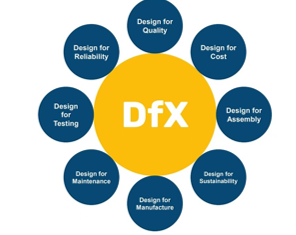
DESIGN FOR EXCELLENCE (DFX)
Design for X — Excellence
X is usually a variable that the project is trying to address
SAMPLING TYPES
Attribute Sampling- binary: Is this a defect? Yes or no
Variable sampling- how big of a defect is this?
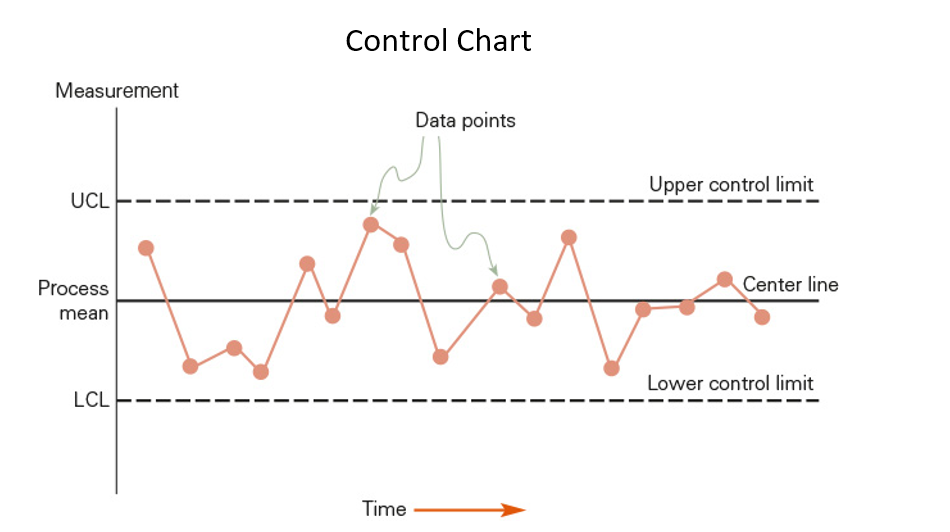
CHECK SHEET
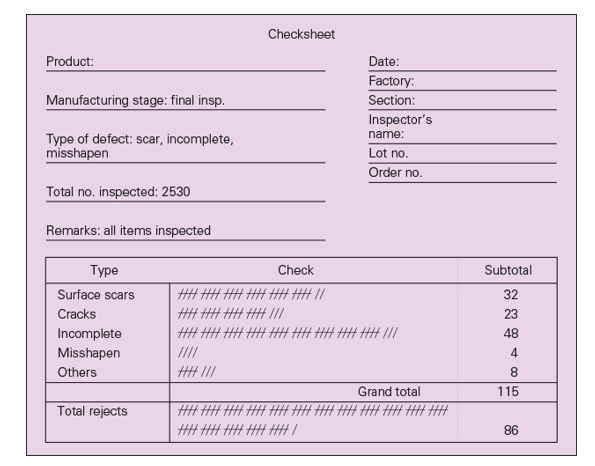
Issue with this is that there isn’t digitization and it’s not specific enough
PARETO DIAGRAM
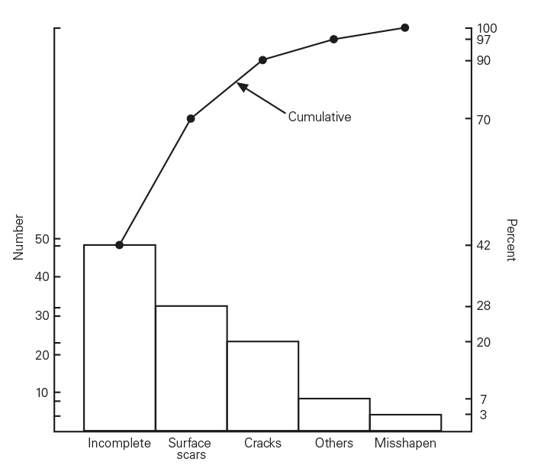
The line above shows what percentage the number indicates from the quality issues
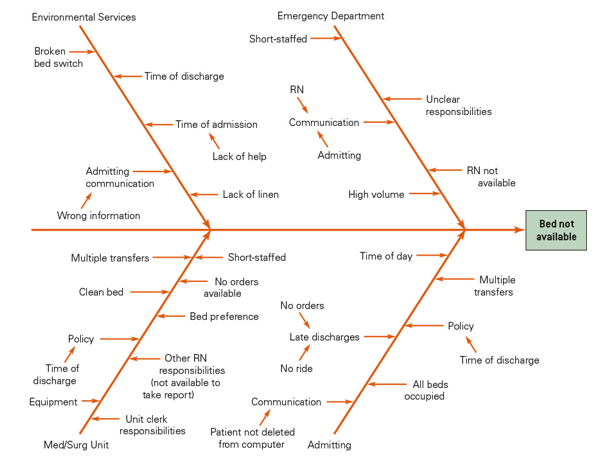
ISHIKAWA/FISHBONE DIAGRAM
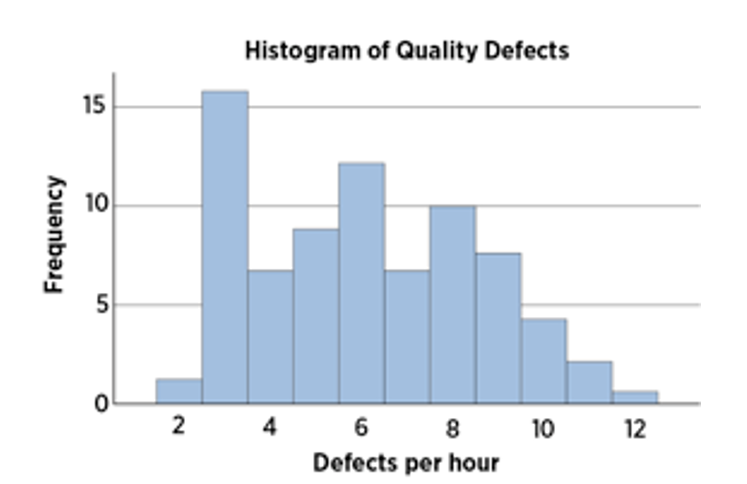
HISTOGRAM
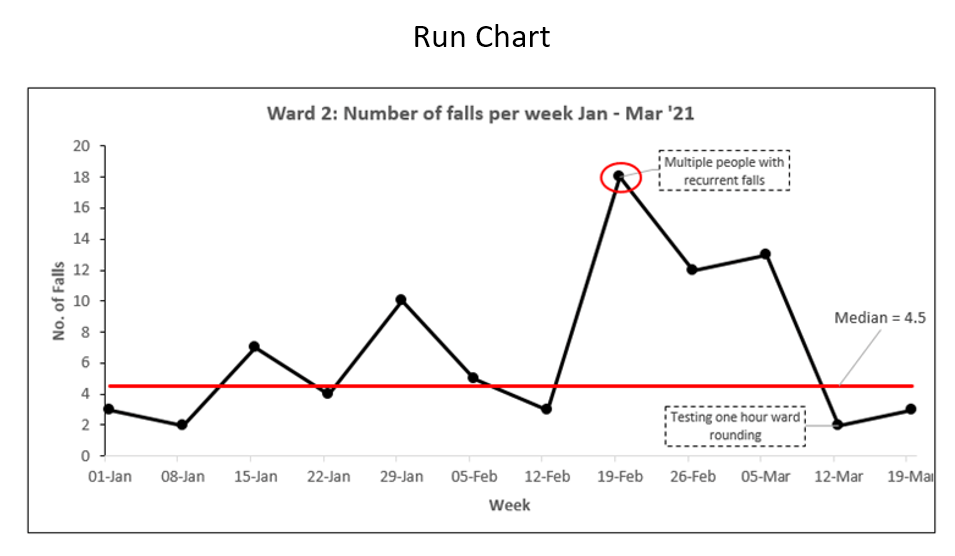
RUN CHART
2/9
CAPM TRAINING SECTION 8
THROUGHPUT
The units to be produced over time
How it’s all connected
CRITICAL CHAIN
Pareto principle - throughput
Cost and protect throughput
Constraints = 1 or at the most 2
difference between feeder and resource buffer = 158 and 159
Resource buffer = a person that needs time to do their tasks accordingly
Page 162 = we change the way we measure progress, progress is measured from the critical path and how much we have completed
Instead of multitasking, implementing focus
Page 178 = compete on lead time, not on cost
PREDICTIVE PLAN SCHEDULE
Key question - when can this be done?
Progressive elaboration - from general idea to specific plan
Goals
Task and milestone start dates and end dates
Dependencies between tasks - predecessors and successors
Allocate resources effectively - to complete tasks
Ensure the project stays on track
CRITICAL PATH
The longest path through a project
The least amount of float or flexibility
Steps
Define the project tasks
Estimate the duration of each task
Identify the dependencies between each task
Draw the project network diagram
Monitor progress and adjust the plan as needed
SECTION 8
In a project management plan, what is the purpose of the schedule?
Correct answer: To outline the specific tasks, milestones, and deadlines for completing the projectWhich of the following best describes the application of the critical path method (CPM)?
Correct answer: A technique for identifying the sequence of project tasks that must be completed on time in order for the project to be completed on scheduleWhich of the following tasks is considered to be a defining task in project management?
Correct answer: Managing and allocating project resourcesWhich of the following methods is considered to be the most accurate for estimating the duration of tasks in project management?
Correct answer: Bottom-up estimationWhich of the following is NOT a tool or technique used for identifying dependencies between tasks in project management?
Correct answer: Surveying team membersWhich of the following is NOT a characteristic of the critical path?
Correct answer: It is the shortest path through the project networkSchedule Variance (SV) is calculated by:
Correct answer: Subtracting the planned value from the earned value (EV − PV)In a Work Breakdown Structure (WBS), what is the lowest level of the hierarchy referred to as?
Correct answer: Work packageWhich of the following is NOT a key component of a quality management plan?
Correct answer: Employee training programWhich of the following is NOT a key responsibility of the project manager regarding integration management?
Correct answer: Managing the project team's performance evaluations
SECTION 9
MINIMUM VIABLE PRODUCT
Minimum: the most rudimentary, bare-bones foundation of the solution possible
Viable: sufficient enough for early adopters
Product: something tangible customers can touch and feel
PROJECT CONTROL IN PREDICTIVE PROJECTS
Need to monitor and control 5 things:
Iron Triangle:
Scope
Time
Cost
Also:
Quality
Risk
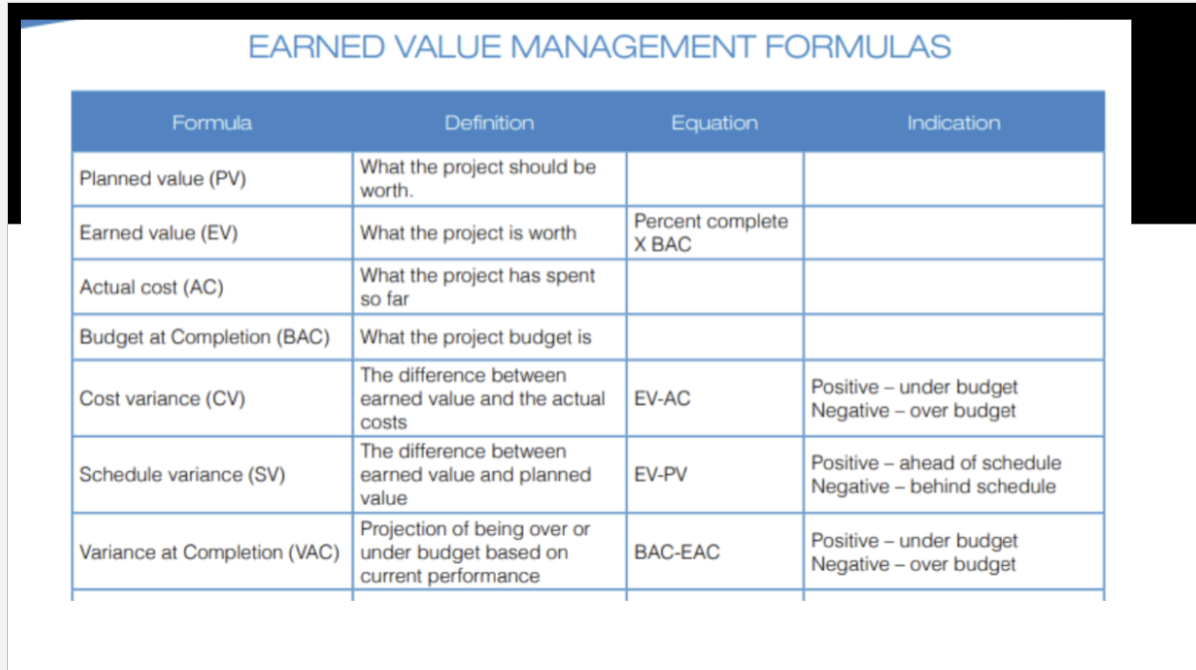
COST VARIANCE AND EARNED VALUE MANAGEMENT
Cost variance: compare actual to planned (video to say this backwards)
Positive - actual < planned
Negative - actual > planned
EVM (Earned Value Management) is a big subject
Addresses cost and schedule
BAC - budget at completion
EAC - estimate at completion
SECTIONS 12-13
Information radiator
Where stakeholders go to see how everything is doing
Interactive dashboard
Story points
On burndown chart
How much is completed and how much is left
Addressing stakeholders wants and needs
Backlog
Looking to complete the highest priorities on the backlog
Project controls
Monitor risks
Who should lead scrum meetings
different team members on rotation