Reproduction
Mitosis
- Mitosis is the process of cell division that occurs in somatic cells, which are all the cells in the body except for the reproductive cells. Mitosis is important for growth, development, and repair of the body.
- Interphase is the period of the cell cycle during which the cell grows, replicates its DNA, and prepares to undergo mitosis or meiosis. It is the longest phase of the cell cycle and can be divided into three stages: G1, S, and G2.
- During the G1 stage, the cell grows and carries out its normal functions.
- In the S (Synthesis) stage, the cell replicates its DNA, so that each of the resulting daughter cells will have a complete set of genetic material.
- During the G2 stage, the cell prepares for mitosis or meiosis by synthesizing proteins and other molecules required for cell division.
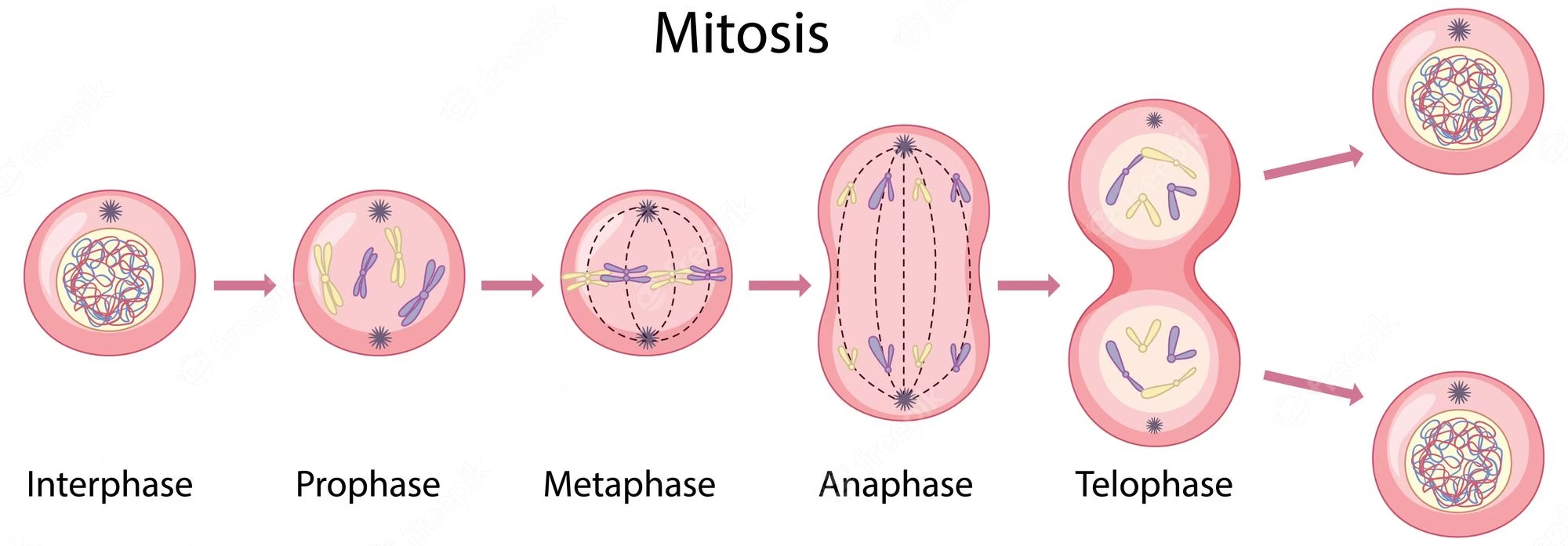
- During mitosis, a cell divides into two identical daughter cells. The steps of mitosis are: prophase, metaphase, anaphase, and telophase.
- In prophase, the chromatin condenses into visible chromosomes, and the nuclear envelope breaks down. The spindle fibers begin to form, and the centrosomes move to opposite poles of the cell.
- In metaphase, the chromosomes align at the equator of the cell, also known as the metaphase plate. The spindle fibers attach to the centromeres of the chromosomes.
- In anaphase, the spindle fibers shorten, pulling the sister chromatids apart and towards opposite poles of the cell.
- In telophase, the chromosomes reach the opposite poles of the cell, and the spindle fibers begin to break down. The nuclear envelope reforms around each set of chromosomes, and the chromosomes begin to unwind back into chromatin.
- Finally, cytokinesis occurs, which is the division of the cytoplasm and the formation of two separate daughter cells.
How can I remember the phases of mitosis?
- PMAT
- Prophase, Metaphase, Anaphase, Telophase
- Don’t forget… Cytokinesis (although it’s not a “phase”)
- I Passed My Anatomy Test
- Interphase → Prophase, Metaphase, Anaphase, Telophase
- Don’t forget… Cytokinesis (although it’s not a “phase”)
Meiosis
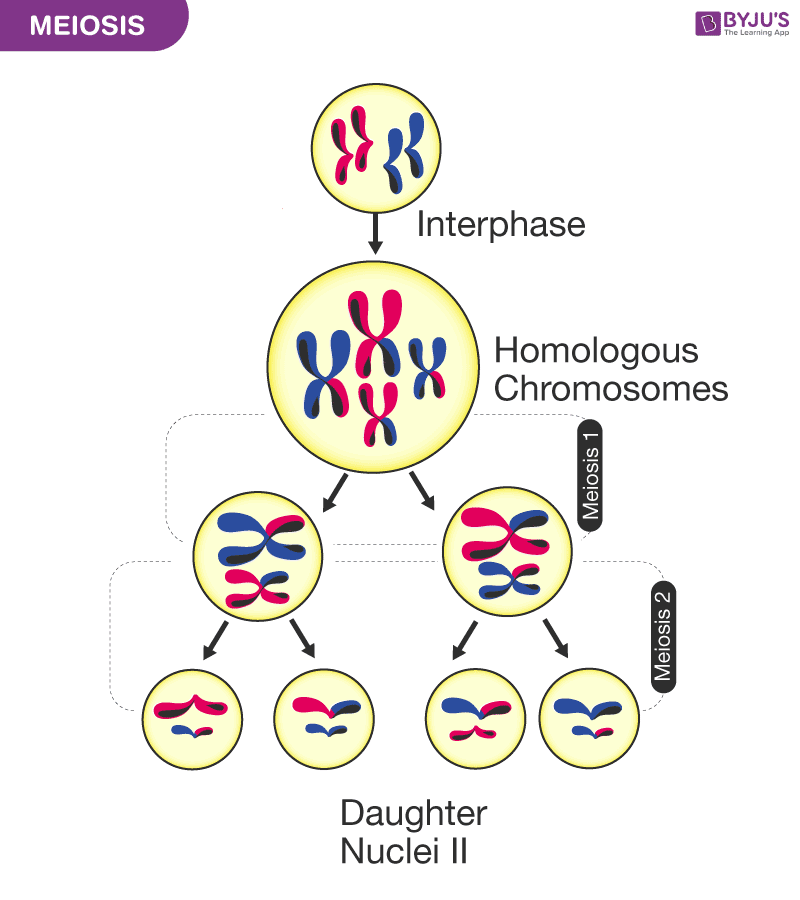
- Meiosis is the process of cell division that occurs in the reproductive cells, which are the cells that give rise to sperm and eggs. Meiosis is important for sexual reproduction, and it results in the formation of four genetically diverse daughter cells.
- The steps of meiosis are similar to those of mitosis, but there are two rounds of cell division, resulting in four daughter cells instead of two. The steps of meiosis are: prophase I, metaphase I, anaphase I, telophase I, cytokinesis, prophase II, metaphase II, anaphase II, telophase II, and cytokinesis II.
- In prophase I, the chromatin condenses into visible chromosomes, and homologous chromosomes pair up and exchange genetic information in a process called crossing over. This results in genetic diversity.
- In metaphase I, the homologous pairs align at the equator of the cell, also known as the metaphase plate. The spindle fibers attach to the homologous pairs.
- In anaphase I, the spindle fibers shorten, pulling the homologous pairs apart and towards opposite poles of the cell.
- In telophase I, the chromosomes reach the opposite poles of the cell, and the spindle fibers begin to break down. The nuclear envelope reforms around each set of chromosomes, and the chromosomes begin to unwind back into chromatin.
- Cytokinesis occurs, which is the division of the cytoplasm and the formation of two separate daughter cells.
- In prophase II, the chromosomes condense again, and the spindle fibers form.
- In metaphase II, the chromosomes align at the equator of the cell, and the spindle fibers attach to the centromeres of the chromosomes.
- In anaphase II, the spindle fibers shorten, pulling the sister chromatids apart and towards opposite poles of the cell.
- In telophase II, the chromosomes reach the opposite poles of the cell, and the spindle fibers begin to break down. The nuclear envelope reforms around each set of chromosomes, and the chromosomes begin to unwind back into chromatin.
- Finally, cytokinesis II occurs, which is the division of the cytoplasm and the formation of four separate daughter cells, each with a unique combination of genetic information.
In basic terms…
Your gametes/germ cells (cells that will mature into sperm or egg cells) are diploid (2n so 1n from each parent). In order for an organism to reproduce and pass on their own genetic information, they need their own egg/sperm cells with only 1n, because they other parent will bring the other n. So, meiosis is the process of making “your own” DNA to pass on to your children by crossing over DNA (mixing traits from mother and father) and dividing until haploid cells have been created.
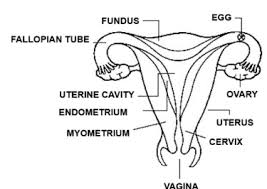
Female Reproductive System
Major Parts
- Ovaries
- produce/mature eggs
- produce estrogen, progesterone
- Fallopian tubes (oviduct)
- carries the egg to the uterus.
- where the egg is fertilized
- Uterus
- womb where the embryo/fetus will develop
- Vagina
- birth canal where the baby will leave the body
- Uterine lining
- when thick the blood vessels will provided the embryo with nourishment
Other Important Information
- Eggs
- are made by meiosis
- females are born with all eggs they will ever need
- eggs contain 23 contains chromosomes and all cell parts (mitochondria, ribosomes, etc.) that the offspring will need to grow and develop
- mitochondria in offspring comes from mother (egg cell)
Menstruation Cycle
The menstrual cycle is the regular natural change that occurs in the female reproductive system that makes pregnancy possible. The cycle is required for the production of eggs, and for the preparation of the uterus for pregnancy.
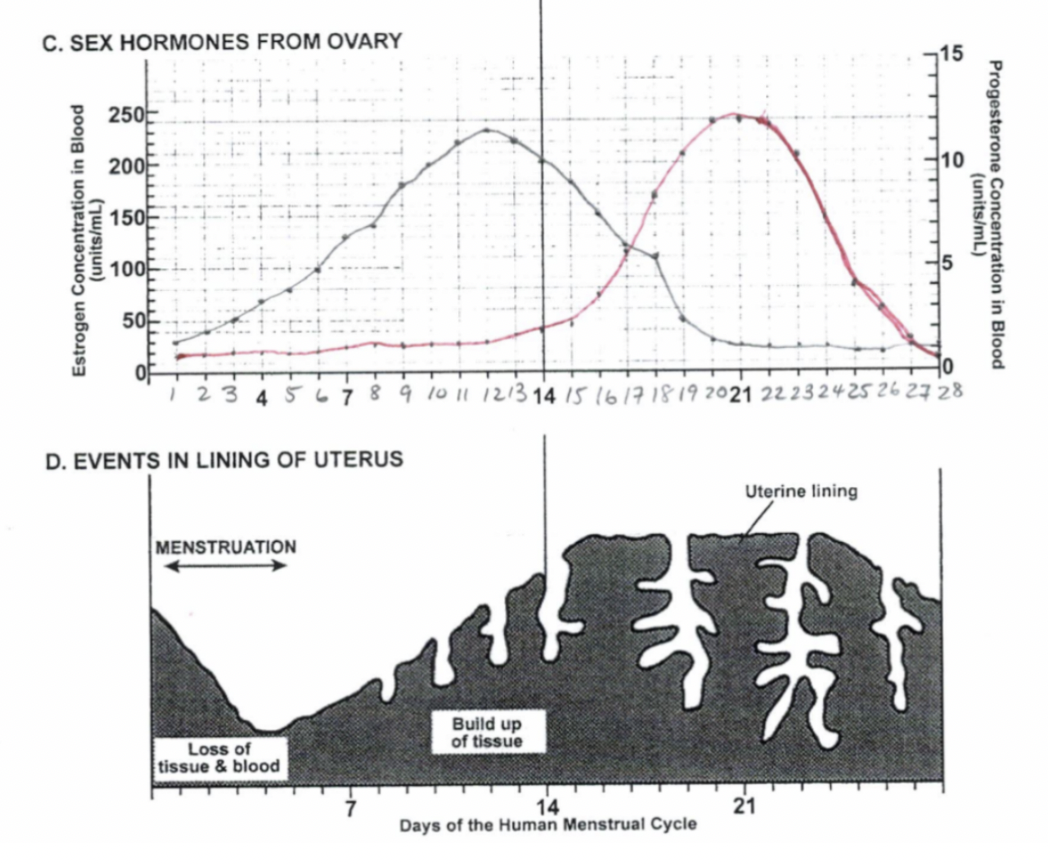
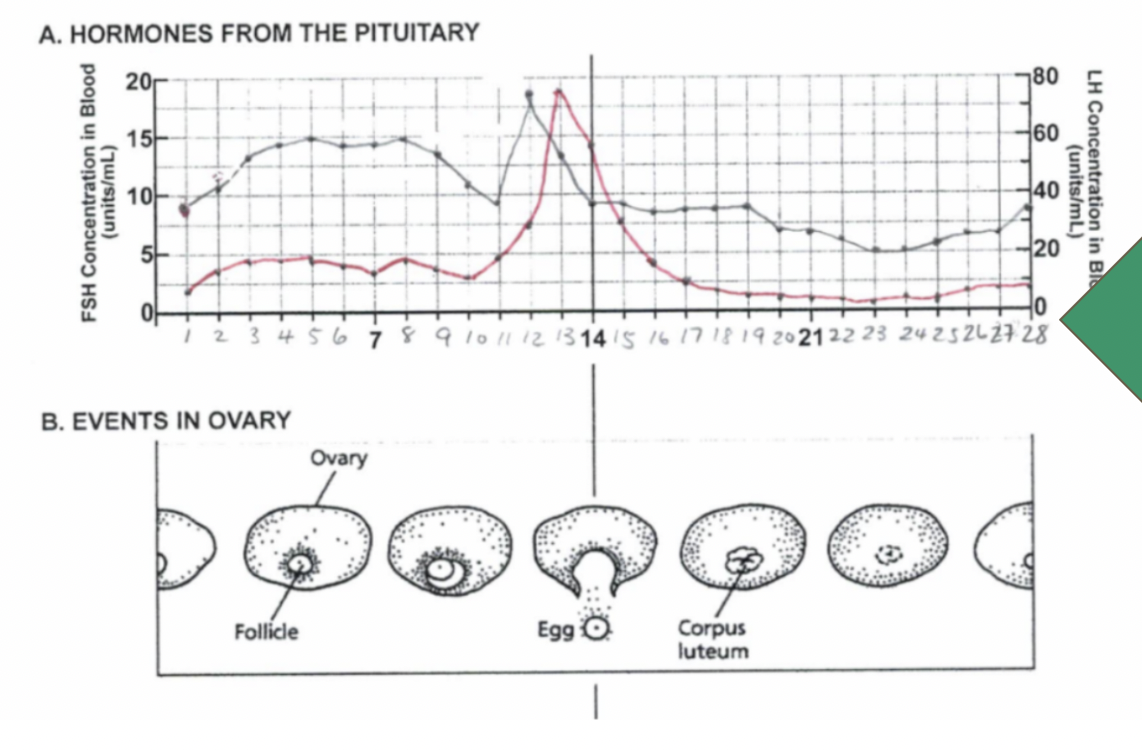
28 day cycle regulated by female sex hormones
- hormones produced in ovaries
- progesterone
- progesterone increases and spikes after egg release as the uterine wall thickens
- So… →FSH stimulates the thickening of the uterine wall/maintains the thickness of the uterine wall
- estrogen
- estrogen increases and spikes before egg release
- So… →estrogen stimulates egg release after maturity and helps the uterine wall gradually thicken
- hormones released from pituitary gland
- LH
- increases and spikes before egg release
- So… →LH stimulates egg release after maturity
- FSH
- increases and spikes before egg release
- So… →FSH stimulates egg release after maturity
 \n
\n
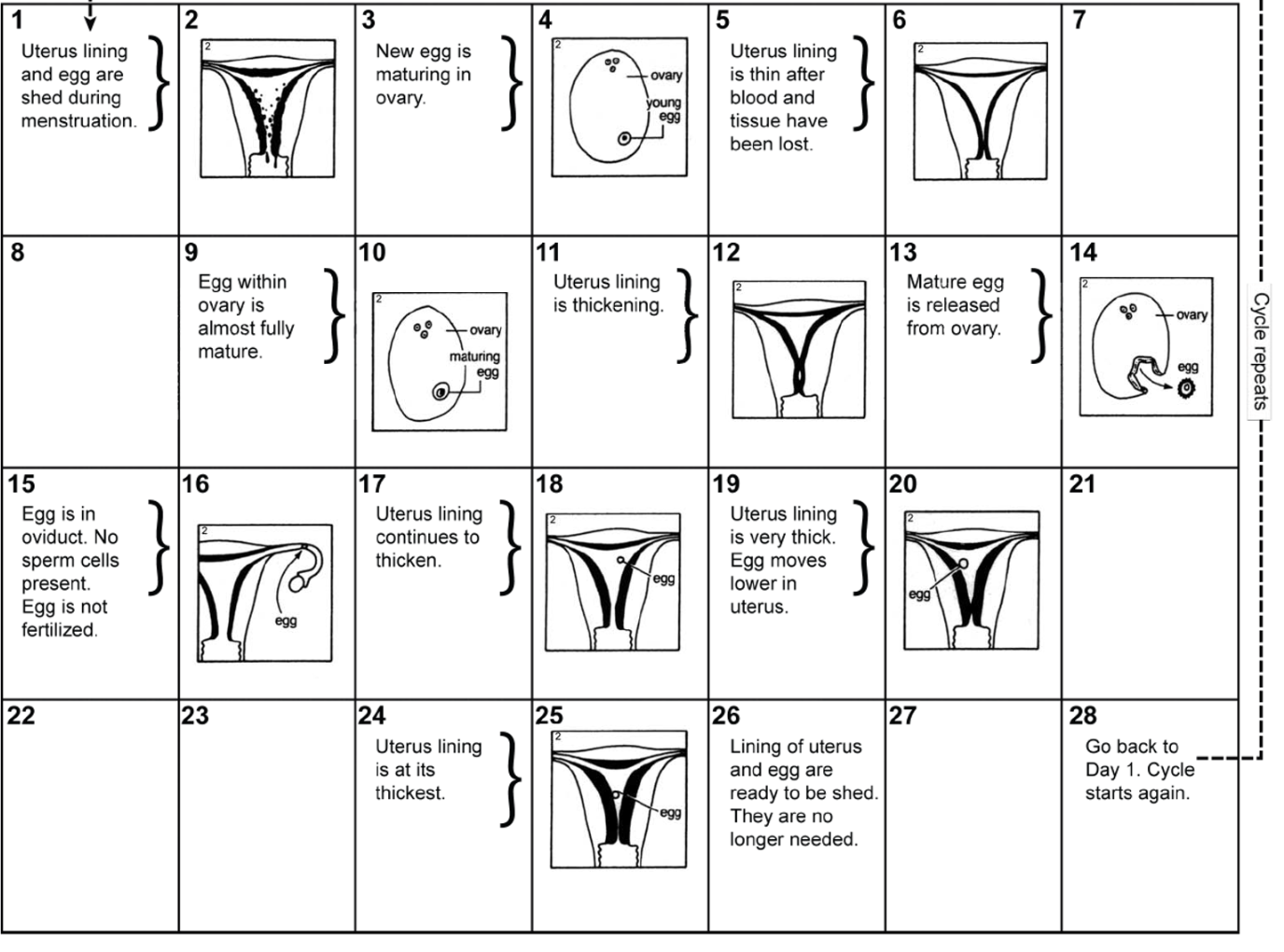
The menstrual cycle is divided into two phases: the follicular phase and the luteal phase. The follicular phase begins on the first day of menstruation and lasts about 14 days. During this phase, follicles in the ovaries begin to mature, each containing an egg. As the follicles mature, they produce estrogen, which causes the lining of the uterus to thicken.
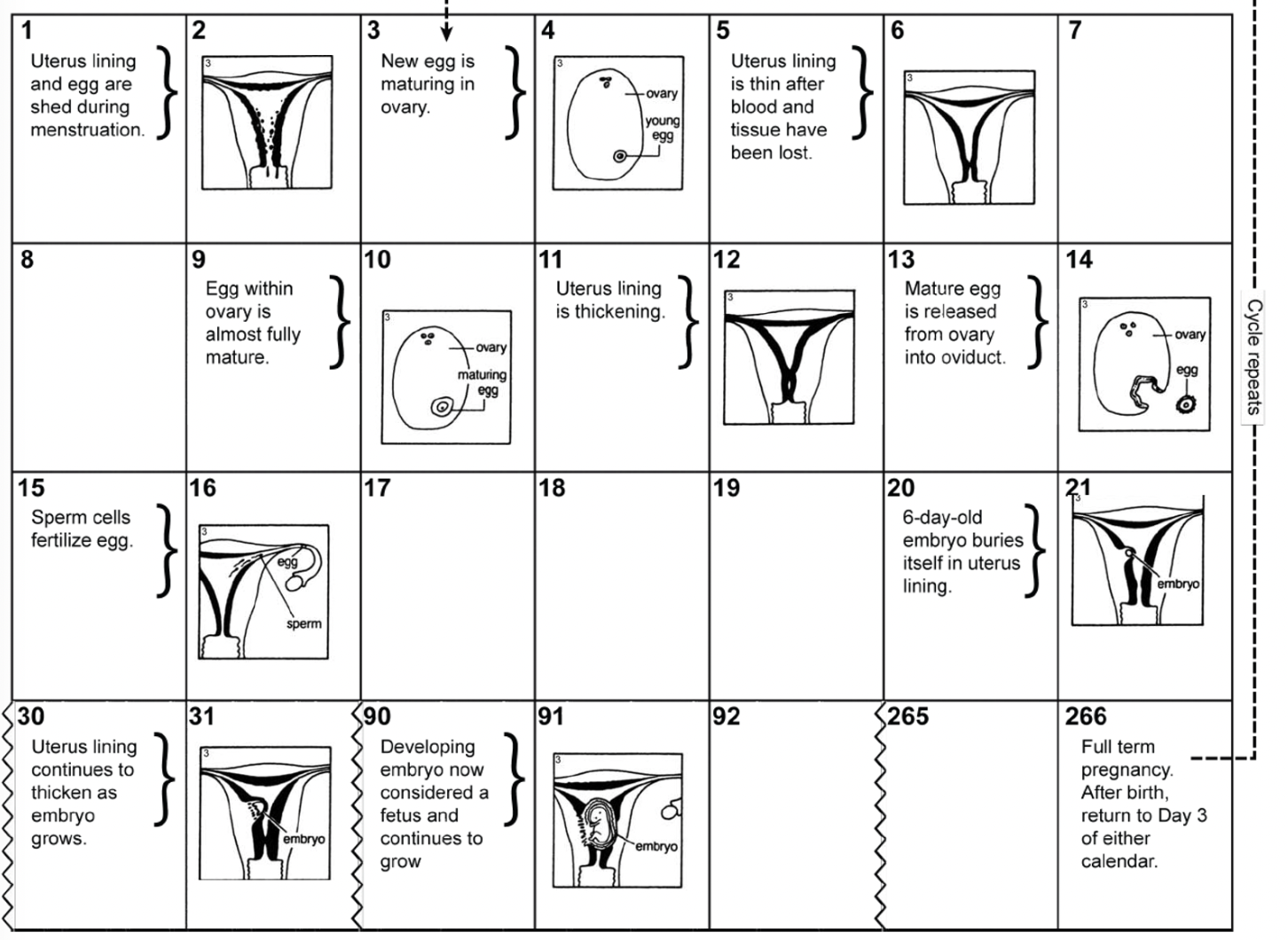
Around day 14 of the cycle, one of the follicles will release an egg in a process called ovulation. The egg then travels down the fallopian tube towards the uterus. If the egg is fertilized by sperm during this time, it may implant in the uterus and develop into a pregnancy.
After ovulation, the luteal phase begins and lasts about 14 days. During this phase, the empty follicle left behind after ovulation becomes the corpus luteum, which produces progesterone. This hormone helps to maintain the thickened lining of the uterus, in case the egg is fertilized and implants.
If the egg is not fertilized, the corpus luteum will stop producing progesterone, and the lining of the uterus will begin to break down. This leads to menstruation, which marks the beginning of a new cycle. The process then repeats itself, with the follicular phase beginning again on the first day of menstruation.
Male Reproductive System
Major Parts
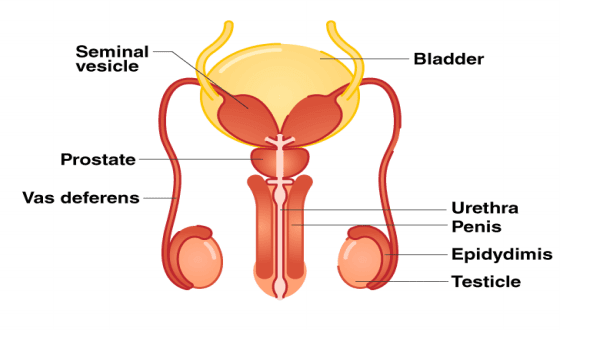
- Testes
- store and produce sperm
- produc testosterone (male sec hormone)
- Penis
- transfers sperm into the female reproductive system
- Vas deferens
- transfers sperm
- Urinary Bladder
Other Important Information
- Sperm
- sperm are haploid cells made by meiosis
- produced in large numbers throughout a male’s life
- are smaller than the egg and mobile
- Acrosome (head)
- releases digestive enzymes to break down the first layer of the egg cell
- mitochondria
- the sperm has a lot of mitochondria in the tail to help it move
- the sperm doesn’t give the zygote mitochondria
- Tail
- propels the cell forward through the female reproductive system to find egg
- sperm only provides offspring with 23 chromosomes (Everything else is from egg)
- Testosterone
- male sex organ
- made in testes
- Semen
- fluid that carries sperm
- contains sugar to give sperm energy
Fertilization
- Fertilization is the process by which a sperm cell and an egg cell combine to form a new individual with a unique set of genetic material. Fertilization typically occurs in the fallopian tube, shortly after ovulation.
- During fertilization, a single sperm cell must penetrate the outer layer of the egg. Once the sperm penetrates the egg, the egg undergoes a series of changes that prevent other sperm from entering. The genetic material from the sperm and the egg then combine, resulting in a single cell called a zygote.
- The zygote begins to divide and undergoes a series of cell divisions, forming a ball of cells called a blastocyst. The blastocyst then implants in the lining of the uterus, where it continues to grow and develop.
- After fertilization, the zygote begins to divide and undergoes a series of cell divisions, forming a ball of cells which implants in the lining of the uterus, where it continues to grow and develop.
- During the first trimester of pregnancy, the developing organism is called an embryo. The embryo undergoes rapid cell division and differentiation, with the formation of many of the major organs and systems occurring during this time. By the end of the first trimester, the embryo has developed into a fetus.
- cell differentiation - when cells become specific to a function and use only specific parts of their coded DNA
Spermatogenesis vs. Oogenesis
- Spermatogenesis is the process by which male germ cells, called spermatogonia, divide and differentiate to form mature sperm cells. This process occurs in the testes and involves several stages of cell division and differentiation, ultimately resulting in the production of four mature sperm cells from each original spermatogonium.
- Oogenesis, is the process by which female germ cells, called oogonia, divide and differentiate to form mature egg cells, or ova. This process occurs in the ovaries and involves several stages of cell division and differentiation, ultimately resulting in the production of a single mature egg cell from each original oogonium.
- One key difference between spermatogenesis and oogenesis is the timing of cell division. In spermatogenesis, cell division is continuous and results in the production of four mature sperm cells from each original spermatogonium. In oogenesis, cell division is not continuous and results in the production of a single mature egg cell from each original oogonium, with the remaining cells forming polar bodies.