10-03-25 Torque, Angular Momentum Principle
Torque
The torque created by a force is a measure of the twist (around a reference point) that that force exerts on the system:
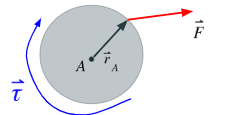
Torque gets its direction in the same way that angular momentum does: from the right-hand-rule.
Calculating Torque
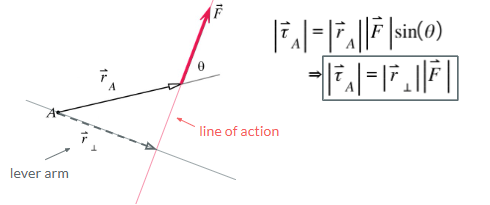
The magnitude of torque can be found by using:
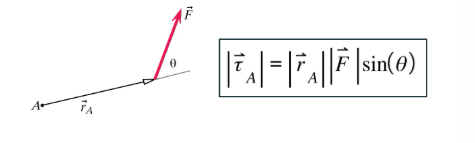
The farther from the axis the force is, the greater the torque.
The closer is to , the greater the torque.
Engineering interpretation:
Q10.x
A force is applied to the end of a long wrench at an angle of degrees from the vertical, as shown below.
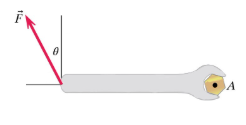
What is the torque (around the point A) that is exerted on the wrench by this force?
<0,0,-0.60> N \cdot m
<0,0,-0.52> N\cdot m
<0,0,-0.43> N\cdot m
<0,0,-0.30> N\cdot m
<0,0,-0.25> N\cdot m
Gather)
Organize)
System: Wrench
Axis: Out of the page through point A
Analyze)
<0,0,-1> from right hand rule
The answer is B
Angular Momentum Principle
The Angular Momentum Principle is very similar to the Momentum Principle as it can be written as (change in momentum) = (appropriate type of impulse).
If we are only interested in the rotational angular momentum, we can relate that directly to torques relative to the center of mass of the system:
We will see later how changes in translational angular momentum are related to torques applied at a point other than the center of mass.
Q10.x
A brake applies a constant net torque of <12,0,-3> N\cdot m (relative to the center of mass) to a wheel that initially has a rotational angular momentum of <100, 50, 20> kg \cdot m²/s. After 3 seconds of having this torque applied, what is the rotational angular momentum of the wheel?
<112,0,17> kg\cdot m²/s
<136,50,11> kg\cdot m²/s
<112,50,17> kg\cdot m²/s
< 136,50,29> kg\cdot m²/s
<12,0,-3> kg\cdot m²/s
Gather)
<12,0,-3> N\cdot m
<100,50,20> kg\cdot m²/s
Organize)
System: Wheel
Axis: Through COM
Surroundings: Brake
<100,50,20> kg\cdot m²/s + (<12,0,-3> N\cdot m) (3s)
<136,50,11> kg\cdot m²/s
The answer is B