AICE marine science paper 2
formulas to know:
- the Lincoln index: used to estimate the population of a species. also known as the “catch-mark-release-recapture” method.
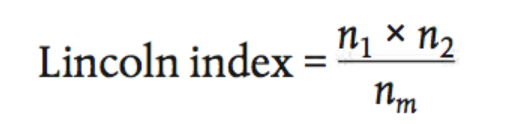
- N= estimated population size
n1 = first sample captured and marked
n2 = second sample captured
m2 = number of marked individuals recaptured- ex: In a study of fish in a lake, researchers capture 100 fish, mark them, and release them back into the lake. Two weeks later, they capture a second sample of 80 fish, 10 of which are marked.
Question: Estimate the total population of fish in the lake.
set up: 100 times 80, then divide by 10
answer: 800
- Simpsons index of diversity: used to calculate biodiversity
very easy
ex: In a coastal ecosystem, researchers observe the following numbers of individuals of different species of crabs:
Species A: 12 crabs
Species B: 30 crabs
Species C: 8 crabs
Species D: 50 crabs
Question: Calculate the Simpson's Index of Diversity for this ecosystem.
- set up: (12/100)²+(30/100)²+(8/100)²+(50/100)² ——> calculate
- answer: subtract 1 from 0.361, gives you 0.639
- energy transfer efficiency: calculating energy transfer through food chains/webs/trophic levels.
formula:

- ex: In a marine food chain, the following data is given:
Producers (phytoplankton): 10,000 J of energy
Primary consumers (zooplankton): 1,500 J of energy
Secondary consumers (small fish): 250 J of energy
Tertiary consumers (large fish): 50 J of energy
Question 1: Calculate the energy transfer efficiency from:
Producers to primary consumers
Primary consumers to secondary consumers
Secondary consumers to tertiary consumers
1. 15%
2. 16.67%
3. 20%
- primary productivity: to find the rate of primary productivity
formula:
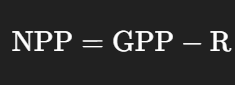
GPP = Gross Primary Productivity (the total energy captured by producers through photosynthesis)
R = Respiration (the energy used by producers for their own metabolism, like growth, reproduction, etc.)
NPP = Net Primary Productivity (the energy left over after respiration, which is available for other organisms, like herbivores)
- ex: In a marine ecosystem, researchers measure the Gross Primary Productivity (GPP) and Respiration (R) of phytoplankton over a period of time:
GPP (Gross Primary Productivity) = 8,000 J/m²/day
R (Respiration) = 2,000 J/m²/day
Question:
Calculate the Net Primary Productivity (NPP) in the ecosystem.
If 1,000 J/m²/day of energy from the phytoplankton is transferred to primary consumers, what is the energy available to primary consumers?
- answers:
6,000 J/m²/day
1,000 J/m²/day
sampling methods:
- continuous sampling: any specie that touch's the line gets recorded
- systemic sampling: species recorded at regular intervals
word equation for photosynthesis:
- carbon dioxide + water—→ glucose + oxygen
word equation for respiration:
- glucose + oxygen—→ carbon dioxide + water + energy
lipids:
- fats and oils
- chemical structure for lipids: carbon, hydrogen, oxygen
plankton are microorganisms that float in the water