CDIS 290: Stuttering
Extra Video Notes:
3 different types of stutters: repetitions, prolongations, blocks
Part 1:
Stuttering:
involuntary, choppy, interrupted speech
developmental
covert stuttering
conceal stuttering
overt stuttering
does not attempt to conceal
Primary characteristics:
3 types of disfluencies
repetitions: repeating a sound or monosyllabic word
“I want want a turn”
prolongations: saying a sound for an extended period of time
“I wwwwant a turn”
blocks: stoppages of airflow or sound production
“I……want a turn”
Secondary characteristics:
throat clearing
eye blinking
foot stomping
interjections
sentence revisions
word substitutions
increased rate of speech
Causes:
unknown
family history
brain difference
diagnosed between 2 and 6 (typical stuttering period)
lifelong

Acquired stuttering:

Variability:
children (3-10)
onset
spontaneous recovery (no intervention and one day they just stopped stuttering)
high prevalence
adolescents (10-19)
social difficulties
reduced signs and symptoms
low prevalence
adults (19+)
acquired
reduced signs and symptoms
management
Impact of stuttering:
social
express wants and needs
confidence
relationships
engaging in conversations
emotional
confidence
social anxiety
avoidance
depression
academic
read aloud
answering questions
presentations
participation
occupational
interacting with colleagues and supervisors
career responsibilities (emails, calls, meetings, etc)
Part 2:
Diagnosogenic theory:
Wendell Johnson
parents cause stuttering
label typical dysfluencies as stuttering
child attempts to avoid stuttering
Communicative failure aka Anticipatory struggle:
Oliver Bloodstein
child’s frustration and difficulty cause stuttering
speech and language delay
traumatic events
typical disfluencies criticized
frustration leads to anticipation
tension
Demands and Capacities Model:
child’s capacity does not equal demands on the child
capacities
articulation
motor speech
neurological development
social-emotional skills
demands
environmental reactions
adult speech
linguistic complexities and processing
Interaction theory:
cause of stuttering is unknown
children inherit a tendency to stutter: a person could maybe stutter, but it depends on the environment
stuttering depends on environment
birth to 4 years old
Multifactorial model:
stuttering is triggered by several factors
hereditary
motor speech
language
emotions
cognition
environment
communicative context
stuttering is complex
Part 3:
Measures:
case history and interview
standardized assessments
2 communication samples
questionnaires
observations
Family history and interview:
risk factors
age of onset
time since onset
family history
was there recovery
speech and language skills
phonological skills
cognitive skills
Standardized assessments:
stuttering severity instrument 4th edition (SSI-4)
2 communication samples
if stuttering occurs in at least 5% of their speech, they meet the stuttering eligibility
analysis of stuttering
frequency of disfluencies
types of disfluencies
longevity of disfluencies
Questionnaires:
parent/caregiver
student/client
feeling
attitudes
Observation:
primary characteristics
secondary characteristics
impact
social
emotional
academic
occupational
Interpret results:
identify all difficulties
identify areas of need (what you are going to work on right away)
identify goals
identify accommodations and modifications
Part 4:
Goal:
increase ability to communicate
stuttering acceptance
feelings
attitudes
confidence
learn about stuttering
holistic
communication and quality of life
Indirect treatment:
parent-child interactions
reduce rate of communication
recasting/rephrasing
indirect prompting
manipulate environment
reduce pressure
include caregivers and other family members
address emotions and attitudes about stuttering
3-6 year olds
play based
6-8 weeks
Direct treatment:
specific approaches to address stuttering
counseling
speech modification
stuttering modification
other strategies
Counseling:
quality of life
empowerment
reduce negative thoughts and emotions
Speech modification:
change time and tension
easy onset
light articulatory contact
continuous phonation
prolonged syllables
rate control
change frequency and placement
increase fluency
improve communication
Stuttering modification:
anticipate moments of stuttering
before, during, and after occurrence
reduce tension
preparatory sets
pull-out
cancellation
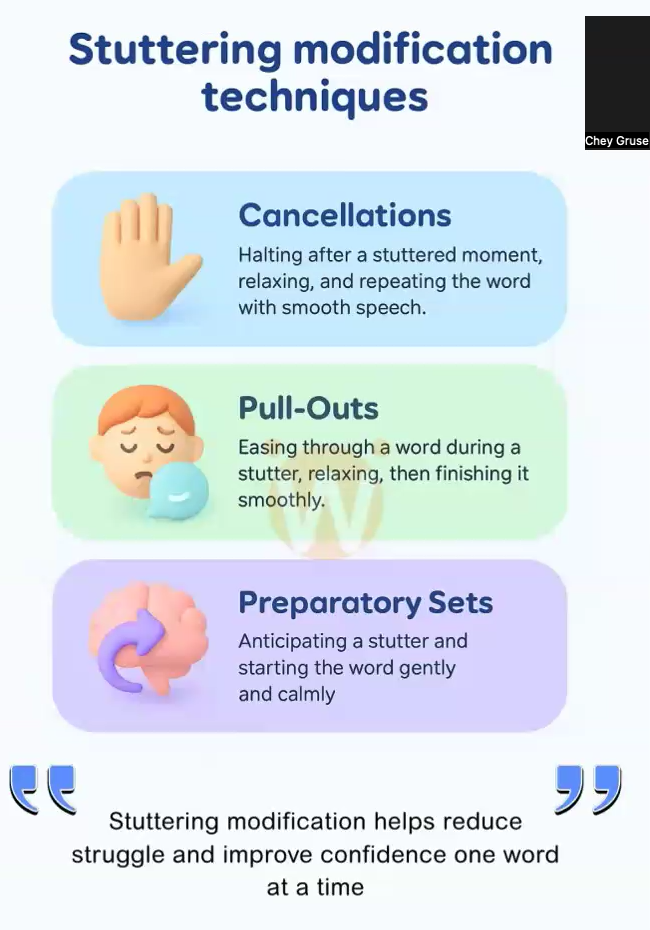
4 phases of stuttering modification: identification, desensitization, modification, stabilization

Strategies:
reduce word avoidance
cognitive restructuring
self-disclosure
reduce negative reactions