Unit 1: Foundations of Pitch, Major Keys, and Scales
Pitch, Clefs, and the Staff
Musical literacy begins with the ability to identify specific frequencies, known as pitches, and place them on a grid of time and frequency known as the staff. In AP Music Theory, fluency in reading all four standard clefs is mandatory.
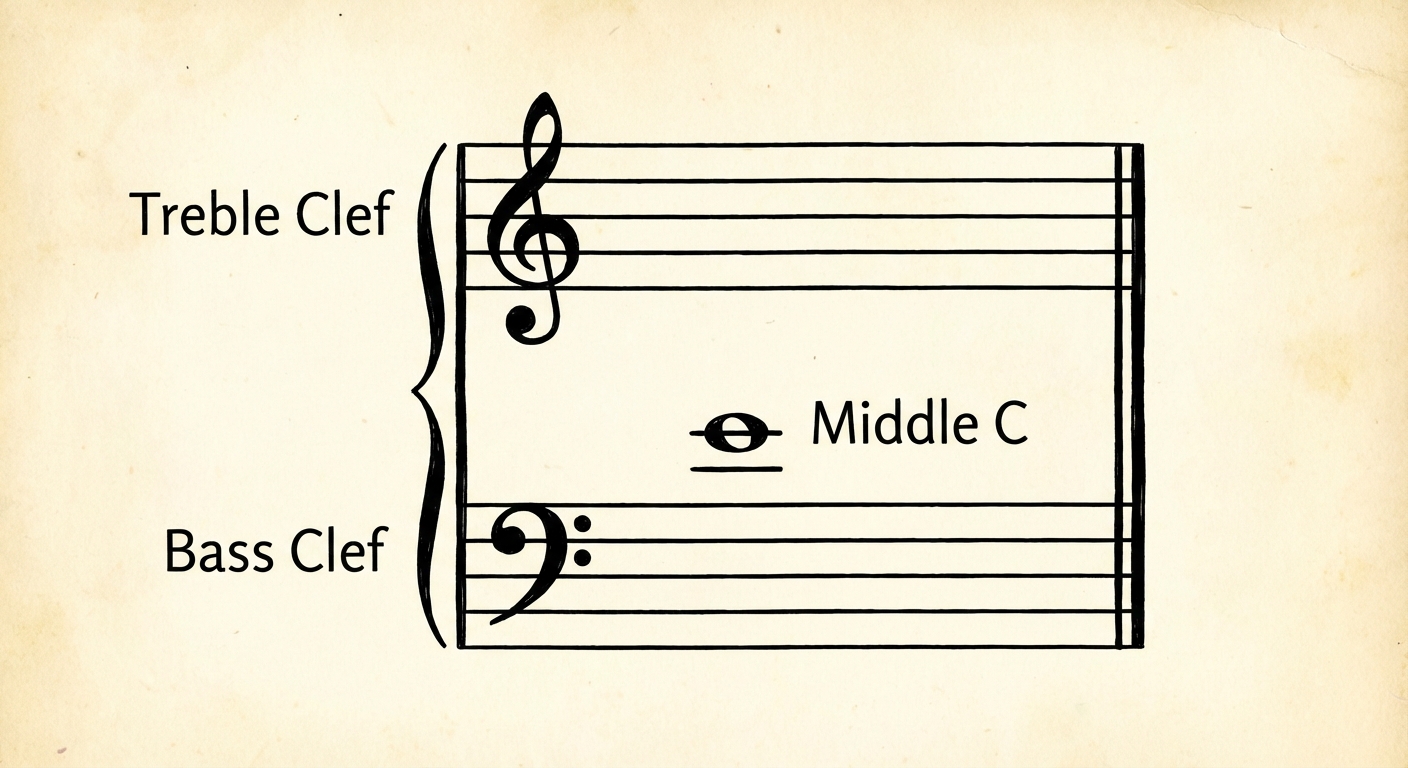
The Staff and The Grand Staff
A standard musical staff consists of five horizontal lines and four spaces. Pitches are notated as noteheads placed either on a line or in a space.
- Higher on the staff = Higher pitch frequency.
- Lower on the staff = Lower pitch frequency.
The Grand Staff connects two staves using a bracket and a brace. It is used primarily for keyboard music.
- Top Staff: Usually Treble Clef (Right hand).
- Bottom Staff: Usually Bass Clef (Left hand).
- Middle C (C4): The conceptual anchor that sits exactly between the two staves on a ledger line.
Clefs: Defines the Reference Pitch
A clef is a symbol placed at the beginning of the staff that assigns a specific letter name to a specific line.
- Treble Clef (G Clef): The spiral centers around the second line from the bottom, defining it as G4. Used for violins, flutes, trumpets, and soprano/alto voices.
- Bass Clef (F Clef): The two dots surround the second line from the top, defining it as F3. Used for cellos, tubas, bassoons, and tenor/bass voices.
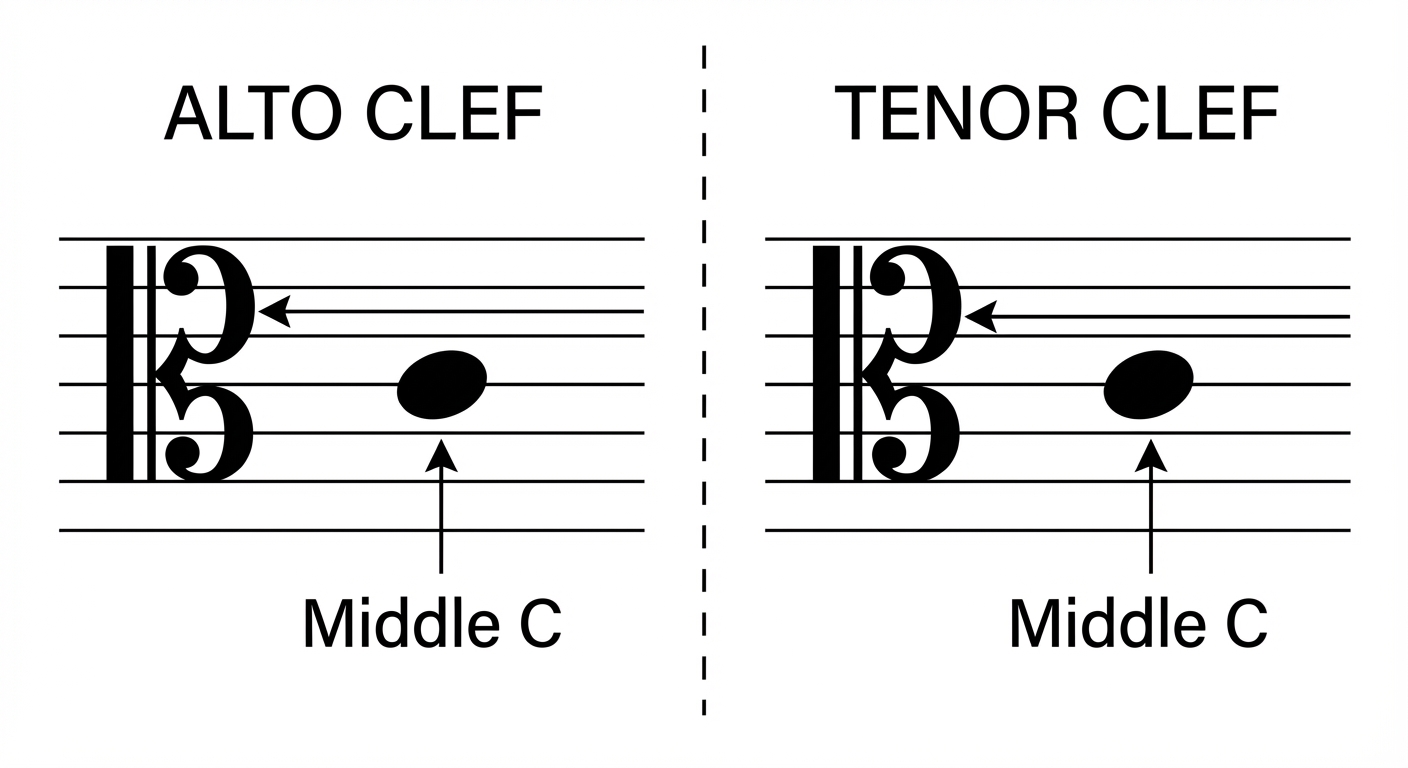
- C Clefs (Movable): The center indentation (or "arrow") of the symbol points to Middle C (C4). You must know two variations:
- Alto Clef: C is on the middle line (3rd line). Used specifically for the Viola.
- Tenor Clef: C is on the second line from the top (4th line). Used for the upper ranges of bass clef instruments (cello, bassoon, trombone).
Accidentals and Enharmonic Equivalence
The musical alphabet uses letters A through G. To access pitches between these natural notes, we use accidentals.
- Sharp ($\sharp$): Raises pitch by one half step.
- Flat ($\flat$): Lowers pitch by one half step.
- Natural ($\natural$): Cancels a previous sharp or flat.
- Double Sharp (x): Raises pitch by two half steps (one whole step).
- Double Flat ($\flat\flat$): Lowers pitch by two half steps (one whole step).
Enharmonic Equivalence describes two notes that sound the exact same pitch but are spelled differently.
- Example: C$\sharp$ and D$\flat$ are enharmonic equivalents.
- Context: E$\sharp$ is enharmonically equivalent to F$\natural$; C$\flat$ is equivalent to B$\natural$.
Major Scales and Key Signatures
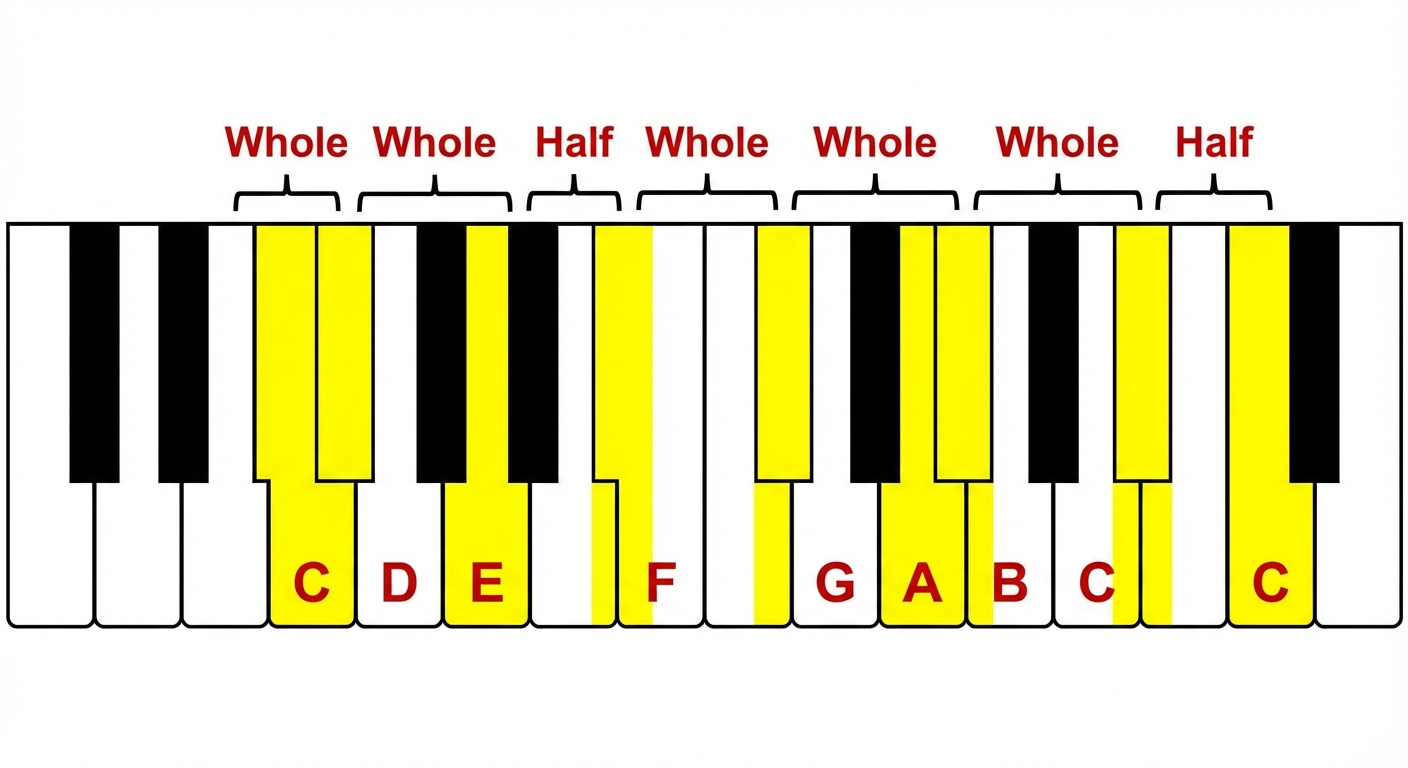
The Major Scale is the diatonic foundation of Western tonal harmony. It is an ordered collection of seven distinct pitches that follows a specific pattern of Whole Steps (W) and Half Steps (H).
The Major Scale Pattern
A Half Step is the distance between two immediately adjacent keys on a piano (e.g., C to C$\sharp$, or E to F). A Whole Step equals two half steps.
The formula for any Major Scale is:
Scale Degree Names
In AP Music Theory, you must refer to notes by their functional names, not just their numbers. Memorize this table:
| Degree | Name | Function/Description |
|---|---|---|
| $\hat{1}$ | Tonic | The home pitch; the key center. |
| $\hat{2}$ | Supertonic | One step above the tonic. |
| $\hat{3}$ | Mediant | Midway between Tonic and Dominant. Determines major vs. minor quality. |
| $\hat{4}$ | Subdominant | The tone below the dominant (same distance below tonic as dominant is above). |
| $\hat{5}$ | Dominant | The second most important tone; creates tension leading to tonic. |
| $\hat{6}$ | Submediant | Midway between Tonic and Subdominant (inverted). |
| $\hat{7}$ | Leading Tone | A half step below the tonic. Strongly pulls (leads) to the tonic. |
Note on Notation: Scale degrees are written with a carat (hat) above the number, e.g., $\hat{1}$.
Key Signatures and The Circle of Fifths
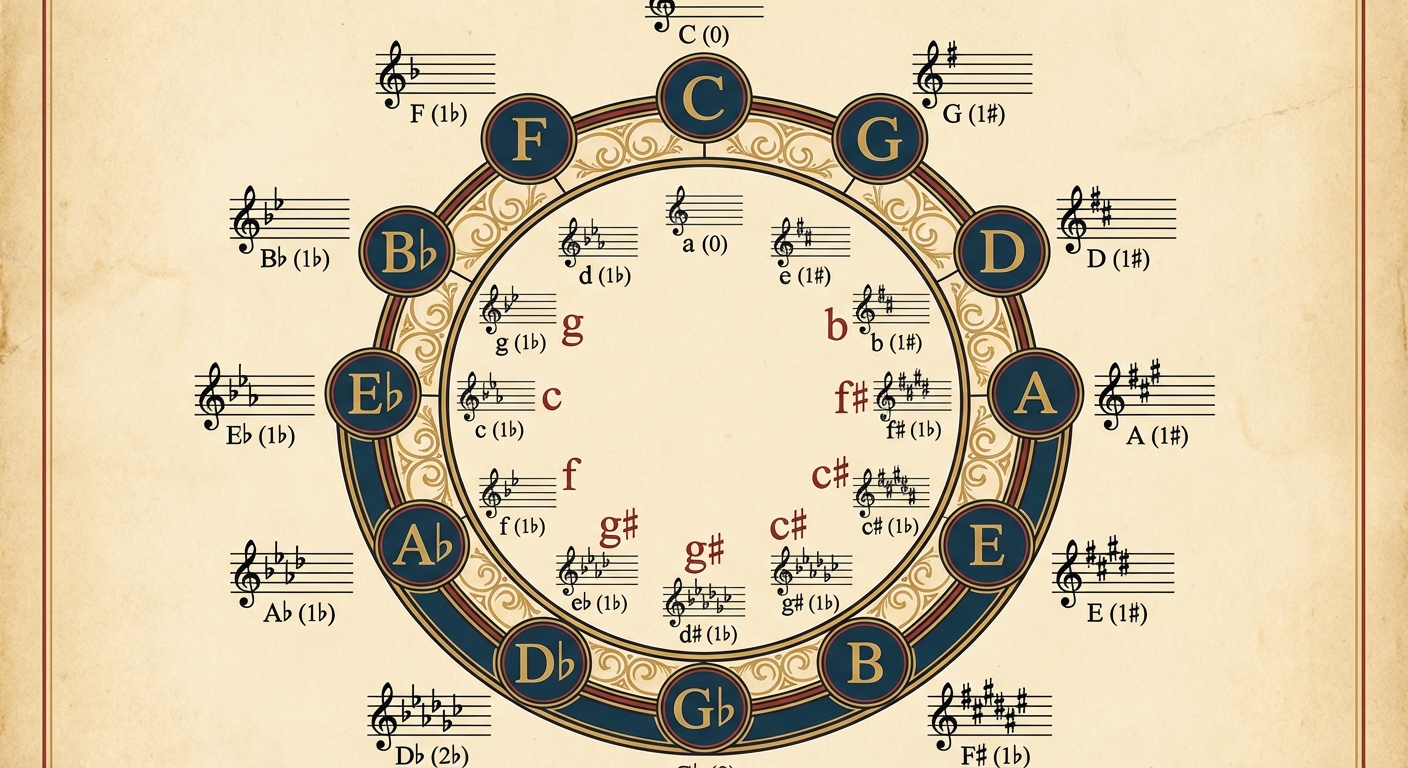
To maintain the W-W-H-W-W-W-H pattern in different keys, we use Key Signatures placed at the start of the line. The Circle of Fifths organizes these keys relative to the number of sharps or flats they contain.
Order of Sharps and Flats
The order in which accidentals appear in a key signature is fixed.
Order of Sharps: F - C - G - D - A - E - B
- Mnemonic: Father Charles Goes Down And Ends Battle.
- Rule: To find the Major Key from a sharp signature, look at the last sharp and go up one half step.
- Example: Last sharp is G$\sharp$ $\rightarrow$ Key is A Major.
Order of Flats: B - E - A - D - G - C - F
- Mnemonic: BEAD Greatest Common Factor (or simply the word BEAD followed by GCF).
- Rule: To find the Major Key from a flat signature, look at the second to last flat. That is the name of the key.
- Exception: F Major has 1 flat (B$\flat$). You must memorize this.
- Example: Flats are B$\flat$, E$\flat$, A$\flat$. Second to last is E$\flat$ $\rightarrow$ Key is E$\flat$ Major.
Intervals
An Interval is the distance in pitch between two notes. In Unit 1, the focus is on calculating the "generic" size and an introduction to harmonic vs. melodic intervals.
Generic Interval Size
This is simply the number of letter names spanned, inclusive of the starting and ending note. Accidentals do not change the generic size.
- C to E is a 3rd (C-1, D-2, E-3).
- C to E$\flat$ is also a 3rd.
- C to F is a 4th.
Tip: If the notes are on the same type of position (line to line, or space to space), the interval is odd (3rd, 5th, 7th). If they shift (line to space), the interval is even (2nd, 4th, 6th).
Harmonic vs. Melodic
- Harmonic Intervals: Two notes played simultaneously (stacked vertically).
- Melodic Intervals: Two notes played successively (one after the other).
Quality of Intervals (Brief Intro)
While specific qualities (Major, Minor, Perfect, Augmented, Diminished) are covered deeply in Unit 2, you should understand the diatonic intervals of the Major Scale:
- Unisons, 4ths, 5ths, and Octaves relative to the Tonic are Perfect.
- 2nds, 3rds, 6ths, and 7ths relative to the Tonic are Major.
Common Mistakes & Pitfalls
- Confusing Alto and Tenor Clef: Students often mix up these two C-clefs. Remember: Alto centers on the middle line; Tenor is higher up (4th line) to accommodate lower instruments playing high notes.
- Miscounting Intervals: When counting distance, you must always count the first note as "1". C to G is a 5th, not a 4th.
- Enharmonic Spelling in Key Signatures: Realizing that G$\flat$ Major and F$\sharp$ Major sound the same but are spelled differently. On the exam, if asked for a specific key, you must provide the correct spelling (e.g., asking for the key with 6 sharps means F$\sharp$, not G$\flat$).
- The Leading Tone vs. Subtonic: In a Major key, $\hat{7}$ is a Leading Tone (half step below tonic). Do not confuse this with a lowered 7th (whole step below tonic), which is called the Subtonic and is found in the Natural Minor scale.