Chapter 12 - Molecular Symmetry
- Group theory - The systematic discussion of symmetry.
The symmetry elements of objects
- Symmetry operation - An action that leaves an object looking the same after it has been carried out.
- Symmetry element - The point, line, or plane with respect to which the symmetry operation is performed.
12.1 Operations and symmetry elements
- Identity (E) - Consists of doing nothing; the corresponding symmetry element is the entire object.
12.2 The symmetry classification of molecules
- Schoenflies system - Used for individual molecules.
- Hermann-Mauguin system (International system) - Used almost exclusively in the discussion of crystal symmetry.
The groups C1, Ci and Cs
- A molecule belongs to group C1 if it has no element other than the identity.
- It belongs to Ci if it has the identity and the inversion alone.
- It belongs to Cs if it has the identity and a mirror plane alone.
The full rotation group
- The full rotation group, R3 (the 3 refers to the rotation in three dimensions) - Consists of an infinite number of rotation axes with all possible values of n.
12.3 Some immediate consequences of symmetry
Polarity
- Polar molecule - One with a permanent electric dipole moment.
Chirality
- Chiral molecule - A molecule that cannot be superimposed on its mirror image.
- Achiral molecule - A molecule that can be superimposed on its mirror image.
- Optically active molecules - They rotate the plane of polarized light. Chiral molecules are optically active.
Applications to molecular orbital theory and spectroscopy
12.4 Character tables and symmetry labels
- Character table - A table that characterizes the different symmetry types possible in the point group.
- Characters - The entries in a complete character table.
- Matrix representation (Γ) - The set of matrices that represents all the operations of the group.
12.5 Vanishing integrals and orbital overlap
- Order - The total number of operations in a group.
- Basis - A set of atomic orbitals.
- Symmetry-adapted linear combinations (SALC) - Combinations that adapt to the symmetry of the molecule.
12.6 Vanishing integrals and selection rules
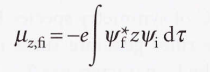
- Transition dipole moment