The Fall of Jerusalem
This lesson uses the terms "Babylon" and "Chaldeans." The phrase "king of Babylon" is also included as it is used frequently in the Bible. Babylon was a city where the king of Babylon lived. The Chaldeans were the people that lived in and around Babylon. They are often synonymous with each other.
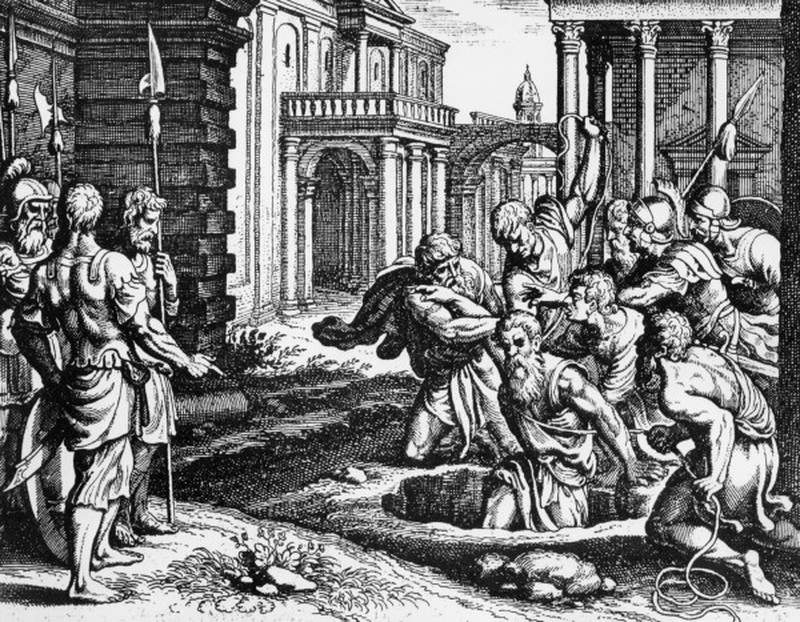
Jeremiah Thrown into the Cistern
Shephatiah, Gedaliah, Jucal, and Pashhur were government officials and heard what Jeremiah had been telling the people. They heard that if people stayed in the city, they would die by pestilence, famine, or the sword. If they surrendered themselves to the Chaldeans, they would be safe. Jeremiah was saying that the army of the king of Babylon would take the city. (The Chaldeans were part of Babylon's army that was besieging Judah.) When the officials heard this and called for Jeremiah's execution, the king refused to execute him, so they put Jeremiah in a cistern. The cistern did not have any water but was full of mud, and Jeremiah sank into the mud.
Ebed-melech the Ethiopian, a eunuch in the king's house, heard about Jeremiah being thrown into the cistern. He went to the king and told him what had been done. The king ordered Ebed-melech to get Jeremiah out of the cistern so he would not starve. Ebed-melech took old rags, tied them to a rope, and pulled Jeremiah out of the cistern. Jeremiah stayed in the court of the guard.
Zedekiah sent for Jeremiah to come to the temple. Zedekiah said that he had a question for Jeremiah, but Jeremiah replied that if he answered the question, the king would execute him and not listen to the answer. Zedekiah swore not to kill him or give him to the men who wanted to kill him. Jeremiah told the king that if he surrendered the city, the king and his house would be spared, and the city would not be burned. The king was afraid of the Judeans that had deserted to the Chaldeans. Jeremiah assured the king that he would not be given to these men if he surrendered. The king then instructed Jeremiah not to speak of their conversation. If any men asked him what had been discussed, he was to say that he had pleaded with the king not to send him back to the house of Jonathan.
Sure enough, the men asked Jeremiah what he and the king had talked about, and Jeremiah answered them with what the king had said to tell them. Jeremiah was taken to the court of the guard until the Chaldeans took the city.
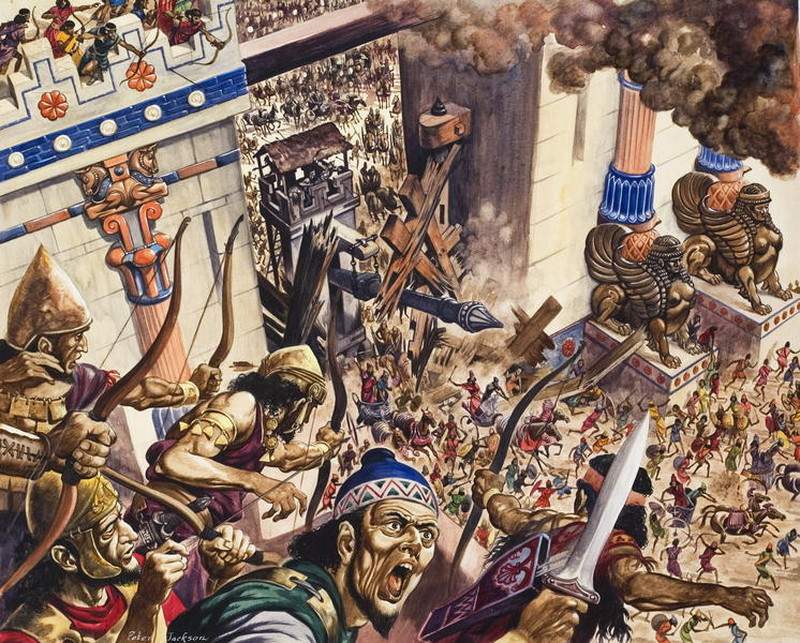
Jerusalem Falls
Nebuchadnezzar, king of Babylon's army, besieged Jerusalem for eighteen months. A breach was made in the wall, and officials of Nebuchadnezzar sat at the middle gate. When King Zedekiah heard this, he fled the city and was captured in the plains of Jericho. The army of Nebuchadnezzar brought King Zedekiah to him at Riblah. Zedekiah's sons and the nobles of Judah were killed before him, and Zedekiah was blinded and brought to Babylon in chains. The Chaldeans burned the king's house and the people's houses, and they also tore down the walls of Jerusalem. Only some of Judah's poor were left behind and given vineyards and fields by Nebuzaradan, the captain of the guard.
Jeremiah Stays in Judah
Nebuchadnezzar commanded Nebuzaradan, the captain of the guard, not to harm Jeremiah. Nebuzaradan had Jeremiah freed from the court of the guard. He told Jeremiah that he could come to Babylon with him and he would take care of Jeremiah, or Jeremiah could remain in Judah. He explained to Jeremiah that if he chose to stay in Judah, he could go to Gedaliah, who had been appointed governor of Judah by the king of Babylon. Jeremiah decided to stay, and after he was released with rations of food and a present, Jeremiah went to Gedaliah and lived with him.
God told Jeremiah to go to Ebed-melech (the Ethiopian) and tell him that God had delivered him from destruction. God said that Ebed-melech would be spared because of his faith in God.
Gedaliah
The king of Babylon appointed Gedaliah, the son of Ahikam, to be the governor of Judah. The poorest in Judah had been left behind to farm the fields and vineyards. Ishmael, Johanan, Seraiah, the sons of Ephai, Jezaniah, and their men went to Gedaliah. Gedaliah told the men not to fear the Chaldeans. He said that they should remain in the land and serve the king of Babylon. Gedaliah stated that he would live in Mizpah to represent the Judeans before the Chaldeans. He told the men to live in the cities they had taken. The remaining Judeans returned to Judah and gathered wine and fruit.
Johanan came to Gedaliah and told him that the king of the Ammonites had sent Ishmael to kill him. Gedaliah did not believe him. Johanan asked Gedaliah if he could seek out Ishmael and kill him so that Gedaliah and the Judeans that had gathered with him would be safe. Gedaliah replied and said not to kill Ishmael because he was being lied about. Johanan was correct, though, because Ishmael killed Gedaliah, the Jews, and the Chaldeans living in Mizpah. The people fled to Egypt after this because they were afraid of the Chaldeans.
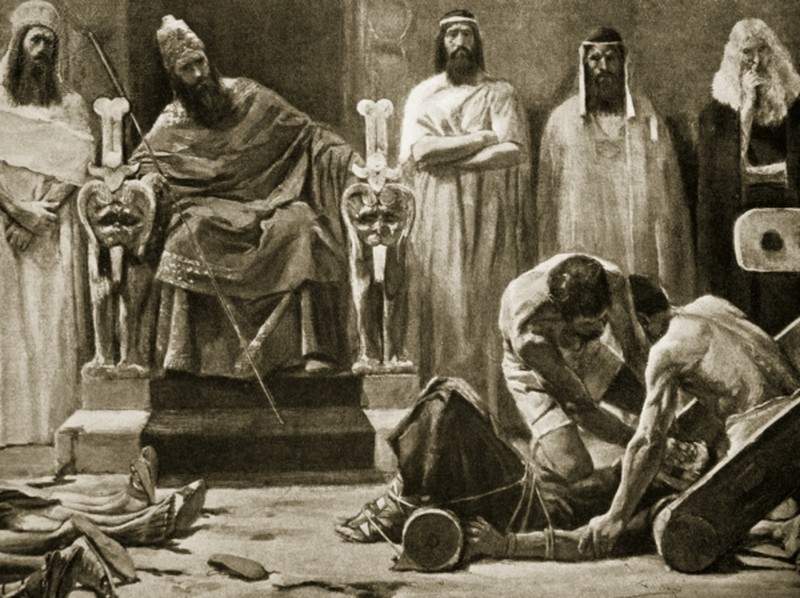
A Second Account
Another account of the destruction of Jerusalem is found in 2 Kings 24-25. This account begins when King Jehoiakim served Nebuchadnezzar, king of Babylon. Jehoiakim rebelled against Nebuchadnezzar. God then sent the Chaldeans and others against Judah. Jehoiakim died, and Jehoiachin assumed the throne of Judah. Jehoiachin ruled for three months and did evil deeds. The Babylonians and their allies besieged Jerusalem. Jehoiachin surrendered to the king of Babylon. The king of Babylon carried away captives from Jerusalem as well as the temple's treasures, the officials, the men of valor, and all of the artisans and blacksmiths. The king of Babylon also took Jehoiachin, Jehoiachin's wives, and Jehoiachin's mother. The king of Babylon made Mattaniah king and changed his name to Zedekiah.
Zedekiah ruled in Jerusalem for eleven years. He did evil deeds. Zedekiah rebelled against the king of Babylon. The king of Babylon took Jerusalem and Zedekiah into captivity.
In the thirty-seventh year of Jehoiachin's captivity, Evil-merodach, king of Babylon, released him. Jehoiachin was given clothes and dined with the king of Babylon as long as Jehoiachin lived.
A Third Account
2 Chronicles 36 recounts the decline of Judah, the eventual capture of Jerusalem, and the exile of the people by the Babylonians. In 2 Chronicles 36:23, additional information is provided that in the first year of Cyrus, the king of Persia, Cyrus proclaimed that he had been given the duty to rebuild the temple in Jerusalem.
Habakkuk
Habakkuk was a prophet. He cried out to God, asking God why He would not answer his prayers. Habakkuk saw violence and sin and wanted to know why God would allow such things. Habakkuk could not understand why God would use these sinners and idolaters to carry out God's punishment. God answered and said that He was using the Chaldeans to punish the sins of Judah. Habakkuk replied that he would watch to see what happened with his complaints. God answered him again and told him to write down his visions on tablets. God explained that even though He was using the Chaldeans to punish Judah, they would not go without their own punishment. God confirmed that all of those that worshipped false gods would be punished.
Habakkuk prayed to God and asked Him to remember His mercy in His wrath. Habakkuk praised God's power and said that he would watch and wait for the trouble to come to the ones that invaded Judah (the Chaldeans). He rejoiced in God and said that even when fig trees did not blossom or flocks of sheep disappeared, he would worship God because God was his strength.
Summary
This lesson contains three accounts of the fall of Judah and the beginning of Babylonian captivity. The people of Judah had sinned against God, and God had sent prophets to warn them on numerous occasions. The prophet Jeremiah was even thrown into a well to silence the warnings that God had sent through him. Jerusalem fell, and Zedekiah was taken into captivity along with all but the poorest residents of Judah. The poor were left behind to work in the fields.
The king of Babylon appointed Gedaliah, Ahikam's son, to be Judah's governor. Ishmael killed him and fled to Egypt. Habakkuk, the prophet, cried out to God, asking why these things were happening at the hands of the Chaldeans.

Application and Reflection
Application
Habakkuk saw violence and sin and wanted to know why God would allow such things. We often see these things in our lives and have the same questions. God has a purpose in all that He does. It is not for us to question God's ways. We can only obey God and be certain that He knows what He is doing.
Reflection
Even when we think one power is more significant than all others, there is no power greater than God. The Babylonians seemed to be the greatest power on earth until they encountered the Persian Empire. When we feel like we are the greatest at something, we must remember that there is always someone better. The greatest power will always be God. Is having the greatest power in the universe on our side an advantage?