Social Studies / Chapter 6-8
#ec8d8d #d24545 #bd0c0c #ffffff #f4f4f4
Chapter 6
The Evolution of Modern Liberalism
To what extent do contemporary economic policies and practices reflect the principles of liberalism?
Theodore Roosevelt’s Progressivism
Conditions inside meat-packing plants caused public outcry and prompted Roosevelt to introduce the Meat Inspection Act (1906) and the Pure Food and Drug Act (1906) in response to the effects of liberalism on early 1900 American society.
In 1906, the US government also investigated acts of preferential treatment for Standard Oil from some rail road companies.
Taft and the Sherman Anti-Trust Act
Roosevelt’s successor was William Howard Taft who was president from 1909-1913.
Continued Roosevelt’s policies and put forward legislation to break up trusts (large business conglomerates that formed monopolies).
The Sherman Anti-Trust Act was introduced in 1890 to prevent collusion or anti-competitive behaviour between companies.
It prevented a business entity (such as trust) from owning two or more competing companies.
In 1911, Taft and the US Supreme Court used the Sherman Anti-Trust Act to force Standard Oil to break up into 34 smaller, independent companies.
While it was principles of classical liberalism that allowed Standard Oil to grow to such a position of market dominance, this eventually led it to undermine other classical liberal principles such as competition.
The Shift Begins: Modern Liberalism ← Classical Liberalism
Although The Anti-Trust legislation limited some aspects of classical liberalism, the reforms prevented certain powerful entities in society from abusing the rights and freedoms of less influential organizations and individuals.
Hence the transformation from classical liberalism (very limited gov’t intervention) to modern liberalism (gov’t ensures equal opportunity for all).
Credit Unions
Credit unions are small financial institutions that are owned by their members; profits are used to offer members better lending rates or lower fees.
Alphonse Desjardins founded the first credit union in Quebec in 1900. Today, Desjardins group is the largest association of credit unions in North America.
Credit unions would later become popular among farmers in rural areas because they were more willing to provide financing than traditional banks.
Credit unions provided financial services to a wider range of individuals than traditional banks did (hence, modern liberalism: equality of opportunity).
The First Red Scare
In 1917-1920 in the United States.
Refers to a public fear of communism red being the colour of communism.
Political Conservatism: Harding & Coolidge
In 1921, Warren G. Harding became President of the U.S.
“Return to normalcy” platform had central ideas:
Isolationism - a retreat from involvement in other countries’ affairs.
Nativism - reduction of immigration and promotion of ‘American’ culture.
A reduction of government involvement in the lives of citizens.
Policies of Harding & Coolidge represent a shift back towards the right…
When Harding died in office in 1923, vice-president Calvin Coolidge took power. He favoured similar policies to his predecessor and twice vetoed legislation that would have allowed the government to subsidize farmers by buying surplus crops and selling them at lower prices in foreign markets (he favoured classical liberalism over modern liberalism).
Economic Prosperity & Consumerism
Henry Ford advocated a minimum wage and a 40 hour work week in his factories.
His motivation was that he thought if employees were happier they would work more efficiently.
He also believed that paying them better wages would allow them to buy the products they produced, thus increasing sales.
Changing Social Values
In 1920, women in the U.S. obtained the right to vote, as Canadian women had 2 years earlier.
In the U.S., Native Americans were granted citizenship by the Indian Citizenship Act (1924).
While greater equality was achieved in some aspects of N. American life, there were still some enduring examples of inequality.
Income disparity, racism, and discrimination were still common problems.
The Great Depression
Tuesday, October 29, 1929 Stock Market crashed.
Between 1926 and 1929, millions of Americans borrowed billions of dollars to purchase stocks.
In the stock market, you sell high but purchase low.
On this day, a financial panic hit the markets and people started to sell their stocks. This caused a glut in the market – too many stocks and not enough purchasers so the value of the stocks plummets.
People who did not sell their stocks still have to repay their loans but the problem is that their stocks do not have the value they once had.
Many people go bankrupt.
People now react and don’t spend money.
This now has a secondary effect. Sales of goods and services go down so factories start to lay off people.
Production levels decrease by 50%.
Unemployment goes from 3.2% in 1929 to 24.9% in 1933.
American economic policy introduces tariffs to protect American industry.
In addition, President Herbert Hoover works on a Social Assistance program to help the needy.
Retreat from laissez-faire (or at least complete laissez-faire).
The New Deal (1933-1939)
President Franklin D. Roosevelt wanted to lessen the effects of the Great Depression by providing relief, economic recovery and reform.
Objectives:
Raise personal incomes
Boost private consumption and investment
Provide work for millions of unemployed
Us Government would have to:
Increase spending.
Introduce controls on banking,
Subsidies for agriculture (hard hit in the depression).
Social Reforms - unemployment insurance, old-age security, old-age pensions, welfare.
Fiscal and Monetary Policy
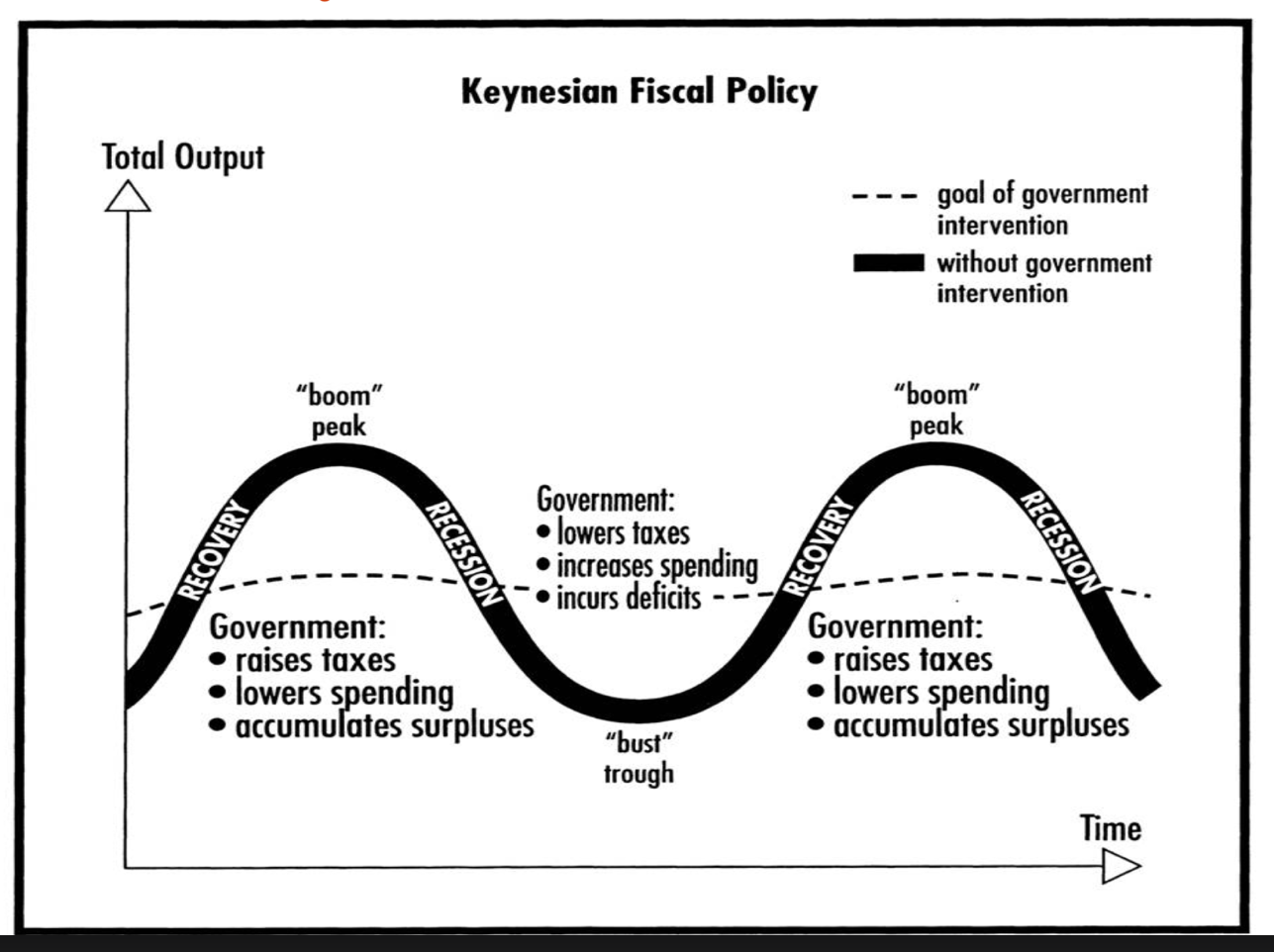
Fiscal policy relates to government spending and revenue collection. For example, when demand is low in the economy, the government can step in and increase its spending to stimulate the economy. Or it can lower taxes to increase disposable income for people as well as corporations.
Monetary policy relates to the supply of money, which is controlled via factors such as interest rates. For example, to control high inflation, policy-makers can raise interest rates thereby reducing money supply in the economy.
Mixed Economy (1939-1975)
Government intervention in full force…
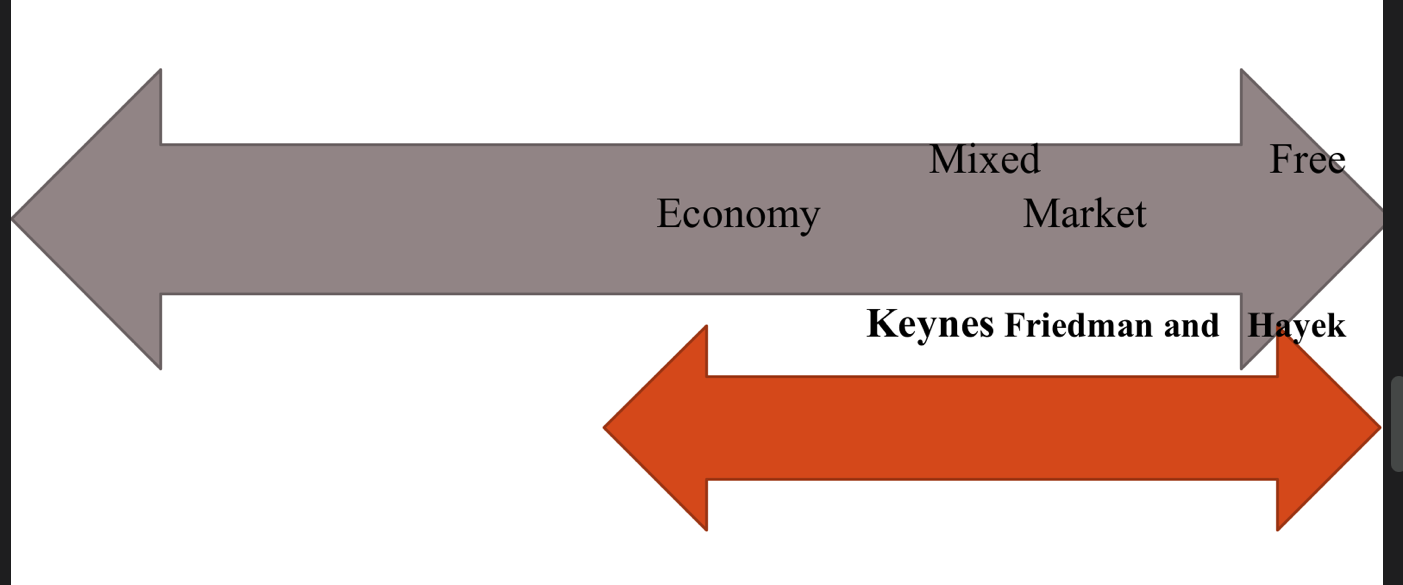
Based on ideas of john Maynard Keynes
Counter-cyclical measures
In good times, increase taxes and decrease spending and in bad times, decrease taxes and increase spending.
Made to balance out the business cycle.
Government involved in many of the New Deal’s initiatives (road building, dams, housing projects, regulation of banking, insurance and foreign exchange).
Increase in the use of fiscal policy.
Promotion of high economic growth, full employment and stable incomes.
Canada: Early Economic Policies
Limited Intervention (up to 1929)
Confined to maintaining public order, national defence, laws to promote business, the dollar and some public works.
Any intervention was only justifiable if it was in the national interest. Ex; WW1.
Most intervention viewed as harmful to the economy.
Some intervention necessary such as:
Canadian National Railways —bankrupt and needed funds.
Provincial old-age pension plants and unemployment.
Economic Situation in Canada
Great Depression
Usual boom and bust cycle non-existent — it is a constant bust.
Industrial Production down 33%.
Unemployment at one point as high as 22%.
R.B. Bennet (Prime Minister) puts in a place tariff system to protect Canadian business and puts in reduced spending (what problems can that create?)
1933 — economic turnaround not happening.
Bennet brings in public work projects.
Bennet introduces idea of Canadian ‘New Deal’ during 1935 election.
More progressive taxation.
Minimun wage.
Regulation of working conditions.
Unemployment insurance.
Health and accident insurance.
Old-Age pensions.
Support for Agriculture (which was hit very hard in the Depression).
October — Bennet loses election and William Lyon Mackenzie King (new PM) puts in many of these changes.
Canadian Government Responses to the Great Depression
In 1935, William Lyon Mackenzie King became PM.
His government became much more involved in the economy such as social programs and a mixed economy.
An important individual during this time was C.D. Howe, nicknamed “Minister of Everything.”
C. D. Howe’s Achievements
He used unemployed workers in the 1930’s to build airstrips across the nation which would soon be used in the rapidly expanding aviation industry.
Established Trans-Canada airlines as a crown corporation (later became Air-Canada).
Created the National Harbours Board (centralized administration of the nation’s ports).
Reformed the heavily indebted Canadian National Railway.
Helped create the CBC in 1936.
Other Public Institutions and Social Programs create during this time include:
Bank of Canada became a crown corporation.
The National Film Board.
Unemployment Insurance Act.
Family allowance.
The National Housing Act and Central Housing and Mortgage Company (public housing for low income families). Today, it is the very important CMHC.
Canada’s Postwar Economic Policy
1940’s
Passed the Unemployment Insurance Act, Universal Family Allowances, Canada Mortgage and Housing, as well as, universal health care (provincial level).
1960’s
Canada Pension Plan, universal health care at a federal level.
1970’s
Increases in the spending for social programs.
1980’s & 1990’s
Decreases in spending, Canada Health Act passed to prevent extra billing, cuts to education (why post-secondary tuitions are high — approx. 208% increase since 1989) and health care.
Canadian Economic Principles
Equal Access
Federal government, through transfer payments, makes sure each province has the same level of access for its citizens.
Social Equality
Provides equality of opportunity for all citizens and greater access to the programs.
Universality
Everyone in Canada, regardless of income, has access to the services.
World Economic Crises of the 1970s
The U.S. pulls out of the Bretton Woods Agreement which
used gold to set currency exchange rates. Other countries followed suit and a period of inflation ensued slowing economic activity.
4th Arab-Israeli War whereby OPEC imposes an oil embargo on the West for their support of Israel. It also slowed oil production; the price of oil quadrupled.
Stagflation occurred; when a recession and high inflation occur at the same time. Stagflation is a problem because high inflation means government programs cost more to run but due to recession the government collects less taxes.
THE SHIFT BACK TOWARDS CLASSICAL LIBERAL LAISSEZ-FAIRE ECONOMICS IN THE FORM OF MONETARISM---A SHIFT THAT BEGAN WITH THE 1970’S ECONOMIC CRISIS IS ANOTHER SWING OF THE PENDULUM WHICH ALTERNATES BETWEEN INTERVENTIONISM AND THE FREE-MARKET ECONOMY.
Monetarism
The Central Bank actively adjusts money supply and interest rates to stabilize the amount of money to purchase goods and services and the ability of the economy to be able to produce these goods and services.
The economist most closely associated with monetarism is Milton Friedman.
Critique of Keynes’ fiscal policy.
Governments went into deficit spending due to spending on social programs.
How does it work?
When consumers and businesses are pessimistic, the central bank would increase the money supply resulting in a lower interest rate. This encourages people to borrow to purchase goods or expand business.
When consumers and businesses are optimistic, the central bank decreases the money supply resulting in a high interest rate. It does this to prevent overexpansion of production and a rise in prices (inflation).
The higher rates discourage borrowing money.
Leads to less spending, less demand for goods.
The goal in all this — keep inflation low.
Friedrich Hayek
Hayek was a critic of collectivist theory.
He argued that it would be impossible in a centrally planned (collectivist) economy for the central planners to have sufficient information to make rational decisions. Although they controlled supply, they could never have enough information about demand (especially in a society the size of modern countries) to make appropriate decisions.
His ideas would influence British Prime Minister Margaret Thatcher.
Milton Friedman
Believed in small government. Critical on the impact of controls on the economy by government;
Believed in reduction government intervention.
Monetarism VS. Keynesian Economics
The adoption of monetarism by Great Britain, the U.S., and others during the late 70’s and 80’s reflects a swing back to classical liberalism and away from Keynes’ interventionist policies.
Fiscal Policy in Action
Friedman Ideas in Practice
Thatcherism (U.K.)
Deregulation of the economy.
Sale of government owned enterprises.
Decentralization of government departments.
Reductions in government spending on social programs.
Reaganomics (U.S.A.)
Supply Side/Trickle-down Economics.
Reduce government spending.
Cutting taxes.
Fewer government social programs.
Focus on production.
Modern Liberalism Tendencies
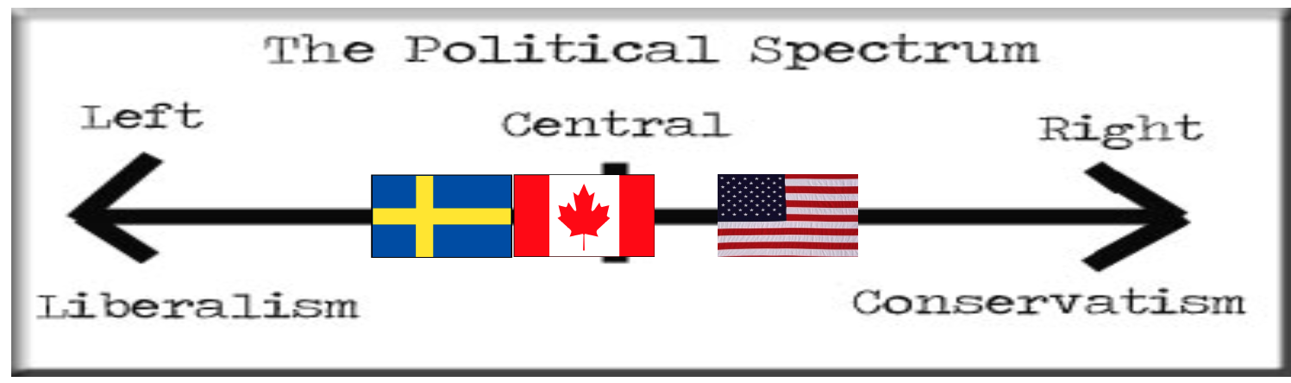
Canada, Sweden
Other countries such as Canada and Sweden have tended to favour more government intervention in the economy and in the lives of citizens.
United States
Countries such as the U.S. have argued that liberal goals are most effectively achieved by limiting government intervention.
Key Terms
Consumerism: Consumer spending; a preoccupation with consumer goods and their acquisition; a set of values focused on the acquisition and display of things in order to denote status.
Income disparity: Difference in earnings between the rich and the poor.
Inflation: An increase in the general price levels of products, the cost of labour, and interest rates.
Monopoly: The exclusive ownership of or control of trade in a particular good or service.
Social programs: Programs that affect human welfare in a society. Social programs are intended to benefit citizens in areas such as education, health, and income support. Supporters base their support both on humanitarian principles and economic principles.
Trickle-down economics: Government economic policies that include reduced income and business taxes, reduced regulation (controls on business), and increased government spending on the military; also known as supply-side economics. Generally these policies favor industry, assuming that if industry prospers then everyone will prosper as wealth “trickles down” to the ordinary workers and consumers.
Welfare state: A state in which the economy is capitalist, but the government uses policies that directly or indirectly modify the market forces in order to ensure economic stability and a basic standard of living for its citizens, usually through social programs.
Chapter 7
Challenges to Liberalism Related To Foreign Policy
The Iron Curtain was the line in Europe between self-governing nations of the West and nations in Eastern Europe under communist Soviet control.
The Iron Curtain
The Americans viewed the iron curtain as a barrier to contain those oppressed by communism, a restriction to civil and economic freedoms.
To what extent does ideological conflict shape our world?
The Cold War (1945-1991) saw most of the world split into two sides: those nations allied with the USSR and communism, and those allied with the USA and democratic liberalism.
Yalta
In February 1945, the Allied Forces could see that the Second World War would soon end and the “Big Three” met at Yalta (on the Black Sea) to plan both their reaming wartime actions and the future for postwar Europe.
The Big Three: Churchill (UK), Roosevelt (US), & Stalin (USSR).
They were redrawing the map of Europe and their decisions would have implications for many years to come.
After Yalta: The Cold War
Numerous events, agreements and conflicts resulted in growing tensions between the USSR and the USA.
A few examples are:
Postwar treatment of Germany.
US aid to Europe has strings attached.
Stalinization.
Hungary’s move to independence.
After WWII, the US and USSR no longer had a common enemy to fight.
The USSR and US emerged from WWII stronger than they were before they entered it. They were considered superpowers.
In July 1945 in Potsdam, Germany, the leaders of the UK, US, and USSR again met to plan for postwar Europe.
They determined the future course of world history.
Truman and Stalin sought to avoid another war but they also recognized each other as rivals for domination over Europe and Asia.
Both sides feared that the other would win the “war of ideas,” convincing the populations of Europe and Asia that liberal capitalism on the one hand, or communism on the other, was the only legitimate system of governance. This ideological battle between the USSR and United States was known as the Cold War.
Essentially much of the Cold War was fought through propaganda.
Expansionism and Containment
Expansionism is the attempt to enlarge territorial and ideological influence beyond a country’’s borders.
At the end of WWII, both the U.S. and the Soviet Union began to establish spheres of influence (countries or territories over which a powerful country dominates) in Europe.
Each of the superpowers responded to its fears with containment (attempts to thwart another country’s expansionism without going to war).
The Truman Doctrine
In 1947 President Truman called upon the U.S. to “support free peoples who are resisting attempted subjugation by armed minorities or by outside pressures”.
Truman wanted to stop Soviet expansionism to contain the communist influence and, rather than fighting a direct war (hot war) with the USSR, the U.S. fought its ideological conflict by creating alliances and giving aid.
For example, the U.S. responded with $400 million to aid postwar Greek and Turkish governments when they asked for support in defeating the appeal of communism in their countries.
The biggest aid plan was the Marshall Plan, a $13 billion plan to aid the recovery of countries ravaged by war in Europe.
This offer was for all countries of Europe, communist or democratic.
Soviet satellite states rejected Marshall Plan aid due to the diplomatic pressure applied by the U.S.S.R.
The Americans required all recipients of aid submit to economic assessment and participate in a unified European economy, conditions that were incompatible with Soviet ideology.
This aid may have been a hollow gesture by the Americans as it is unlikely they would have approved aid to a nation under communist influence.
The Molotov Plan
The Molotov Plan was the Soviet response to the Marshall Plan.
It was for Eastern European nations under Soviet influence.
It involved bilateral trade agreements that helped consolidate the economic of socialist countries and solidify USSR presence in Europe.

Berlin (1945-1949)
After WWII, Berlin was divided into 4 sectors (A British, French, American, and Soviet sector).
However, the city fell 176 km inside Soviet controlled East Germany.
The Marshall Plan as eagerly accepted into Western zones of Germany but rejected in the Soviet zone.
Berlin Blockade - On June 24, 1948 Stalin blocked all road, rail and canal transportation to West Berlin leaving 2.1 million West Berliners cut off from all supplies.
The Berlin Airlift - The western response was to fly in supplies to West Berliners; at the height of these flights planes were landing every 3 minutes.
Over 11 months, the Americans, British, and French flew in all supplies needed by West Berliners.
On May 12, 1949, Stalin finally lifted the blockade.
Due to a history of invasion, the Soviets had long been sensitive to the security of their borders, and this increased after WWII.
Countries that shared a border with the USSR were under pressure to maintain political and economic ties with the Soviets were not receptive to the encroachment of capitalism or democracy. This was the first ideological battle between the USSR and the United States.
The Berlin Wall
At midnight on August 12, 1961, East German troops locked down the border between East Germany and West Berlin. The city of W. Berlin was essentially surrounded.
Breaking Free of the Iron Curtain (TEXTBOOK QUESTION)
Hungary Revolution of 1956
Hungarian people revolted against the Stalinist government.
Formed militias and fought against the state police and Soviet troops.
A new government was established, and the state police were disbanded.
Initial steps toward democracy were taken.
In November, Soviet forces invaded, crushed the revolution, and restored a pro-Soviet government.
Soviet power in Central Europe was reinforced, signalling the permanence of communism in the region.
Czechoslovak Socialist Republic: Prague, Spring 1968
Reformist Alexander Dubcek came to power in January 1968.
By April, he implemented reforms granting more rights and freedoms (media, speech, travel).
Limited the power of the secret police and proposed a gradual transition to democracy over 10 years.
Emphasized good relations with Western countries and considered multi-party governance.
Communist-bloc countries were critical; Soviet Union began talks with the CSSR that ultimately failed.
On August 20, 1968, Warsaw Pact armies invaded and occupied the CSSR.
Dubcek's reforms were reversed within a year.
Yugoslavia: Tito’s Defiance
Yugoslavia aligned with the Soviet Union after WWII under a communist government.
Leader Josip Tito distanced Yugoslavia from Soviet control despite being a communist.
Tito defied Stalin, rejecting demands for loyalty to the Soviet Union.
In 1955, Yugoslavia became a founding member of the Non-Aligned Movement.
Tito maintained a more liberal government and built relationships with Western countries.
Yugoslavia’s independence was facilitated by its geographic location, not sharing a border with the Soviet Union.
Alignment
In the interest of security, some countries aligned themselves with one of the superpowers.
Examples of superpower influence:
After WWII the CIA was part of a major covert operation to influence an Italian election so that a communist-socialist coalition would not win.
Also, postwar Czechoslovakia was interested in accepting Marshall Plan aid but the USSR did not allow it to do so.
Non-Alignment
Some countries chose or tried to follow their own ideologies outside those of the two superpowers.
April 1955, the Bandung Conference held in Indonesia saw representatives from 29 African and Asian countries meet to promote economic and cultural co-operation and to oppose the colonial and imperialist intentions of the superpowers.
The conference was the start of the Non-Alignment Movement (NAM).
In 1961, in Belgrade, Yugoslavia leaders from Ghana, Egypt, India, Indonesia, and Yugoslavia officially began the NAM.
Despite their desired neutrality, the superpowers still tried to influence the ideologies within these nations.
Countries of NAM sought unsuccessfully to use the UN to challenge the hegemony of the US and USSR.

Deterrence
Deterrence is a cold war strategy involving the building up of one’s capacity to fight such that neither opponent will fight because of the unexpected outcomes.
The development of nuclear weapons at the end of WWII meant that the superpowers knew that if the cold war escalated into hot war, nuclear weapons would be used.
Each nation knew a nuclear war would not only kill their opponents but also much of the population of the planet.
An unwinnable, nuclear war is known as mutually assured destruction (MAD); it deters each side because attacking your opponent would assure a counter attack would destroy you as well. These include weapons of mass destruction (WMDs).
Canada in the Cold War
Because of Canada’s historical ties to Britain and its shared border with the US there has never been any doubt as to which side Canada supported in the Cold War.
In 1949, Canada was a founding member of the North Atlantic Treaty Organization (NATO), a military alliance designed to defend members from attack from the USSR and its allies.
Canada also fought communists troops in the Korean War (1950-1953) and participated in North American Aerospace Defence (NORAD).
France’s Dissuasion Policy
In the early 20th century France was one of the world’s leaders in nuclear technology research.
After WWII France began developing nuclear weapons independently of the US and UK which it used as a deterrent.
This was called dissuasion, the French word for deterrent.
Its deterrence was different though in that it developed its nuclear weapons not as a response to a specific adversary but as a general deterrence.
France sought to exercise some sovereignty from what it saw as a U.S. dominated NATO. In fact, France withdrew from NATO in 1966. France’s nuclear defence is still prominent today.
Brinkmanship
Brinkmanship is the attempt to push a dangerous situation as far as possible without conceding anything to your opponent.(The Cuban Missile Crisis is an example of this from the Cold War.)
Cuban leader Batista was a corrupt, pro-capitalist military leader who ignored the poor.
1956-59 Fidel Castro led a socialist revolution and overthrew Batista’s government.
Castro in Cuba
Fidel Castro signed the First Agrarian Reform which broke up large landholdings, restricted foreign land ownership, and redistributed land to those who worked it, co-operatives, and the state.
The U.S. grew wary of Castro’s socialist ideas and his relationship with the USSR.
Essentially Cuba and the US began an economic and political game of diplomatic chess.
Bay of Pigs Invasion
In the years after the revolution the US received over 1 million Cuban refugees and encouraged and helped plan an attempt by these refugees to retake the island of Cuba with training and support from the U.S. government.
1511 Cubans and 177 paratroopers attacked April 17, 1961 and were defeated after 2 days of fighting.
The failed invasion increased the popularity of Castro and made Cuba even more distrustful of the U.S.
U.S. Embargo
The U.S. became unwilling to trade with Cuba and in 1962 it imposed an economic, commercial, and financial embargo on Cuba.
The Soviets, on the other hand, supported Cuba with aid.
Cuban Missile Crisis
US President John F. Kennedy became aware that the USSR was building missile launch sites in Cuba and imposed a naval blockade around Cuba.
The world watched as the two superpowers came close to the brink of nuclear war.
October 27, 1962 a diplomatic breakthrough was reached. Kennedy agreed not to invade Cuba and secretly agreed to remove US missile sites from Turkey and, in exchange, the USSR would remove its missiles from Cuba.
The end of the Cuban Missile Crisis ironically led to a period of relatively peaceful relations between the US and the USSR as both superpowers realized how close they came to mutually assured destruction.
Détente and Treaties
Because the superpowers came so close to the brink of war in the Cuban missile crisis, some steps were taken to reduce the tension between the two nations. For example:
The USSR was spending billions on the arms race which was unsustainable. Eased tensions with the US might open up more trade options.
The US was fighting in Vietnam against the communist north, a war that was draining financially and they wanted to spend more on social programs.
The period of reduced tensions, from the mid 1960s to 1979, was called détente.
During this time the superpowers met at summits, signed treaties, and took other measures to reduce tensions.
This was a method of settling differences through diplomacy, however, it only lasted about 15 years.
REVIEW TIMELINE ON COLD WAR (256-257)
Event that increased tensions:
1979 Soviet War in Afghanistan: This event led to significant tension as the U.S. government refused to ratify the SALT II agreement and many Western countries boycotted the 1980 Moscow Summer Olympics. It represented a clear escalation of Cold War hostilities.
Event that decreased tensions:
1987 Intermediate-range Nuclear Forces (INF) Treaty: This treaty marked a significant reduction in nuclear arms, with the U.S. and Soviet Union agreeing to eliminate certain categories of missiles. It was a major step in de-escalating nuclear tensions and fostering cooperation.
Rank these from the event that lead to decreased tensions to that which lead most to increased tensions:
1987 INF Treaty: This landmark treaty significantly reduced nuclear arms, showing strong cooperation between the U.S. and the Soviet Union.
1985 Gorbachev’s Reforms: Gorbachev’s policies of glasnost and perestroika and his withdrawal of Soviet forces from Afghanistan and Eastern Europe marked major steps toward reducing Cold War tensions.
1975 Helsinki Accords: Promoted peaceful cooperation, respect for sovereignty, and human rights, fostering dialogue between East and West.
1969 SALT I Talks: Initiated a controlled arms reduction, leading to the 1972 treaty that limited strategic missile numbers.
1963 Partial Test Ban Treaty: Helped mitigate the risks of nuclear fallout, reflecting a mutual desire for responsible nuclear policies.
1963 Hotline Creation: Established direct communication between the U.S. and Soviet leaders, reducing the risk of accidental escalation.
1982 Strategic Arms Reduction Treaty I (START I): While proposed with the intent of reducing arms, it faced criticism for being complex and one-sided, which strained negotiations until its signing in 1992.
1979 Soviet War in Afghanistan: This conflict heightened Cold War tensions, leading to the U.S. refusal to ratify SALT II and the boycott of the 1980 Olympics by many Western nations.
1980 President Reagan’s Election and Military Buildup: Reagan's strong anti-communist stance, military expansion, and "evil empire" rhetoric significantly escalated tensions during his presidency.
Proxy Wars and Liberation Movements
Although the US and the USSR did not fight a direct war, they did fight proxy wars.
Proxy Wars are when one superpower fights in another country or provides support to a group which opposes the rival superpower.
Liberation Movements occur when a country rebels against the country that colonized it or otherwise oppressed it. They fight against their perceived oppressor. They are often supported by one of the superpowers.
PAGE 258-260
Korea and Vietnam
Post-War Division: Both Korea (1945) and Vietnam (1954) were divided into two zones by agreements among world powers, with plans for free elections to reunify them.
Missed Elections: These elections never took place, leading to ideological divisions.
Cold War Hotspots: Both countries became battlegrounds for proxy wars between the US (capitalist) and the Soviet Union (communist).
Casualties and Setbacks: Both sustained massive civilian and military losses, along with long-term political and economic challenges.
Chile
Salvador Allende's Presidency: Elected in 1970 on a socialist platform; nationalized industries, started healthcare reform, and established ties with Cuba and the Soviet Union.
US Interference: CIA meddled in the 1964 and 1970 elections to prevent Allende's rise; President Nixon funded efforts to destabilize Chile.
1973 Coup: Allende died during a military coup led by General Augusto Pinochet, who ruled as a dictator until 1990, implementing free-market capitalist policies.
US Denial: While the US denied direct involvement in the coup, it admitted to creating conditions that led to it.
Afghanistan
Soviet Invasion (1979): USSR invaded Afghanistan to support a pro-Soviet regime and ensure regional influence.
US Response: The CIA covertly armed Afghan resistance fighters (Mujahedeen) in a costly operation that escalated over time.
Outcome: The Soviets withdrew in 1989, leaving behind a weakened Afghan Army to confront a strong insurgent force, which included future Taliban and al-Qaeda leaders.
Legacy: The conflict contributed to the rise of extremist groups and long-term instability in Afghanistan.
The Iran Contra Affair
Reagan Doctrine: The US aimed to eliminate socialist influence in Central and South America, considering the region part of its sphere of influence.
Illegal Arms Deals: The Reagan administration sold arms to Iran (hoping for help in freeing hostages in Lebanon) and funneled the proceeds to Nicaraguan rebels (Contras), circumventing Congressional restrictions.
Exposure: The scandal was uncovered in 1986, leading to resignations and legal proceedings against several officials, including Oliver North and John Poindexter.
Aftermath: Convictions were eventually overturned or pardoned by President George H.W. Bush, but the scandal tarnished the administration's reputation.
Cold War Hysteria
Fuelled by propaganda, misinformation, and the threat of a 3rd World War, paranoia grew among citizens during the Cold War, especially in the U.S.
Espionage
Espionage, the practice of spying or using spies to obtain secret information, was a key tool of the superpowers in the Cold War.
It fuelled paranoia but, as a retired KGB agent said, it also “...played a tremendous role in keeping the world from the brink, from turning the Cold War into a hot war.”
Post Second World War Red Scare and McCarthyism
During and after WWII, American society experienced a red scare-an intense fear of communism overcame the majority of the American population.
This created a strong backlash toward American communists and anyone perceived as being sympathetic towards the Soviets.
A movement against all things communist was led by an ex-marine and Republican Senator, Joseph McCarthy.
He accused many members of the State Dept. of being communists. A hearing was held and the charges were proven false. Yet he continued to accuse members of the democratic government of being communist.
Dec 2, 1954 the Senate voted to formally reprimand McCarthy but he died 3 years later.
McCarthyism was the name given to the movement to uncover and prosecute those with perceived ties to communism.
HOMEWORK:
1. Comparing the Maps from 1959 to 1982:
Factors contributing to changing alliances between Angola and Mozambique:
Decolonization movements: The independence from colonial rule influenced new political and ideological alignments. Both Angola and Mozambique gained independence from Portugal in the 1970s, shifting the geopolitical landscape.
Cold War influence: The Cold War rivalry between the U.S. and the Soviet Union led to support for opposing factions within these countries. The U.S. and its allies backed anti-communist groups, while the USSR and Cuba supported communist regimes, affecting alliances and internal conflicts.
Economic and military aid: Foreign powers supplied military and financial aid to bolster their favored factions, leading to changes in power dynamics.
Liberation Movements and Ideological Conflicts:
Support and motives during the Cold War:
Countries involved: The Soviet Union, China, Cuba, and the U.S. supported different liberation movements. For example, the Soviet Union and Cuba supported the Popular Movement for the Liberation of Angola (MPLA), while the U.S. supported UNITA (National Union for the Total Independence of Angola).
Motives:
Soviet Union and Cuba: Promoted Marxist-Leninist ideology to expand their influence and counter Western powers.
U.S.: Aimed to prevent the spread of communism and secure alliances in resource-rich regions.
Examples of support: The U.S. supplied weapons to UNITA, while Cuba sent troops and Soviet-supplied arms to MPLA.
Impact on Modern Political Ideology: Research on current political ideologies in Africa:
The legacy of Cold War involvement has left some African countries with military-oriented governance or strong remnants of socialist ideology. For example, Mozambique's current political framework still reflects elements of its Cold War-era alliances, with FRELIMO remaining a dominant party.
Impact on stability: Countries that received significant military support during the Cold War have sometimes struggled with long-term impacts, including the prevalence of weapons and militarized politics.
Easing of Tensions
In the mid 1980’s, Soviet Leader Mikhail Gorbachev initiated 2 major policy changes in the USSR:
Glasnost - was a policy that called for increased openness and transparency in government institutions and activities in the Soviet Union.
Perestroika - economic and governmental restructuring that marked an ideological shift to the right and included more cooperative relations with Western Europe and the U.S.
Key Terms
Brinkmanship: International behaviour or foreign policy that takes a country to the brink of war; pushing one’s demands to the point of threatening military action; usually refers to the showdown between the United states and the soviet union over Cuba in October 1962
Cold War: The political, economic, and social struggle between the soviet union and its allies, and the united states and its allies, conducted using propaganda, economic measures, and espionage rather than military means.
Containment: The American cold war foreign policy of containing and the spread of communism by establishing strategic allies around the world through trade and military alliances.
Détente: A period of the cold war during which the major powers tried to lessen the tensions between them through diplomacy, arms talks and reductions, and cultural exchanges.
Deterrence: The cold war foreign policy of both major powers aiming to deter the strategic advances of the other through arms development and arms build up. Deterrence depends on each combatant creating the perception that each is willing to resort to military confrontation.
Expansionism: A country’s foreign policy of acquiring additional territory through violation of another country’s sovereignty for reasons of defence, resources markets, national pride, or perceived radical superiorities.
Liberation movements: Military and political struggles of people for independence from countries that have colonized or otherwise oppressed them.
McCarthyism: An anti-communist movement in the US during the 1950’s, which was led by Republican senator Joseph McCarthy. IT was intended to uncover and persecute those with perceived ties to communism within the US government, universities, and entertainment industries.
Non-alignment: The position taken during the Cold War by those countries in the UN that did not form an alliance with either the US or the SU. THis group of countries became a third voting bloc within the UN and pushed for more aid for the developing world.
Proxy wars: When a conflict arises, a superpower provides support (money, arms, personnel) to a group or state that opposes the rival superpower.
Chapter 8
Contemporary Challenges to Liberalism
To What Extent is Modern Liberalism Evolving?
Explore the Issues Q&A: Page 297
A) Identify three major differences between classical and modern liberalism.
Classical Liberal
Modern Liberal
Laissez-faire government
Government should act to protect
Individuals rights, freedoms and property
Economic freedom
Range of individual value
Equality of opportunity
Hands-on role for government
Gov’t should establish programs to help disadvantaged individuals
Redistribution of wealth
Individuals valued equally
Equality of outcome
B) Identify three examples of positive rights and three examples of negative rights.
Classical Liberal
Modern Liberal
Freedom from want, freedom from prejudice.
Freedom from religious persecution.
Freedom from discrimination.
Freedom of thought, belief, opinion, and expression (freedom of the press).
Freedom of the press.
Freedom of conscience and religion.
Compare and Contrast. The Chapter Issue asks you to consider the extent to which liberalism is continuing to evolve. To help you understand this evolution, work with a partner to compare and contrast how a classical liberal and a modern liberal might respond to the following scenarios:
Scenario: A family loses its home in a hurricane.
Classical Liberal Response: The family should rely on private charity, personal savings, and community support. Government intervention should be minimal, as classical liberals believe in individual and community responsibility over state welfare.
Modern Liberal Response: The government should provide emergency assistance, housing, and potentially longer-term support programs. Modern liberals believe in state responsibility to step in during crises to ensure people have access to essential support.
Scenario: A young person from a low-income household cannot afford to go to university.
Classical Liberal Response: The individual should seek private scholarships, work part-time, or take out loans. Classical liberals value individual initiative and personal responsibility for securing education without reliance on public funding.
Modern Liberal Response: The government should offer financial aid, subsidies, or free tuition programs for low-income students. Modern liberals believe access to education is essential for equal opportunity, and state intervention is justified to reduce social inequalities.
Liberalism Evolves: Question 1 - Page 296
Challenges to Modern Liberalism may include:
Who decides what is progress? Is progress always desirable? (environmentalism)
What obligation do people have to others? (environmentalism, security, rule of law, property)
What actions take precedence: economic growth or environmental protection (environmentalism)
Does individual self-interest take precedent over group rights? (neo-conservatism)
What role does patriotism play in liberal ideology? (neo-conservatism)
To what extent should government intervention be allowed? (neo-conservatism)
Into what areas of life is government intervention acceptable (neo-conservatism)
Are freedoms granted to all people even if they do not support liberal practices in their cultures? (religion)
Raises questions about the integration of church and state (religion)
How is Modern Liberalism challenged by alternative thought?
Environmentalism
Neo-Conservatism
Religious Perspectives
Aboriginal Perspectives
Historical Environmentalism
As an ideology, gained widespread support in the 1960s.
1970s: Greenpeace and Friends of the Earth successfully lobbied governments to enact laws to protect the environment.
Banning certain types of nuclear testing, dumping of toxic wastes, using certain toxic chemicals in computer products.
Environmentalists are critical of many human economic activities.. HOWEVER.
Free market economists and global warming skeptics claim that environmental reform of the economy will do more harm than good.
“Government policy must, above all, preserve the general conditions that have brought us to this state of achievement, not destroy them” Terence Corcoran.
Environmentalism Today
How the Green Party-and the other parties in Canada- address Canadians’ growing concerns about the environment –and the impact of these policies on the Canadian economy-has become a major issue for many Canadians.
A major political debate is about carbon tax. Even though there are major consumer and business implications, the tax is prominent in political party platforms.
Neo-Conservatism
One clear cut definition does not exist.
Emerged in the US in the1960s as a reaction against modern liberal principles that were believed to have been taken “too far”.
Gained support in the 1980s under the leadership of Margaret Thatcher and Ronald Reagan.
What is Neo-Conservatism?
Some aspects challenge modern liberal principles and favour a return to certain classical liberal values.
Other aspects challenge both classical and modern liberal principles and favour “family values”, often resting on old fashioned religious foundations.
Neo-Conservative Economic Policy
Resembles classical liberal laissez-faire economic policy.
Economic growth can be stimulated by cutting taxes; lower taxes create conditions that provide everyone with the opportunity to prosper.
Govt. involvement in economic markets should be limited.
Promoted by Milton Friedman and embraced by Reagan and Thatcher.
Neo-Conservatism and the Role of Government
Prefer alternative ways to deliver services currently provided by many governments.
Challenges modern liberals who believe that govt. should provide most essential services, such as education and health.
Classical liberals want to minimize govt. intervention but do believe that govt. should be responsible for such things as education. Neo-Cons want govt. to be as small as possible.
Example of Neo-Conservative Influence:
Private schools.
Privatizing state owned industries.
Decreasing taxes.
Reducing government programs related to health, employment, education and social security.
Individualism over Collectivism
Neo-Conservatism and Foreign Policy
An area of “common ground” for neo conservatives.
Patriotism is good and should be encouraged.
World government is not a good idea; it would lead to tyranny.
A large country has interests that extend beyond its own borders and therefore needs a large military.
Democratic capitalism the most preferred system and should be internationally supported. (Decision to invade Iraq partially based on this idea).
Neo Conservatives and Morality
Have traditional views on social issues.
Concerned about the “THE END OF TRADITIONAL MORAL CULTURE”.
Suspicious of counter cultures.
Influence by the Christian Right and seek to:
Put an end to abortion rights.
Allow prayer in schools.
Promote teaching of creationism in science classes
Challenges both classical and modern liberalism as both view religion as being a private matter.
Religious Perspectives
A wide range of religious perspectives exist.
Some people believe that the needs of the community should be placed above those of individuals.
FOR EXAMPLE:
Doukhobors (Communitarians; did not recognize secular governments), Hutterites.
Emphasis on the community is against the classical liberal principle of………?
Government Limitations on Religious Practices
Freedom of religion is a central value of liberalism however, governments sometimes place limits on religious practices to prevent them from conflicting with the rights of individual members of a religious community.
Political Influence of the Christian Right
The Christian Right is a group of conservative groups in the U.S. (and other liberal democracies) that focus on applying specific Christian beliefs to public policy.
Represent a challenge to modern liberalism; they believe that modern liberalism as straying from religious values and principles that they believe society should follow.
Aboriginal Collective Thought
Several key aboriginal policies challenge modern liberalism:
The importance of the collective.
Aboriginal traditions provide a different interpretation of progress than that of liberalism.
Tradition and continuity are important (importance of elders and their wisdom ); group needs are more important than individual needs.

Key Terms
Civil rights movements: A movement that works to extend rights to marginalized members of society. These problems aim for legal and civic rights, along with respect, dignity, and economic and social equality for each and every individual.
Environmentalism: The political and ethical ideology that focuses on the protection of the environment and reduction of the human activities that affect the ecosystem.
Neo-Conservatism: An ideology that arose in the US around the 1950's and 1960’s as a reaction towards modern liberal principles. Some aspects of this challenge modern liberal principles and favor a return to particular values of classical liberalism. Others challenge both classical and modern liberal principles and favor values identified as “family values” and traditional values, often resting on a religious foundation.