Chapter 23: Global Change
Global change: refers to all transformations or modifications of physical and biological components of Earth system over time
Types of global change:
Gradual change
Catastrophic
Unidirectional
Cyclic
Gradual change:
Great Oxygenation Event (unidirectional change)
Archean → Paleozoci → Mesozoic → Cenozoic
Plate tectonic processes take place over geologic time scales
Supercontinent cycle
Catastrophic change:
Formation of Earth Moon system
Collision of large protoplanet with Earth
Ejects debris in space
Moon coalesced from the debris
Advance and retreat of glaciers and ice sheets (cyclic)
Earth’s Climate Through Time
Climate oscillated between warm and cold conditions
Several ice ages: unusual events occurring at irregular intervals
Pleistocene Ice age: aka The Ice Age
Started with Pleistocene Epoch
Ended with glacial retreat
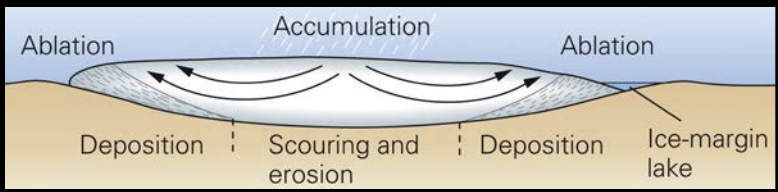
Several ice sheets in northern hemisphere connected by sea ice
Ice sheets flow from center, the point of maximum thickness, outward in all direction
Erosion dominates in the interior of ice sheets
Deposition dominates along margins
Traces of Pleistocene Ice Age:
Great Lakes and Finger Lakes
Glacial lakes
Submerged terminal moraine
Glacially polished landscape
Not covered by ice
Upper limit of ice cover
Till
Erratic boulders
Glacial striations
Consequences of Pleistocene Ice Age
Weight of ice causes lithosphere to bend downwards
Land surface subsides
Glacial rebound
Uplift
Rates of uplift depend on location (highest where ice sheet was thickest)
Changes in drainage patterns
Sea-level rise
Melting of ice-age glaciers
Colonization of the Americas
Climactic belts shifted towards equator
Vegetation belts shifted towards pole as glaciers retreated
Little Ice Age
Medieval warm period followed by Little Ice Age
Glaciers began retreating around 1850
Global T Change
T increased more than 1.2 Celcius by end of 2023
CO2 Concentration in Atmosphere
50% increase
Assumption (NGS 2013)
All ice in our planet melts → sea level rises by 65 m