Electrical charge and current topic 2.1.2/3
this contains definitions of current, potential difference, current equation, ohms law and graphs of filament bulbs, diodes and fixed resistor
charge is a measure of the total current that flows through within a period of time.
current refers to the rate at which electrons flow through a circuit (charge) and is measured in amperes (A) by an ammeter. charge flow, current and time are all linked by this equation
charge flow = current x time
Q = I x T
charge flow (coulombs)
current (amperes)
time (seconds)
electrical charge can only flow through a closed circuit, including a source of potential difference. potential difference refers to work done per unit of charge. one volt is equivalent to one joule. for example a battery supplies electrons with 6V of energy, then the electrons will transfer energy 6V to a component ( in this case a bulb) in the form of heat or light energy. after the energy has been transferred, electrons will return to the battery to be supplied once more with 6V and this process will repeat again.
the current flowing through a circuit depends on the resistance and potential difference across the components. resistance refers to the opposition to the flow of current. a high resistance meaning current will struggle harder to flow. the greater the resistance of the component, the smaller the current for a given potential difference across the component.
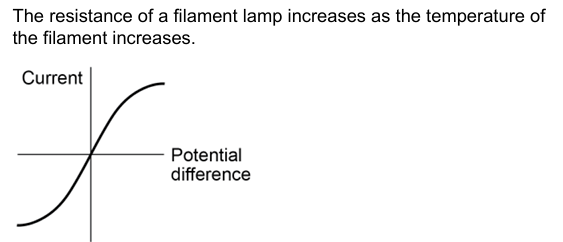
resistance can be affected by temperature. as temperature increases, the resistance will also increase, this is due to metal ions within wires of a circuit vibrating faster, which makes it harder for electrons to pass along the wire as there is further obstruction.
current, potential difference or resistance can all be calculated using the equation:
potential difference = current x resistance
v = I x r
potential difference (volts)
current (amps)
resistance (ohms) Ω
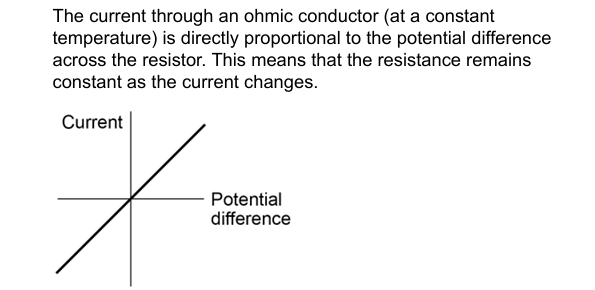
ohms law states that current flowing is directly proportional to voltage as long as the temperature stays the same; meaning that if you increase the voltage, current will also increase and that if you decrease the voltage, current will also decrease.
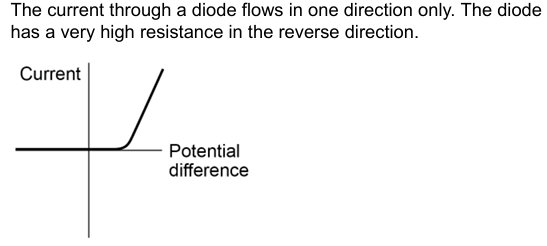
Diodes allow current to only flow through one direction. Meaning that if the current is negative ( its flowing in the opposite direction, there cannot be potential difference.)