Reaction Kinetics I: Basic Principles, Orders, and Measurements
Learning Outcomes
After this lecture, students should be able to define reaction rates in terms of the rate constant, reactant concentration, and reaction order.
Describe the distinct properties of reaction kinetics for zero, first, second, and pseudo-first order reactions.
Understand the experimental methodologies used to measure reaction rates and determine reaction orders.
Utilize appropriate graphical plots to determine reaction rates and orders (specifically zero, first, and second order).
Describe the various factors that affect the rates of chemical reactions.
Thermodynamics vs. Reaction Kinetics
The Gibbs Free Energy Equation: The spontaneity of a reaction is determined by the change in Gibbs free energy (),
: Change in Gibbs free energy.
: Change in enthalpy.
: Temperature.
: Energy required to drive the entropy change.
Spontaneity Condition: For a reaction to be spontaneous, the value must be NEGATIVE ().
Kinetics vs. Thermodynamics: While determines if a reaction can happen (favourability), kinetics determines how fast it happens. A reaction can be thermodynamically favourable (negative ) but kinetically unfavourable (very slow initially).
Case Studies in Reaction Speed
Hydrogen and Oxygen Reaction:
Thermodynamics: .
Kinetics: It is initially very slow but can become extremely fast (explosive) under certain conditions.
Oxidation of Glucose:
Thermodynamics: .
Kinetics: This reaction is thermodynamically favourable but very slow kinetically and typically does not get much faster without biological intervention.
Factors Affecting the Rate of Reaction
The rate of a reaction can be altered by three primary factors:
Change of temperature: Increasing temperature generally increases the rate of reaction.
Reactant concentration / partial pressure: Higher concentrations or pressures of reactants typically lead to higher reaction rates.
Addition of a catalyst: Catalysts provide an alternative pathway with a lower activation energy, increasing the rate without being consumed.
General Definitions in Reaction Kinetics
Concentration Trends Over Time: In a general reaction where :
The concentration of the reactant () decreases () over time.
The concentration of the product () increases () over time.
Rate of Reaction: Defined as the rate of change of the concentration of reactants or products over time.
Initial Rate (): Experimentally, the rate is often measured at the very beginning of the reaction () using varying initial concentrations ().
The Rate Law Equation:
: The rate constant.
: The order of the reaction.

Reaction Orders and Rate Equations
Zero Order Reactions
Rate Equation: .
Characteristics: The rate is independent of the concentration of the reactant ().
Examples: Observed mostly in catalysed reactions.
Case Example: Blood alcohol concentration over time. The rate at which alcohol is metabolized is constant, resulting in a linear decrease in concentration regardless of the starting amount.
rate vs conc → y=c

First Order Reactions
Rate Equation: .
Characteristics: The rate is linearly dependent on the concentration of the reactant ().
Graphical Representation: Plotting Concentration () vs. Time results in an exponential decay curve.
rate vs conc → y=mx

Second Order Reactions
Rate Equation: .
Characteristics: The rate is proportional to the square of the concentration of the reactant.
rate vs conc → y=ax²
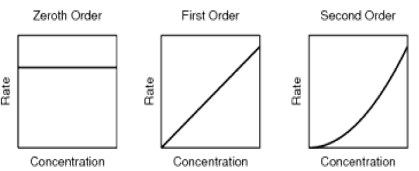
Graphical Analysis of Reaction Orders
Different reaction orders produce distinct shapes when plotting Rate vs. Concentration:
Zero Order: A horizontal line (). The rate stays the same as concentration changes.
First Order: A straight diagonal line through the origin (). The rate increases linearly with concentration.
Second Order: A parabolic curve (). The rate increases exponentially as concentration increases.
Experimental Example: Chloroethane Decomposition
Reaction:
Conditions: Determined at .
Data Table:
Experiment | Initial Rate () | |
|---|---|---|
1 | ||
2 | ||
3 | ||
4 |
Observation: When the concentration is doubled ( to ), the rate also doubles ( to ). This indicates a linear relationship (), confirming it is a First Order reaction.
Half-Life ()
Definition: The time required for the concentration of a reactant to decrease to half of its initial value.
Utility: Measuring initial rates is often difficult. Half-life is often much easier to measure experimentally and can be used to determine reaction order.
Behavior by Order:
Zero Order: The half-life is not constant. It depends on the initial concentration. In zero order, the second half-life is shorter than the first (e.g., if the first half-life is , the second is ).
First Order: The half-life is constant. It is independent of the initial concentration (e.g., if the first half-life is , the second half-life will also be ). This results in a characteristic exponential decay.
Half-Life Experimental Example
Reaction:
Procedure: Keep constant and measure at three different initial concentrations of .
Data:
Experiment | ||
|---|---|---|
1 | ||
2 | ||
3 |
Analysis: The question asks if the reaction is first order.
Finding: Because the half-life () is not a constant value (it decreases as concentration increases), it is not a 1st order reaction. The specific transcript conclusion identifies this as 0th order.
References
Crowe, 2nd Edition, Chapter 14.
Atkins, 2nd Edition, Chapter 6.
Averill & Eldredge, General Chemistry: Principles, Patterns, and Applications, v. 1.0 (available at http://www.flatworldknowledge.com/).