Review Cards 1
Long-term Causes of the Civil War
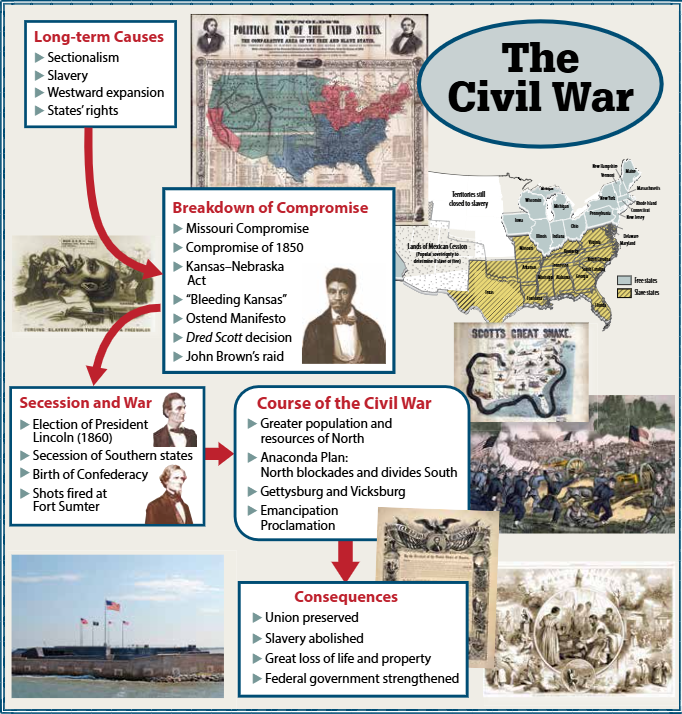
The Civil War was the war between the Northern and Southern states from 1861 to 1865. It had several long-term causes:
Sectionalism: People felt greater loyalty to their section—the North, South, or West—than to the nation as a whole.
Slavery: Abolitionists wanted to end slavery. Escaped slaves like Frederick Douglass spoke out against the horrors of slavery. Pro-slavery apologists in the South argued that slaves were better off than Northern factory workers.
Westward Expansion and the Extension of Slavery: The nation’s westward expansion raised an important question: should slavery be allowed in the new territories being added to the west? Many Northerners did not want to see slavery extended to new territories; Southerners feared being outnumbered by free states if slavery did not spread. The westward expansion of the nation made this an urgent issue.
States’ Rights: Many Southerners believed states had the right to leave the Union if they wished.
Causes of the Civil War
The Breakdown of Compromise
Early Compromises over the Slavery Question
(a) Missouri Compromise (1820): Missouri admitted as a slave state and Maine as a free state; slavery prohibited in the Louisiana Purchase north of 36°30'N.
(b) Compromise of 1850: California admitted as a free state; the sale of slaves banned in Washington, D.C.; tough Fugitive Slave Act of 1850 enacted; popular sovereignty applied to the slavery question in the rest of Mexican Cession.
The Breakdown of Compromise
Kansas-Nebraska Act (1854): This law applied popular sovereignty to determine whether slavery would be allowed in remaining territories of the Louisiana Purchase, reopening the slavery issue there.
Birth of Republican Party (1854): Republicans opposed the extension of slavery. The Ostend Manifesto (1854):
Attempt by U.S. diplomats from the South to purchase Cuba as a new slave state. News of the Manifesto enraged Northerners.
Dred Scott decision (1857): Supreme Court ruled that decision ((t, an African American, was not a citizen and had no right to sue in court; the Court also ruled that Congress had no right to forbid slavery in federal territories.
Freeport Doctrine (1858): View of Stephen Douglas that local communities could still choose to ban slavery despite the Dred Scott decision. This doctrine was unpopular in the South.
The Secession Crisis
Presidential Election of 1860: Democrats were divided, helping Republican candidate Abraham Lincoln to win the election with 39% of the vote.
Secession: South Carolina immediately seceded. Six Southern states followed, forming the Confederacy. Four states of the upper South seceded after war broke out.
Fort Sumter: Lincoln sent supplies to this fort in Charleston Harbor. Confederate forces fired on the fort, starting the Civil War. This was an armed conflict between the North and the South, which lasted from 1861 to 1865. Border states stayed loyal to the Union.
Course of the Civil War
▶ The North had a larger population, more industry and resources, and the navy. Lincoln imposed a naval blockade on the South. The Anaconda Plan was the North’s strategy for winning the war. It used naval power to blockade the South and divide Southern states along the Mississippi River.
▶ Lincoln issued the Emancipation Proclamation in September 1862, freeing all slaves in states still in rebellion on January 1, 1863. He acted on the basis of his emergency wartime powers.
▶ The Battle of Gettysburg (1863) was the turning point of war. Lee suffered heavy casualties in his failed attempt to invade the North and never invaded the North again. Lincoln gave the Gettysburg Address, saying the war was a struggle for democracy; Grant captured Vicksburg, giving the North control of the Mississippi, and became Union commander; Lee surrendered at Appomattox in April 1865, ending the war.
Consequences of the Civil War
▶ Preservation of the Union
▶ Power of the federal government strengthened
▶ Abolition of slavery
▶ Tremendous loss of life and destruction of property