Vocab
facial feedback hypothesis
Unit 1
medial temporal lob damage → difficulty forming new memories and events shortly before the accident that caused the trauma
REM neurologically resembles awakeness b/c of dreaming → think diagram question
EEG measures general brain activity, fMRI is sections
Unit 2
heuristics → potential approaches to solving a problem
primacy: memorizing first items; recency: memorizing recent items → together create serial position effect
elaborative encoding → engaging in deeper processing = better memory
thinking about the meaning > rhyming
reliability, validity, standardization (validity = does the assessment measure what its supposed to measure?)
Models of Memory
multi-store model
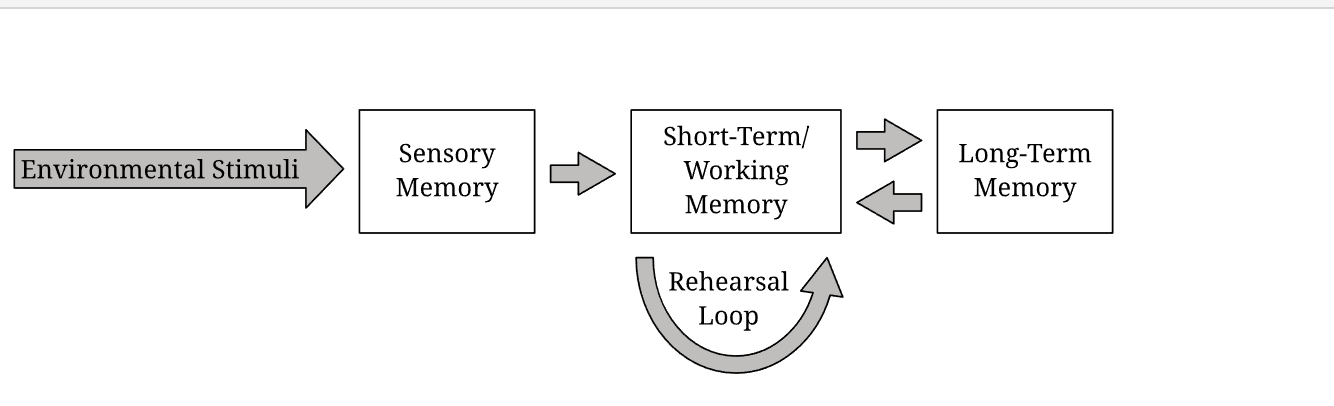
working memory model
working memory would be separated into visual spatial sketchpad, phonological system, executive function section
levels of processing model of memory
shallow, intermediate, and deep of memories
Retroactive vs Proactive interference
Retroactive interference: new blocks old (RNO)
Proactive interference: old blocks new (PON)
Elaborative Rehearsal
information is practiced in ways that promote meaning
Maintenance Rehearsal
items in memory are repeated over and over
Unit 3
Piaget’s stages
sensorimotor
preoperational
concrete
formal
longitudinal study vs cross sectional
Linguistic relativity (how language affects perception)
Linguistic Overgeneralization
think of the “I eated” example
identity foreclosed - individuals prematurely commit to an identity, values, or career path
Unit 4
Fundamental attribution error
overemphasize personality-based explanations and underestimate situational factors
Elaboration Likelihood Model
Central route to persuasion
facts, data, logical arguments
Peripheral route to persuasion
attractiveness, celebrity endorsements, or emotions
superficial cues
Psychodynamic
uncovering unconscious, childhood-rooted patterns
Behavioral
Social-cognitive explanation for depression
cycle of negative life experiences are interpreted through faulty beliefs, pessimistic attributions, and rumination
Unit 5
prenatal flu → higher risk of schizophrenia for the child
agoraphobia
fear of situations where escape might be difficult or help unavailable if a panic attack occurs
general adaptation syndrome model
alarm
resistance
exhaustion
broaden and build
accumulate positive emotions → increased personal resources → greater resiliency
diathesis-stress
individual’s susceptibility to mental/physical illness is due to predisposition and exposure to stressful life events
Practice Exam 1
types of disorders (anxiety, etc.)
anxiety disorders
somatoform disorders
dissociative
opponent-process vs trichromatic theory
opponent process → color pairs, afterimages
Erikson’s psychosocial stages
Trust vs Mistrust
Autonomy vs Shame and Doubt
Initiative vs Guilt
Industry vs Inferiority
Identity vs Confusion
Intimacy vs Isolation
Generativity vs Stagnation
Integrity vs Despair
Relative size + monocular cues
distance is judged on how large image is on retina
iconic memory → visual
phonological loop → memorizing verbal info by repeating
Big Five Traits (OCEAN)
Openness (willingness to experience)
Conscientiousness (Thoughtfulness)
Extraversion
Agreeableness
Neuroticism (Emotional Stability/Reactivity)
DSM can create stigma
Reciprocal determinism
(personal factors, environmental influences, and behavior continuously interact and influence one another)
think a triangle that shows they are all interconnected and impact each other
prospective memory → allows someone to carry out future action
Individuals with an internal locus of control tend to be less depressed than individuals who have an external locus of control.
Law of Effect
A person is more likely to engage in a behavior more frequently when the behavior is followed by a positive result.
according to psychodynamic perspective → defense mechanisms help ot protect the ego
eustress → stress that motivates and helps people reach personal goals
GABA calms
latent learning → no reinforcement, and not immediately demonstrated
replication of a study is due to use of operational definitions
random selection → generalizability
hearing stereotypes can lead to internalization of beliefs associated with it
just-world phenomenon → people get what they deserve
behavioral perspective → think conditioning
perceptual set → prior experience and preconceived notions influence expectations and behaviors
Practice Exam 2
Superordinate goals
glial cells
nourishment and protection for neurons
ganglion cells
visual output to brain
activation synthesis
drive reduction
agonist vs antagonist
convergent vs divergent thinking
convergent → narrowing down
divergent → creativity
accommodation vs assimilation
coping types
problem focused coping
directly attacking stress
approach approach conflict
two different options
emotion focused coping
mitigating emotions
humanistic psych
animism
types of conflict (i.e. approach-avoidance conflict)
display rules, cognitive appraisal
prosopagnosia
top-down vs bottom-up processing
reflex arc (what’s involved)
both central nervous system and peripheral nervous system are involved
forgetting curve
displacement, sublimation, rationalization (defense mechanisms?)
behavioral vs cognitive psychology
instinctive drift
display rules
activation synthesis
drive-reduction theory
Practice Exam 3
achievement vs aptitude
eclectic treatment
top-down vs bottom-up processing
closure visual processing
what is included in gestalt?
relative deprivation
microsystem vs macrosystem
social desirability bias
false consensus
individualistic thinking
fidelity (Ethical guideline)
anterograde vs retrograde amnesia
anterograde: preventing formation of new memories
retrograde: loss of memories before incident
flashing → illusion of motion → phi effect
lesioning
threshold
reuptake
refractory period