Lecture 16: Aquatic Biomes and Zonation
Key Concepts
Concept 52.3: Aquatic biomes are diverse and dynamic systems that cover most of Earth
Learning Outcomes
1. Give the names of the main aquatic biomes of the world and their key characteristics
2. Recall the physical extent of aquatic biomes on planet Earth
3. Describe the characteristic of different depth zones in aquatic systems
Characteristics of Aquatic Biomes
Cover most of earths surface
Characterized by their physical and chemical (fresh vs. salt water ect.) environment
These characteristics are influenced by the surrounding terrestrial biome, patterns and speed of water flow, and climate.
They show less latitudinal variation (due to sun exsposure) than terrestrial biomes
Marine vs Freshwater Biomes
Marine: saltwater ( average salt concentration of 3%); dominant systems are oceans (70-75% of earths surface).
Freshwater (salt concentrations of less than 0.1%) : lakes, rivers, wetlands; crucial for biodiversity. Have a greater interaction with and thus are influenced more by surrounding terrestrial biomes).
Zonation in Aquatic Biomes
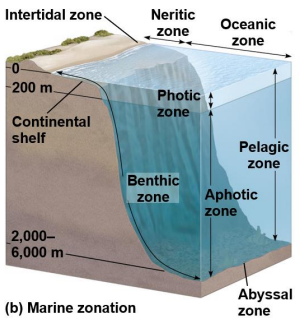
Many aquatic biomes are stratified into zones defined by light penetration, temperature, and depth.
Communities in aquatic biomes vary with depth, light penetration, distance from shore, and position in the pelagic or benthic zone
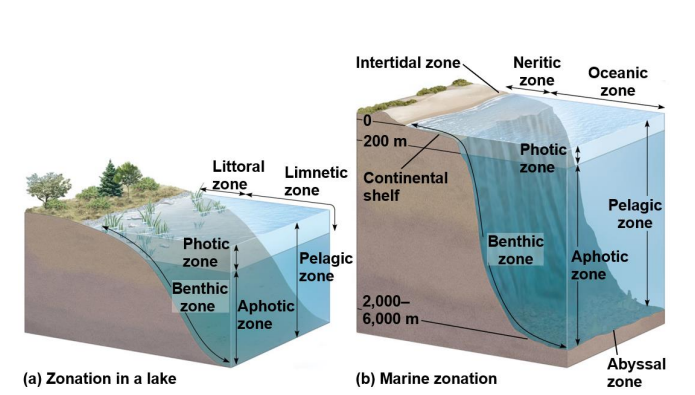
Pelagic Zone:
Made up by the photic and aphotic zones;
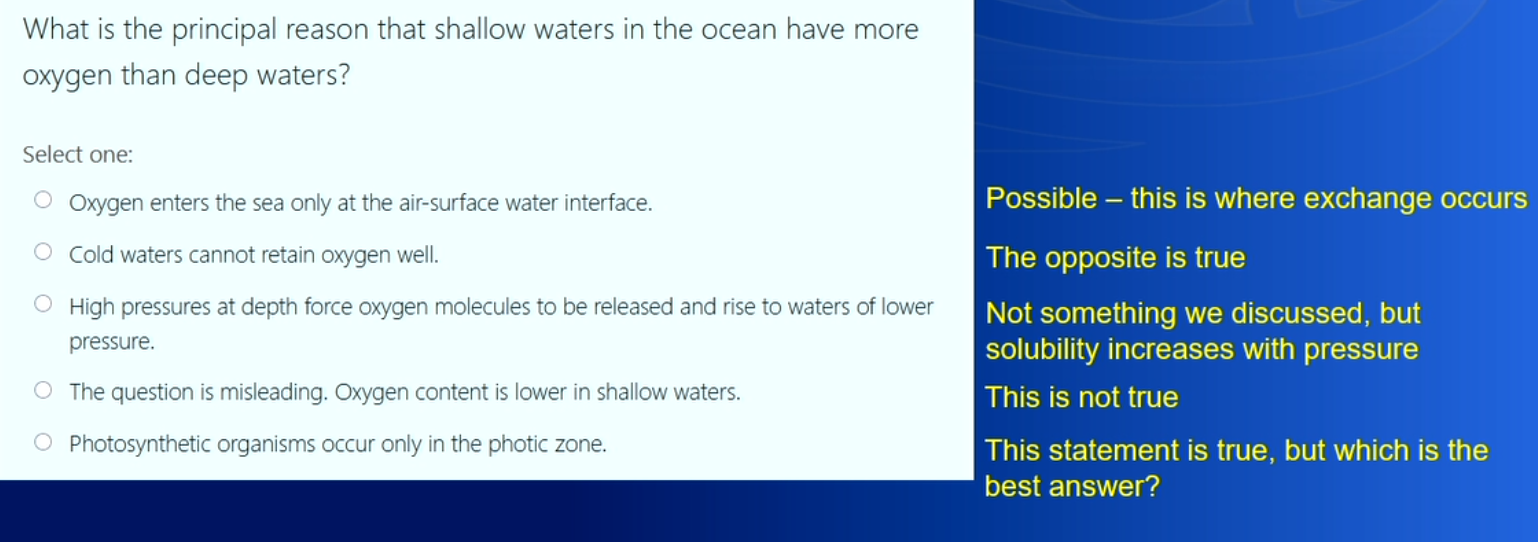
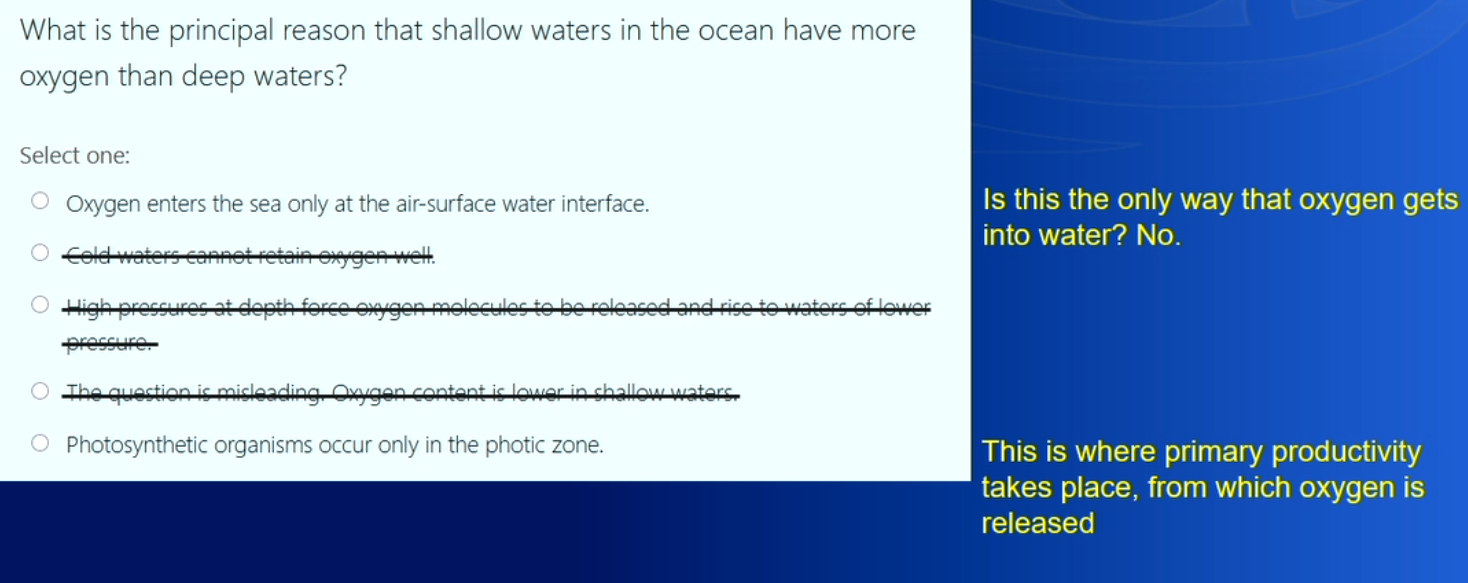
Upper: photic zone(zone light can penetrate) has sufficient light for photosynthesis.
Thus most organisms occur in the relatively shallow photic zone.
Lower: aphotic zone(light decreases in penertration) receives little light.
The aphotic zone in oceans is extensive but harbors little life
Located in the depths of the aphotic zone: The abyssal zone ( 2,000 to 6,000 m )organisms living here have to be able to survive extremely high pressures.
Benthic Zone:
The Benthic Zone: the organic and inorganic sediment at the bottom of all aquatic zones.
The communities of organisms in the benthic zone are collectively called the benthos.
How does this system get energy? as there is little growing here due to little light and thus photosynthesis.
Food source: Detritus, dead organic matter, falls from the productive surface water.
Thermoclines:
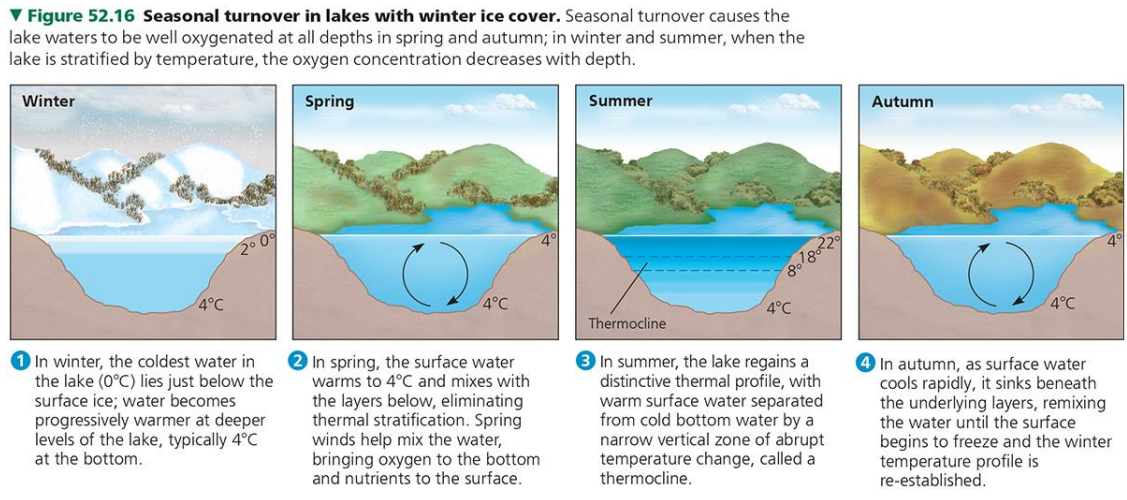
In oceans and most lakes, a temperature boundary called the thermocline separates the warm upper layer from the cold deeper water (In summer as the top layer can be greatly warmed) limits nutrient/oxygen cycling.
Many lakes undergo a semiannual mixing of their waters called turnover.
Turnover mixes oxygenated water from the surface with nutrient-rich water from the bottom.
Aquatic Biomes:
Lakes
Size ranges from small ponds to very large lakes.
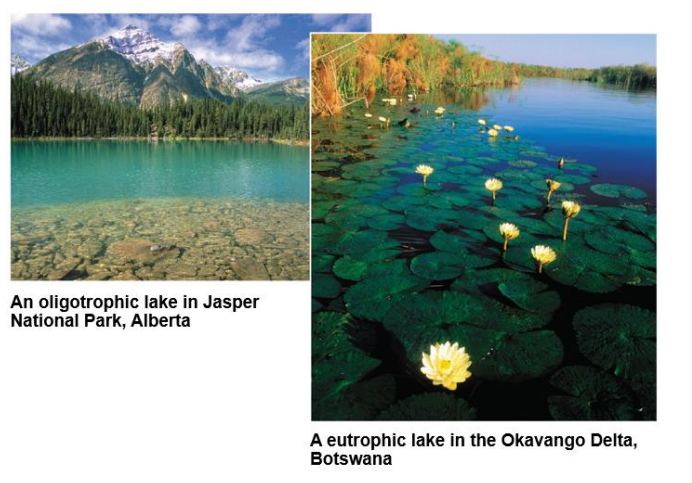
Categorized into oligotrophic (nutrient-poor, oxygen-rich) and eutrophic (nutrient-rich).
Wetlands
Develop in shallow basins, along riverbanks, or coastal areas.
Support specific plant and animal life; vital for water purification.
Streams and Rivers
Streams combine into larger streams and eventually rivers, characterized by varying velocities and temperatures.
Estuaries
Transition regions between rivers and oceans, nutrient-rich and highly productive.
Intertidal Zones
Areas exposed to seawater at high tide and dry at low tide, facing unique environmental challenges.
Ocean Pelagic Zone
Covers about 70% of Earth's surface, dominated by phytoplankton.
Coral Reefs
Formed from coral skeletons, thrive in warm, shallow waters with high biodiversity.
Marine Benthic Zone
Seafloor habitat with organisms adapted to high pressure and cold temperatures.
Lakes
Enclosed body of fresh water.
Size ranges from small ponds to very large lakes.
Littoral zone (water by the shore) and limnetic zone (open water area).
Temperate lakes may have a seasonal thermocline.
Tropical lowland lakes have a year round thermocline, constant separation in temperature.
Oligotrophic lakes: Nutrient-poor, oxygen-rich.
Eutrophic lakes: Nutrient-rich, often have low oxygen levels in deep zones, or throughout zones if ice covered in winter.
Wetlands
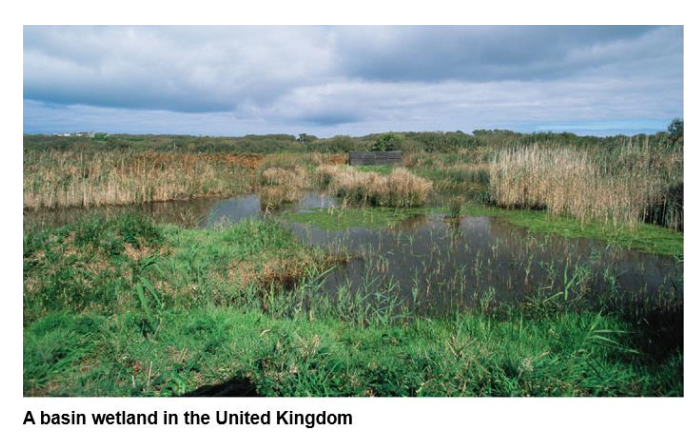
Wetlands develop in shallow basins, along flooded riverbanks, or on the coasts of large lakes and seas.
They are submerged by water at least some of the time.
They thus support plants adapted to water-saturated soil (e.g. lilies, cattails, sedges, and flaxes) .
Home to diverse invertebrates, amphibians and birds, as well as mammals such as otters and reptiles such as alligators
Rapid organic production and decomposition periodically deplete dissolved oxygen.
Wetlands purify water and reduce flooding (can be used for environmental management)
Threatened by human developments, leading to significant loss of wetlands.
Streams and Rivers
Streams combine into larger streams and eventually into rivers.
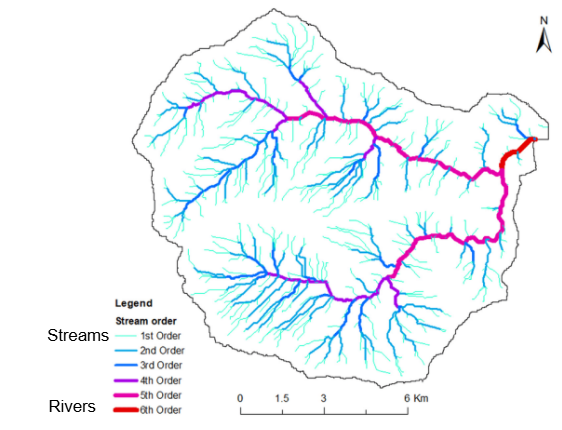
They increase in size (volume of water, flow) while they usually decrease in velocity.
The most prominent physical characteristic of streams and rivers is current.
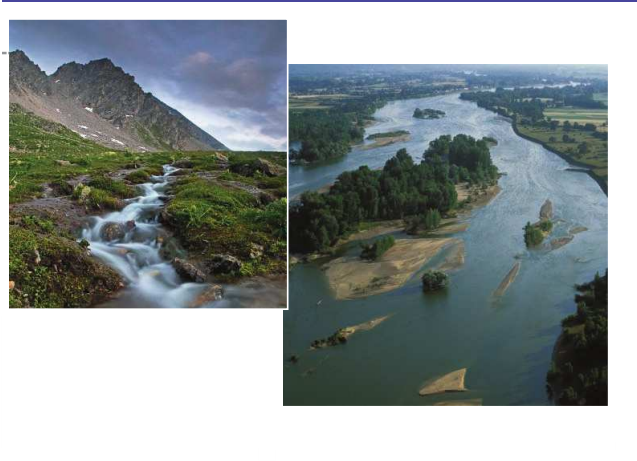
Physical Characteristics
Headwaters: cold, clear, turbulent, swift, and oxygen-rich; they are often narrow and rocky.
Downstream waters ( form rivers ): warmer, more turbid, and well oxygenated; they are often wide and meandering and have silty bottoms
Ecosystem Health
Energy sources: Headwater streams in grasslands or deserts may be rich in phytoplankton or rooted aquatic plants; in NZ forest leaf fall may be a major input
A diversity of fishes and invertebrates inhabit unpolluted rivers and streams.
Pollution impacts water quality and aquatic life; and ecosystems can be impaired by human activity such as damming (restricts fish movement and ability too hold water).
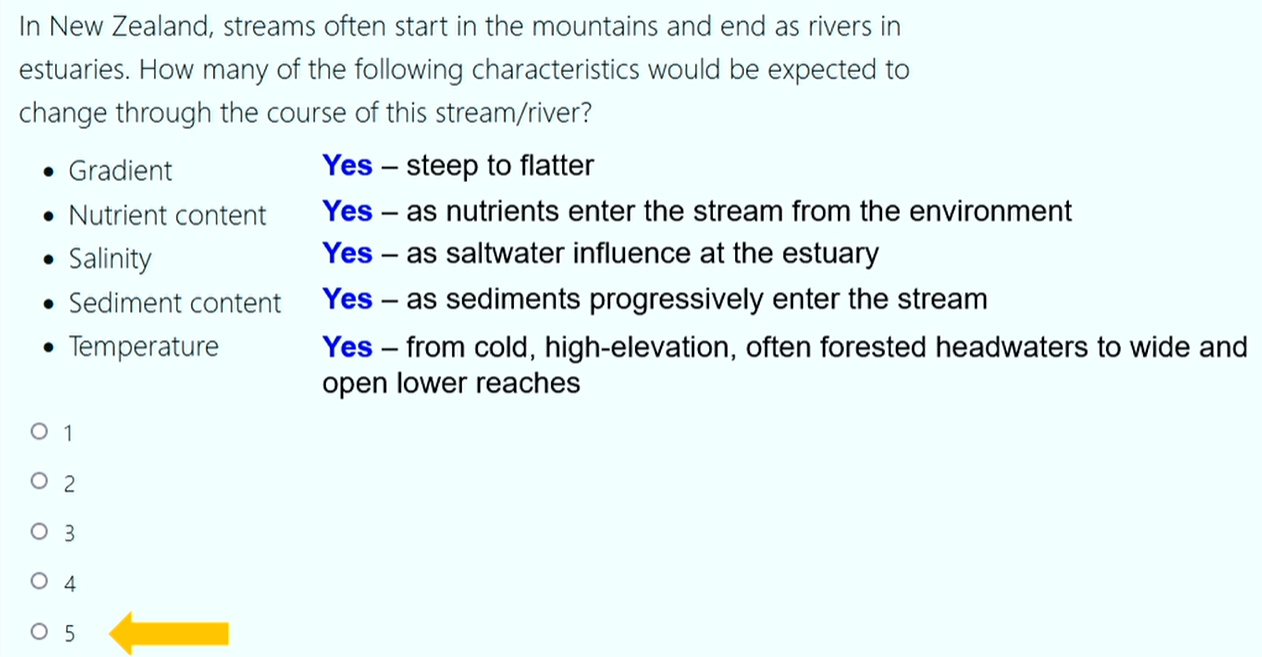
Estuaries
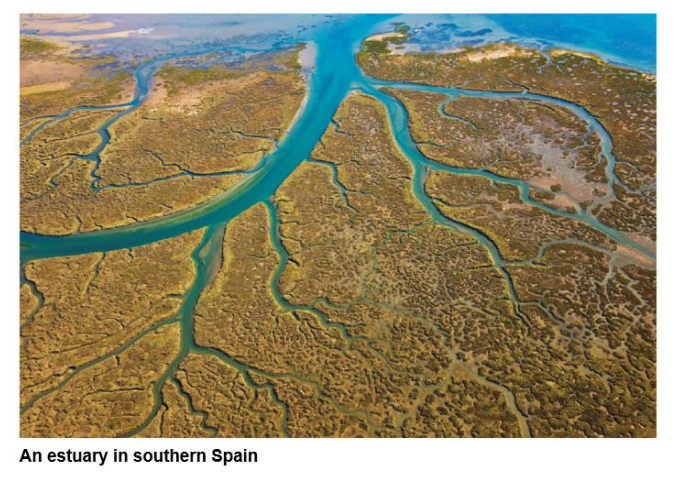
Transition regions between rivers and oceans (have a marine and tidal influence on them).
Salinity varies spatially and with the rise and fall of the tides (organisms living there have to be able to adapt to these variations.)
Include a complex network of tidal channels, islands, natural levees, and mudflats.
Estuaries are nutrient-rich and highly productive; vital habitat for diverse marine life.
Saltmarsh grasses and algae are the major producers
An abundant supply of food attracts marine invertebrates, fish, birds, and marine mammals.
Human activities (Filling, dredging, and pollution) upstream disrupt estuaries.
Intertidal Zones
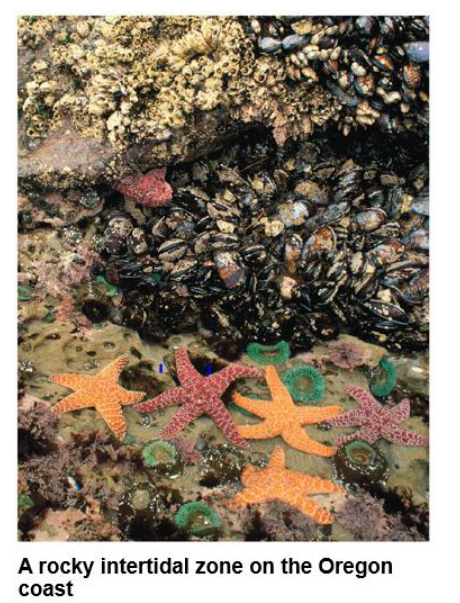
Areas exposed to seawater at high tide and dry at low tide.
Thus estuaries fall under this biome as well as costal beaches and rock pools.
This presents unique challenges to organisms. (by variations in temperature and salinity and by the mechanical forces of wave action).
High oxygen and nutrient levels.
Substrates are generally either rocky or sandy.
Ocean Pelagic Zone
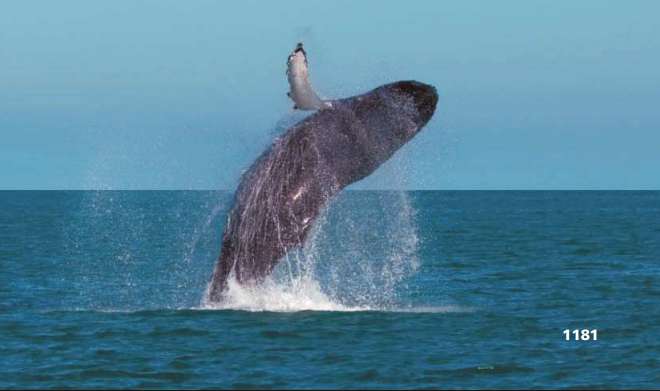
Covers ~approximately 70% to 75% of Earth's surface
Constantly mixed by wind-driven oceanic currents.
Seasonal turnover in temperate oceans renews nutrients in the photic zones
Nutrient concentrations are lower in tropical oceans (latitudinal variation) due to year-round thermal stratification.
High oxygen levels.
Dominated by phytoplankton (essential for global photosynthesis aproximatly account for 50-85%) and zooplankton(which eat phytoplankton).
Fish, squid, turtles, and marine mammals also occupy the pelagic zone
Human Actions have harmed the biome: Overfishing, pollution, ocean acidification, and global warming.
Coral Reefs
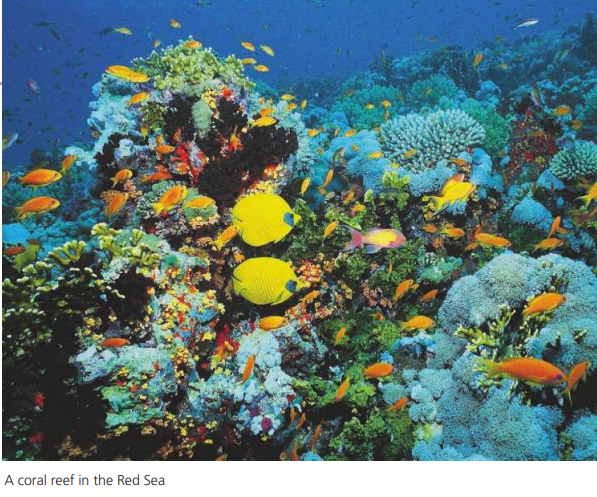
Formed from calcium carbonate coral (cnidarias) skeletons.
Shallow reef-building corals live in the photic zone in warm, clear water.
Deep-sea corals live at depths of 200–1,500 m.
Corals require high oxygen concentrations and a solid substrate for attachment.
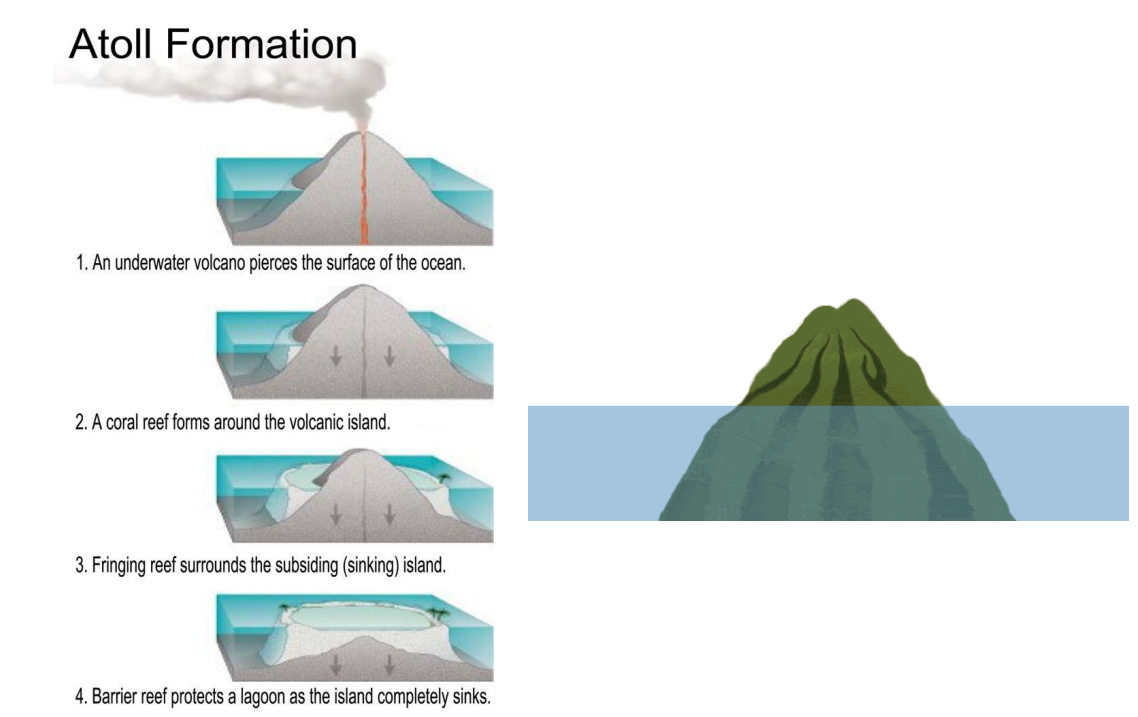
A coral reef progresses from a fringing reef to a barrier reef to a coral atoll.
Corals form a mutualistic relationship with unicellular algae, which provide them with organic molecules
Other invertebrates and fish are also exceptionally diverse
Human actions threaten the biome; impacted by overfishing, global warming (coral bleaching), pollution, and aquaculture.
Marine Benthic Zone
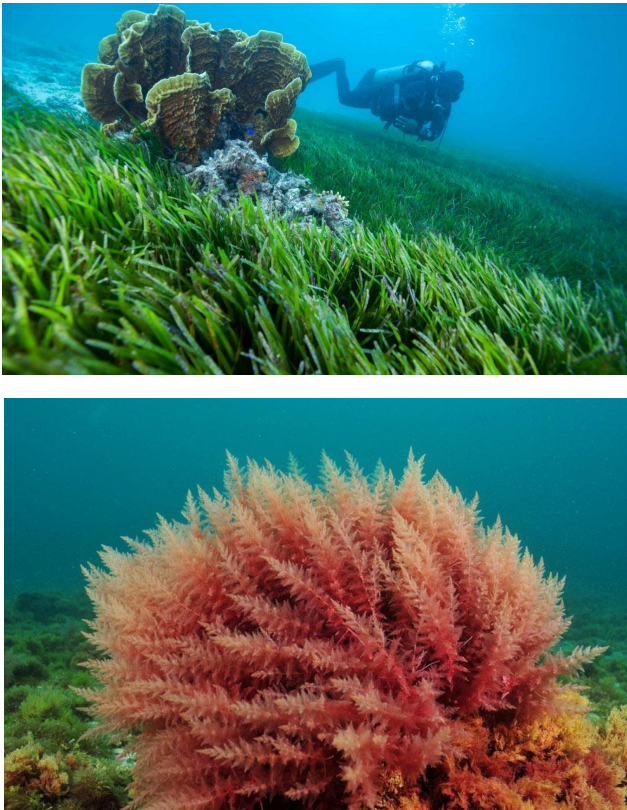
Consists of the seafloor below the surface waters of the neritic zone (coastal zone) and the offshore pelagic zone.
Organisms in the very deep benthic (abyssal) zone are adapted to continuous cold and extremely high water pressure.
Shallow areas(where there is light for photosynthesis) contain seaweeds and filamentous algae
Neritic benthic communities include invertebrates and fishes.
High pressure and Low light for photosynthesis= little number of organisms that live or grow there. So how does the system get its energy?: Methods such as Hydrothermal Vents.
Substrate is mainly soft sediments; some areas are rocky.
Risks and Threats: Overfishing and fishing methods like bottom trawling, and dumping of waste accumulated from dredging, are incredibly destructive and have depleted fish populations
Alternative Energy source: Hydrothermal vents
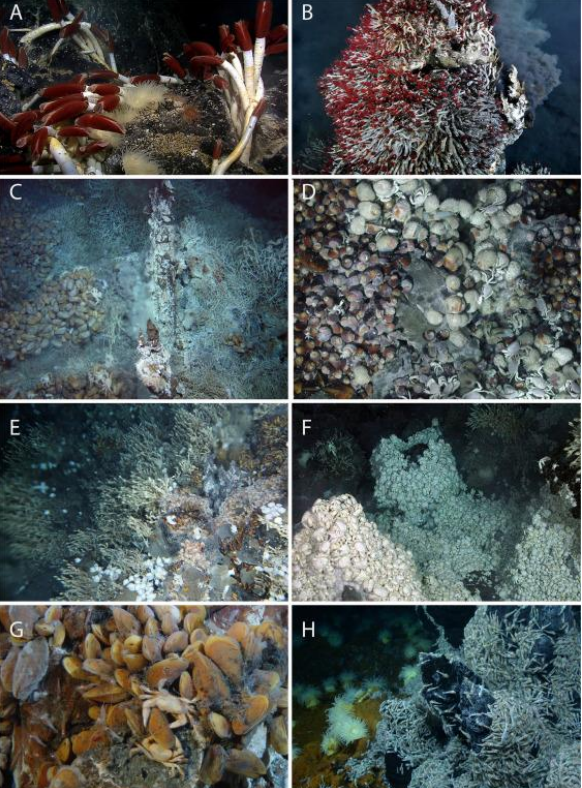
Not all energy comes from the sun
Deep-sea hydrothermal vents of volcanic origin on mid-oceanic ridges are surrounded by unique chemoautotrophic prokaryotes, as well as echinoderms and arthropods
Self Test Questions (lectures 15 and 16)
Why does the Earth vary in solar radiation across latitudes?
Why does the Earth have seasons?
How do oceans affect climates over land?
What terrestrial biomes are characterized by
(a) high temperature and high rainfall,
(b) high temperature and low rainfall,
(c) low temperatures and low to medium precipitation?
Which biomes have the greatest seasonal variation in environmental conditions, and which have the least?
What terrestrial biome has the greatest biodiversity?
What is the most extensive aquatic biome?
Why are phytoplankton, and not benthic algae or rooted aquatic plants, the dominant photosynthetic organisms of the oceanic pelagic zone?
What characterizes estuaries as opposed to intertidal zones generally?
What environmental parameters change with depth?
How important are aquatic biomes for oxygen production?