3.1 Cellular Energetics + Photosynthesis & Cellular Respiration
Enzymes: Structure and Function
Activation Energy
Chemical reactions require an initial energy input called activation energy.
This energy barrier prevents cells from releasing energy uncontrollably.
Activation energy can be overcome by:
-Adding energy (e.g., heat)
-Using a catalyst
Catalysts
Catalysts:
-Lower activation energy
-Increase the rate of a reaction
-Are not changed or consumed in the reaction
Enzymes as Biological Catalysts
Enzymes are biological catalysts.
They work by:
-Changing the shape (conformation) of molecules
-Making molecules more favorable for reactions
Key Enzyme Terms
Active Site:
-The specific region of the enzyme where the reaction occurs
Substrate:
-The molecule that binds to the enzyme
Environmental Effects on Enzyme Activity
Temperature:
Increased temperature:
-Speeds up reactions
-Increases molecular movement and collisions
Excessive heat:
-Causes denaturation (loss of structure)
-Prevents enzyme function
pH:
Changes in pH:
-Affect hydrogen bonding
-Alter enzyme shape and efficiency
Effects may be reversible if conditions return to normal
Concentration Effects
Higher substrate concentration:
-Increases reaction rate (more collisions)
Higher enzyme concentration:
-Also increases reaction rate
Enzyme Inhibitors
Competitive Inhibitors:
Compete with substrate for the active site
Block substrate binding
Slow or stop the reaction
Noncompetitive Inhibitors:
Bind to a different site (not the active site)
Change enzyme shape (conformation)
Reduce enzyme efficiency
The Role of Energy in Living Systems
Importance of Energy
All living organisms require energy to survive.
Energy is needed to:
-Maintain organization
-Carry out cellular processes
-Support growth and movement
Bioenergetics and Metabolism
Bioenergetics:
-Study of energy transformations in living organisms
Metabolism:
All chemical reactions involving energy in organisms
Includes processes such as:
-Photosynthesis
-Cellular respiration
-Movement
Energy in Living Systems
Energy input must exceed energy loss to sustain life.
Energy is stored in molecules with chemical bonds, such as:
-Sugars
-Fats
Anabolism vs. Catabolism
Anabolism:
Builds molecules
Stores energy in chemical bonds
Catabolism:
Breaks down molecules
Releases energy from chemical bonds
These processes are often linked, so released energy is immediately used by cells.
Energy Storage and Efficiency
Large molecules (fats and sugars) store large amounts of energy.
Breaking them down directly can release more energy than needed.
To prevent energy waste:
-Cells convert large energy molecules into smaller, usable forms.
ATP
Adenosine triphosphate (ATP) is the main energy molecule used by cells.
ATP provides a controlled and efficient way to supply energy.
ATP Breakdown
ATP can be broken down into:
-ADP (adenosine diphosphate)
-AMP (adenosine monophosphate)
These breakdown processes occur during:
-Respiration
-Fermentation
Each step releases usable energy.
ATP and Cellular Processes
ATP breakdown is linked to most cellular activities.
This allows cells to:
-Efficiently capture and use energy
-Directly power biological processes
The Processes of Photosynthesis
Overview of Photosynthesis
Photosynthesis converts light energy into chemical energy (glucose).
Overall equation:
6CO₂ + 6H₂O + Light → C₆H₁₂O₆ + 6O₂
Inputs:
-Carbon dioxide (CO₂)
-Water (H₂O)
-Light energy
Outputs:
-Glucose (C₆H₁₂O₆)
-Oxygen (O₂)
Evolution of Photosynthesis
First evolved in cyanobacteria.
Led to the oxygenation of Earth’s atmosphere.
Forms the basis for photosynthesis in modern plants.
Two Main Phases of Photosynthesis
A. Light-Dependent Reactions (Photolysis)
Location: Thylakoid membranes of chloroplasts
Key processes:
-Light absorbed by chlorophyll
-Production of:
ATP
NADPH (electron carrier)
Water is split → releases oxygen
B. Light-Independent Reactions (Calvin Cycle)
Location: Stroma of chloroplasts
Key processes:
Uses:
CO₂
ATP
NADPH
Produces:
3-carbon sugars → combine to form glucose
Importance of Glucose and Carbon Fixation
Glucose:
-Used to produce ATP (energy)
-Stores energy for later use
Fixed carbon:
-Organic carbon molecules (like sugars)
-Used to build cellular components
Calvin cycle:
-Removes CO₂ from atmosphere
-Stores energy in chemical form
Photosystems and Light Harvesting
Light-dependent reactions rely on photosystems:
-Photosystem II (PSII)
-Photosystem I (PSI)
Located in thylakoid membranes
Structure:
-Light-harvesting complex (pigments + proteins)
Non-Cyclic Photophosphorylation
Main process of light reactions
Produces:
-ATP
-NADPH
Involves electron movement from water → NADP⁺
Step-by-Step: Electron Flow
Step 1: Photosystem II (PSII)
Light excites electrons
Electrons passed to an acceptor
Water split to replace electrons:
-Releases O₂
Electrons enter electron transport chain (ETC)
Step 2: Electron Transport Chain (ETC)
Electrons lose energy as they move
Energy used to pump H⁺ ions into thylakoid space
Creates a proton gradient
Step 3: ATP Formation (Chemiosmosis)
H⁺ ions flow through ATP synthase
Drives conversion of ADP → ATP
This process is called photophosphorylation
Step 4: Photosystem I (PSI)
Electrons arrive at PSI
Light re-excites electrons
Electrons passed to another ETC
Step 5: NADPH Formation
High-energy electrons used to convert:
NADP⁺ → NADPH
Connection to Calvin Cycle
ATP and NADPH from light reactions:
-Used in the Calvin cycle
-Help convert CO₂ into glucose

Cellular Respiration & Fermentation
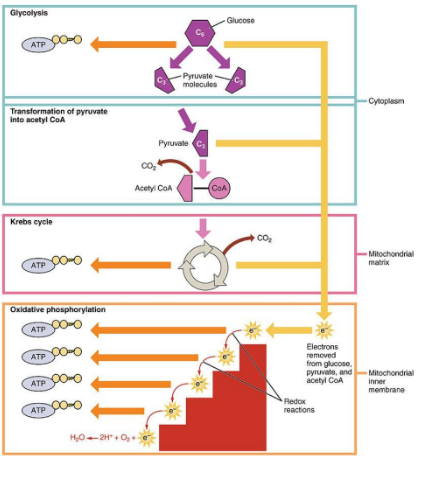
All forms of life break down biological macromolecules (like sugars and fats) to produce ATP.
Two main processes:
-Cellular respiration (uses oxygen)
-Fermentation (does not require oxygen)
Both involve transferring energy through electron carriers and metabolic pathways.
Cellular Respiration in Eukaryotes
Breaks down glucose into carbon dioxide (CO₂) and water (H₂O).
Occurs in multiple stages with energy passed along an electron transport chain (ETC).
Step 1: Glycolysis
Location:
Cytosol
Process:
1 glucose (6-carbon) → 2 pyruvate (3-carbon each)
Products:
2 ATP
2 NADH
Key events:
ADP → ATP
NAD⁺ → NADH
Step 2: Pyruvate Oxidation
Location:
Mitochondria
Process:
Pyruvate → acetyl group → binds to coenzyme A → acetyl CoA
Products:
NADH
Notes:
No ATP produced
Step 3: Krebs Cycle (Citric Acid Cycle)
Location:
Mitochondrial matrix
Type:
Aerobic respiration
Process:
Acetyl CoA is broken down
Products (per cycle):
1 NADH
1 FADH₂
2 CO₂
1 ATP (or GTP)
Step 4: Oxidative Phosphorylation
Location:
Inner mitochondrial membrane
Includes:
Electron transport chain (ETC)
Chemiosmosis
Process:
NADH and FADH₂ donate electrons to the ETC
Energy released pumps H⁺ ions into intermembrane space
Creates a proton gradient
H⁺ flows back through ATP synthase, producing ATP
Final electron acceptor:
Oxygen (O₂) → forms water (H₂O)
Cellular Respiration in Prokaryotes
Glycolysis, pyruvate oxidation, and citric acid cycle:
Occur in the cytosol
Oxidative phosphorylation:
Occurs in the cell membrane
Some anaerobic prokaryotes:
Use alternative final electron acceptors (not oxygen)
Special Case: Heat Production
In some cells:
Electron transport chain is decoupled from ATP production
Energy is released as heat instead of ATP
Fermentation (Anaerobic Conditions)
Occurs when oxygen is not available
Only glycolysis continues
Pyruvate is converted into:
Lactic acid OR Alcohol (ethanol)
Purpose:
Regenerates NAD⁺ from NADH
Allows glycolysis to keep producing ATP
Molecular Diversity & Cellular Response to Environmental Changes
Living organisms have multiple, overlapping mechanisms to produce ATP for immediate energy needs.
Adaptations in Energy Production
Cells can adjust how they produce ATP based on environmental conditions:
With oxygen → use cellular respiration
Without oxygen → switch to fermentation
Molecular Diversity in Photosynthesis (Plants)
Plants contain different types of chlorophyll molecules.
These variations allow plants to:
Absorb different wavelengths of light
Maximize energy capture under varying light conditions
Importance of Molecular Diversity
The presence of diverse molecules allows organisms to:
-Adapt to changing environments
-Maintain efficient energy production
-Increase chances of survival and reproduction
Connection to Evolution
These adaptive mechanisms contribute to:
Natural selection
Long-term evolutionary success of species