Unit 6 - Market Failure and the Role of Government Guide (copy)
[[6.1 Socially Efficient and Inefficient Market Outcomes[[
- Socially efficiency is when resources are allocated effectively
- MSB=MSC !!
- Allocatively Efficient Points
- Perfectly competitive market : S=D, MB=MC
- Perfectly competitive firm : P=MC
- Perfectly competitive labor market : W=MRP (total economic surplus : MSC=MSB)
- Causes of Market Failure
- Market power (imperfectly competitive markets)
- Asymmetric information (lack of info provided by buyers and sellers)
- Positive and negative externalities
- Insufficient production of public goods
- Government policies used to get rid of DWL
- Taxes
- Subsidies
- Reguations
- Public prodivions
- Market failure : exists when firms produce @ MPC=MPC, S=D
- The government tries to get them to produce @ MSC =MSB
[[6.2: Externalities[[
- Externality : when external cost/benefit is placed on members of society who did not pay for them
- MSB does not equal MSC
- Negative externality : when someone uses a product, it decreases the benefit of others (ex. smoking), MSC > MPC (correct with per unit tax)
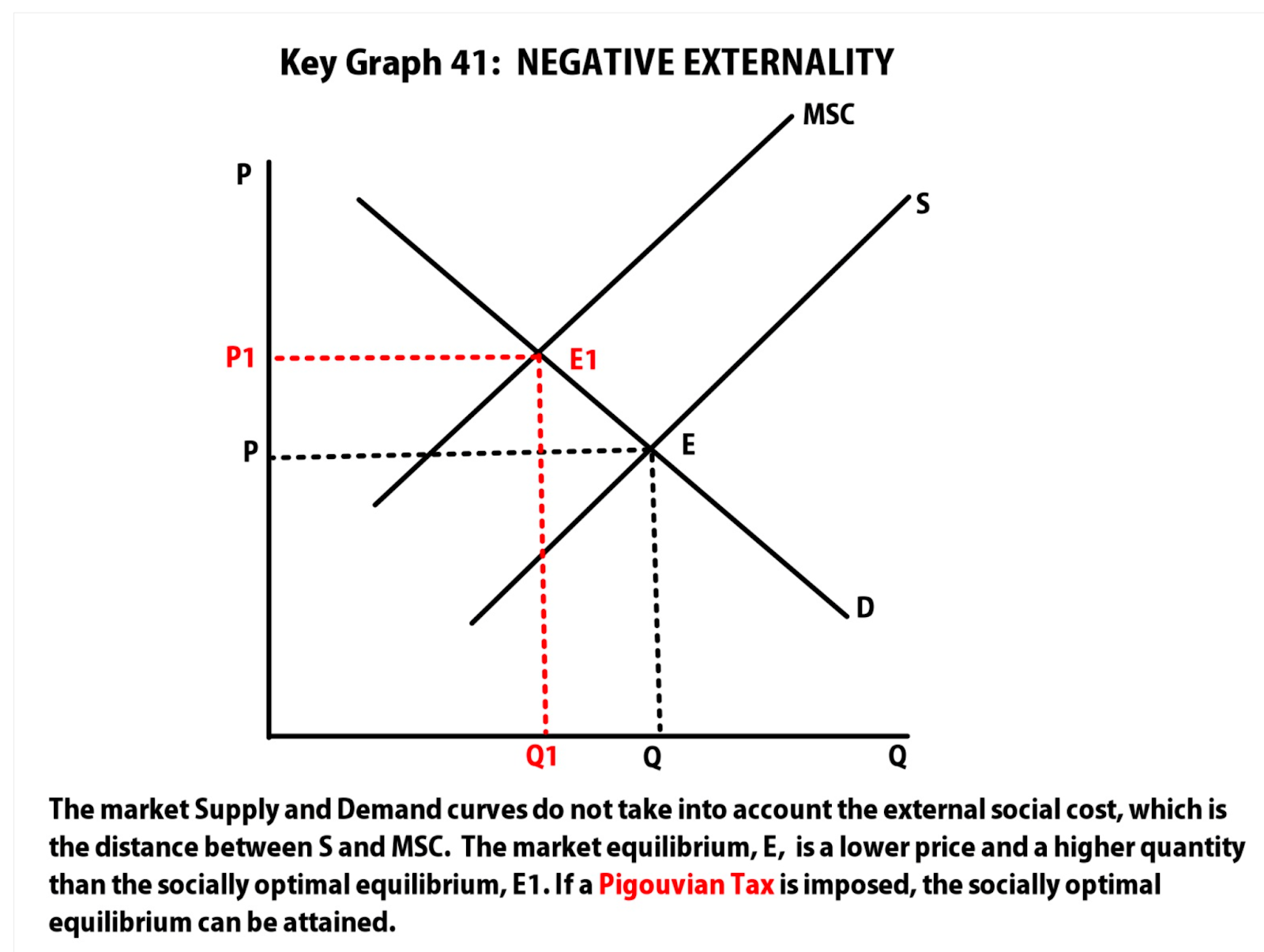
- Positive externality : when one uses a product, others benefit (ex. education) MSC < MPC (correct with subsidy)

[[6.3: Public and Private Goods[[
- Rivalrous good : if someone consumers a product, others cannot
- Rivalrous : food, shoes, etc
- Nonrivalrous : national defense, fireworks, etc
- Somewhere in middle : schools, roads, etc
- Excludable good : non payers can be prevented from enjoying the benefits
- Excludable : food, school, etc
- Nonexcludable : national defense, air, etc
- Public goods : underproduced due to freeloader problem
- Examples : national defense, law enforcement, etc
- Freeloader problem : people can enjoy the benefit of a good/service without paying
- Government will provide subsidies to producers
- Private goods : goods produced by private markets, can be excludable
[[6.4: The Effects of Government Intervention in Different Market Structures[[
- Causes of inefficient markets
- Market power
- Externalities
- Nonrival and nonexcludable goods (public goods)
- Forms of government intervention
- Taxes
- Subsidies
- Price floors/ceilings
- Regulation
- Per unit subsidy : gives benefits per unit
- Perfect competition : MC, ATC, AVC decreases, price doesn’t change (price taker)
- Monopolistic competition : MC, ATC, price decreases (price maker @ MR=MC)
- Lump sum subsidy : gives benefit no matter how many units
- Taxes will always shift supply curve to the left in long run, profits decrease
- Per unit tax : increase MC, ATC, and AVC
- Perfect competition : MC, ATC, AVC increases, price doesn’t change (price taker)
- Monopolistic competition : MC, ATC, price increases (price maker @ MR=MC)
- Lump sum tax : only increase ATC
- won’t change output level

- Non price regulation : works like taxes, they ensure competition/environmental protection/health and safety
- Antitrust policy : promote competition and prevents monopolies
- Antitrust laws
- Lawsuits
- Price controls
- Subsidies
- Price ceiling : sets minimum price
- Perfect competition : causes shortage
- Monopolistic competition : becomes MR curve, price and output decreases
- Price floor : sets maximum price
- Perfect competition : leads to surplus
- Monopsony : wages go up and workers go up
[[6.5: Inequality[[
- Income distribution : measures % of income that goes to individuals in different percentiles/brackets
- In a system with perfectly equality : everyone would receive equal shares of income
- Income : wages, rent, interest, profit
- Lorenz curve : measures the distribution of income equality (you want to be as close of possible to the perfect equality line as possible)

- @@Gini coefficient@@ : A/(A+B)
- Closer to 0, more equality
- Closer to 1, the more inequality
- @@Causes of income inequality@@
- Supply + demand in labor market
- Human capital
- Discrimination
- Inheritance
- Bargaining power
- Etc
- @@Policies to address inequality@@
- Taxes + transfers
- Minimum wage laws
- Anti-poverty program
- Income protection program
- Scholarships
- @@Taxes :@@
- Proportional : everyone pays the same percentage of their income (no impact on income distribution)
- Progressive : taxes are higher % on people earning a higher income (reduces income inequality)
- Regressive : taxes are lower % on people earning a higher income (increases income inequality)