Gases
Properties
Gases have very low density, assume the shape and volume of their container, are highly compressible, and mix evenly and fully when combined.
Pressure
The pressure of a gas is measured by the force exerted on a given area. P = F/A where F represents a force in Newtons and A represents area in m^2.
The pressure of the liquid is measured in height (h) and density (d) with the equation P = ghd where g represents gravity.
Atmospheric pressure (atm) is calculated using a barometer. A glass tube is placed vertically in mercury and the height mercury reaches represents atmospheric pressure. atm = 760mm of mercury (Hg) at sea level. Millimeters of mercury are referred to as torr because Evangelista Torricelli was the inventor of the barometer. 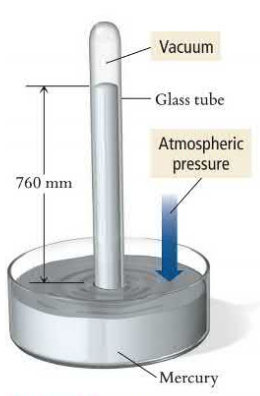
The International Unit of Pure and Applied Chemistry defines standard pressure at sea level as 100 000 pascals where pascals is the standard unit of pressure. A bar is 100 000 pascals meaning 1 bar is one unit of standard pressure.
| Measurement | Unit | Standard Pressure |
|---|---|---|
| bar | bar | 1 bar |
| pascal | Pa | 100 000 Pa |
| torr / mmHg | torr / mmHg | 750.06 Torr / mmHg |
| atmosphere | atm | 0.98692 atm |
| pound per square inch | psi | 14.504 psi |
A manometer measures the pressure of a gas, usually using mercury in a U-shaped tube. One end of the tube is open, representing standard pressure, and the other is connected to a sealed container of gas whose pressure is being calculated.
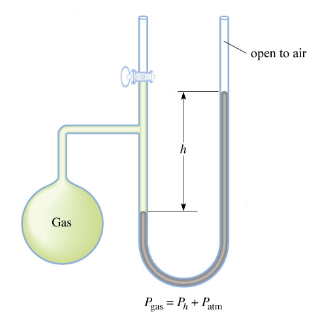
If the height of mercury is the same on both sides of the U, then the gas has standard pressure. If the height of mercury is higher on the open side, the gas’s pressure is higher than the standard pressure. If the height of mercury is higher on the gas side, the gas’s pressure is lower than the standard pressure.
Boyle’s law states that volume is inversely proportional to pressure when temperature and the number of moles are constant. As volume increases, pressure decreases, and vice versa. Pressure is measured in bars (bar) and volume is measured in liters (L).
| P ∝ 1/V | P1V1 = P2V2 |
|---|
Temperature
The standard temperature is 273.15K which is 0°C. Charle’s law states that temperature is directly proportional to volume when pressure and the number of moles are constant. As temperature increases, volume increases, and vice versa. Temperature is measured in Kelvin (K).
| T ∝ V | V1/T1 = V2/T2 |
|---|
Quantity
Avogadro’s law states that the number of moles is directly proportional to the volume when pressure and temperature are constant. As the number of moles increases, the volume increases, and vice versa. Quantity is measured in moles (mol).
| n ∝ V | V1/n1 = V2/n2 |
|---|
Ideal Gas Laws
Using Boyle’s law (pressure), Charle’s law (temperature), and Avogadro’s law (moles) we can create the ideal gas law, which combines all their formulas. The ideal gas constant is represented by R = 0.08314 using bar as the pressure unit which is used to replace the proportional sign. R varies depending on the pressure unit.
| V ∝ nT/P | V = RnT/P |
|---|

The standard temperature and pressure (STP) is 273K and 1 bar. The volume at STP for one mole of gas using bar is 22.7L and for atm is 22.4L.
Density
Density is measured in standard conditions where density is the molar mass (Mm) divided by molar volume (MV). Density is measured in g/L.
| d = Mm/MV | d = PM/RT |
|---|
Partial Pressure
When ideal gases are found in solution together, they will exert an individual pressure, known as partial pressure. Pressure can be calculated by adding the partial pressure from each gas. This is Dalton’s law of partial pressure. Note that temperature and volume must be consistent.

Mole fraction is the ration of moles of a subtance to the total number of moles in the mixture.
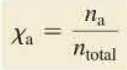
Partial pressure can be calculated for each substance of a mixture by mulitplying the total pressure to teh mole fraction. 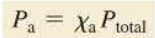
Kinetic Molecular Theory
The microscopic properties of gases are described in kinetic molecular theory. KE = 1/2mv^2 where m represents mass (g) and v represents velocity (m/s)
- gas particles have a negligible volume
- the particles move in a constant, random, straight-line motion
- particles are very far apart
- collisions are rapid and elastic
- particles are not attracted nor repulsed by each other
- average kinetic energy is proportional to temperature
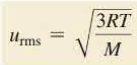
Root mean square velocity is average of the squares of the particle velocities and is used instead of velocity.
Diffusion & Effusion
Diffusion is the migration of molecules due to random movement over time. The rate of diffusion is proportional to the velocity which is proportional to molecular weight.
Effusion is the escape of molecules through a small opening. The rate of effusion is inversly proportional to the molecular mass. This is known as Graham’s law of effusion. 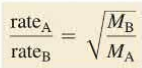
Real Gases
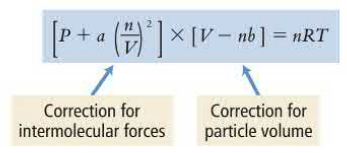
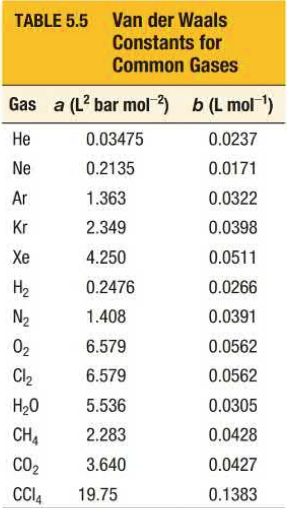
Real gases have different properties than ideal gases due to Van der Waals forces. Ideal gas does not have a volume, in reality gases take up space. The fixed volume equation in the ideal gas equation to account for the real volume gases take up is V-nb where b is a predetermined constant that varies for each element. Ideal gases are said to not have attractive/repulsive forces and do not interact. The modified pressure equation takes into account real gases have less pressure than ideal gases at the same low pressures and that real gasses at high pressures have repulsive forces. The modified pressure equation is P + an^2/V^2 where a is a predetermined constant that is different for each element.