Chapter 3b
Genetic Influences on Behaviour
Evolution
Behavior: An organism’s actions in response to some stimulus
Evolution: Change in heritable traits in a population over time
Natural Selection: The process by which evolution occurs. e.g. Survival of the fittest
Heredity of Intelligence
genes account only for 50–70% of heredity intelligence
Reaction Range: The inheritable range for potential expression environmental effects determines where a person falls within these limits
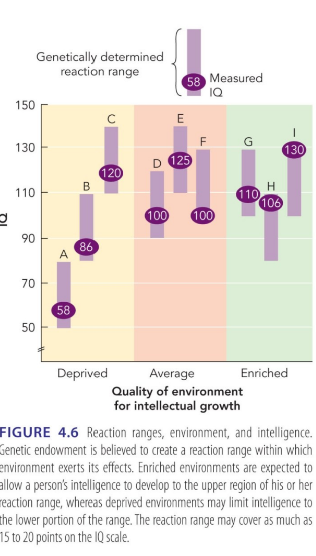
This image shows the inherited intelligence reaction range of a person and the correlation between their environment and their IQ with each person’s reaction range
Heredity of Personality
reared means brought up
Four (4) Groups of People to Study
Identical twins reared together
Identical twins reared apart
Fraternal twins reared together
Fraternal twins reared apart
The “Big Five” Personality Traits
Openness
Conscientiousness
Extraversion - Introversion
Agreeableness
Neuroticism
Minnesota Twin Study
Genetic factors: 39-58%
Unique Experiences: 36-56%
Familial environment: little to no effect
Evolutionary Psychology
Based on the Theory of Evolution
Evolutionary Psychology asks how behavior and actions have evolved in response to environmental demands.
Theory of Evolution
A slow change in genes and therefore characteristics of a population over time
Population: An interbreeding set of individuals
Changes occur due to heritable genetic mutations
Natural Selection
Heritable characteristics that increase your likelihood of surviving remain in the population and become more common over time!
You do NOT die therefore you pass on more genes than those who did die!
Adaptations: traits that occur due to natural selection
The Human Brain
Growth in certain brain areas is associated with higher mental processes over time due to evolution. Attention, memory, thought, language
The evolution of behavior is also impacted by culture
Type of Adaptations
Broad:
for wide use, e.g learning language, logical reasoning
Domain-specific:
Solve a particular problem, mate selection, choosing safe food
Social Adaptations in Humans
Innate ability to acquire language
Responsiveness to human faces
group-seeking behavior
some universal emotions
Parental Investment
Time, effort, energy, and risk associated with caring successfully for each offspring
Humans invest a lot in a small number of offspring
Mice produce large numbers of offspring and offer little care
The two parents may not invest equally in offspring
These sex differences in investment can explain mating systems (Trivers, 1972)
Mating Systems
There will be more competition for the sex that makes the highest parental investment (usually female)
The sex with the highest investment will be more picky in selecting a mate
Monogamous
• Two parents have equal parental investment
• Little sexual dimorphism between the sexes
• Usually arises because any one parent could not successfully rear their young
• Especially birds
Polygamous = Unequal contributions
Polyandry: one female, many males
• Thus, male competition drives evolution
Polygyny: one male, many females
• Thus, female competition drives evolution
Polygynandry: many males, many females • i.e., promiscuity
Altruism vs cooperation
Cooperation: One individual helps another and gains some advantage. e.g, cooperating to achieve a goal
Altruism: One individual helps another but there are costs involved e.g, putting oneself in danger to help another
Altruism Theories
Kin selection Theory: Arose to increase the likelihood of relatives surviving e.g. help individuals with similar genes
If true, we should see: • Positive relationship between acts of altruism and degree of relatedness • i.e., more altruistic acts toward relatives
Reciprocal Altruism Theory: Contributes to long-term cooperation e.g, I help you now, you help me later. (Does not require relatedness!)
Aggression
Evolutionary reasons:
To protect one’s mate/young/territory or food
To take another’s resources
gain access to new resources
In social animals, individuals can recognize individuals and remember past encounters.
Dominance hierarchies
Animals fight to establish rank, and then that position and the access that comes with it are set = “pecking order”
Chapter Terms Summarized
Behaviour: An organism's actions in response to some stimulus.1
Evolution: Change in heritable traits in a population over time.1
Natural Selection: The process by which evolution occurs – i.e. "survival of the fittest".1
Gene: The basic unit of heredity, traits are passed on from parent to offspring through genes.12 Genes are units of hereditary transmission (genetic blueprints).2
DNA (deoxyribonucleic acid): The chemical substance containing nucleotides; hereditary, inherited from parents, made up of bases (Adenine, Thymine, Guanine, and Cytosine).2
Genome: The complete set of genetic material for an organism.2
Chromosomes: Strands of DNA wound around each other in a double-helix configuration.2
RNA (ribonucleic acid): Similar to DNA, created when genes are expressed.2
Amino Acids: "Building blocks of life".3
Genotype: The specific genetic makeup of an organism.3
Phenotype: The observable characteristics of an organism due to its genetic makeup.3
Somatic cells: In somatic cells, humans have 46 chromosomes in 23 pairs – i.e., one copy from the mother (23), one from the father (23).3
Genetic Relatedness: The percentage of genetic material shared between individuals. For example: parent = 50%, grandparent = 25%, cousins = 12.5%.34
Twins: Two offspring produced by the same pregnancy. Identical twins share 100% of their genetic material, while fraternal twins share 50%.4
●
Dominant gene: If a gene in a pair is dominant, the characteristic it controls will be displayed.4
●
Recessive gene: If a gene in a pair is recessive, the characteristic will not show up unless the partner gene is also recessive.4
●
Alleles: We receive two alleles for every gene, one from each parent.4
●
Homozygous: A person has an identical pair of alleles for a given gene.4
●
Heterozygous: A person has a combination of alleles for a given gene.4
●
Dominant alleles: Expressed if you have only one copy.45
●
Recessive alleles: Expressed if you have both copies.5
●
Polygenic transmission: When several gene pairs combine to create a single phenotypic trait.5
●
Epigenetics: Lasting changes in gene function during development that are NOT caused by the genes themselves - i.e., external (or environmental) influential factors.5
●
Recombinant DNA procedures: Procedures used to duplicate genes or the proteins the genes make. This involves using enzymes to cut DNA into pieces, combining it with the DNA of another organism, and inserting the combined DNA into a host cell.56
●
Gene Knockout Procedure: Altering a specific gene so it cannot function and observing the results.6
●
Behaviour Genetics: The study of how genetic and environmental components lead to changes in behaviour.6
●
Heredity: The passage of characteristics from parents to offspring by way of genes.6
●
Heritability: How much of the variation in a characteristic within a population can be attributed to genetic differences.67
●
Heritability Coefficient: An estimate of how much of a characteristic is due to genetic factors – also known as a Heritability Estimate.7
●
Concordance Rate: The rate of co-occurrence of a characteristic among individuals – i.e., how often you see two people with trait X. Higher rates with increasing relatedness = possible genetic contribution.7
●
Adoption Studies: A research method used in behavioural genetics that compares characteristics of an adopted person with both their biological and adoptive parents (biological = genes; adoptive = environment).8
●
Twin Studies: A research method that compares monozygotic (identical) and dizygotic (fraternal) twins, who share differing amounts of genetic material.8 These studies are used to investigate the relative contributions of genes and environment to behavioro.
●
Intelligence: Genes account for 50-70% of intelligence.9
●
Reaction Range: A range of possibilities that the genetic code allows. Individuals inherit a range for potential expression, and environmental effects determine where a person falls within those limits.9
●
Personality: To study personality, we need to look at genetic contributions, the shared family environment and unique individual experiences.9
●
The “Big Five” personality traits: Openness, Conscientiousness, Extraversion-Introversion, Agreeableness, and Neuroticism.10
●
Minnesota Twin Study: This study investigated the heritability of personality and found that genetic factors account for 39-58%, unique experiences for 36-56%, and the familial environment has little or no effect.10
●
Evolutionary Psychology: The study of how behaviour and actions have evolved in response to environmental demands, based on the Theory of Evolution.11
●
Theory of Evolution: A theory that states that species change over time due to heritable genetic mutations.11
●
Population: An interbreeding set of individuals.11
●
Adaptations: The traits that occur due to natural selection; heritable characteristics that increase the likelihood of surviving remain in the population and become more common over time.12
●
Broad Adaptations: Adaptations for wide use, e.g. learn language, logical reasoning.12
●
Domain-specific Adaptations: Adaptations to solve a particular problem, e.g. mate selection, choosing safe food.12
●
Social Adaptations in Humans: The innate ability to acquire language, responsiveness to human faces, group-seeking behaviour and universal emotions.1213
●
Parental Investment: Time, effort, energy, and risk associated with caring successfully for each offspring.13
●
Mating Systems: Systems that can be explained by sex differences in parental investment.13
●
Monogamous mating system: Two parents have equal parental investment. There is little sexual dimorphism between the sexes. This system usually arises because no parent could not successfully rear their young.14
●
Polygamous mating system: Unequal parental investment between two parents.14
○
Polyandry: One female, many males; male competition drives evolution.14
○
Polygyny: One male, many females; female competition drives evolution.1415
○
Polygynandry: Many males, many females – i.e., promiscuity.15
●
Mate Preference: Refers to the traits that individuals find desirable in a potential mate.15
●
Altruism and Cooperation:
○
Cooperation: One individual helps another and gains some advantage, e.g. cooperating to achieve a goal.15
○
Altruism: One individual helps another but there are costs involved, e.g. putting oneself in danger to help another.16
●
Kin Selection Theory: A theory that suggests altruism arose to increase the likelihood of relatives surviving – e.g., to help individuals with similar genes.16
●
Reciprocal Altruism Theory: A theory that posits that altruism contributes to long-term cooperation, e.g. I help you now, you help me later.1617 This does not require relatedness.
●
Aggression: A behavior that may have evolved to protect one's mate, young, territory, and/or food, or to take another's resources or gain access to new resources.1718
●
Dominance hierarchies: Established in social animals after fighting to establish rank; position and the access that comes with it are set – e.g., a "pecking order".18
●
Genetic Determinism: The false idea that the effects of genes are concrete and unchangeable.18
●
Social Darwinism: The false idea that those at the top of the social hierarchy are the “best” – i.e. survival of the fittest and the less fit need to go.18