AP Gov 2.1 2.2
Part II: Terms
2.1 Terms
Term | Definition / Explanation |
|---|---|
Advice and consent | The Senate’s constitutional power to approve or reject presidential appointments (e.g., judges, ambassadors, cabinet officials) and treaties. |
Bicameral | A two-house legislature; in the U.S., Congress is divided into the House of Representatives and the Senate. |
Caucuses | Groups of members of Congress that meet to pursue common legislative objectives (e.g., Congressional Black Caucus, Freedom Caucus). |
Enumerated powers | Powers explicitly granted to Congress by the Constitution (Article I, Section 8), such as taxing, declaring war, and regulating commerce. |
Implied powers | Powers not explicitly stated but reasonably inferred from the Necessary and Proper Clause (Elastic Clause) — e.g., creating a national bank. |
Inherent powers | Powers Congress and the president need to get the job done but aren’t specified in the Constitution; often relate to foreign affairs and national sovereignty. |
Power of the purse | Congress’s control over government spending and taxation; allows it to check the executive branch. |
House of Representatives (Chart – Page 102 Summary)
Feature | Description |
|---|---|
Members | 435 (based on population, 2-year terms) |
Constituency | Smaller, local districts |
Leadership | Speaker of the House (most powerful), Majority and Minority Leaders |
Powers | Initiates revenue bills, impeaches federal officials, chooses president if Electoral College is tied |
Rules | More formal; limited debate; Rules Committee controls floor debate |
Focus | More responsive to public opinion; short-term issues |
Senate (Chart – Page 102 Summary)
Feature | Description |
|---|---|
Members | 100 (2 per state, 6-year terms) |
Constituency | Larger, statewide |
Leadership | Vice President (President of Senate), President Pro Tempore, Majority and Minority Leaders |
Powers | Confirms presidential appointments, ratifies treaties, conducts impeachment trials |
Rules | Less formal; unlimited debate (filibuster possible) |
Focus | More deliberate; long-term national issues |
2.2 Terms
Term | Definition / Explanation |
|---|---|
Speaker of the House | Mike Johnson (R–LA) — Presides over the House, controls floor debate, assigns bills to committees, and is 2nd in line for the presidency. |
Minority Leader of the House | Hakeem Jeffries (D–NY) — Leads the opposition party and coordinates Democratic legislative strategy. |
President of the Senate | Vice President J.D. Vance — Presides over the Senate, casts tie-breaking votes. |
Majority Leader of the Senate | John Thune (R–SD) — True leader of the Senate; sets agenda and guides party strategy. |
Minority Leader of the Senate | Chuck Schumer (D–NY) — Leads minority party, negotiates with majority leadership. |
Congressional committees | Smaller groups in Congress that handle specific policy areas and review bills. Most legislative work happens in committees. |
Types of Committees (p.112) | Standing – permanent; handle broad areas (e.g., Armed Services). |
House Rules Committee | Decides how and when bills will be debated and voted on; powerful in controlling the legislative process. |
Filibuster | Tactic used in the Senate to delay or block a vote by extending debate. |
Cloture rule | Procedure to end a filibuster; requires 60 votes in the Senate. |
Riders | Unrelated amendments added to a bill, often to pass controversial measures. |
Omnibus bill | A large bill that includes multiple issues or programs, often used to pass many provisions at once; Christmas Tree bill |
Pork-barrel spending | Government spending for local projects designed to please voters or legislators and help win votes. |
Logrolling | “You vote for my bill, I’ll vote for yours” — mutual support among legislators for each other’s bills. |
Mandatory spending | Required by law; includes entitlement programs like Social Security, Medicare, Medicaid. |
Entitlement | Government benefits that all qualified individuals are legally entitled to receive. These programs, such as Social Security, Medicare, and Medicaid, guarantee payments or benefits to all who qualify, regardless of budget limitations for that specific program. |
Discretionary spending | Government spending that Congress must approve each year, such as defense, education, and transportation. |
Budget deficit | When government spending exceeds revenue in a single fiscal year. |
Budget debt | The total amount the government owes from accumulated deficits over time. |
Steve Scalise: House Majority Leader
Part III: Comparing House and Senate (Chart Page 102)
Category | House of Representatives | Senate |
|---|---|---|
Size | 435 members | 100 members |
Term Length | 2 years | 6 years |
Representation | By population | Equal (2 per state) |
Debate Rules | Strict limits on debate; Rules Committee controls floor time | Unlimited debate; filibusters allowed |
Leadership | Speaker of the House | Majority Leader (real power), VP presides |
Special Powers | Initiates revenue bills, impeaches officials | Confirms appointments, ratifies treaties, tries impeachments |
Constituents | Local districts | Entire states |
Focus | Domestic/local concerns | National and foreign policy |
Part IV: Short Answers
Types of Powers in Congress
Enumerated powers: Listed directly in the Constitution (e.g., tax, declare war, regulate commerce).
Implied powers: Derived from the Necessary and Proper Clause — allows Congress to make laws needed to carry out enumerated powers.
Inherent powers: Powers naturally belonging to any national government (e.g., controlling borders, recognizing foreign nations).
Leadership of the House and Senate (p.110)
Chamber | Position | Description |
|---|---|---|
House | Speaker of the House | Presiding officer; sets agenda; assigns bills to committees. |
Majority Leader | Helps plan legislative agenda; supports Speaker. | |
Minority Leader | Heads opposition party in House. | |
Whips | Assist leaders, count votes, maintain party discipline. | |
Senate | Vice President (President of Senate) | Presides over Senate; votes in ties. |
President Pro Tempore | Senior member of majority party; presides when VP absent. | |
Majority Leader | Sets legislative agenda; most powerful senator. | |
Minority Leader | Leads opposition in Senate. | |
Whips | Manage party voting strategy. |
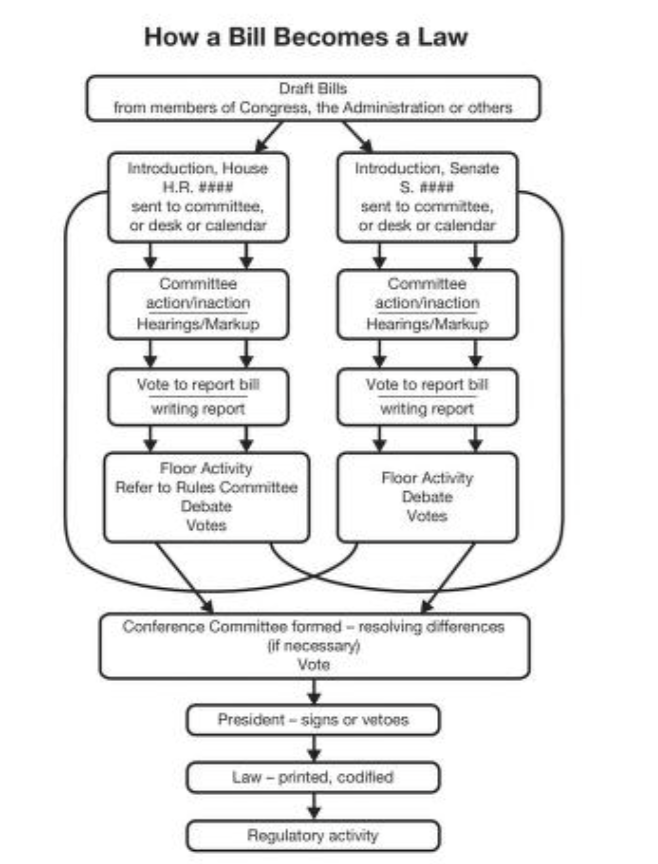
Bill Becomes a Law (p.116)
Drafted the bill
introduction to chamber in a committee
committee action, hearings/markup
bill is voted on to be reported
bill is sent to the chamber to be debated
sent to opposing chamber
opposing chamber introduction to committee
opposing chamber committee action
bill is voted on to be reported
sent to opposing chamber to be debated
conference committee formed to resolve differences
Presidential Action: President signs or vetoes.
If vetoed, Congress can override with 2/3 vote in both chambers.
Law printed
regulatory activity