Sound Waves
Mechanical Wave Sub-Types
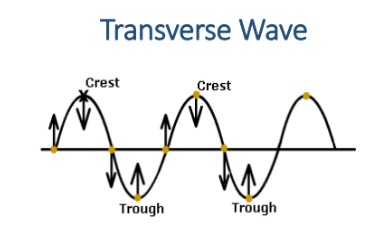
Transverse waves
Waves where the particle vibration is perpendicular to the direction of wave propagation,
characterized by crests and troughs
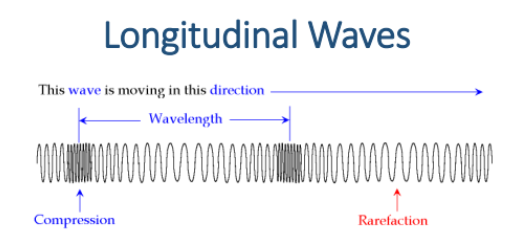
Longitudinal waves
Waves where the particle vibration is parallel to the direction of wave propagation
characterized by compressions and rarefactions.
Creation of Sound
When an object vibrates, it creates sound
loud, deep and long, short and high-pitched
pure, gravely, distorted, sweet, soft, piercing, buzz
Any sound your ear can hear is created by the mechanical back-and-forth motion of an object
Amplitude & Volume
Amplitude describes how much energy a wave is carrying
more energy = greater amplitude = louder sound
greater amplitude = taller wave or more intense compressions
Volume tells how loud or soft a sound is
determined by how much energy a wave carries
Ultrasound
Ultrasound refers to sound waves with frequencies higher than 20,000 Hz, which is above the human hearing range.
These waves are mechanical longitudinal waves that require a medium to propagate.
Applications:
Medical imaging (e.g., prenatal scans)
Non-destructive testing in industries
Cleaning delicate objects using ultrasonic cleaners
Doppler Effect
The Doppler Effect is the apparent change in frequency (or pitch) of a sound wave caused by the relative motion between the source of the sound and the observer.
When the source moves toward the observer:
The frequency appears higher
The wavelength appears shorter
When the source moves away from the observer:
The frequency appears lower
The wavelength appears longer
This principle is commonly heard in the changing pitch of a passing ambulance siren.
Doppler Radar
Doppler radar uses the Doppler Effect to detect motion and measure speed.
It sends out radio waves (not sound), which bounce off a moving object (e.g., a car or raindrop).
By analyzing the frequency shift in the returned signal, it determines:
Speed
Direction
Applications:
Weather forecasting (e.g., tracking storms)
Traffic speed enforcement
Air traffic control
extra questions
Application of electricity in real life as you practice as an OSHA practitioner?
🔌 1. Electrical Hazard Identification
Recognize potential electrical hazards in workplaces (e.g., exposed wires, overloaded circuits, faulty equipment).
Inspect work environments to ensure compliance with OSHA electrical standards (like 29 CFR 1910 Subpart S).
⚠ 2. Electrical Safety Implementation
Ensure lockout/tagout (LOTO) procedures are used when maintaining or repairing electrical systems.
Use ground fault circuit interrupters (GFCIs) in wet or outdoor locations to prevent electrocution.
Ensure proper grounding of equipment to prevent electric shock.
🛠 3. Safe Use of Electrical Tools and Equipment
Ensure all tools are double-insulated or grounded.
Conduct regular inspections of cords and plugs.
Only qualified workers should handle high-voltage or energized systems.
🧯 4. Emergency Preparedness
Develop emergency response plans for electrical accidents.
Train workers in CPR and AED use for electrical shock victims.
Install circuit breakers and emergency shut-off systems.
📚 5. Training and Education
Conduct electrical safety training for workers.
Display warning signs and labels on electrical panels and equipment.
Promote awareness of NFPA 70E (Electrical Safety in the Workplace) standards.
🏢 6. Application in Different Industries
In construction: Manage temporary wiring and power tools safely.
In manufacturing: Ensure safe operation of machinery powered by electricity.
In offices: Prevent risks from overloaded sockets, power strips, and improper wiring.
Explain the concept of the application of force, in implementation at the workplace, as you consider an OSHA practitioner?
1. Lifting Heavy Boxes (Warehouse or Factory)
A worker lifts a 25 kg box from the floor to a shelf.
Risk: If lifted incorrectly, it may strain the back or knees.
Solution: Use proper lifting posture or mechanical lifting aids (e.g., trolleys or forklifts).
2. Pushing a Medical Trolley (Hospital)
A nurse pushes a trolley filled with medical equipment.
Risk: Excessive force or poor wheels can lead to shoulder or arm injuries.
Solution: Maintain equipment wheels, reduce trolley weight, train on pushing techniques.
3. Using Hand Tools (Construction or Engineering)
A worker uses a wrench or screwdriver for several hours.
Risk: Continuous grip and twisting cause hand/wrist fatigue or repetitive strain injury (RSI).
Solution: Use ergonomically designed tools and allow rest breaks.
4. Pulling Heavy Cables (Electrical Work)
An electrician pulls underground cables during installation.
Risk: Pulling with poor posture or heavy force can injure shoulders or back.
Solution: Use cable rollers or team lifting techniques.
5. Stacking Shelves (Retail)
An employee stacks goods on high shelves, using force to lift and reach.
Risk: Reaching overhead while lifting causes shoulder strain.
Solution: Use ladders or adjust shelf height to a safer level.