Physics 2.5 Checklist for internal
Model of the atom
Plum pudding model
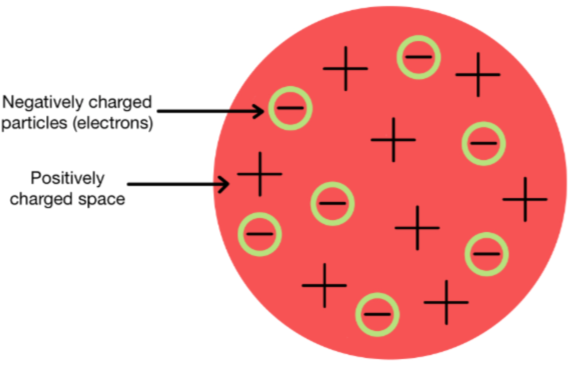
In Thomson’s plum pudding model of the atom, @@the electrons were embedded in a uniform sphere of positive charge, like blueberries in a muffin.@@ The positive matter was thought to be jelly-like. The electrons were considered somewhat mobile.
Rutherford’s Explanation
Rutherford fired positively charged alpha particles at a thin sheet of gold foil in a vacuum.
@@Most alpha particles passed through unaffected@@ - The atom must be made up of %%mostly empty space.%%
@@Some particles were deflected@@ - As the alpha particles were positive, there must be %%a concentration of positive charge%% in the atom which repels the positively charged alpha particles (the nucleus).
@@Some particles bounced back@@ - %%The concentration of positive charge must be very dense - most of the atoms mass must be concentrated in a very small and positively charged nucleus%%. The nucleus must be very dense as alpha particles were able to ‘collide’ with the nucleus and bounce back without having any appreciable effect on the nuclei they hit.
Types of radiation
Alpha radiation (α)
Alpha particles are positively charged particles %%consisting of 2 protons and 2 neutrons.%% They are essentially the nucleus of a %%He atom%% which also contains 2 protons and 2 neutrons.

Alpha particles generally travel around %%5% of the speed of light.%%
Alpha particles have %%low penetrating ability%%, which means it can easily be stopped by particles in the air (can travel a few cm) or through thin substances such as paper.
Beta radiation (β)
Beta particles are formed when a ^^neutron in the nucleus breaks down into a proton^^ giving off a negatively charged beta particle (essentially a high speed electron).
They generally travel around ^^90% the speed of light.^^
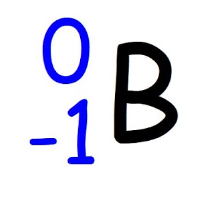
The ^^-1 shows it has a charge of -1 and the 0 shows they essentially have no mass.^^
They have a ^^higher penetrating ability than alpha particles^^, which means they can travel a few metres in air but can be ^^stopped by a few mm of aluminium.^^
Gamma radiation (γ)
Gamma %%rays%% are a form of %%electromagnetic radiation%% (light visible light but higher energy). %%They travel at the speed of light.%%

They neither have a %%mass nor a charge%%. %%The 0’s indicate no charge and no mass.%%
Gamma rays have a %%very high penetrating ability%% and can easily pass through a human. They generally are stopped by very thick barriers (a few metres of concrete) or a few cm of lead.
Ionising
Ionising
Ionising is the process where ==radiation detach electrons from substances== they interact with.
These substances are the atoms and molecules in the medium that the radiation is travelling through, like the molecules in the air.
Ionising radiation is dangerous to humans, as ==when it ionises molecules in the body it can lead to cellular dysfunction, cell death and certain cancers.==
Radiation sickness
Exposure to radiation carries two types of health risks: those typically ascoiated with low level, long-term exposure: such as cancer and DNA mutation, and those from short-term: high levels - acute exposure - including burns and radiation sickness.
Ionising radiation
Alpha, beta, gamma radiation can all ionise atoms/molecules to from ions.
and therefore has the potential to do the most damage. However, as it has it is only a major (in the lungs or gut) as the
It is the most penetrating, it can only be stopped by lead or some concrete.
. It is the second most penetrating, it can be stopped by a few mm of aluminimum.
Why is alpha the most ionising?
Alpha radiation has the %%greatest charge (+2)%%, therefore it exerts the %%greatest force on the electrons%% in a substance, making it more likely to %%exert an electron (which is what ionising is)%%.
Alpha is also the %%most massive%%, and travels with the %%most kinetic energy%% which can be used to %%remove an electron%% from a substance.
The %%greater ionising ability%% of the alpha particles is also responsible for its %%lowest penetrating ability.%%
As it is so good at ionising particles, %%as soon as it encounters a molecule, it is likely to ionise it. As it does this it loses its energy%% and thus its ability to penetrate further.
Smoke detectors
The alpha particles emitted from the radioactive source (Americium-241) ^^ionise molecules in the air (forming ions).^^
The presence of these ions ^^allows current to flow through the circuit.^^
When smoke is present, the smoke ^^interferes with the ionisation^^, this means that the ^^current no longer flows^^ through the circuit. ^^This lack of current is detected and the alarm sounds.^^
Dosimeters
As different forms of radiation have different ionising abilities, it is important to know what type of radiation a person has been exposed to.
Radiation badges contain a film that darkens when exposed to radiation. They are divided into three parts.
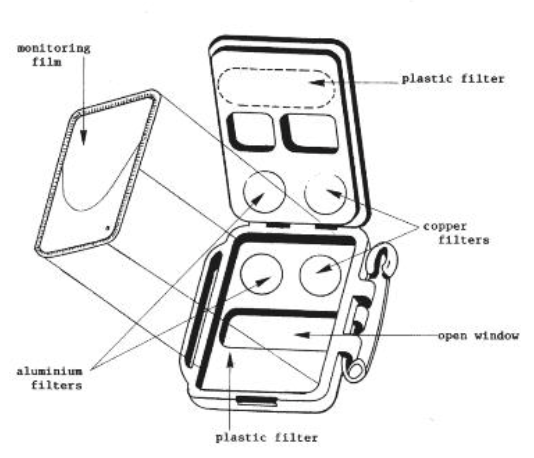
One part has no cover over the film.
One part has a paper cover.
One part has a aluminium cover.
If the film @@behind the aluminium darkens@@, you know they must have been exposed to @@gamma radiation@@.
If the film @@behind the paper darkens@@, they must have been exposed to @@at least beta and potentially also gamma@@.
If only the film @@behind the open window@@ darkens, they can only have been exposed to @@alpha radiation@@.
Radioactive decay
Radioactive decay is when an unstable nucleus releases energy and radiation to become more stable. The nucleus ==before it decays is called the parent== nucleus and the nucleus ==it forms is called the daughter nucleus.==
Alpha decay
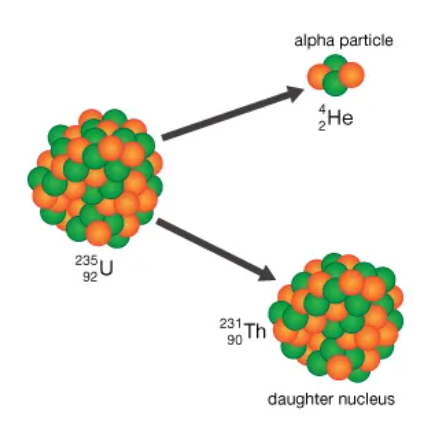
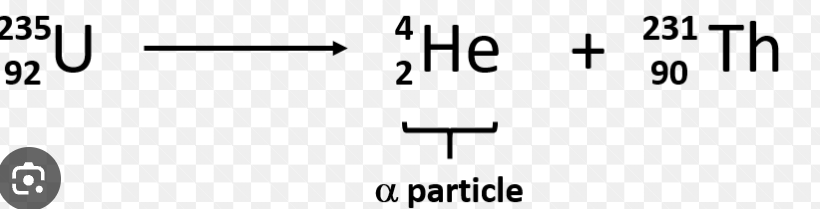
When a nucleus emits an alpha particle, the ==mass number decreases by 4 and the atomic number decreases by 2==. Giving a ==new element==.
Beta decay
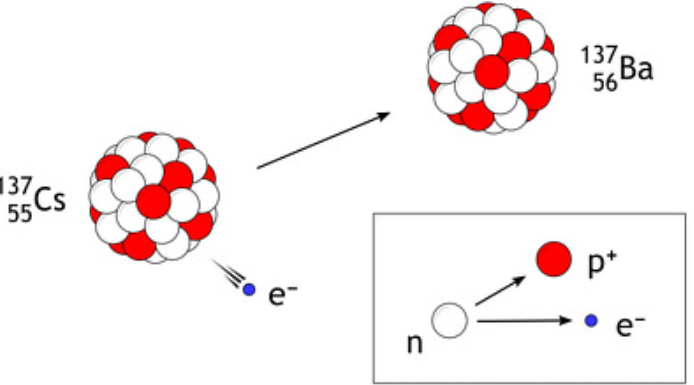
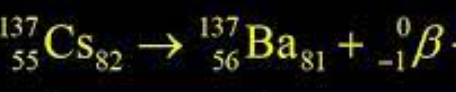
In beta decay, ==a neutron in the nucleus turns into a proton== and a beta particle is emitted. ==The mass numbers stays the same and the atomic number increases by 1.==
Gamma decay (Gamma emission)
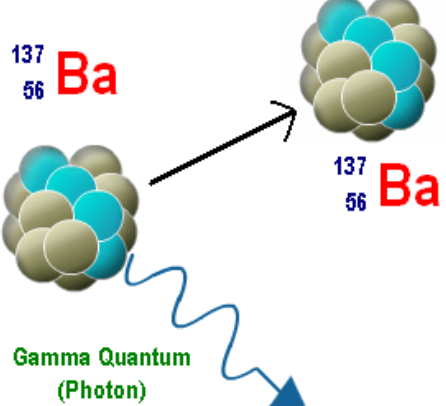
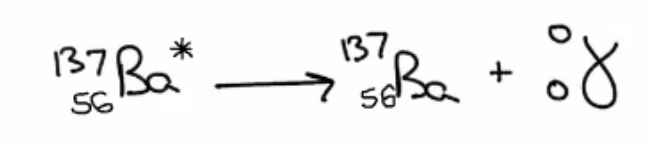
Gamma rays have no mass or charge so the parent nuclide and daughter nuclide ==have the same mass number and atomic number.== The daughter nuclide is ==more stable and lower energy.==
Half life of radioactive materials
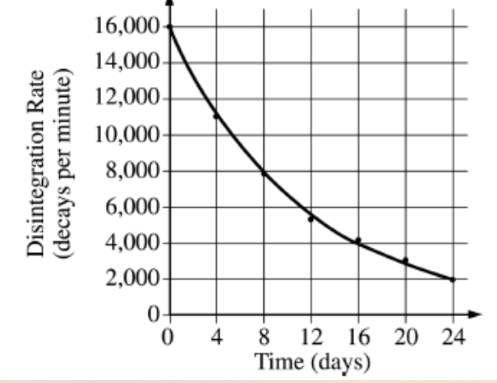
The half life of a radioactive material is the time it takes for ==half of a radioactive substance to decay== into its daughter nucleotide. The ==longer the half life, the more stable the parent nucleotide is.==
After one half life you would have ==50% of your origional sample==. After ==2 half lives you would have 25%, after 3 you would have 12.5%.==
Eqaution for working out half lifes. N=No x ½ n. N = Amount of sample remaining. No = Origional amount of sample. n = Number of half-lifes elapsed. Before you use this equation you must work out the number of half-lifes which have occurred.
Half life graphs
On the y-axis we can plot the mass of substance (g or kg), the concentration of substance (% or M), or the activity of the substance (how much radiation it is emitted - measured in counts per sample).
E=mc2
The energy released by a nuclear reaction can be calculated using E=mc2. E= energy released (J), m= the change in mass during a reaction (kg), c=the speed of light (3.00 x 10(to the power of 8)ms-1.
To find the difference in mass/massdefect, we must subtract the right hand side from the left hand side. To work out the left hand side you must add all particles on the left hand side of the arrow. To work out the right hand side you must add all particles on the right of the arrow.