math final notes (sem 2)
module 7: rational function
if the problem is simplifying and you need to add, you can’t get rid of a common factor because it is addition
an expression is undefined (excluded value) when the denominator is equal to 0
graphing rational functions
vertical asymptote: if f(x)=a(x)/b(x) and there are no common factors other than 1 for a(x) and b(x), solve for x in the denominator to get V.A.
horizontal asymptote:
if degree of a(x) is greater than degree of b(x) —> no H.A.
if degree of a(x) is less than degree of b(x) —> H.A. is y=0
if degree is equal, H.A. is y= a(x) leading coefficient/b(x) leading coefficient
oblique asymptote: if degree of a(x)-degree of b(x)=1, there is an oblique asymptote
equation of asymptote is y=a(x)/b(x) with no remainder (use long division)
holes/point discontinuity: if f(x)=a(x)/b(x), b(x)≠0, and x-c is a factor for both, there is a hole at x-c
multiplicity: number of times a factor/number shows up
even/odd function:
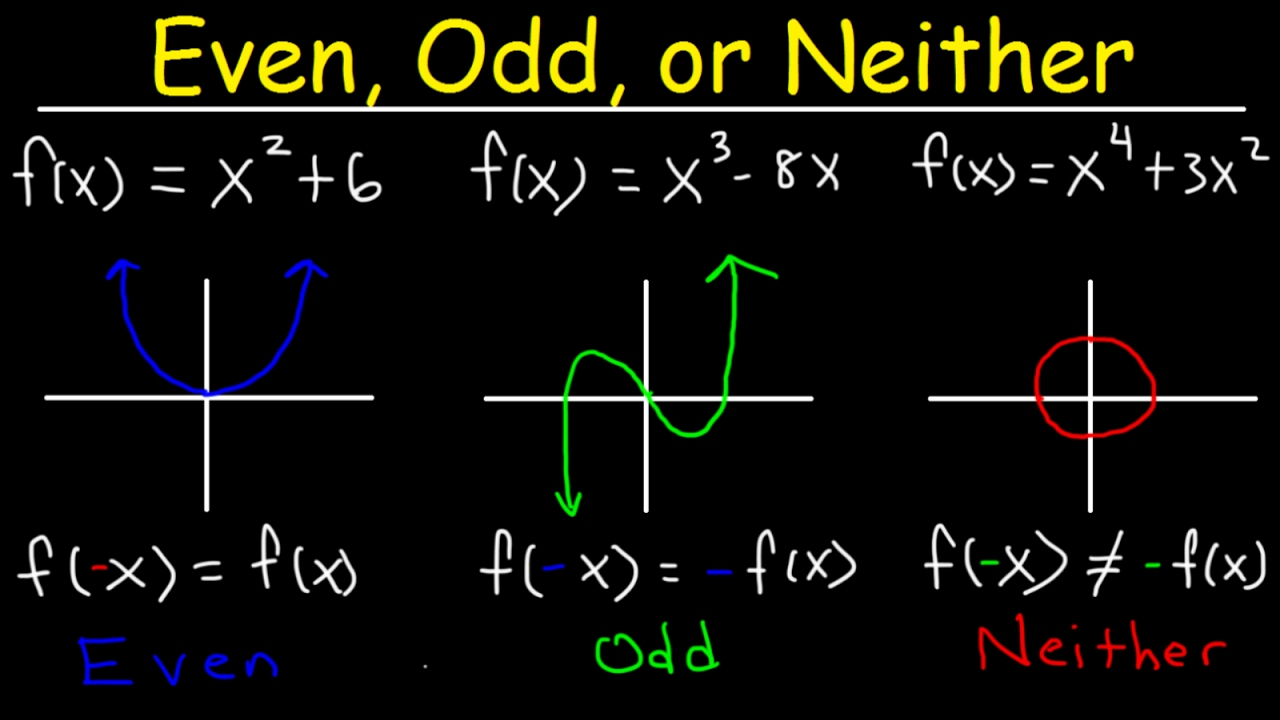
number line things (?):
when solving rational equations, find the common denominator and use cross multiplication with answer to solve for x
first step however should be to find the excluded values
module 4: inverse & radical functions
when doing (f/g)(x), you can just leave the answer in the (f/g)(x) form as long as you write the excluded values
or you can use synthetic division or long division to solve
when checking inverses, you can use composition of functions to find
composition of functions: plug one function into another and if it =x, it is an inverse
changing exponent to radical form: the numerator is the number inside the rad sign and denominator is the power of the radical (?)
graphing radical functions
when the function is like square root, the end point is the numbers
ex. g(x)=-(sqrt x+6)-2, then the end point is going to be at -6,-2 because it is translated down 2 and moved left 6 units
find the next point by plugging in a point
when the function is like cube root, the middle point is the numbers
ex. g(x)=(cbrt x)-4, then the middle point is down 4 and x-value is still at 0
find the next point by plugging in a point
the graph is shaped like a S
module 5: exponential functions
formula for continuous compound interest: A=Pe^rt
formula for continuous compound interest: A=P(1+r/n)^nt
if something is increase by a certain percent each week or something, you would multiply the starting factor and (1+%)^x
refer to question 14
e is around 2.718
module 6: logarithmic functions
rewriting exponent in logarithmic form
snail method
when solving for x given equation but the number in the equal sign doesn’t have a log, you have to make the base of the log to the power of that number after that equal sign
ex.

ln is the same as log e
log 10 is the same as e
log functions are inverses of exponential functions
log functions do not have horizontal asymptotes
they only have vertical and you find that by looking at the function and if there is a + or - next to the x, that is the vertical asymptote)
how to graph
find two points on the parent function
do the reflection/dilation
if - is outside the log then you change the y-value
then do the translations
the order is similar to PEMDAS
when solving for x given equation, usually - answers are extraneous because you can’t have a negative argument (the thing inside the () after log base __
module 13: trigonometric identities
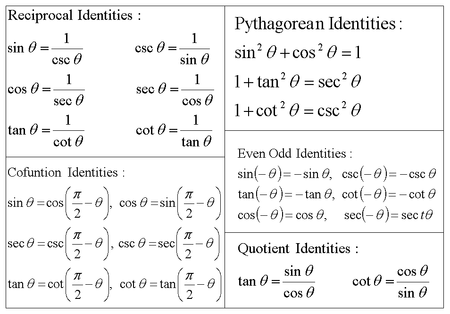
sec, csc, tan, and cot all don’t have an amplitude
V.A. of sec and csc is where the sin or cos graph touches the x-axis
module 8: inferential statistics
lower the standard deviation: the more reliable or stable
types of study
survey
observational study
experiment
other notes
text