Rivers
River Components
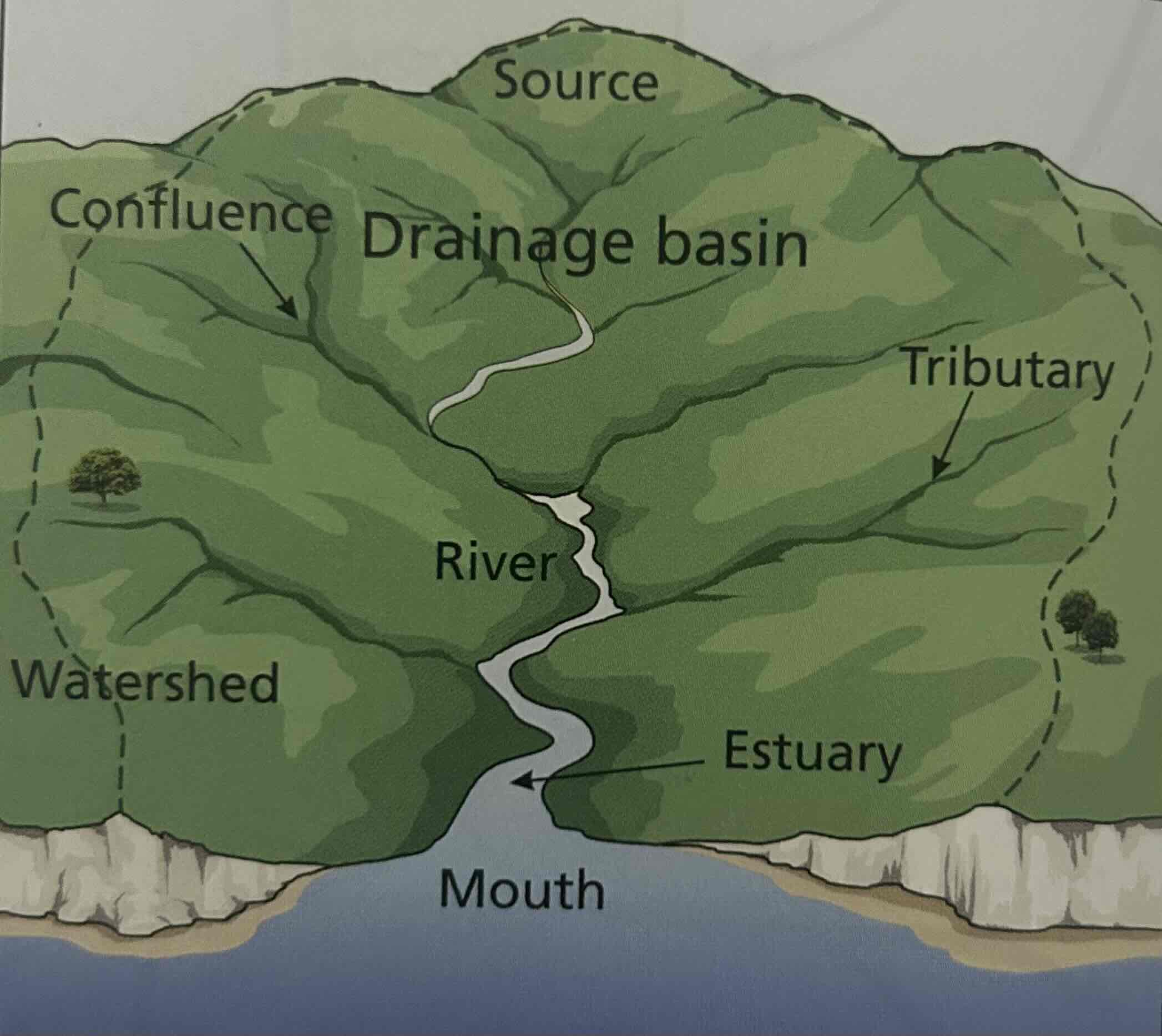
River Source: The beginning point of a river.
course: The route a river takes to sea.
Drainage basin: the area of land drained by the river.
Watershed: The region or area of land that separates waters flowing to different rivers, basins, or seas.
Tributary: Smaller river that feeds into the main river.
Confluence: Point where tributary meets the main river.
Estuary: Tidal area of the river.
River Mouth: Where the river meets the sea.
Stages of a River
1. Youthful Stage
steep
fast flowing
low volume of water
erosion
2. Mature Stage
gently sloping
starts to slow down
higher volume of water
erosion and deposition
3. Old Age Stage
leveling off
slow moving
large volume of water
deposition
Processes of Erosion
Hydraulic Action: Force of moving water eroding riverbeds and banks.
Abrasion: Rocks carried by the river scrape the bed, deepening it.
Attrition: River's load collides and breaks into smaller pieces.
Solution: Chemicals in the river dissolve rock on the riverbed.
Processes of river transportation
Rolling(traction): Heavy stones moved along the bottom.
Bouncing(saltation): Smaller stones bouncing along the riverbed.
Suspension: Small stones and pebbles floating in the water.
Solution: Tiny dissolved bits.
Features of Rivers
Youthful River Features
Interlocking Spurs: Streams flow around hills unable to erode.
V-Shaped Valley: Caused by vertical erosion; steep valley sides.
Waterfall: Formed when a river flows over hard rock, eroding softer rock below.
Mature River Features
Meanders: Bends and curves in the river due to flatter land.
Erosion on the outer bend, deposition on the inner bend.
Old Age River Features
Oxbow Lakes: Horseshoe-shaped lakes formed from meanders cut off due to deposition during floods.
Levees: Ridges of alluvium formed by the deposition of floodwaters.
Human Interaction with Rivers
Case Study: Dam Building in Ireland (e.g., Arda Crussia on River Shannon).
Hydroelectric power plants create artificial lakes.
Benefits: Free electricity.
Disadvantages: Flooding of fertile farmland.