Wk 2 PD, DF, SPL and Bandwidth
Overview
This lecture focuses on several important concepts in ultrasound physics including Pulse Duration (PD), Duty Factor (DF), Spatial Pulse Length (SPL), and Bandwidth.
Learning Objectives
Understand key definitions and formulas related to:
Pulse Duration (PD)
Duty Factor (DF)
Spatial Pulse Length (SPL)
Frequency Bandwidth
Frame rate and its importance in ultrasound imaging.
Pulse Duration (PD)
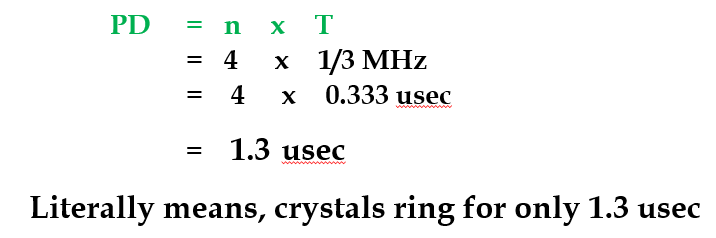
Definition: The time it takes for a single pulse emitted from the ultrasound transducer.
Measurement: Typically in microseconds (µs).
Formula:
Where T is the period of one cycle, and n is the number of cycles in the pulse.
Typical values:
B-mode pulses: 2 or 3 cycles long
Doppler pulses: 5 to 30 cycles long
Calculating Pulse Duration
Example: For a 3 MHz transducer with 4 cycles:
Duty Factor (DF)
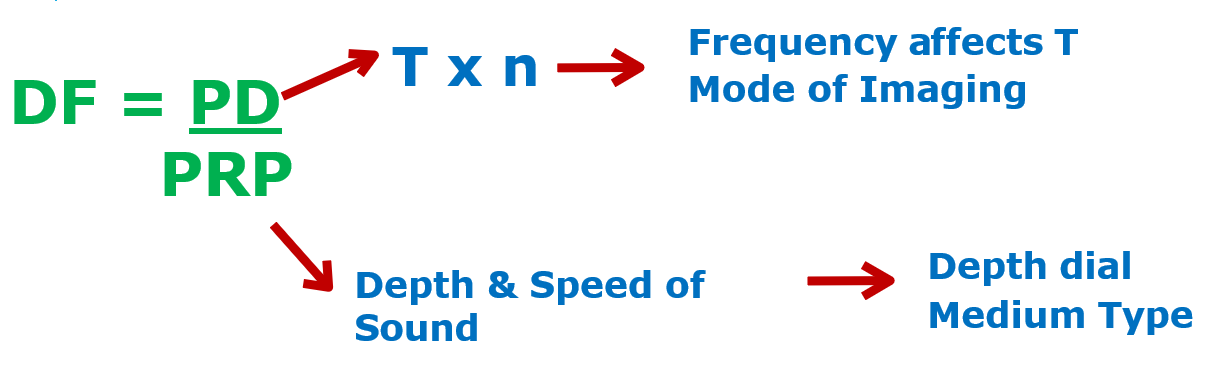
Definition: The percentage of time that the ultrasound system is actively emitting a pulse compared to the total time (ringing + listening).
Importance: Provides insight into how often ultrasound is used in imaging versus listening time.
Formula:
Where PRP (Pulse Repetition Period) represents the total time for one pulse cycle.
Typical values for DF:
Sonography: 0.1% - 1.0%
Doppler ultrasound: 0.5% - 5.0%
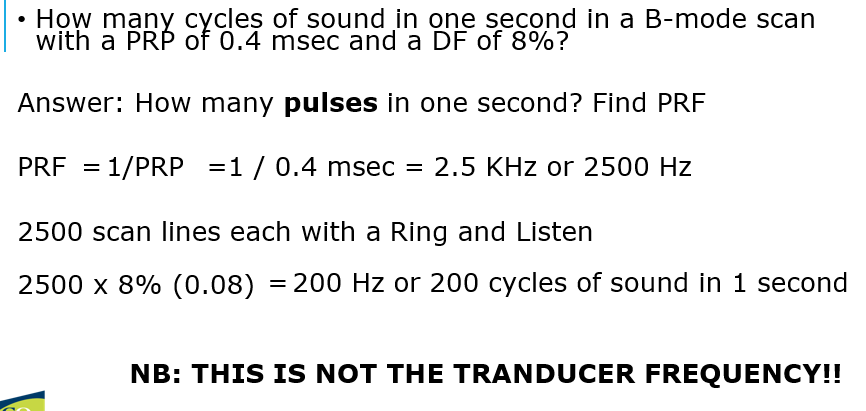
Example: If a transducer with a PRF of 4 KHz is used:
Calculate total time spent ‘ringing’ (very minimal) compared to the time spent ‘listening’.
Spatial Pulse Length (SPL)
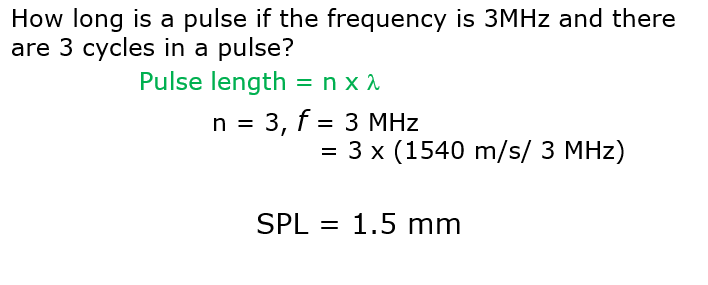
Definition: The physical space that a pulse occupies in the medium.
Unit: Millimeters (mm).
Formula:
Example calculation for a 3-cycle pulse with a wavelength of 0.41 mm:
Impact on Image Quality:
Smaller SPL = Better Image Resolution
Very long pulses lead to poor resolution because they cannot differentiate between closely located objects.
Bandwidth
Definition: The range of frequencies contained within a pulse. The shorter the pulse, the broader the bandwidth.
More Advanced Considerations
The relationship between PRF, PRP, scan lines, and frame rate is critical for understanding how ultrasound imaging works.
Understanding how duty factor, pulse duration and spatial pulse length are influenced by changes in transducer frequency.