PASS Notes
The Skeletal System
Our body systems play an important role to work together to efficiently move the body
Body Systems
Skeletal
Muscular
Circulatory
Respiratory
Endocrine (pancreas, kidneys - internal organs)
Nervous
Reproductive
Lymphatic
Excretory
Digestive
Integumentary (skin)
There are 6 types of bones
There are 206 bones in the adult body
Functions of the skeleton
Shape and support
The way bones are arranged give us our general framework and shape
Sportspeople will all have different shapes because of their framework
Different builds are more suited to certain sports
Bones are firm and rigid they can support the rest of the body and keep us upright
Muscles are attached to the skeleton and it is bones that act as a framework for them
Movement
When bones work with muscles they allow the body to move
Bones are used by muscles as levers that allow movement
Protection
Some bones help protect the internal organs of the body
In some sports where contact is high this is especially important
Blood production
In the long bones in the body the production of red and white blood cells take place
Blood production takes place in the bone marrow
Red blood cells, white blood cells and platelets are all in the bone marrow
Classification of bones
Long bones
Used to provide levers
Produce blood cells
Slightly curved for strength
Found in arms and legs
e.g. femur
Short bones
Specialize in fine movement
These bones can make small adjustments and can help a body keep balanced
Nearly equal in length and width
e.g. tarsals
Flat bones
Tough and can withstand hard impact
Used for protection
Thin and flat
e.g. skull protects brain, sternum protects heart and lungs, and scapula in the back
Irregular bones
Work together and act like a shock absorber
Also used for protection
Unusual shape
e.g. Vertebrae
Sesamoid Bones
Small and must cope with considerable stress
e.g. the patella bone which is located in the tendon of the knee and the pisiform bone of the wrist
As you reach puberty, the pisiform calcifies
Sutural bones
Immovable
Small extra bone pieces that can occur within a suture (joint) in the cranium (another work for skull)
Only in the skull
SKELETAL JOINTS
The Skeleton and Movement
Bones help a sportsperson move more efficiently
Long bones create leverage when playing a sport helping generate speed, force and power
Flat bones are tough and can withstand impact
e.g. in a rugby tackle the pelvis and rib cage protects a player's organs
Short bones specialize in fine movement
e.g. putting the spin on a ball in cricket, or small adjustments to aid balance in a gymnast
Irregular bones work together as a shock absorber
e.g. a basketball player landing from a jump shot will rely on the vertebrae to reduce the shock on their back
Match bones
Type of Bone | Name of Bone |
Long bone | Femur |
Short bone | Tarsal |
Flat bone | Scapular |
Irregular bone | Vertebra |
Sesamoid bone | Patella |
Joints
Joints are where two bones meet
There are three types depending on how much movement they allow
Different joints allow the body to move in different ways. Muscles pull against the bones to create movement
Movement at a Join
Flexion - a decrease in the angle between two bones
e.g. biceps curl
Extension - an increase in the angle between two bones
e.g. in a press up, kicking a ball
Adduction - movement towards the midline of the body
e.g. crossover step in javelin
Abduction - movement away from the midline of the body
e.g. cartwheel
Rotation - movement in the horizontal plane on a longitudinal axis
e.g. movement of the head to allow breathing in freestyle swimming
Pronation (inversion) - an action where the foot or hand is turned inward
Supination (eversion) - an action where the foot o hand is turned outward
Circumduction - an action that is similar to rotation but involves the circular motion of a limb
Plantar flexion - an action of the foot, where the toes are pointed forward
Dorsi flexion - an action where the toes are lifted upwards
Example of joint movements
Flexion of the elbow - bicep curl, bowling
Extension of the hip - kicking a ball, back arch in gymnastics, diving into water
Abduction of the hip - javelin, ice-skating, sidestep
Extension of the knee - kicking a ball
Extension of the wrist - shooting a basketball, throwing a dart
Classification of Joint
Fixed / immoveable / fibrous joints
The bones cannot move at all. The bones are held together by dense bundles of though and strong white collagenous fibers
Examples are joints in tooth sockets and between skull bones
Slightly moveable / cartilaginous joints
At these joints the bones are held together by discs of white fibro-cartilage. These cartilages are strong, but more elastic and compressible than the while fibrous tissue
Examples are joints between the vertebrae pubis and between sternum and ribs
The bones make some movements at these joints through compression of the discs of cartilage
Synovial / freely moveable joints
They are freely movable joints and are present at the elbow, ankle, hip, wrist and knee
In synovial joints the articular surfaces of the bones are covered with a smooth piece of hyaline cartilage
The space between the ends of the bones is filled with a slippery fluid called synovial fluid
The cavity or space is lined by a membrane, the synovial membrane. The synovial fluid and the cartilage allow free movement of bones at the joints
Synovial joints are classified into various types according to the nature of articulation and the degree of movement they allow
SYNOVIAL JOINTS
Synovial Joint
Knee joint - frontal view
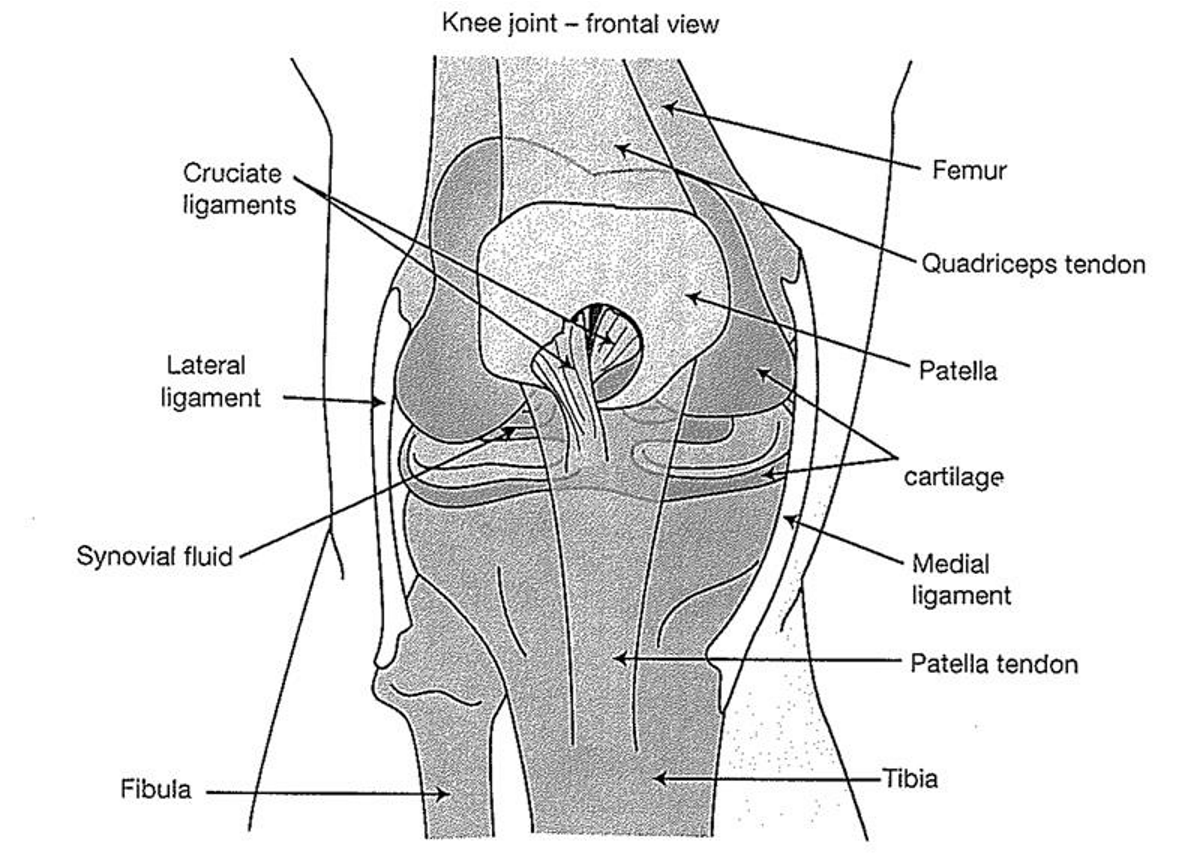
Cartilage - acts as a cushion and creates a barrier reducing the amount of friction
Synovial fluid - lubricated the joint allowing the parts to move against each other smoothly. It also keeps the joint free from infection
Ligament - surround the side of the joint and are made of though elastic fibers. They hold the bones in place and attach bone to bone
Tendon - though band of connective tissue that connects muscle to bone (more likely to get inflamed as not as though as the ligaments)
Types of Synovial Joints - WILL BE IN THE TEST
Hinge joint
Enables flexion and extension to occur
Movement is along one plane only
e.g. elbow, knee, fingers
Ball and socket
It's allowed the ball and socket because the head of a long bone is shaped like a ball and fits into a socket in the shape of a cup
Allows movement along several planes
Ball and socket joint allows flexion, extension, adduction, abductoin and rotation
e.g. shoulder, hip
Adduction is towards your body (your adding to your body)
Abduction is away from the body (you are taking your hands away from your body, you are being abducted)
Pivot joint
Allows rotation to occur
e.g. between radius and ulna which enables us to rotate the elbow
In the neck between the atlas and axis bone
Condyloid Joint (or Ellipsoid Joint) (IF ASKED IN AN EXAM WHAT JOINT THE WRIST IS, SAY THIS ONE)
Allows movement in two planes
It enables flexion, extension, abduction, adduction and circumduction
The wrist
Gliding Joint (or Plane Joint)
Allows sliding or gliding movement
Two flat-ish surfaces on top of each other allowing it to slide and twist
These joints are made up of small bones that move over each other in quick repetitive patterns. This is what allows the writs to move in so many direction
e.g. the wrist
Saddle Joint
The opposing surfaces are reciprocally concave-convex
It enables flexion, extension, abduction, adduction and circumduction
e.g. in the thumb
Name of Bone | Type of Bone | Function during Exercise |
Vertebral column | Irregular bones | Movement and support |
Femur | Long bone | Primarily used for movement but also for support |
Cranium | Sutural bones | Protection and structure |
Pelvis | Irregular bones | Support, protection and movement |
Ribs | Flat bones | Protection |
Carpals | Short bones | Movement |
Tarsals | Short bones | Movement |
Tibia |
|
|
Radius |
|
|
Ulna |
|
|
Clavicle |
|
|
Scapula |
|
|
Patella |
|
|
Humerus |
|
|
THE MUSCULAR SYSTEM
Approximately 40% of the body mass is made up of muscle tissue, with the main purpose being to move bones
Every body movement is the result of muscular action
Muscles generally work in pairs. When one is contracting the other is relaxing
e.g. as the biceps contract they become shorter and the elbow bends (flexion), while the triceps relax and lengthen. When the triceps contract and the biceps relax, the arm straightens (extension).
Introduction to the Muscular System
The integrated action of joints, bones, and skeletal muscles produces obvious movements such as walking and running
Skeletal muscles also produce more subtle movements that result in various facial expressions, eye movements, and respiration
Heat production, to maintain body temperature, is an important by-product of muscle metabolism. Nearly 85% of the heat produced in the body is the result of muscle contraction
Video Notes
650 muscles cover the body
Made of 3 main muscle types
Skeletal muscle
30-40% of the body weight and are the main type of muscle
Connected to the nervous system
2 types of fibers, fast-twitch and slow-twitch (e.g. your back to keep your posture)
Smooth muscle
Managed by the autonomic nervous system
Cardiac muscle
Managed by the autonomic nervous system
Ted Talk Questions
Multiple Choice
What type of muscle makes up the musical system?
Skeletal, cardiac and smooth muscle
Fast twitch muscle cells:
Would be abundant in the muscles of a sprinter
One types of muscle contraction results in a stabilizing force. This:
Enables us to stand and sit upright
What proportion of the body's wight does the muscle system make up?
40%
Without the muscular system, we wouldn't be able to make most of the body heat that we require
True
Short Answer
Describe the function difference between fast and slow twitch muscles?
What benefits does the muscular system provide, other than just helping you move?
If our muscles didn't generate opposing forces, in what specific ways would that limit us?
Types of Muscles
Approximately 45% of our body weight is muscle
There are 3 types of muscle issue
Voluntary/skeletal muscle
Which are attached to the skeleton and which we control
Involuntary muscle
Which are not under our control and contract/relax automatically
Cardiac muscle
Found in the wall of the heart, that will never tire as long as it has a good blood supply
Skeletal Muscle
Muscle is made of protein
Skeletal muscle is made of cylindrical fibers
Skeletal muscles cells are long and thin
All these muscle are attached to the skeleton
These muscles pull on bones to create movement
Muscle are made of fibers
Each fiber contains many myofibrils (any words that start with myo is the latin word or muscles)
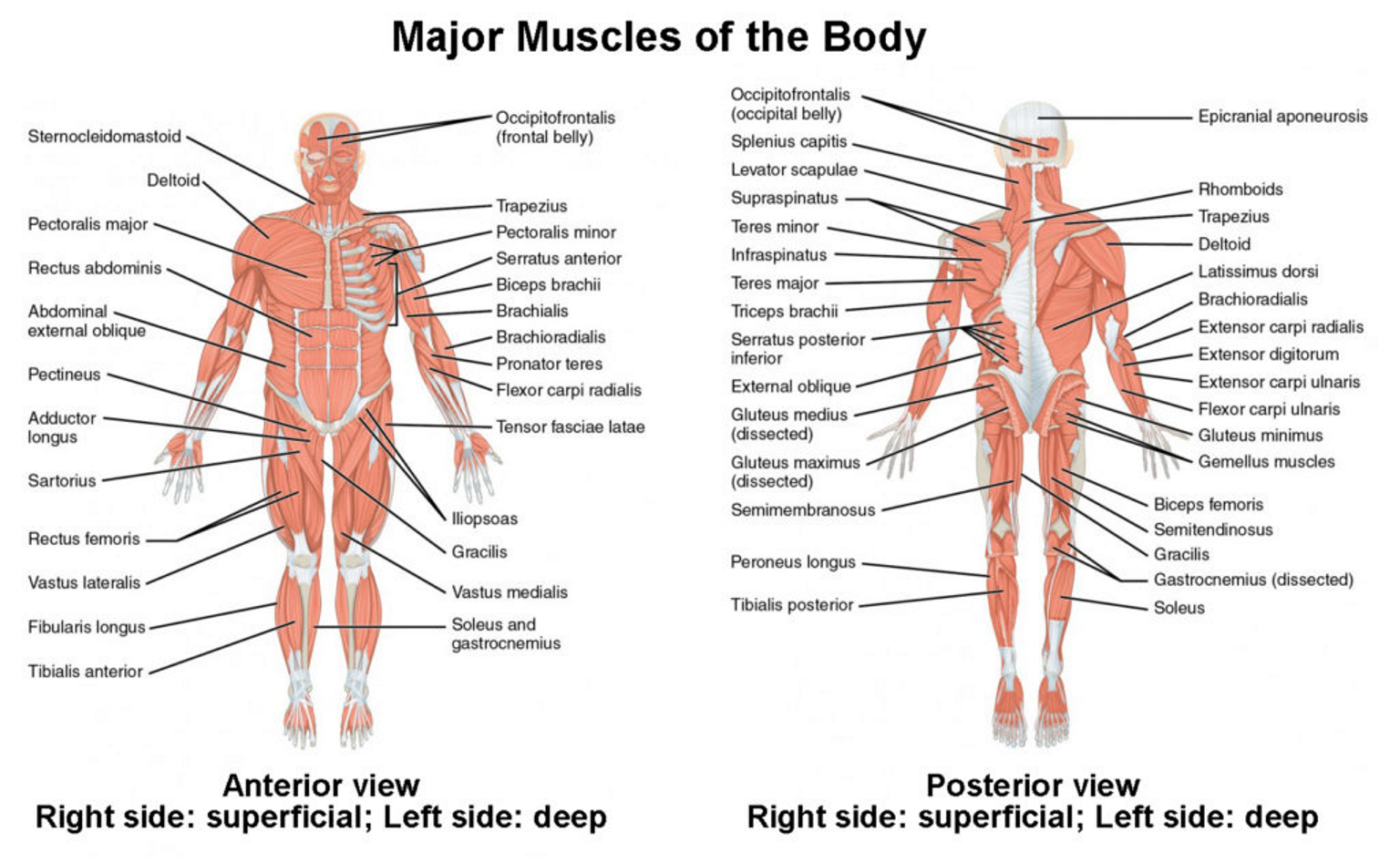
Function of Different Muscle Groups - Upper Body and Limbs
Trapezius
Holds back the shoulders
Is attached to head and neck
Functions are to lift shoulders, to brace back and rotate scapula
Latissimus Dorsi
Adduction and rotation of arms
Pectorals
Adduction of the arms and draws arms forwards and rotates it
Deltoid
Abduction of the arm and lifts arm above the head
Abdominals
Hold your stomach in as well as flexion and rotation of trunk
Biceps and Triceps
Flex and extend arm
Function of Different Muscle Groups - Lower Body
Gluteus Maximus
Pulls leg backwards
Quadriceps
Extends the leg
Hamstrings
Flexes the leg backwards
Gastrocnemius
Ends in the Achilles tendon and points toes away
Muscles and Movement
The skeleton provides attachment for the muscles
Muscles contract against the skeleton to move
Most muscles are long and thin, when they contract they get shorter and thicker
Muscles are attached to the bones by tendons
Muscles are attached at both ends. At the origin to something rigid and at the insertion which at the bone is moves
Muscles work in pairs. One muscle contracts whilst the other relaxes. This is called antagonistic action
A prime mover is the muscle that moves the joint in a particular direction
A synergist will work with another muscle to create movement. Often it works in stabilizing a joint for movement to occur
Complete the table
Muscle | Movement |
| Body Part |
Biceps | Flexion of the arm | of the | Elbow/upper arm |
Triceps | Extension of the arm | of the | Elbow/upper arm |
Deltoid | Abduction of arms + extension of arm above head | of the | Should cap/shoulder |
Latissimus Dorsi |
| of the | Back/shoulder |
Quadriceps |
| of the | Thigh/knee |
Hamstrings |
| of the | Thigh/knee |
Tibialis Anterior |
| of the | Skin/ankle |
Gluteal |
| of the | Behind/hip |
Gastrocnemius |
| of the | Calf/ankle |
Ilio-psoas | Flexion | of the | Hip |
Questions
For the following actions work out
Antagonistic pair
Contracting muscle
Relaxing muscle
Fixator point
Flexion of arm at elbow
Flexion of leg at knee
MUSCULAR SYSTEM
Two types of muscle fibres:
Fast Twitch
Fast twitch fibres are used for short burst of energy usually in explosive activities. They only have a limited oxygen supply so tire quicky. Best used for speed events, throwing and jumping
Slow Twitch
Slow twitch fibres are used for slow prolonged activities involving endurance They can contract many times and stay efficient for long periods. They have a good oxygen supply. Best suited to long distance running, cycling or swimming
Activity | Muscle fibre |
100m sprint | Fast |
300m race | Fast |
Throwing a javelin | Fast |
Kicking a penalty in rugby | Fast |
10k cycle race | Slow |
A handspring vault in gymnastics | Fast |
1500m swim | Slow |
Training the Muscular System
Strength - the maximum force a muscle can contract. By repeating strength exercises the size of the muscle increases as well as becoming stronger. Increases muscle size is advantageous in several sports. Weight training can be used to increase strength and the athlete would lift heavy weights for a few repetitions
Powerlifting
Shot put
Javelin
Wrestling
Gymnastics (vault)
Rock climbing
Boxing
Muscular endurance - means that the muscle can continue to work over a long period of time without tiring. Training that muscles this way will not increase muscle size only their ability to work for longer. If weight training is used then light weight with lots of repetitions would improve muscle endurance. Muscular endurance is needed in specific sports like long distance running but also in general in games
Triathlon
Marathon running
Ironman
Swimming (medley)
Cycling (long distance)
Muscle Contractions
Isotonic muscle contractions - this is when there is movement of the body. The muscle will contract and relax - shortening and lengthening as it does. Working the muscles isotopically improves dynamic strength
Push ups
Pull ups
Bicep curls
Running
Squats
Isometric muscle contractions - this is when the muscle length stays the same. Used for stabilising parts of the body and holding the body steady so movement can take place. Working the muscles isometrically improves static strength
Tiring because it's underload but it's not moving
Plank
Holding leg lift
Balancing on one leg
Wall sit
Half-curl/holding a bicep curl
Front lever
THE CIRCULATORY SYSTEM
All parts of the body are linked through this system. In particular the circulatory system is the transport systems of the blood. Its function is to carry nutrients and oxygen to the cells of the body and to transport waste materials to the required areas.
It is made up of the following:
Blood (the circulating fluid)
Blood is a specialized fluid connective tissue
Blood:
Distributes nutrients, oxygen and hormones
Carries metabolic wastes to the kidneys
Transports specialized cells that fight off infection
There are 2 main components of blood:
Plasma (containing such things as dissolved proteins, e.g. fibrinogen - clotting) and makes up roughly 55% of blood. Water makes up 92% of blood volume
Formed elements (platelets, WBCs, RCBs - 99.9%)
Heart (the pump)
Arteries (blood vessels from the hear)
Capillaries (exchange beds)
Veins (blood vessels to the heart)
The Circulatory System is made up of the following:
Blood (the circulating fluid)
Blood is a specialized fluid connective tissue
Blood:
Distributes nutrients, oxygen and hormones
Carries metabolic wastes to the kidneys
Transports specialized cells that fight off infection
There are 2 main components of blood:
Plasma (containing such things as dissolved proteins, e.g. fibrinogen - clotting) and makes up roughly 55% of blood. Water makes up 92% of blood volume
Components:
Water - transfers heat, dissolves and transports molecules, distributes blood cells
Electrolytes - extracellular fluid ion composition essential for vital cellular activities
Nutrients - used for energy production, growth and maintenance of cells
Organic wastes - transported to sites
Proteins - transport and things like clotting
Formed elements (platelets, WBCs, RCBs - 99.9%)
Components:
Red blood cells - transport gases (O2 & CO2)
White blood cells - provide a defense mechanism against infection through removing toxins, wastes and damaged cells
Platelets - function in blood clotting
Heart (the pump)
Arteries (blood vessels from the hear)
Capillaries (exchange beds)
Veins (blood vessels to the heart)
How much blood do we have in our systems?
Men:
Women:
56
104
Effects of exercise on the Heart
A fit athlete will have a lower than normal HR at rest
With continuous exercise the heart will become larger, stronger and more efficient. (This means it won't have to beat as many times to pump the same amount of blood around the body)
Why else are athletes HR's lower??
Less resistance (in veins and arteries, and getting the blood back to the heart)
More efficient system of O2 uptake
The Heart Questions
Why is the heart referred to as a 2 sided or double pump
What is the function of the valves?
What is a normal HR?
What process occurs in the capillaries?
How long does it take for blood to be circulated?
What are some of the major diseases/illnesses that affect the heart?
Research Task
What is a cardiac cycle?
The cardiac cycle is a series of pressure changes that take place within the heart. These pressure changes result in the movement of blood through different chambers of the heart and the body as a whole. There are three major stages of the cardiac cycles:
Atrial systole
Ventricular systole
Complete cardiac diastole
What is the difference between diastolic BP and systolic BP
Diastolic blood pressure measures the pressure in your arteries when your heart rests between beats. Whereas, systolic blood pressure measures the pressure in your arteries when you heart beats.
Why is it important to measure it?
It is important to get your blood pressure measured so you can have a clearer picture of your risk for heart disease and stroke. Having your blood pressure read can save your life as a high blood pressure can increase your risk of developing serious problems if not treated.
What is our max HR?
Maximum heart rate is the upper limit of what your heart and blood vessel system can handle during physical activity.
You can estimate your maximum heart rate based on your age, by subtracting your age from 220.
e.g for a 50 year old person, the estimated max
What is the relationship between workload and HR?
What is the difference between cardiac output and stoke volume?
What impact does training have?
THE RESPIRATORY SYSTEM
In order to function, the human body must be able to breathe. His enables oxygen to be supplied to the working cells and enables the removal of carbon dioxide
The exchange of these gases between the body and the environment is called RESPIRATION
Your respiratory system is responsible for the uptake of oxygen, the transfer of oxygen unto your blood and the removal of CO2
Anatomy of the respiratory system
The respiratory system consists of
Nasal Cavities
Warms and filters air
Moistens air: mucous lining the nose moistens the inspired air to assist the functioning of the air passages
Pharynx
Is the passage from the nasal cavity to the larynx
Is the common passage for food and air stopped by the epiglottis which allows food into the esophagus
Larynx
Contains vocal cords and is located at the beginning of the trachea
Trachea
A tough flexible tube that extends from the larynx down to the bronchi
The trachea is lined with cartilage which is C-shaped and stiffens the walls
It is lined with cilia (small hair-like structures that push mucus out of your trachea)
Bronchi
Are two branches of the trachea which leads to the right and left lung
Each Bronchus divides into a number of branches (bronchioles) within the lung
Bronchi (plural)
Bronchus (singular)
Bronchioles
Are smaller branches of the bronchi which act as a passageway for air the reach the air sacs called alveoli
Alveoli
These are tiny 'air sacs'
They look like grapes and are covered in capillaries. Oxygen is transferred into these capillaries and CO2 is transferred out
Oxygenated blood returns to the heart from the lungs and CO2 is exhaled
Lungs
Are composed of millions of tiny air sacs
Expand and contract up to 20 times a minute to supply oxygen to be distributed to tissues all over the body and expel carbon dioxide that has been created throughout the body
Diaphragm
It is a sheet of muscle at the base of the chest cavity ad is crucial in the process of breathing
It is the diaphragm that creates the pressure difference to draw air in and force air out
The effect of exercise on the circulatory and respiratory systems
Changes to the circulatory system
Stronger heart muscle
Increased cardiac output
Increased stroke (beat) volume - push more blood around the body
Lower resting heart rate
Increased capillarisation
Stronger heart muscle
Your heart muscle itself doesn't get stronger, but the physiology around it improves the function of the heart, by making it more efficient
Exercise lowers heart rate and blood pressure, which enables you to exercise longer before you get tired because your heart is working more efficiently
Each heart beat delivers a greater volume of blood to your exercising muscle so your heart doesn't have to work as hard
Increased cardiac output/stroke volume
Your heart can also increase its stoke volume by pumping more forcefully or increasing the amount of blood that fills the left ventricle before it pumps
Generally speaking, your heart beats both faster and stronger to increase cardiac output during exercise
Lower resting heart rate
A fit athlete will have a lower than normal HR at rest
With continuous exercise the heart will become larger, stronger and more efficient (this means it won't have to beat as many times to pump the same amount of blood around the body
Increases Cappillarisation
Capillarisation is the process where new capillaries are formed
Capillarisation takes place at the alveoli in the lungs and the skeletal muscles
This has the effect of increasing the amount of oxygen that can be transferred to the working muscles as well as increasing the amount of carbon dioxide that can be removed
Changes to the Respiratory System
Tidal volume
Tidal volume is the amount of air breathed in with each normal breath
The average tidal volume is 500 ml
During exercise, tidal volume increases as the depth of breathing increases and the rate of breathing increases too
This has the effect of taking more oxygen into the body and removing more carbon dioxide
Vital Capacity
Vital capacity is the maximum amount of air that can be breathed out after breathing in as much air as possible
Taking part in regular aerobic exercise has been shown to increase a person's vital capacity
More efficient Gaseous exchange
Increased capillaries leads to a faster gas exchange both in alveoli in the lungs and in the muscles throughout the body
Recover After Exercise
After a training session or playing a game tour body needs to return to a normal state - this is called recovery
It takes some time for your body to recover
Oxygen Debt
After strenuous exercise like sprinting, your muscles need extra oxygen quickly
This extra oxygen is called OXYGEN DEBT
You will pay it off by gulping air into your lungs
When exercise is over, lactic acid must be removed as the body's tolerance is limited
To remove lactic acid, the processes require oxygen. This is why a person's breathing and heart rate do not return to normal straightaway
The amount of oxygen required to remove the lactic, acid, and replace the body's reserves of oxygen, is called the oxygen debt
Recovery
Heart Rate
The heart rate slows down to its normal resting rate
The fitter you are the faster this happens
Lactic Acid Removal
Lactic acid will have been produced in the muscles and you will need to get rid of it
Oxygen removes lactic acid from the body
The body normally breathes deeper and faster to do this
The process is faster if you do a cool down
Muscle Repair
The muscles may suffer minor damage during training
Exercise may cause microscopic tears in muscles and fibers
Your body has to repair this
Stiffness and soreness take time to clear
Stretching as part of a cool down helps prevent stiffness
Replacing Glycogen
The glycogen stores in the muscles get used up during exercise
The store in the liver may also get depleted
It take time to replace glycogen
A starchy snack (e.g. a banana, or pasta) after exercise will help
After prolonged exercise, such as marathon running, it can take 48 hours for glycogen stores to recover
How long does it take?
This depends on:
How much strenuous the exercise was
Your fitness, the fitter you are, fast you recover
Allow 24-28 hours between training session for recovery in the early stages of training
If you train every day, follow a heavy session one day with a light session the next
Even during heavy training, take one rest day a week
5 Types for Post-Workout Recovery
Drink lots of fluids and hydrate
Important to drink lots of fluids if you want to avoid muscle fatigue, damage and other complications
Many athletes focus on drinking water before exercise and forget to do it afterwards as well. Others have the bad habit of only drinking water when they fell thirst, which is not recommended
To dimmish the risk of tears, ruptures, and other sports-related injuries, always drink plenty of water after your training
Get a good night's sleep
Lack of sleep can greatly hinder not only the course of your muscular recovery but also your overall athletic performance
Sleep deprivation is detrimental to recuperation as it inhibits the body's natural processes
Focus on tour protein and carbohydrate intake
Protein is the number one muscle repairing nutrient you can incorporate in your diet, and carbohydrates refuel your energy reserves
It is essential to consume a snack that is rich in protein before bed so that your muscles repair over time
Plan your rest days accordingly
When it comes to rest days, the general rule is to maintain a healthy gap of 48 hours between workout if you are a fan of more physically demanding routine
Never forget about stretching, especially during recovery days. IN time, this habit will help your muscle recovery and won't be a burden any longer
Depending on your age and skill level, you might require less time to rest or more
Take cold baths when needed
Muscle tension and fatigue can be improved with a cold bath
This will help reduce soreness and inflammation for a period of 24 to 48 hours
Ice will also act as an anesthetic that will numb the affect area and make the recovery a lot easier
ENERGY PRODUCTION DURING PHYSICAL ACTIVITY
Energy Balance Model
The combination of nutrition and physical activity in relation to weight management is referred to as energy balance
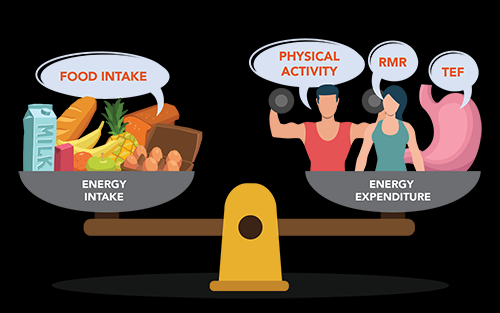
Nutrition, Physical Activity & Weight Management
A fundamental principle of nutrition and metabolism is that body weight change is associated with an imbalance between the energy content of food eaten and energy expended by the body to maintain life and to perform physical work
Healthy weight loss or gain
Occurs over time through proper nutrition and physical activity
A healthy weight loss or gain target is 0.5-1.0kg per week
Quick fix solutions may have an immediate weight loss effect but they are not long term solutions and often have negative health consequences
Energy intake includes 3 major macronutrient groups - carbohydrate, protein, and fat
Any imbalance between the intake and utilization of these macronutrients will lead to an alteration in body composition
Energy use varies between and within individuals depending on body size, body composition and recent energy imbalance
Greater total tissue mass increases it, and the contribution of lean tissue is greater than fat tissue
Activity
Input your personal information to see how many kilojoules you should be eating
8205kJ
Then compare energy requirements for a 70kg, 170cm, maintain weight
24 year old male, very active occupation - 12,317kJ
70 year old female, little to no activity - 6,623kJ
14 year old male student, moderate activity - 11,436kJ
Who requires the largest amount of energy each day?
The mid-twenty year old male that is the most active
What is the difference between the woman and the student?
The male is more active and is much younger, this would mean that they need more energy to move around and do their daily activities
4,813kJ
Influence of energy production on performance
'You are what you eat'. This saying indicates that what you put into your body is what you will get out of it - by eating healthy foods, you will look and feel much better
That intake of energy (the food we eat_ for physical activity is an important factor to consider before, during and after the performance of any physical activity
Energy Consumption
If an athlete consumes a lot of sugary foods for instant energy (simple carbohydrates) this will not be of benefit to them, as this quick energy burst can result in very low energy levels soon after, as well as cravings for more
It is far better for an athlete to have a nutritious balance of foods in their diet to maximize their energy output. They will perform much better, feel great and as a result be able to maintain a healthier lifestyle
Role of food as fuel sources
The three main nutrients we consume are carbohydrates, proteins and fats (lipids)
Carbs are the preferred energy source as they are the easiest to convert
Carbs provide an equal amount of kj energy as proteins, although fats provide the most energy but it takes a long time to digest/convert
The most efficient muscle fuel is complex carbohydrates, as they supply our muscles with glycogen, which in turn acts as an energy reserve for the muscles - glycogen is stored in the muscles
Protein is important for muscle growth and repair
Fat is used for transportation of hormones and insulation, and can also be a source of fuel when glycogen stores are depleted - important for fat soluble vitamins like A, D, E, K - water soluble vitamins B, C
Vitamin D is used for the strong bones, important for athletes
Vitamin E used for immune system and cell development / repair
Vitamin K used for blood clotting
Vitamin B (1,2,3) metabolism
Aerobic energy system (with oxygen - endurance based)
The aerobic energy system is used for long duration or endurance exercise that uses oxygen to break down glucose
This system is used most often, as we use it for day-to-day living and basic activities
Most important energy system for endurance athletes. Most physical activity will commence with his system and call upon the anaerobic system when faster or more powerful movement is required
Anaerobic Energy System (without oxygen - depletes first - short cycle of energy system)
The anerobic energy is used for exercise that involved short duration or stops and starts
This system is broken into two types:
Lactate energy system, which relies on the use of glycogen for energy, with lactic acid as the by-product
Latic Acid - from 10 seconds to approximately 3 minutes - depends on how explosive the action is
Need to cool down and subside the effects of lactic acid
Up to 2 hrs to replenish
Breaks down glycogen
Phosphate energy system, which relies on stores of creatine phosphate as the energy source and is used in very fast explosive movement
ATP PC - explosive and up to 10 seconds -
Takes 2 minutes to be replenished
Byproduct is water
Energy Systems
The energy system that is used is determined by:
Type
Duration (length of time)
Intensity (how hard) of the exercise is performed
A combination of these energy systems is used for participation in most sports or physical activities
e.g. an endurance athlete would use the aerobic system for the majority of a long-distance event but to maintain the same speed up a steep hill they would need to use the anaerobic lactate or phosphate systems for a small amount of time
Sports/activity | Energy System |
Long jump | Anaerobic - quick movement, explosive |
Triathlon | Aerobic for most of the race, Anaerobic for the first and last few metres |
100m sprint | Anaerobic |
Mid field soccer player | Mostly Aerobic but at some points Anaerobic for sprints |
Javelin | Anaerobic |
Basketball - guard | Aerobic to keep on running around but anerobic in bursts |
Netball - GA | Sustained aerobic system used for anaerobic in bursts as well, mostly using anaerobic systems to make quick breaks/movements |
High jump | Anerobic - high recovery time and explosive and quick |
Table tennis | Anerobic and aerobic - quick bursts of explosive hits and aerobically to last the full match |
Tennis | Anerobic and aerobic - have to sustain over a match but need to make quick explosive runs |
TOUCH FOOTY RULES
7 Basic Rules of Touch Footy
There are six players for each team on the field at a time. Though there can be up to 14 players on the team, with unlimited substitutions.
You can only pass backwards.
If you get touched with the ball, you have to put the ball on the ground and step over it.
The person who collects the ball, known as the ‘dummy half’, should try to offload quickly because they’re not allowed to get touched or score. If they do, it’s a ‘changeover’ (the ball goes to the other team).
The team that makes the touch has to get back seven metres before they can make another touch.
After six touches to a team, there’s a changeover.
The ball can’t touch the ground. If it does, it’s a changeover.