Socio-Cultural Lens
Background
COMM1100 is about decision making by organisations, with assumptions made; context was not considered. COMM1150 focuses on the external context/factors (environment) in which these decisions are made.
“Context” and “environment” used interchangeably
Context or environments are dynamic (changing), heterogenous (things are different in different parts of the world), and multi-layered
"Global" means holistic, or the whole world
When something is complex, we need to take it apart.
Context is important to make the right decisions, which results in impact.
Global Business Environment and Complexity
The global business environment is very complex because it is not only heterogeneous, but also changing. We make sense of this complexity through levels and lenses (areas to focus on). It is an analytical approach to addressing complex, dynamic problems and issues.
Analytical approach: break complexity into 4 lenses
Social & cultural (THIS WEEK)
Political & legal (Week 3)
Economic
Sustainability (Week 5)
Levels framework (zooming in/out)
Micro ↔ Macro; Local ↔ Global
Example hierarchy: Kensington → Eastern Suburbs → Sydney → NSW → Australia → Southern Hemisphere → World
In terms of levels, think about global events that have affected Australian businesses; this is at a global/international level, and the national level. Answers include pandemics, world politics, tariffs - these are things happening at the global/international level, but they affected the national level. It is all about the external environment of the business.
Again in terms of levels, there is the international/global environment level, which includes the world, down to regional blocks (e.g. EU, ASEAN), and the national environment, which includes nation-state (country), down to state/province, down to regions within states/provinces, down to cities, and further.
If you are sitting in UNSW campus at Kensington, Kensington is also in the Eastern suburbs, Eastern suburbs is part of Sydney, Sydney is part of NSW, NSW is part of Australia, Australia is part of Southern Hemisphere. Point is, they can be divided up into many more levels.
In terms of zooming in and zooming out, zooming in is getting closer to the ground, to the local level, looking for finer details for a particular locality, and zooming out is going to the global level. You go from the micro level, which is the most detailed, local, analysis, at the level of individuals, all the way up to the whole world, macro, which is the global level. From micro to macro, or from local to global.
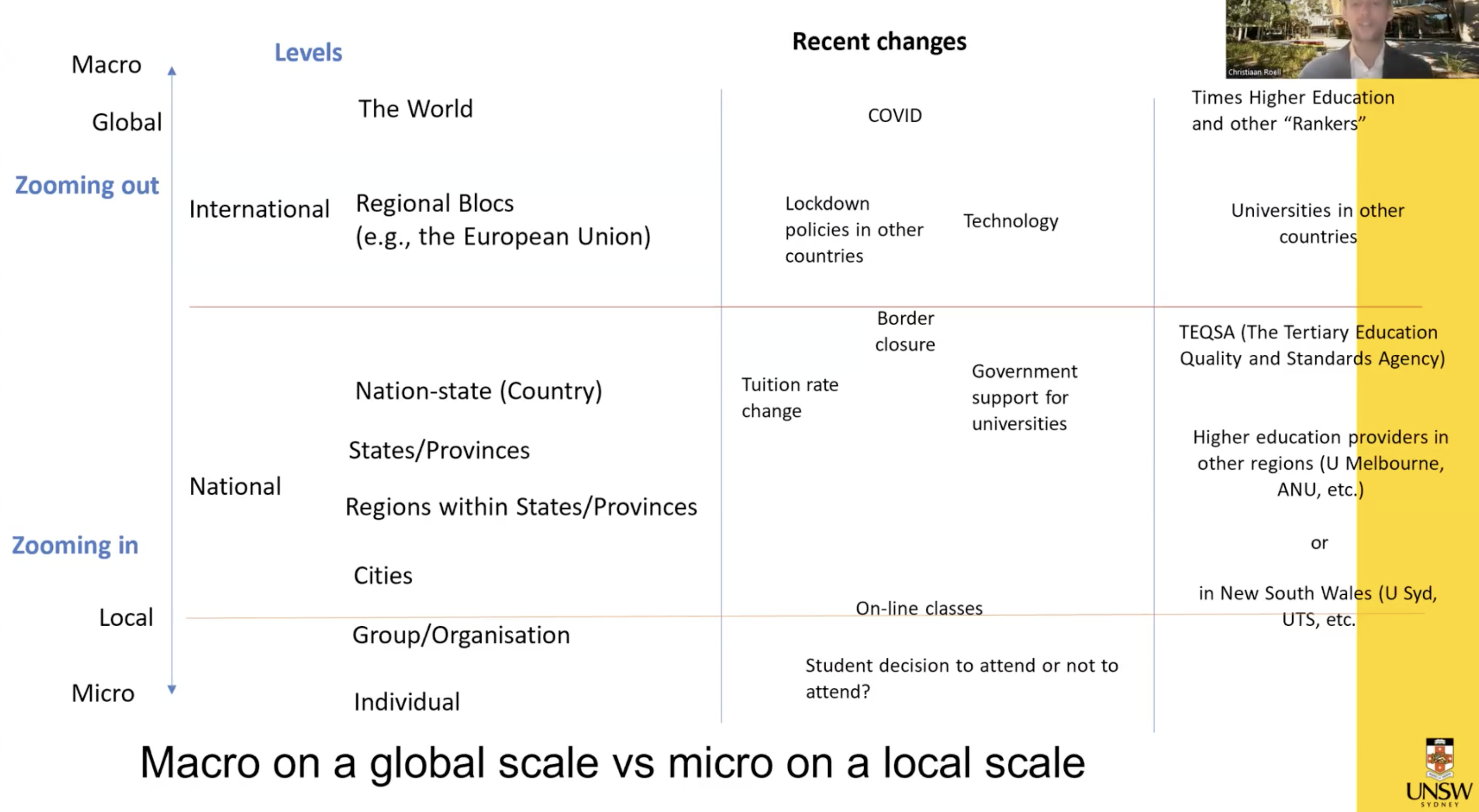
Referring to the diagram, think about individual decisions; for example, whether to attend a lecture or not. Professors have to decide whether to do the class online or in person. During the pandemic, lectures had to be fully online. There are different stakeholders which are important at different levels; at the micro level, that is UNSW, at the national level, there are different bodies that look at education standards, and we also have organisations that provide rankings for universities across the globe – these, therefore, are the stakeholders at the global level. Stakeholders differ by level (students & lecturers ↔ accreditation bodies ↔ global university rankers).
What is important regarding zooming in and zooming out is understanding that what happens at one level can actually have effects on what happens at another level.
The four lenses are also interconnected. Some cultures are, for instance, much more likely to take risks than other cultures; this may, for instance, influence the levels of entrepreneurship in a country and therefore also the economy. Political systems also influence the economy; the stark differences between North and South Korea are to do with political systems.
Socio-Cultural Lens
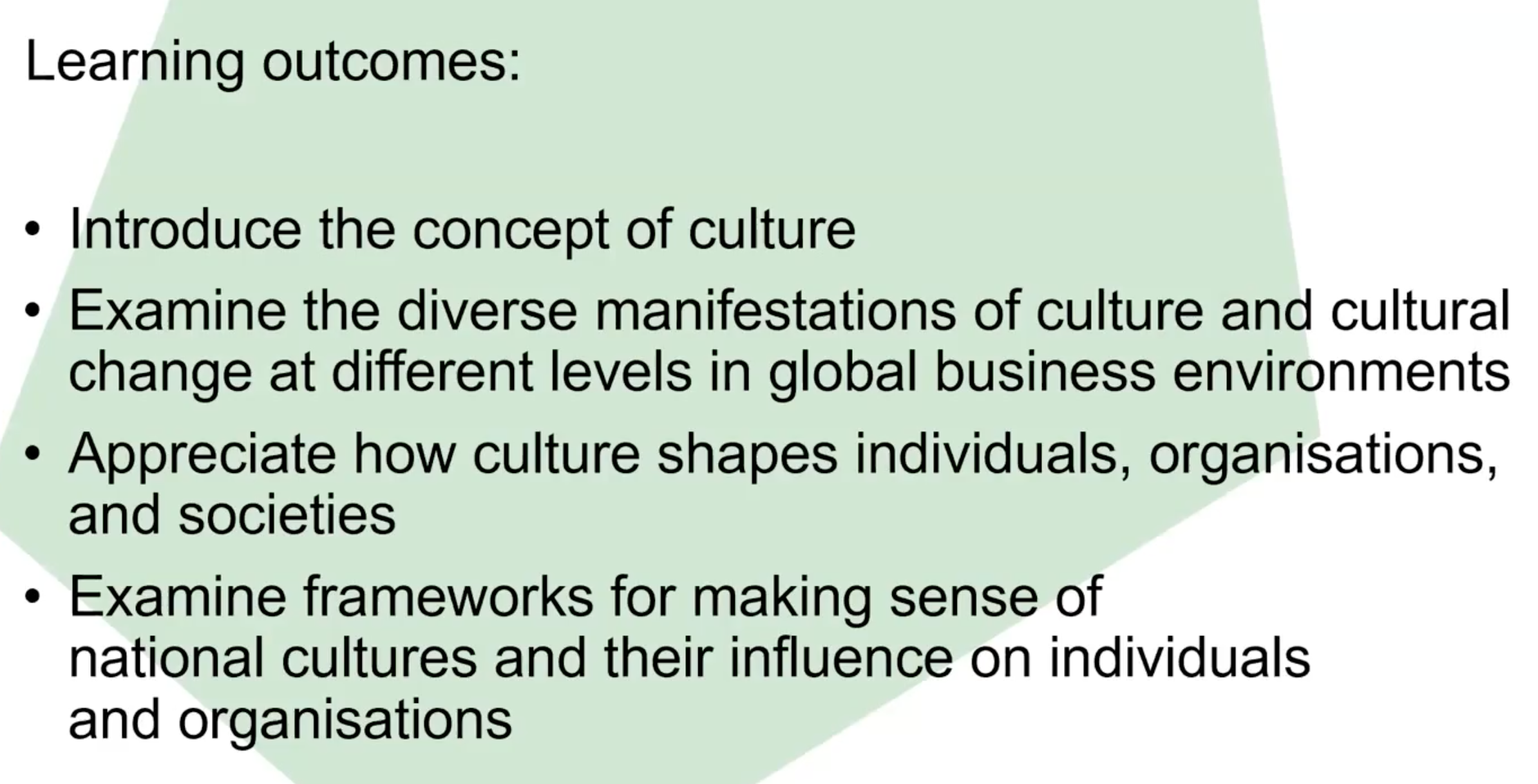
Culture = crucial yet "loaded" term; multiple scholarly definitions (≈ catalogued)
Why does culture matter for the GBE? Particularly for multinational enterprises, they have to deal with many different types of cultures; in a way, culture shapes us individuals, organisations and environments.
How do we make the right decisions in the cultural context? Cultural diversity is important.
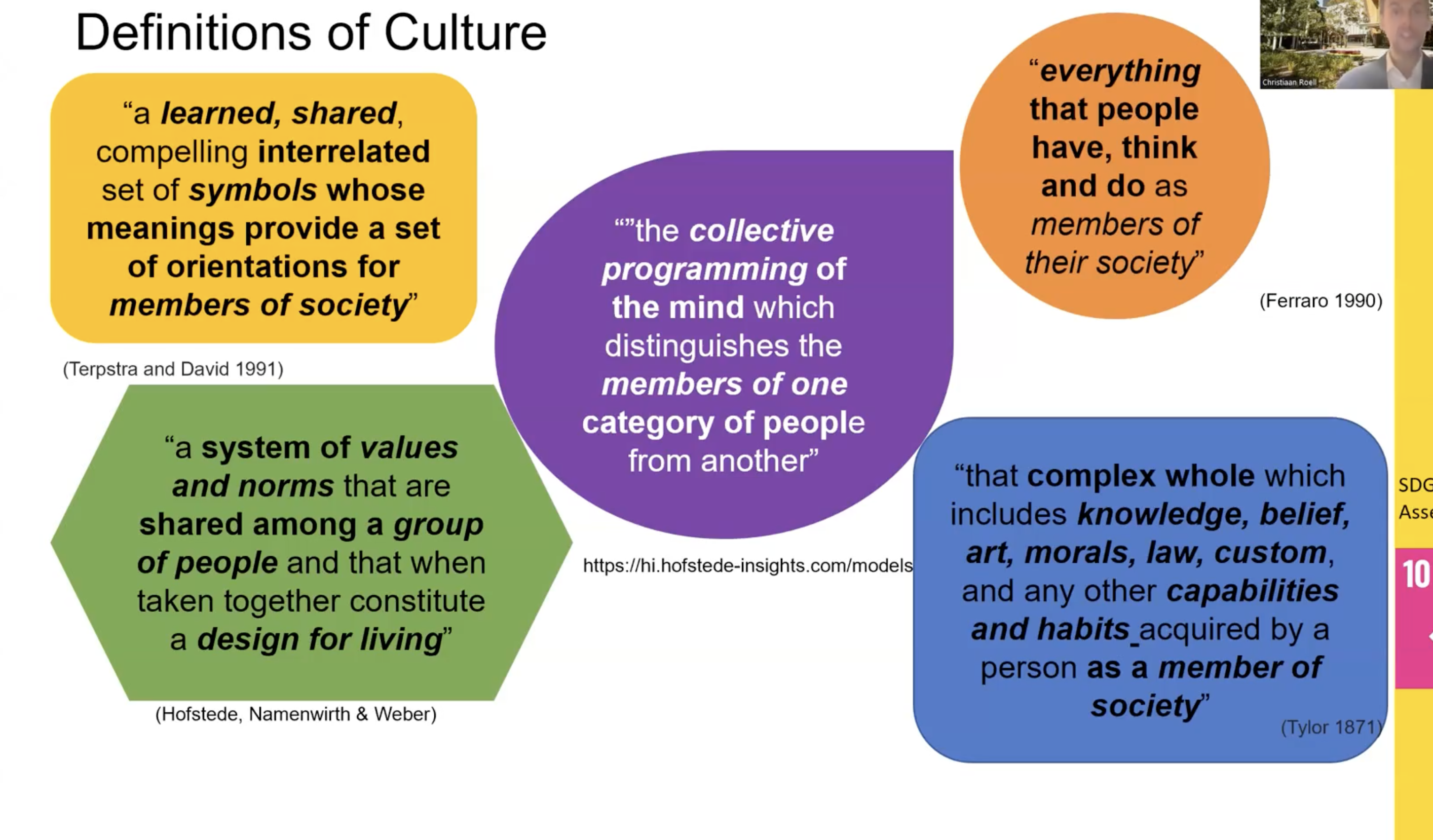
Important considerations from definitions include MEMBERS OF SOCIETY, NORMS AND VALUES SHARED AMONG A GROUP OF PEOPLE, PURPLE DEFINITION shows that culture is a binding force (something people have in common) but also divisive force in that it separates groups of people. Refer to below.
Common threads across the different definitions of culture.
Shared among group members
System of values and norms
Learned over time (nurture, not nature)
Learned over time through different institutions, your education system, your family members, television
Provides orientation/meaning through symbols, norms, values
Is enduring yet dynamic (slowly changes) (parents, grandparents)
Binds insiders & divides outsiders (membership)
Key characteristics
Shared among a group of people / collective, that is not accessible to those outside the group (divisive force).
Learned & enduring (transmitted via family, schools, media, religion). Learned very on in childhood. Nature, not nurture. It's not something you're born with, but it's something that you learn over time into institutions. Think about religious beliefs, norms, forms of marriage. All of these things are going to pass down through generations.
Interrelated & organised (mutually reinforcing)
Dynamic / evolving (e.g., work-from-home norm due to pandemic) but slowly
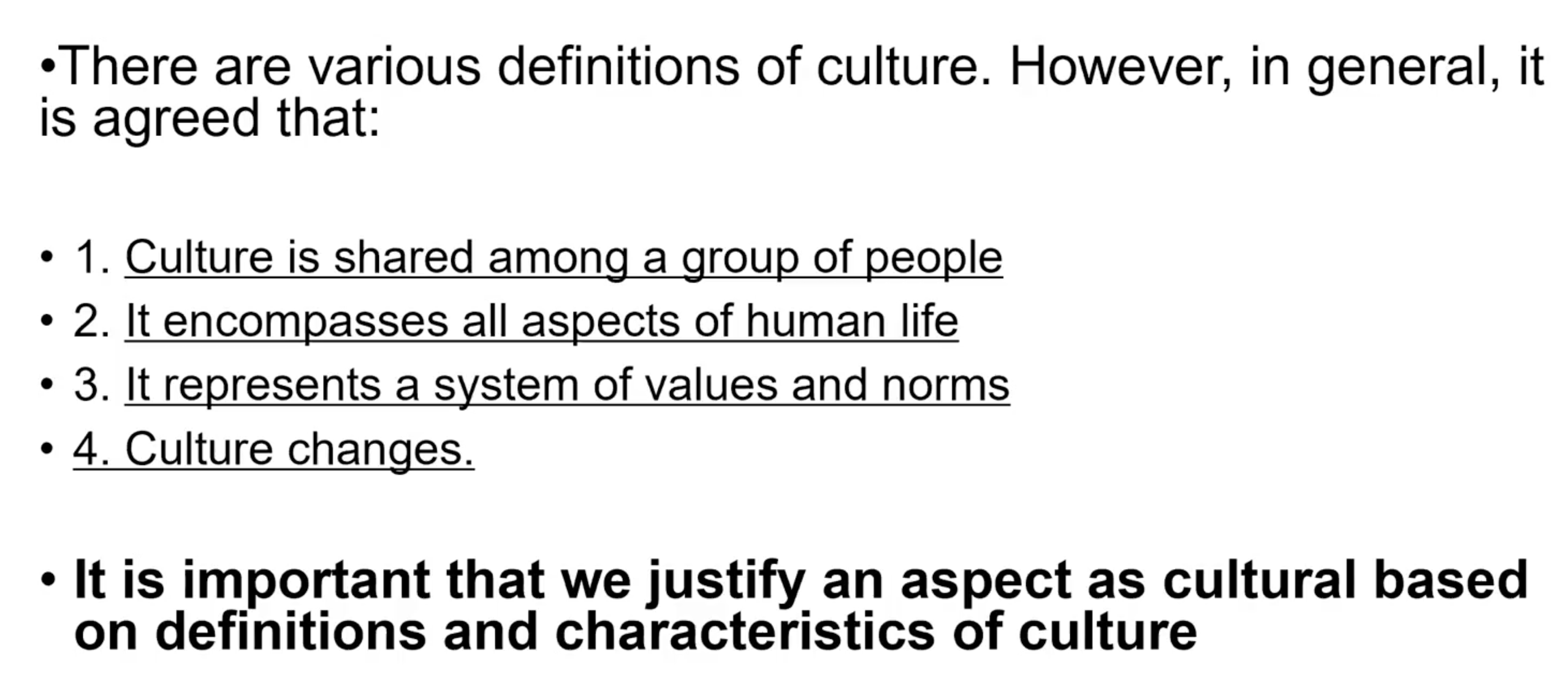
In assessment, in relation to dot point in bold, we need to clearly and explicitly mention and explain why something is related to culture, why something is cultural. You can do this either by referencing a definition, for instance, or by clearly explaining that it is one of the characteristics of culture.
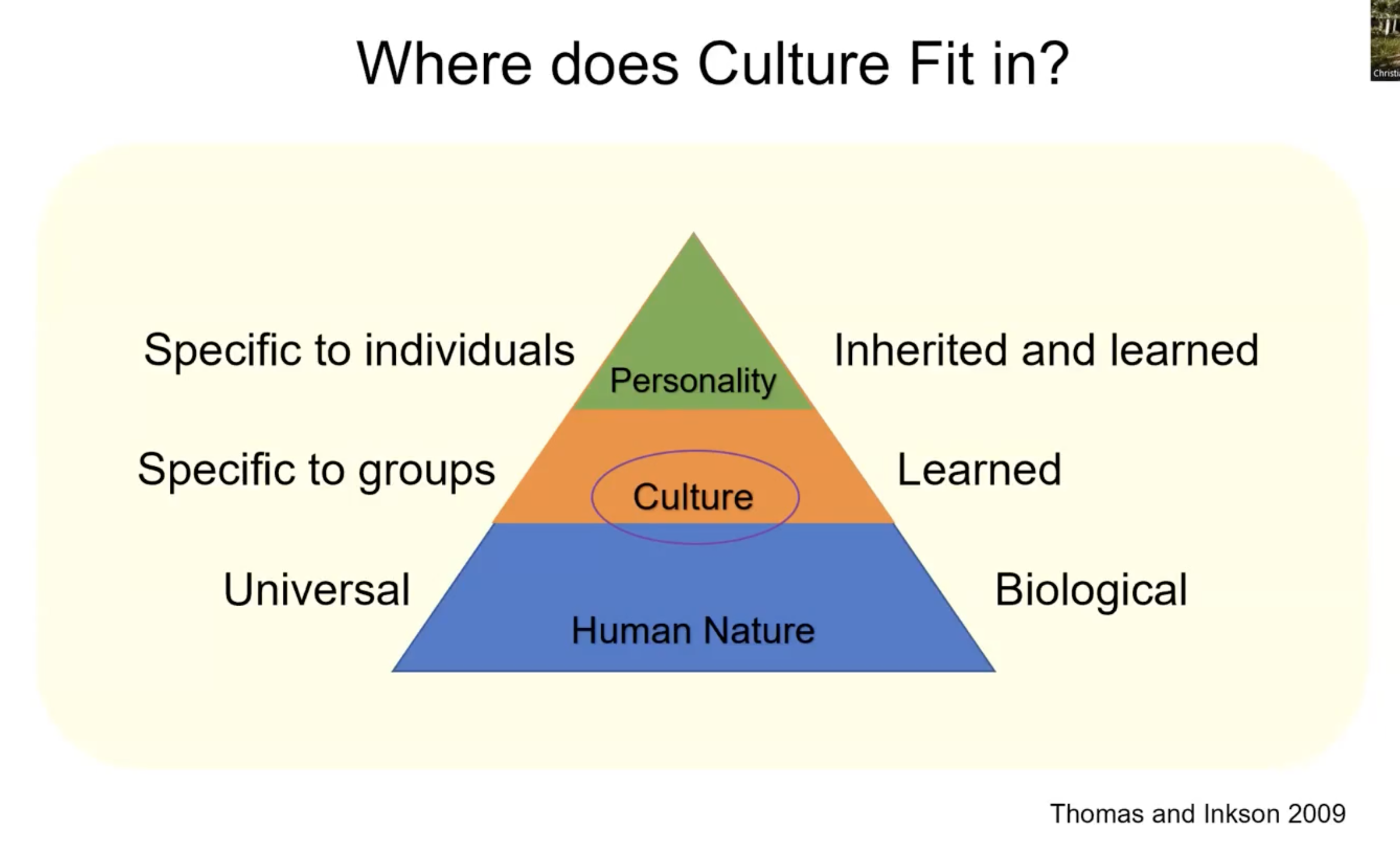
Pyramid of Behaviour Sources (Thomas & Inkson 2009)
Human nature (biological universals e.g. hunger, sex drive - all members of the human race have these in common). Because of human nature, there are many behaviours and understandings that ALL people share, so even though they come from different cultures, human nature is not really culture.
Culture (shared with certain group) based on these common experiences that we share with a particular group of our fellow human beings. It is something that's shared among a group of people; cultural values, attitudes, and assumptions are about proper behaviour, that give us something in common with a definable group of others, but not with all of them.
Personality (individual uniqueness) based on specific genetic makeup and person experiences that make us unique as individuals. Some of us may be more sociable or more introverted or more aggressive, more submissive. So that is very much at the very personal individual level.
Culture Examples
Rituals and kind of symbols are the most visual manifestations of culture. In terms of the Archibald prize, for example, Australia has become much more diverse in terms of who gets reflected in prize-winning portraits; there are more women, more minorities (aboriginals), and much more diversity. Okay, so you're looking at these three examples in this competition. If you go back decades, it was much less diverse, and that reflects the changes the character and national identity of Australia.
Sport is an important part of culture. You can zoom out and look at the entire world, looking at different popular sports in different countries. You've got football, you've got soccer. In Australia, you've got cricket. You've also got rugby in Australia. Cricket is also very famous in India. In the US, you have American football. Different countries have their different kind of favorite sports and sports is very much part of culture.
Language and national identity. As mentioned, culture is very much a binding and a divisive force. This graph is from an article called, what does it take to truly be one of us? Being able to speak the national language has wide agreement as being a requirement to be part of a culture. Other things include sharing national customs and traditions, as well as religion.
But culture is also changing. On the right side, you see that older people say that, you know, your birthplace, you know, is very important to national identity. Younger people say less so.
Culture is also very much used by politicians. You see these nationalists and populists, you know, from Donald Trump to Britain's UK Independent Party, to the Alternatives for Germany, it proclaimed that governments should give priority to keep the foreigners out.
Pinning down what exactly makes someone truly a national or a stranger is difficult, partly because identity is kind of based on a mix of values, language, history, culture, and citizenship.
Visible vs Invisible Culture – Iceberg Model
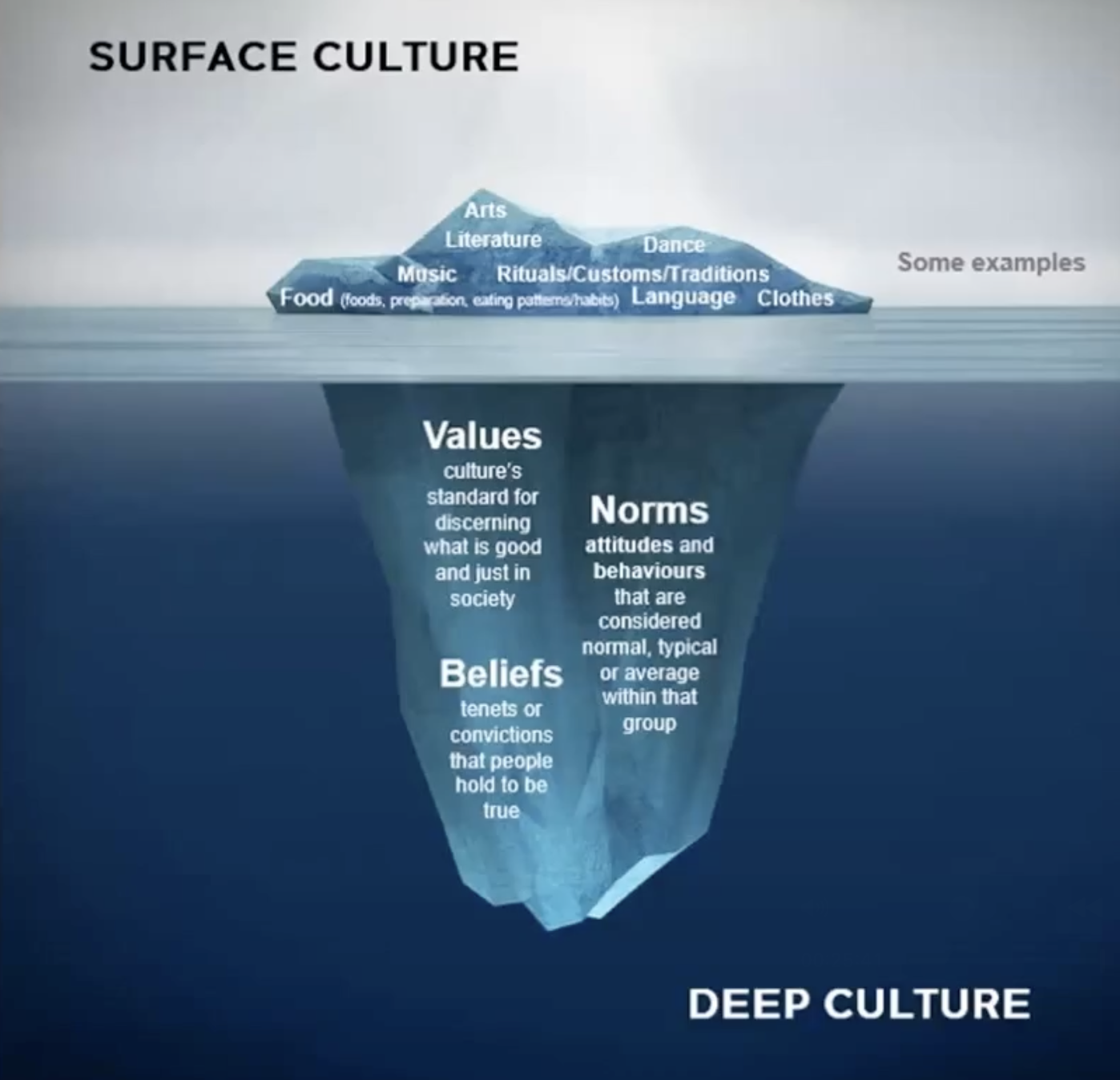
Illustration that most culture lies beneath the surface.
Above water (10 %): Observable aspects of culture - symbols, literature, rituals, food, dress, language, art, music, dance.
The observable aspects reflect much deeper things.
Below water (90 %): values, norms, beliefs, assumptions, attitudes → these underlying elements drive visible practices/observable aspects, they shape how people behave in interpretive worlds around them, often subconsciously.
Because the below water elements are less visible, they can lead to misunderstandings or conflicts in cross-cultural interactions if this is not recognised.
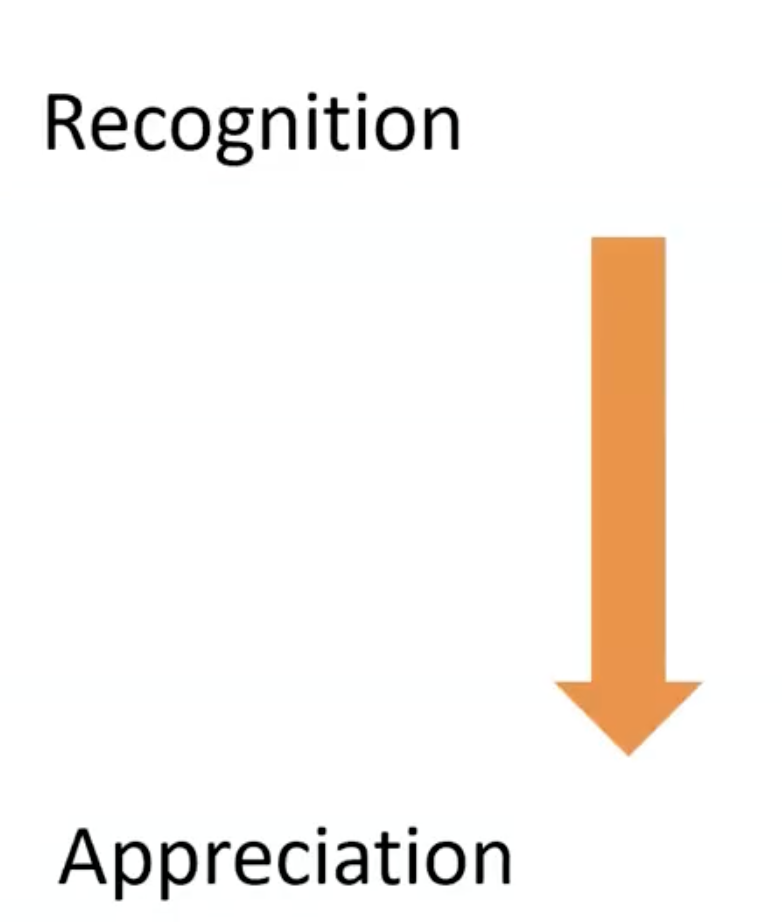
Apply the iceberg model to move from recognition to appreciation
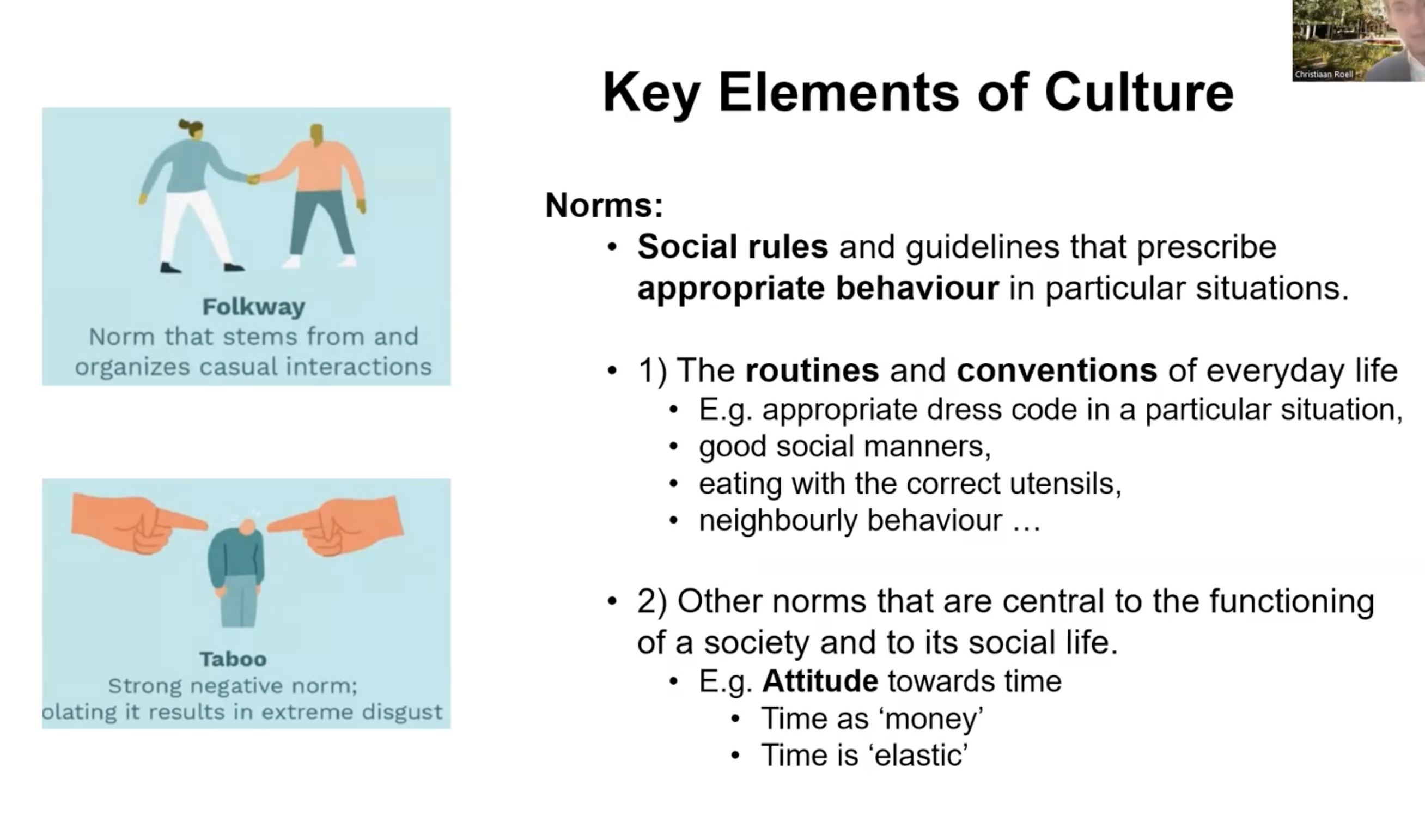
Elements of Culture
You can't see somebody's norms, values or beliefs; you only see what you can observe with your eyes; but what people do often reflects their values and norms and beliefs.
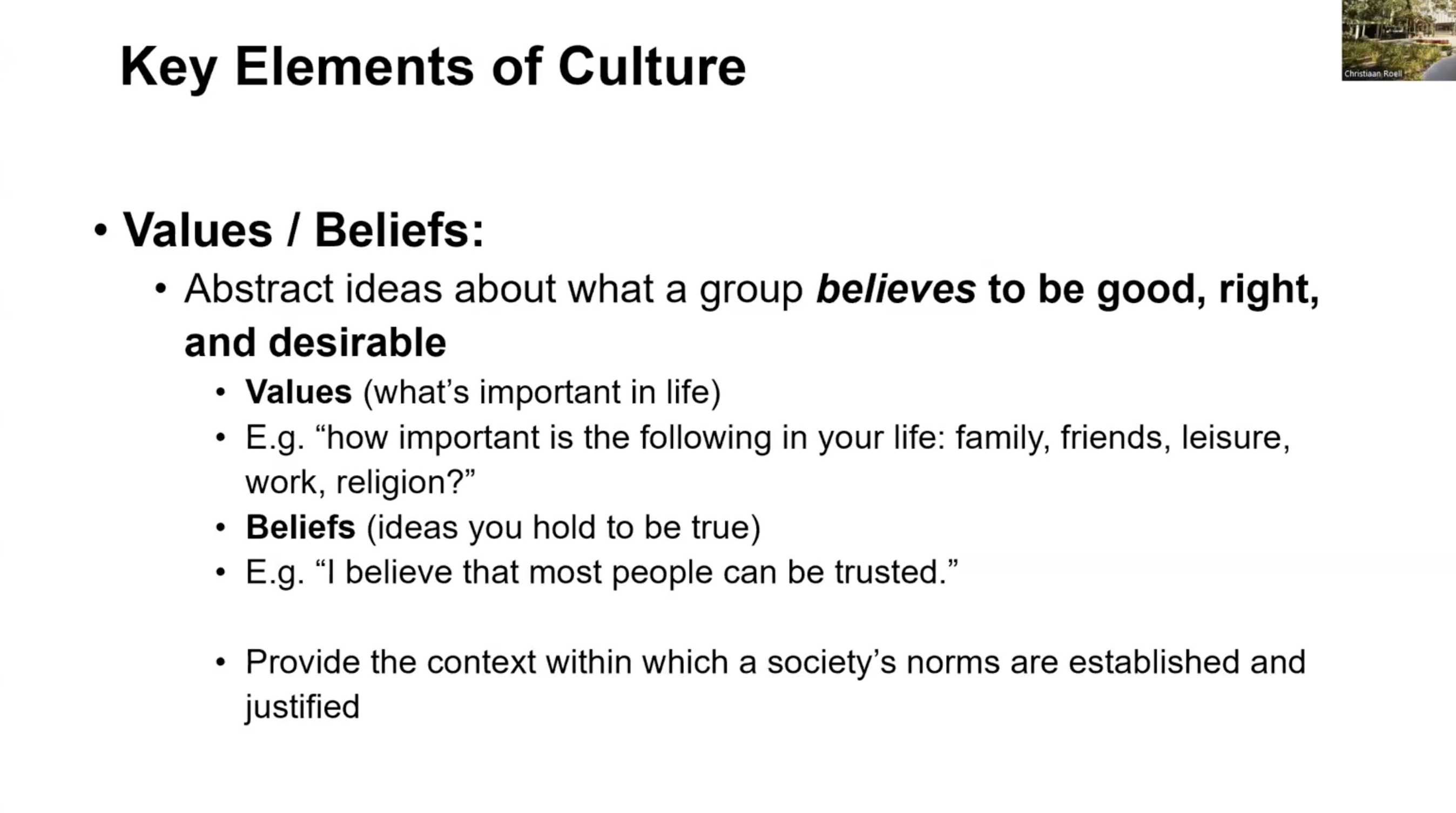
Values: abstract ideas of what a group believes to be good, right and desirable (e.g., education, work, religion, rights).
In terms of education, if you didn’t find it important, you probably wouldn't be studying at UNSW.
Norms: social rules/expectations that prescribe appropriate behavior in a particular situation (greetings, dress codes, work hours)
Folkways vs mores (not elaborated but implied)
Beliefs: Ideas which you hold to be true (trust in people, faith in deity) (e.g. I believe most people can be trusted, I believe in a particular God)
Going back to this idea of heterogeneity, every culture has its own beliefs in terms of religion or belief that they think is most important. And these things again, change over time. For instance we talk about religion, people used to be much more religious than they are today; things change over time as people learn from other cultures, from science, all these different things.
Levels & Types of Culture
National culture (most studied)
Regional / sub-cultures
When people talk about culture, they are focusing on national culture, but there are many regional differences within countries.
Particularly when it comes to very big countries like huge countries like Russia or China or the US, not everybody behaves the same way. There are many different types of subcultures.
You can look at the differences between cities. Melbourne scores high for cultural, fashionable. Sydney scores a bit lower on cultural, fashionable, but more beautiful and more famous.
Japan escalator etiquette: Kansai right-standing vs Kanto left-standing. These are both regions within Tokyo.
You can also think about like archipelagos, groups of islands. Indonesia has more than 10,000 islands. They now share a lot of similarities; there is a similar language and education system, but, up until not that long ago there was a lot less communication and probably each of these islands had their own culture.
Organisational culture
Global culture
Zooming out and looking at the whole world, is there such a thing as world or global culture?
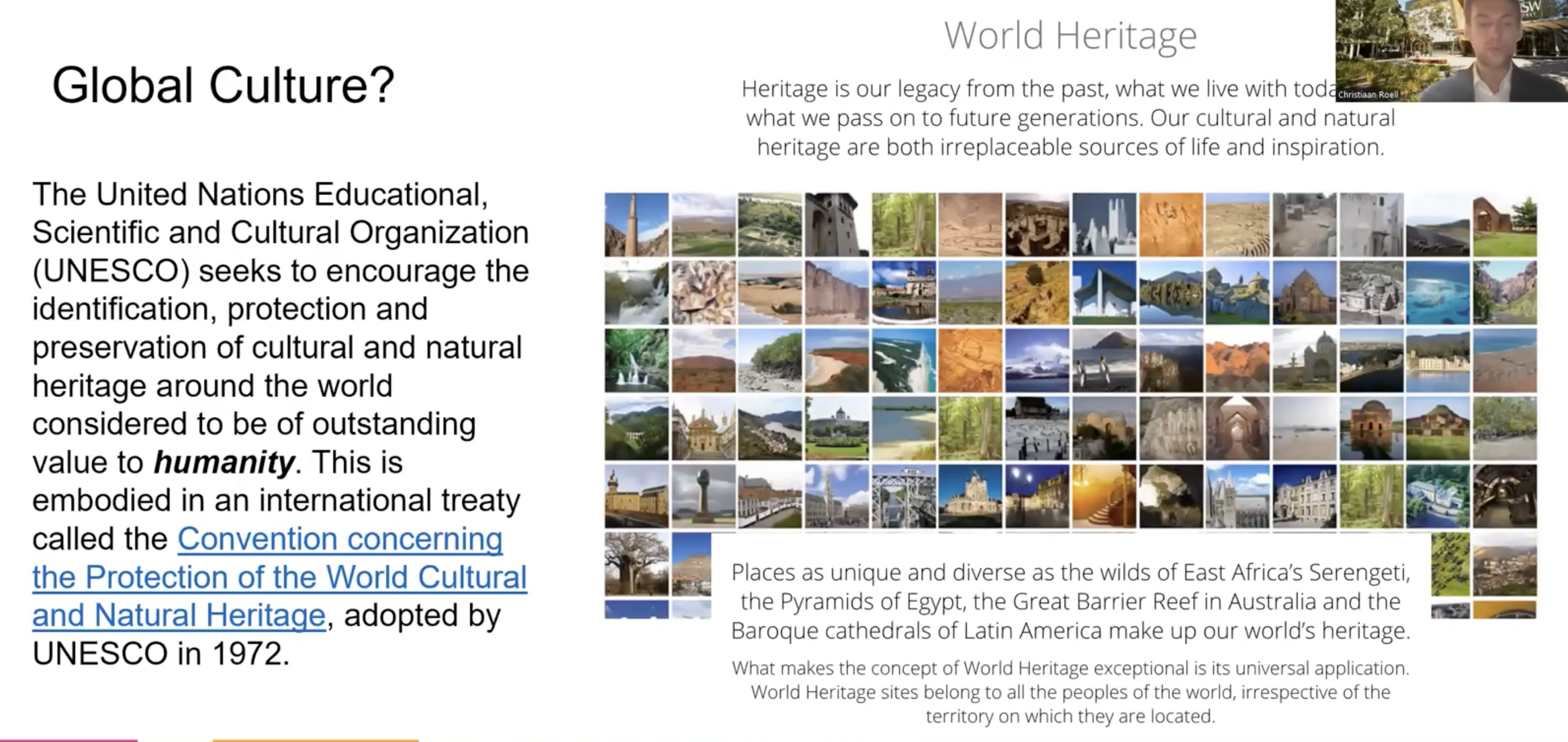
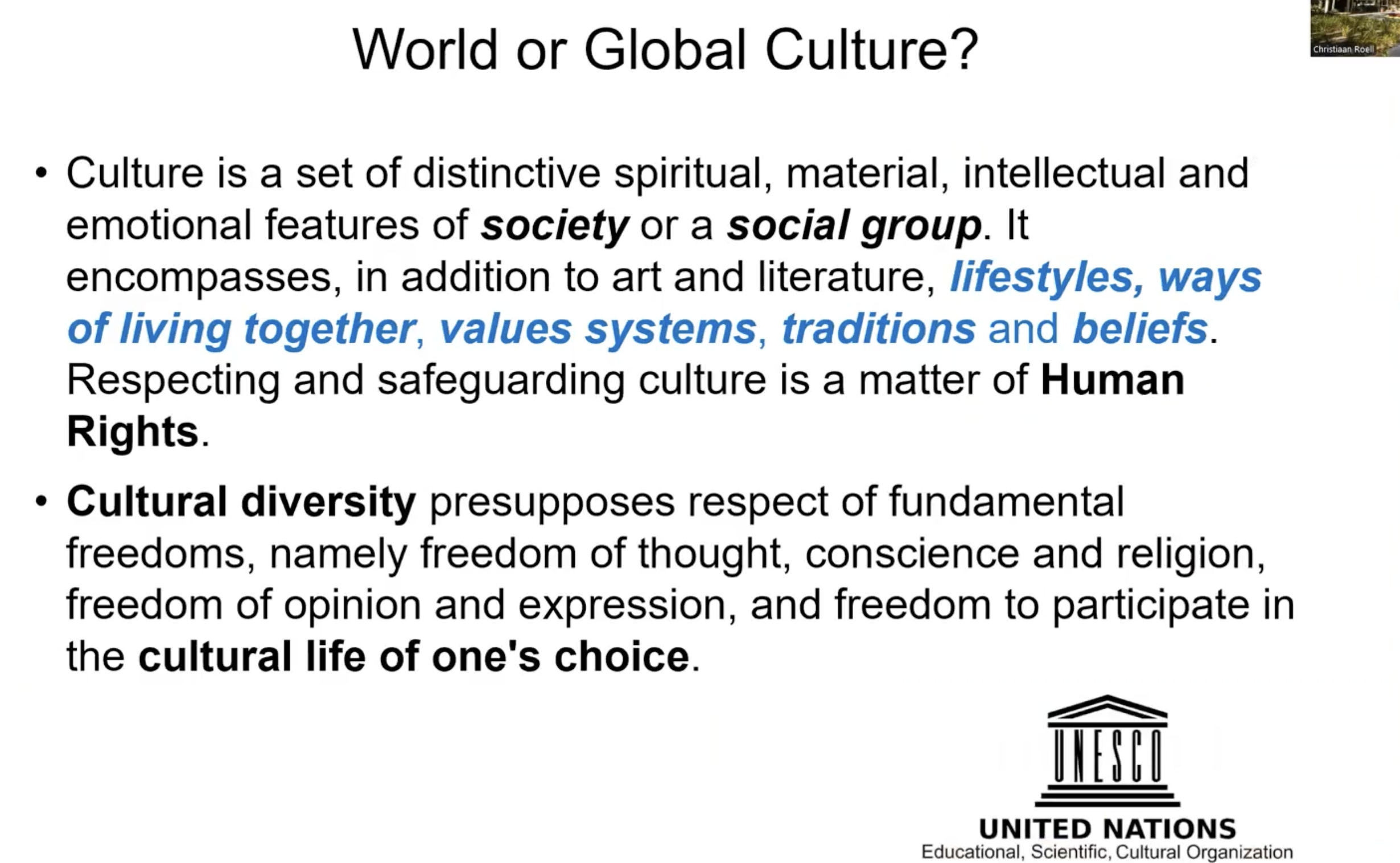
Following UNESCO, this involves respecting fundamental freedoms, freedom of thought, freedom of religion, freedom of opinion. This is essentially global culture; so global culture is essentially cultural diversity. UNESCO are trying to encourage the protection and preservation of cultural and natural heritage around the world, which is kind of considered to be an important value to humanity. And they argue that this diversity is part of this, is part of global culture.
(UNESCO): universal freedoms, protection of cultural heritage, cultural diversity
There are several Australian national treasures on UNESCO’s world heritage list.
Illustrative Cultural Manifestations
Think of things that is typical for people in one culture but not in others.
People in different countries (and cultures) do things very differently to each other.
- This relates back to the idea of heterogeneity.
The above two points are kind of separate from everything else.
Archibald Prize portraits reveal diversification of Australian identity (more women, minorities, academia)
Sport preferences by country (soccer, cricket, rugby, NFL)
Language & national identity
Survey: speaking national language= key to belonging
Age gap: older cohorts emphasise birthplace more than youth
Rise of nationalist/populist politics (Trump, UKIP, AfD) leveraging culture
Cultural Change Drivers & Examples (Cultural Change and its Manifestations)
Globalisation
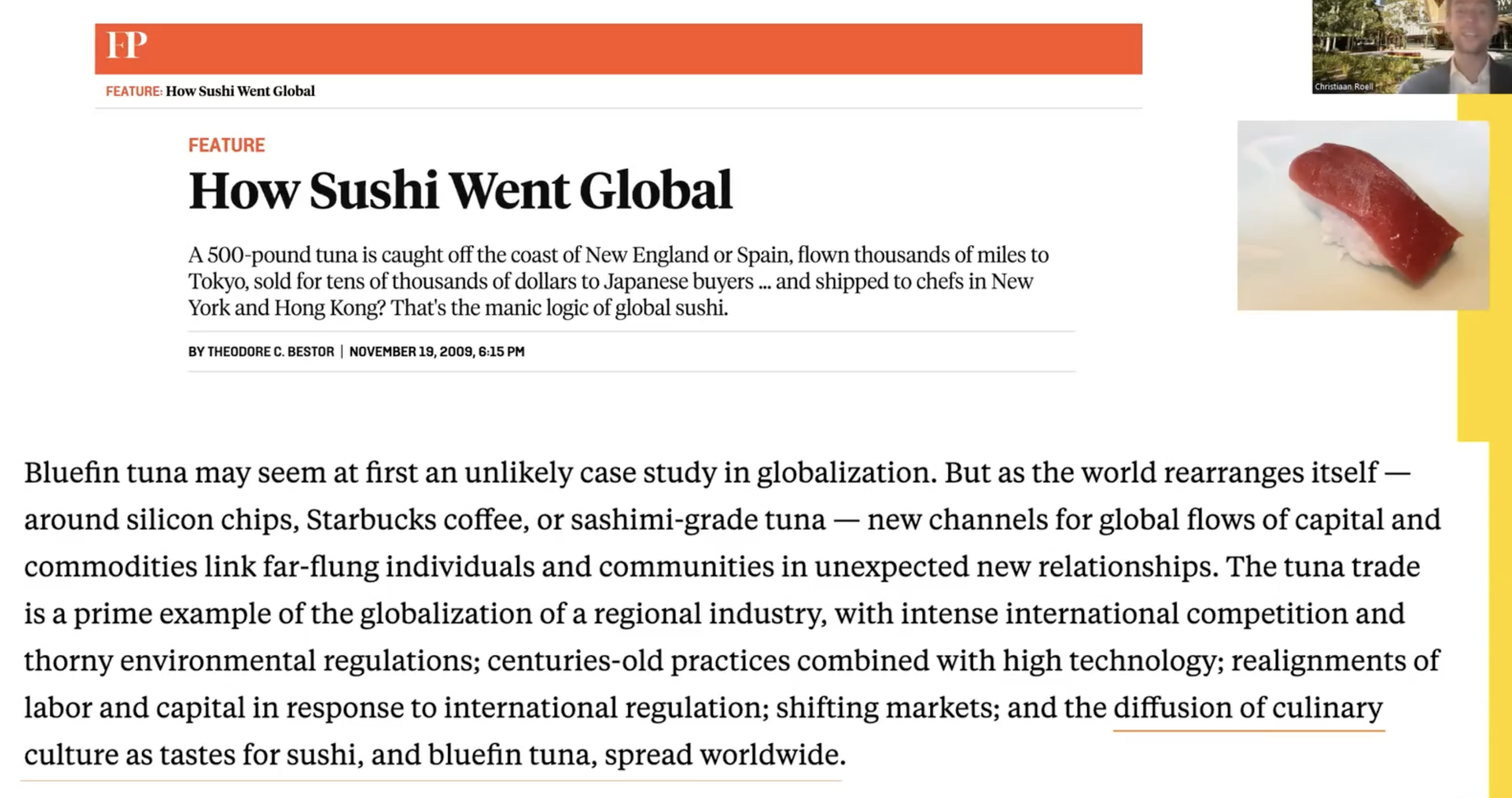
Sushi & bluefin tuna, as a result of globalisation, became an export of culture
Food is very much part of culture and because of globalisation, that spreads over time globally. Refer to last sentence of photo.
MNEs as cultural vectors: Starbucks coffee culture – success/failure (Australia case-study: early exit, targeted re-entry in tourist spots)
Corporations can be an important part of cultural change.
Starbucks popularised coffee in many places. There was some resistance in certain places that already had an existing coffee culture (Italy and Australia; in Australis where they opened up many outlets um in the early 2000s and about 10 years later closed down almost all of them because Australians very much already had a coffee culture, they like their local cafes, they like to drink their flat whites and this kind of idea of coffee on the go, this American idea of coffee drinking coffee, didn't really seem to sit well with Australians. They came back recently but they focus more on tourist hot spots.
This comes under globalisation and cultural change.
Economic growth facilitates cultural shifts (World Bank 4 income tiers)
Lifestyle, diet, commuting, housing evolve with GDP growth
There are four different income levels. As countries become more prosperous, their income increases and people start doing things differently. What they eat, how they commute, how they spend their leisure time, where they live. This (culture) very much links to the economic lens.
Gender norms evolution
Increased female tertiary enrolment & labour‐force participation.
Women were for a long time for different reasons not really expected to work and study. Now, many more women go to university and there is still a wage gap problem, but it is slowly closing in certain parts of the world.
Norms about who should be doing the housework in a family have also changed. For a long time, women also worked and were still expected to do this housework, so this change took quite a long time.
Overall, because of the feminist revolution that started quite a long time ago, over time, women have become much more active in the labor force.
Afghanistan reversal post-Taliban 2021: When the US withdrew its troops after the Taliban took over, because of the new political system, which has very different ideas about the role of men and women, the number of women that were part of the workforce dramatically decreased in a very short period of time.
Again, political systems are very important. And also this idea of change is very important.
Climate change & culture
Making a connection with the sustainability lens, environmental factors including climate change are affecting the things that we love to do, including sports.
Extreme weather cancelling sporting events (sport = cultural practice)
The above makes links between culture and the different lenses.
Opportunities and Threats
Cultural change creates opportunities and threats for businesses.
COVID-19 & work culture
Previous generations spent their whole lives working in offices.
Mass remote work (necessity during COVID-19) → migration from cities because people didn’t need to be there, instead looking for more space.
Ongoing hybrid models; employee expectations shifted
People take jobs based on how often they have to be in the office.
The social part of coming into the office is important, though.
Above is an ongoing shift. Companies are struggling with how to deal with it. Everybody was supposed to go to the office initially, then everybody had to work from home, and now they're kind of trying to find their way. Some companies are still fully remote and some companies are saying that you still have to come in a couple days a week.
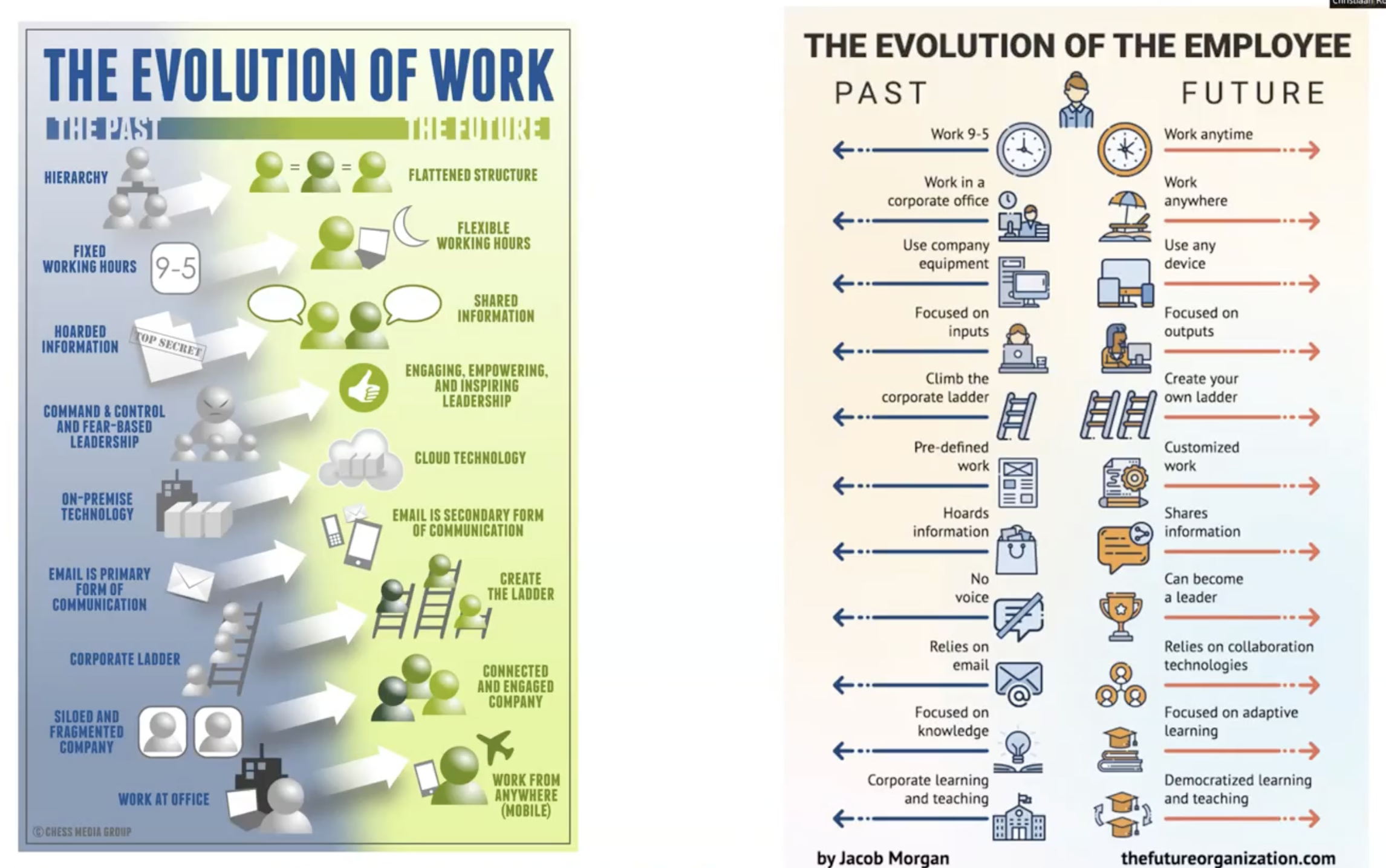
Building on the above, there has been an evolution of work. COVID-19 has accelerated this shift in culture. Employees want different things.
Evolution of work table: fixed hours → flexible (not always good because companies want you to be available all day and night; therefore working more rather than less); office → anywhere (different cities, countries); local staff → distributed teams
Changing of Values (Dietary Values)
Creates opportunities and threats
Big cultural shift. 42% Australians reducing meat consumption/eating none at all; rise of vegan/vegetarian
The question is, is that just a threat for certain types of companies, you know, agriculture companies, et cetera, food companies? No, because it can also be opportunities; companies can respond to these changes in values and norms. They also need to, because these are their customers. 7-Eleven plant-based pies, Domino’s vegan pizzas.
Recent cultural trend of "carnivore diet", opposite of veganism.
Netflix documentaries (“Game Changers”, “What the Health”) are a big influence and shape perceptions. Causing people to go vegan and vegetarian, showing details about the meat industry and the consequences for your health.
Cultural Frameworks for Analysis
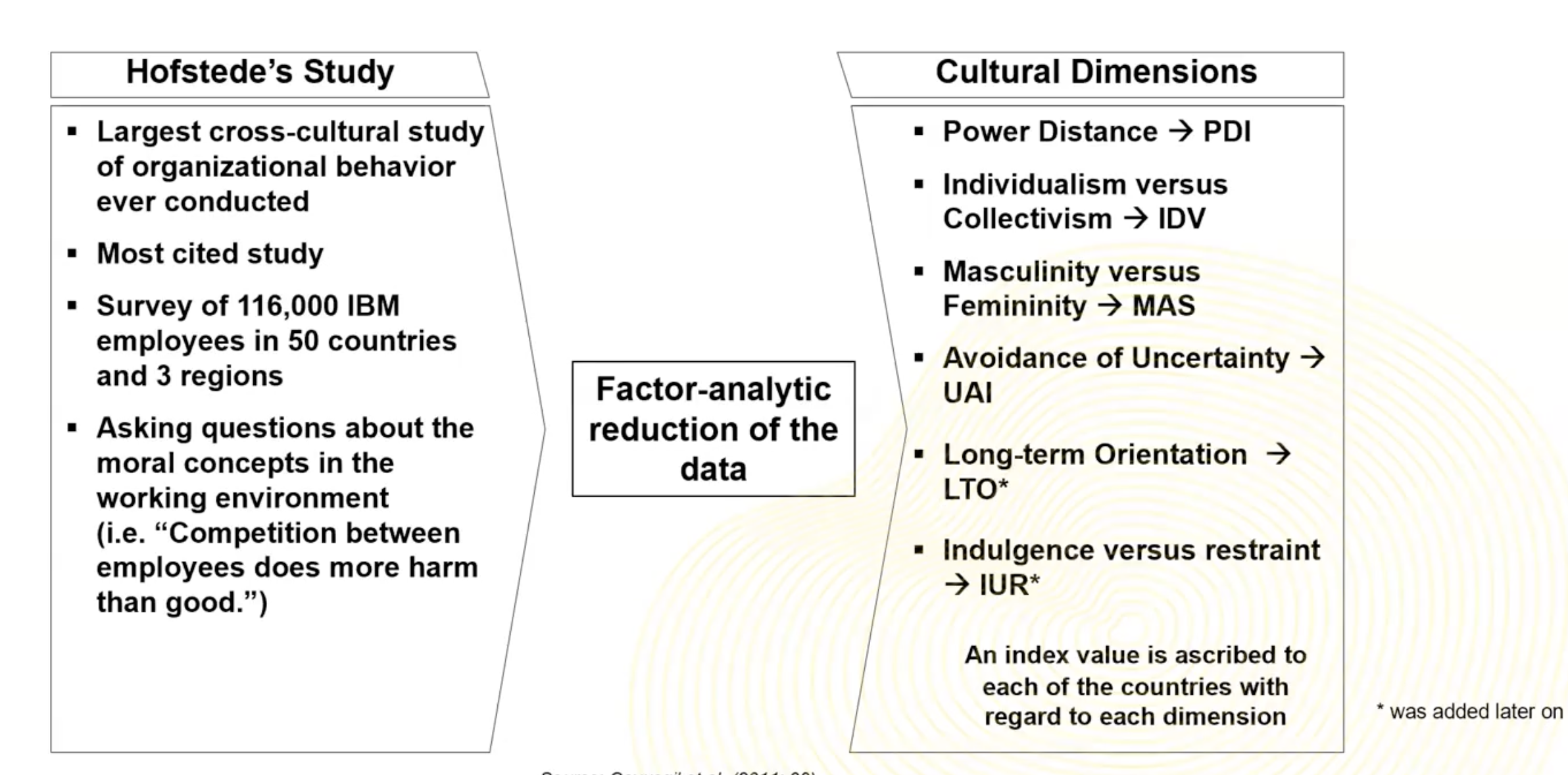
Hofstede’s Cultural Dimensions (IBM study of employees, countries, regions)
Geert Hofstede conducted one of the largest cross-cultural studies of organizational behaviour, focusing on cross-cultural differences. It outlines the key dimensions along which national cultures differ. Study was of over 100,000 people, all employees of one organisation, IBM, in 50 different countries and in three regions.
In the survey, questions were asked about different moral concepts about the working environments. They came up with four different cultural dimensions; later, more research was done and they kind of added two extra dimensions.
Essentially, differences between countries can be analysed using the different dimensions, with countries being scored on the different dimensions. Use website to do this. It is good for looking at what it actually means for organisations and maybe for HR policies et cetera.
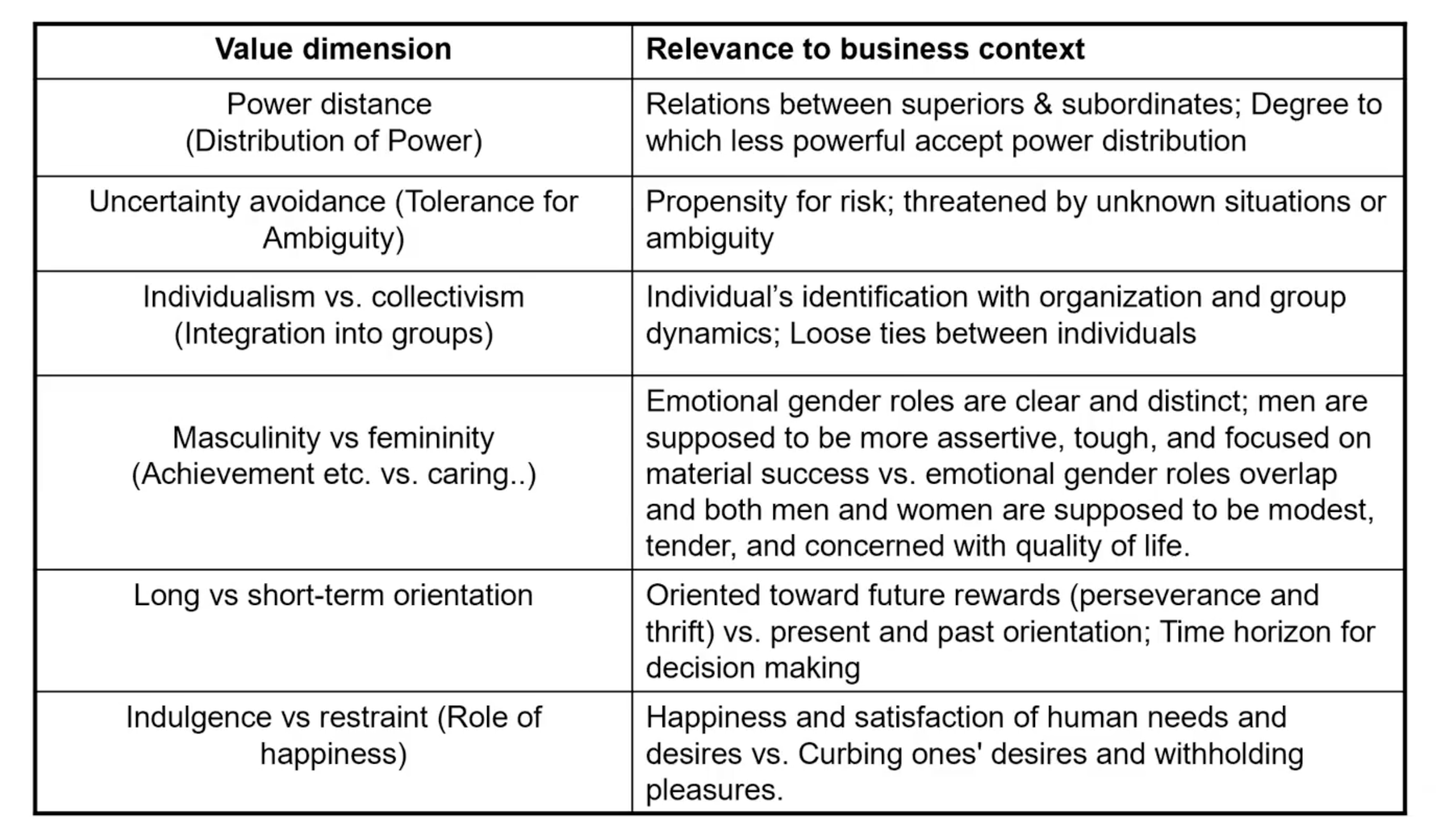
Power Distance (PDI) – acceptance of unequal power. The extent to which a society accepts unequal distribution of power within the society. It relates to, you know, superiors and subordinates in an organisation.
Uncertainty Avoidance (UAI) – tolerance for ambiguity & risk. The extent to which members of society feel threatened by ambiguity, or whether they can tolerate uncertainty. In a business context, high uncertainty avoidance cultures have very formal rules and procedures that are designed to provide more security and greater career stability. In cultures with high uncertainty avoidance, managers have a propensity for low-risk decisions where employees show little aggressiveness with lifetime employment conditions being common. On the other hand, you also have companies in kind of low-uncertainty-avoidance cultures where rules are less structured and less formal, and managers are more likely to take risks.
Individualism vs Collectivism (IDV) – individualistic societies versus collective societies, which is all about the extent to which members of society perceive themselves to be independent, or part of the society. In collectivistic cultures (societies), promotion and rewards tend to be based on seniority rather than on the achievements or personal capabilities, whereas in individualistic societies, including Australia and the US and many parts of Western Europe, including the Netherlands, it is much more about the individual performance, so if you want a promotion, if you want a higher salary, it is about what you contribute and whether you are really productive.
Masculinity vs Femininity (MAS) – achievement/material success vs relationships/quality of life. The extent to which society recognises achievements and material success versus kind of the quality of life and relationships. This dimension affects the members' work ethic, the concern for relationships, caring and quality of life versus the concern for success and material possession. Two extremes would be Japan and Sweden.
Long-Term vs Short-Term Orientation (LTO) – future rewards vs immediate results. Focuses on people's time perspectives in life. This dimension has an influence on performance appraisal systems, for instance, the focus on short-term versus long-term results or profits versus market share.
Indulgence vs Restraint (IVR) – gratification vs suppression of desires. Some cultures focus more on happiness and satisfaction of human needs and desires versus curbing one's desires and withholding different pleasures.
Practical tool: hofstede-insights.com allows country comparisons (e.g., Denmark low PDI vs Panama high PDI)
Criticisms: single-firm sample, extrapolation from organisational to national level, static snapshot
High vs Low Context Cultures (Hall)
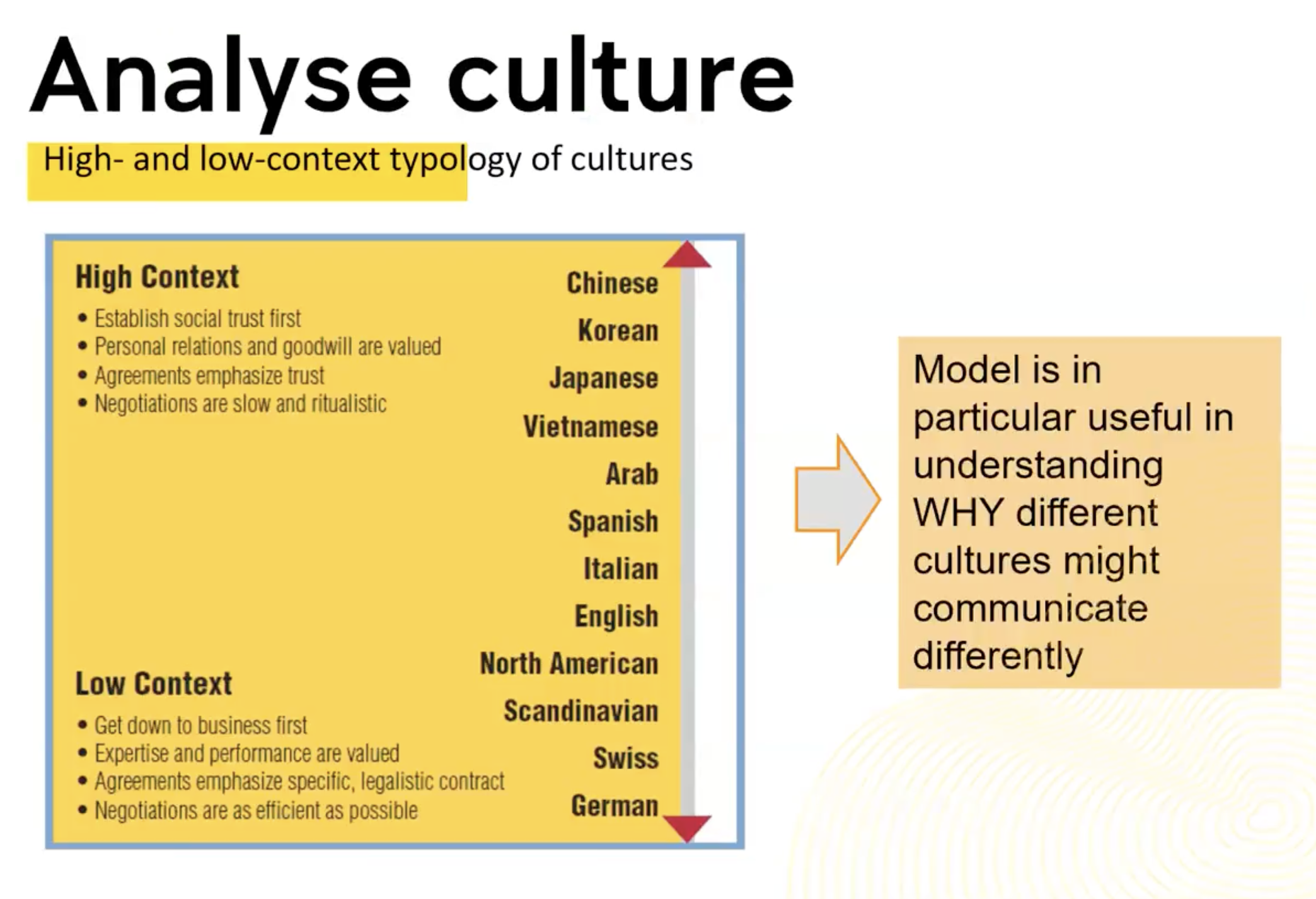
High and low context cultures describe different communication styles, especially in international or cross-cultural settings.
High context: implicit, relational, ritualistic negotiations; East Asia examples.
Rely heavily on implicit communication, nonverbal cues, shared experiences, and the surrounding context. What is not said is almost just as important as what is actually said. It focuses on establishing social trust first; before you want to do business, you want to have a good relationship first. This is very common in China, in Japan, in Korea, in Eastern cultures. Typically, negotiations are very slow and ritualistic.
Low context: explicit, direct, contract-centric; USA, Germany, Australia.
Low-context cultures which use very explicit direct communication; words are taken at face value and clarity is prioritized over nuance, so rules, contracts, and written communication are emphasized, and you see that very much so in the US and Germany and Australia.
Understanding the distinction helps individuals as well as companies communicate more effectively across cultures. Misunderstandings arise when styles clash.
It becomes more of an issue or a problem when the German company wants to work together with a Chinese company. Now there's actually many successful German companies that operate in China. So it's something that you can certainly learn. But there are also very stark differences, right? And it's important to be aware of that before you go to a particular country. Watch the high and low context video on lecture slides.
World Values Survey (≈100 countries, 90% population, 5-year waves)
Looks at Culture using Two dimensions (different to Hofstede):
Traditional vs Secular-Rational Values
Survival vs Self-Expression Values
Longitudinal arrows show global drift toward rationality, tolerance, participation
Looking at kind of how culture and values change over time or how values change over time, examining the shifts in human beliefs and values. Includes views on happiness, governance, religion, gender roles, and work ethics.
Traditional vs Secular-Rational Values
Traditional values, which can emphasise religion, the importance of family and traditionally family roles, and the deference to authority and national prides, a stronger adherence to kind of traditional gender roles and societal norms.
Secular rational values, with much less emphasis on religion and traditional family values. Much greater acceptance of, for instance, divorce, autonomy and individual choice. There's much more skepticism towards traditional authorities and less emphasis on national pride.
There has been a shift away from absolute values and norms towards values that are increasingly rational, tolerant, trusting, and participatory. Overall, that is quite a good thing.
Dealing with Culture at the Individual Level
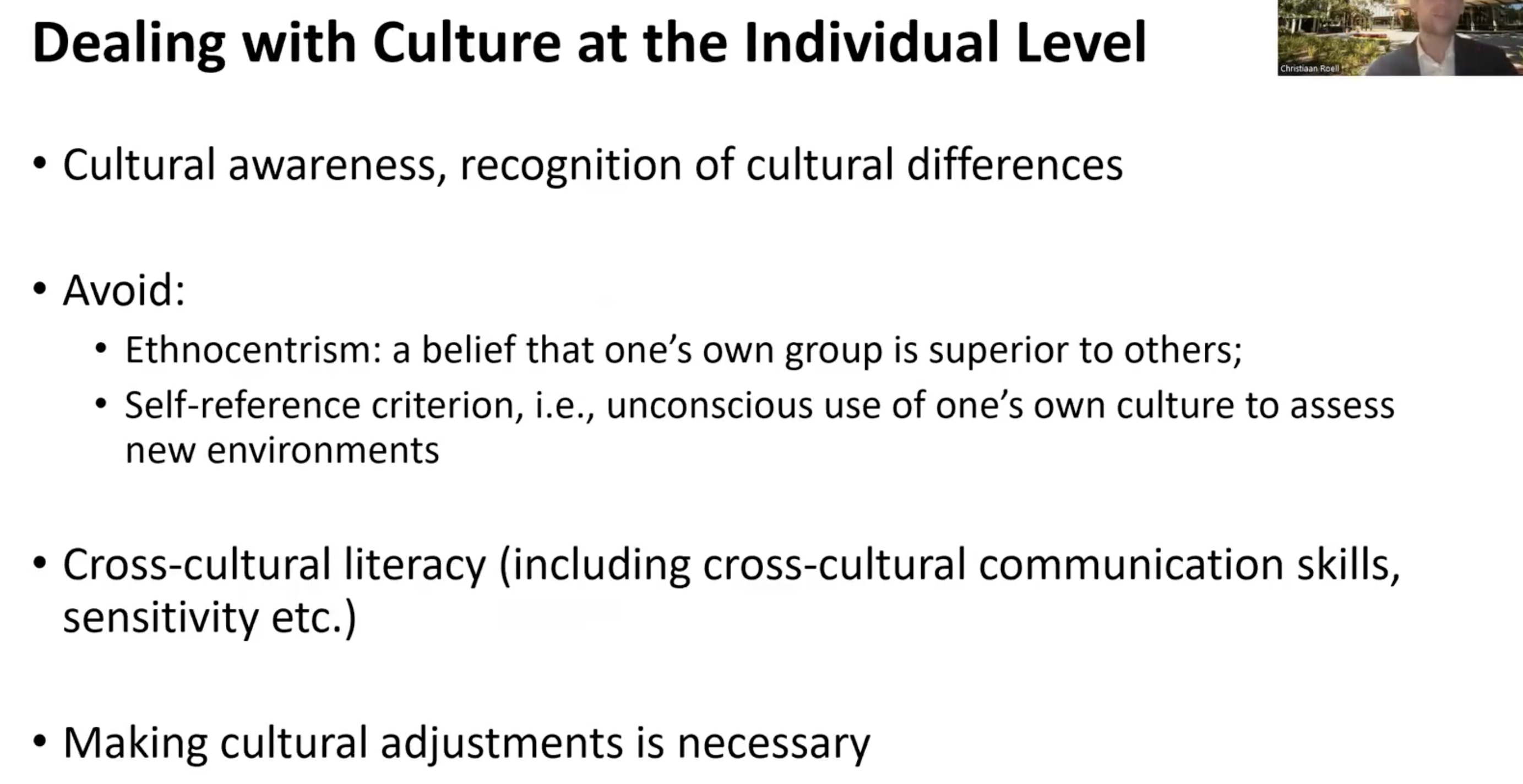
Cultural awareness is important, understanding that people do things differently and believe different things, & avoidance of ethnocentric beliefs where you believe that your own group or your own culture is superior to others, and somebody else is strange.
Cross-cultural literacy (including cross-cultural communication skills, sensitivity et cetera) helps with this.
Cross-cultural communication skills, being sensitive, being aware of your kind of own biases that you have, making cultural adjustments, make friends locally, study the culture, read about the culture, talk to a lot of people, learn the language, all of these things help you kind of understand culture in international contexts.
adapt message, decode non-verbal cues
Self-knowledge of biases
Adjustment tactics: make local friends, learn language, study context before business engagement
Inter-Lens Connections
Economics ↔ Culture: income growth alters consumption & gender roles
Politics ↔ Culture: political regimes enforce/reshape cultural norms (e.g., Taliban)
Sustainability ↔ Culture: climate actions depend on societal values; SDGs global goals executed locally
Recap
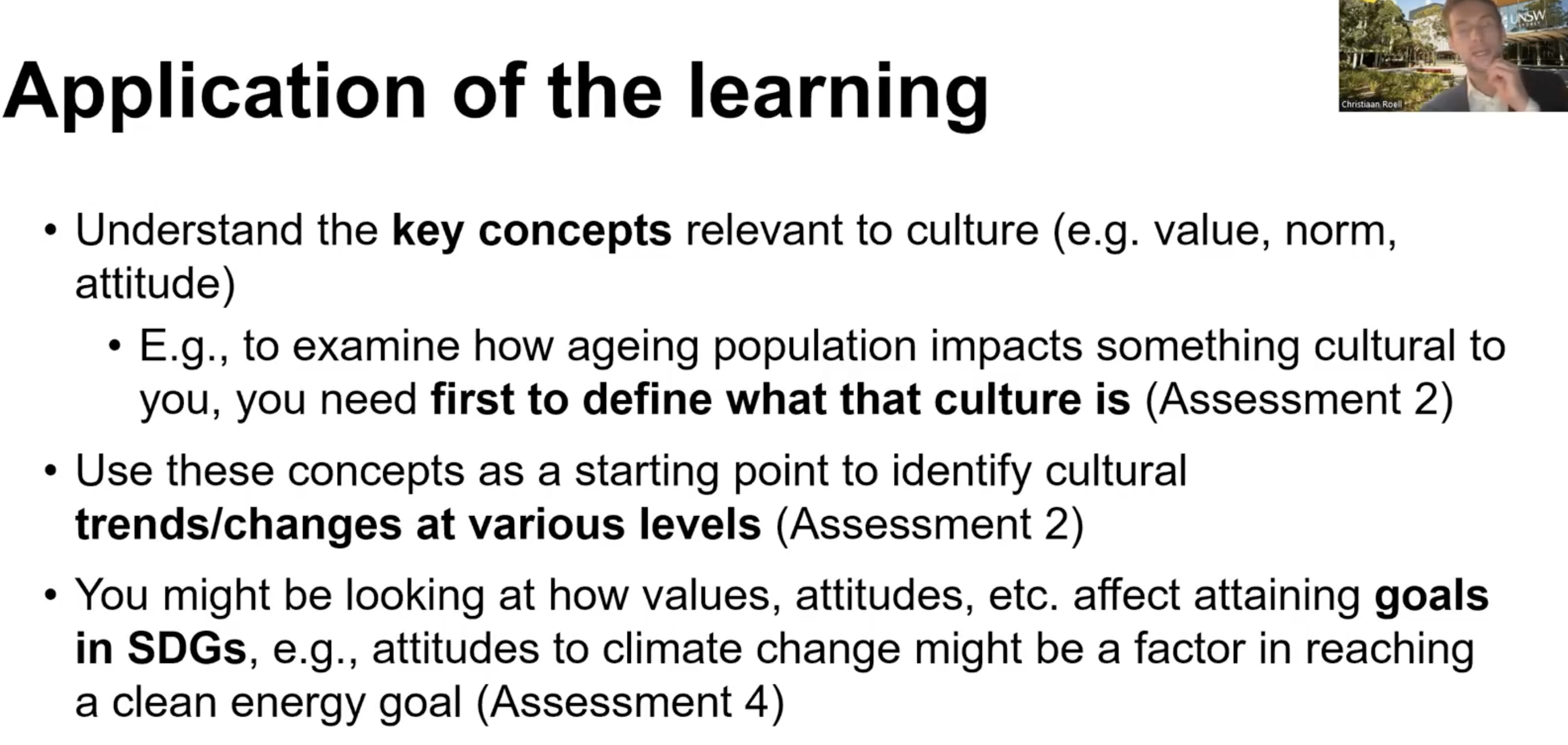
We need to understand the key concepts relevant to culture; values, norms, attitudes et cetera, for example to examine how an aging population impacts something cultural. We need to first define what the culture is and explain why something is cultural; one way of doing that is linking it back to the characteristics of culture. You want to explicitly state this and you also want to link it back to a definition; one definition is plenty, but you want to make sure that you link it back to the things we discussed in the lecture and link it back to the definitions that experts in the field came up with. So, you need to clearly define what culture is.

You also use these concepts as a starting point to identify cultural trends and changes at different levels.
You might be looking at how values, attitudes, et cetera, affect attaining goals in the SDGs. So you have these 17 goals. Again, looking at the global versus the local level. The SDGs, the Sustainable Development Goals, are global goals that most countries around the world have agreed upon that they must be achieved by 2030. But the implementation of these goals is actually very much done at the local level. So here in Australia, we have all sorts of problems around major weather events, climate change, etc. But we have to deal with that here locally. So we have to make sure that businesses are following the regulations. Right, so that's also related to your kind of session number four, which is your presentation about sustainability. Now, that's in week 11, so it's a very long time ago.
Assessment & Study Guidance
Always define and justify why a phenomenon is cultural (cite definitions/characteristics)
Use levels & lenses in written Report 1 (due Week 5 Friday)
For SDG presentation (Week 11) link cultural values/attitudes to achievement barriers/enablers
Engage in tutorials: iceberg exercise, Hofstede tool, case discussions
Key Numbers & Facts (LaTeX formatted)
+ scholarly definitions of culture identified in literature review
Hofstede survey: IBM employees, countries, world regions
Australians reducing meat: respondents (Roy Morgan)
World Values Survey coverage: countries, of global population
Take-Home Messages
Culture is pervasive, multifaceted, dynamic – understand both the seen (symbols) and unseen (values)
Analytical lenses & levels help deconstruct global complexity for better business decisions
Cultural competence = asset for individuals and organisations in a heterogenous, ever-changing world