More on Stalin
og: 42-51
new: 33-58
33-42
51-58
Guiding Questions
- What groups of opposition (real or alleged) were targeted by Stalin during the purges?
- How were the purges used to consolidate/maintain Stalin's control over the party, government, and nation?
- What was the role of the Gulags in these purges?
- How was a cult of personality developed around Stalin? What role did this cult of personality play in his consolidation/maintenance of power?
- Describe the USSR's foreign policy under Stalin. Did foreign policy contribute or detract from Stalin's maintenance of power?
- What were the aims of Stalin's economic policies?
- What specific policies were implemented to achieve these aims?
- What were the effects of these economic policies?
- What were the aims and results of Stalin's policies toward women, minorities, religion, education, youth, and art/culture?
How did the Great Purge (1936–39) help establish Stalin’s power?
Stalin’s insecurities in 1930
- Purges were not unknown to the Party, but Stalin took it pretty far
Stalin had defeated his main opponents by 1929, but he was not totally dominant.
- In the late 1920s, Politburo members did not always support his calls for stricter action against defeated opponents.
- Though removed from high office, Bukharin still had sympathizers and supporters in the party.
- Was re-elected to the Central Committee in 1930
- The problems stemming from mass collectivization and rapid industrialization caused political division even within the Politburo
- Vyacheslav Molotov and Lazar Kaganovich were the only uncritical supporters of Stalin
- In December 1930, Sergey Syrtsov and others were expelled from the Central Committee for criticizing the excesses committed under collectivization
- They had previously supported Stalin in the struggle against Bukharin and the right
The Ryutin Affair (1932)
More serious opposition to Stalin’s policies came when Martemyan Ryutin, a rightist, wrote a document calling for:
- the end of forced collectivization
- the rehabilitation of oppositionists (including Trotsky)
- Stalin’s dismissal
The document was signed by several prominent communists.
- Members of the group were put on trial in September – Ryutin, Zinoviev, Kamenev and 17 others were then expelled from the Central Committee.
- Stalin had wanted Ryutin executed, but the Politburo refused to go that far, thus underlining the fact that Stalin did not yet have complete control.
- During the next two years, nearly a million party members were expelled as ‘Ryutinites’
The 17th Party Congress (1934)
Despite these expulsions, opposition to Stalin continued after the Ryutin Affair.
January 1933
Smirnov (another leading communist) was expelled for forming an ‘anti-party group’ in order to remove Stalin.
February 1934
17th Party Congress (the Congress of Victors)
- Evidence suggests that, before the Congress began, some leading local officials asked Kirov (a Politburo member and the party boss of Leningrad) to replace Stalin, but he refused.
- However, the Congress did abolish the post of general secretary.
- Stalin was now no more important than Kirov, Kaganovich, and Zhdanov, the three other secretaries of the Communist Party who were elected after the Congress.
- It is possible that Stalin himself desired this, in order to share responsibility for the economic crisis. However, the Central Committee elected by the Congress indicated that not everyone in the Communist Party approved of Stalin’s leadership.
The Kirov Affair (1934)
Kirov was known to have doubts about the pace of industrialization, and Stalin’s methods of disciplining the party.
December 1934
Under suspicious circumstances, Kirov was assassinated.
Stalin immediately claimed this was part of a plot to overthrow him and the rule of the Communist Party.
- The plot was supposedly organized by a ‘Leningrad Opposition Centre’, which had links with Trotsky’s Left Opposition and the United Opposition.
- After the passing of a special terrorist degree (passed the day after the assassination), the recently reorganized NKVD was given sweeping powers of:
- arrest
- trial
- execution
- \
In the next few weeks, over 100 party members were shot and thousands of Trotskyists and Zinovievists were arrested, including Kamenev and Zinoviev himself
- Trotsky was abroad, having been deported in 1929
January 1935
- Zinoviev, Kamenev and 17 others were tried and imprisoned for 5-10 years
- A few days later, 12 important NKVD members in Leningrad were also tried and imprisoned, and several thousand ‘bourgeois elements’ were rounded up
The Great Purge
By mid-1935, the purges had begun to come to a halt.
- A new purge began in the summer of 1936, signaling the start of what later became known as the Great Purge.
The Trial of the Sixteen (August 1936)
The NKVD claimed to have uncovered a Trotskyist–Zinovievist counter-revolutionary conspiracy.
- Zinoviev, Kamenev, and 14 others were accused of organizing the conspiracy and plotting to kill Stalin and other Politburo members.
- All 16 were found guilty and executed.
- Bukharin and other Right Opposition leaders were questioned but were not arrested, possibly because of disagreements within the Politburo.
- Stalin then had Yagoda replaced by Ezhov, on the grounds that Yagoda had not been active enough in exposing the full scope of the ‘conspiracy’
The Trial of the Seventeen (January 1937)
At the second show trial, 17 communist leaders were accused of plotting with Trotsky to carry out assassinations, sabotage of industry, and spying.
- NKVD interrogations again produced ‘confessions’ that were the main ‘evidence’
- 13 were sentenced to death.
- Following the second show trial, the Central Committee met during February and March 1937.
- Its main business was to consider the destruction of the ‘Trotskyist Conspiracy’, as ‘revealed’ by Stalin and Molotov.
- Ezhov took his cue from Stalin and accused Bukharin of having known of Trotsky’s ‘plans’.
- Bukharin refused to ‘confess’ to this, was expelled from the party, and was immediately arrested.
The Trial of the Twenty-One (March 1938)
The Trial of the Twenty-One was the last and biggest of the show trials.
- It focused on Bukharin and 20 others, who were accused of membership of a ‘Trotskyist– Rightist Bloc’.
- As before, most of the accused ‘confessed’ to their ‘crimes’ – but not Bukharin.
- The court returned the desired verdict, and Bukharin and 16 others were shot.
The Great Terror
The Great Purge had turned into the Great Terror – or Ezhovshchina – as the number of denunciations, expulsions, trials, imprisonments, and executions multiplied.
- Initially, the purges had mainly affected party members; by mid-1937, they widened to include large numbers of administrators and specialists, including engineers and railway workers.
1937–1938
- Almost the entire party structure in Ukraine, from the Politburo downwards, was purged.
- In most of the other republics, high-ranking party officials were purged of ‘nationalists’.
- Moscow even set quotas for each region as to the number of ‘wreckers’ they should find.
- Many ended up in the Gulag, while others were simply executed by the NKVD.
The Great Terror also spread to the Red Army. As the threat of war with Nazi Germany increased, Stalin began to worry about a military coup. Some officers/former officers had been implicated in the first or second show trials.
May 1937
Marshal Mikhail Tukhachevsky (chief of general staff and a deputy commissar for defense) and Yan Gamarnik (head of the Red Army’s political commissars) were:
- arrested
- accused of plotting with Trotsky and foreign enemies to assassinate Soviet leaders
June 1937
Tukhachevsky and some other leading commanders were executed.
The Great Terror then spread down to the lower ranks of the Red Army so that, by the end of 1938, the list of those executed included:
- 3/5 Red Army marshals
- 14/16 top commanders
- all eight admirals
Airforce officers and the military intelligence service were also badly hit. In all, about 35,000 (about 50%) of the entire officer corps were either executed or imprisoned.
The Great Terror also began to affect large numbers of ordinary people.
- To avoid suspicion, many people tried to prove their loyalty to Stalin by denouncing others.
- Some also saw it as a way of settling scores or securing the jobs of those who were purged.
- By the end of 1938, most Russians were in a state of terror, reluctant to talk openly to anyone. It was at that point, however, that the Great Terror began to diminish.
The end of the Great Terror
As early as October 1937, Stalin raised doubts about the purging of industrial workers.
December 1938
Beria replaced Ezhov as general commissar for state security.
18th Party Congress in March 1939
Stalin and Zhdanov announced that ‘mass cleansings’ were no longer needed and even admitted that ‘mistakes’ had been made.
- Later in 1939, Ezhov was accused of being a British agent, and was executed.
- As a result, mass arrests ended, several thousand Gulag prisoners were released and many more who had been expelled from the party and had lost their jobs were rehabilitated.
- Political opponents of Stalin continued to be arrested and imprisoned or executed, although on a much smaller scale
The impact of the Great Purge
The numbers debate
Before Gorbachev and his policy of ‘glasnost’, estimates of total victims of the Great Purge (imprisoned, sent to the Gulag or executed) varied from 5 million to 18 million.
1990
KGB archives were made public.
- These gave much lower figures of just under 2 million victims.
- The lower figures are now taken as fairly reliable by many historians and they support lower estimates given in the past.
- Recent evidence has led to some historians favoring an upward revision of the number of victims.
- There is also the problem of trying to separate deaths due to the ‘liquidation’ of the kulaks and the famine from deaths connected to the Great Terror
How can the Great Purge and the Great Terror be explained?
Totalitarian Theories
The traditional views on the reasons for the Great Purge center on the role of Stalin. They are based on his position as dictator of the Soviet Union, which was clearly established by the time the Great Purge ended. Many historians accept Stalin’s responsibility for and planning of the Great Terror, but argue that it should be seen, at least in part, as a ‘rational’ response to the circumstances of the 1930s:
- Serving Stalin’s determination to remain as leader
- Suffering from some form of mental illness, or at least paranoia, that led to irrational and extreme action
- Trotsky himself saw the Great Terror as a way of providing scapegoats to explain the economic problems.
- He also saw it as a consequence of an inevitable paranoia resulting from the increasing isolation of Stalin and the bureaucracy from Soviet society.
- Fear of the international situation in the 1930s, as the outbreak of war may lead to coup attempts
- Lust for power and unlimited ambition; intent to strengthen the regime and Stalin’s position
Revisionist Theories
More recently, several historians have focused attention on the existence of genuine opposition that posed a potential threat to Stalin’s position.
- Suggestions that there is evidence that Stalin’s references to a Trotskyist–Zinovievist plot were partly based on fact.
1930--1932
Middle-ranking communist officials contacted Trotsky about forming a new opposition bloc, and proposals for a new Trotsky–Zinoviev alliance were being made.
However, the number of victims of the Great Purge was far greater than the number of likely oppositionists by the mid-1930s.
- Some historians have argued that although Stalin made crucial appointments – such as replacing Yagoda with Ezhov as head of the NKVD – the NKVD and local party bosses were often out of control in the chaos of the 1930s and frequently took matters well beyond Stalin’s intentions.
- These historians argue that at times the Great Terror was an opportunity for rival local leaders to settle old scores. These arguments echo the structuralist debate over the nature and distribution of power in Nazi Germany.
Stalin and Lenin
Historians have argued that the rise of Stalin and the Great Terror can be traced to the Marxist roots of early Bolshevism and in particular to Leninism. T
- They point to the way that Lenin and the Bolsheviks frequently portrayed those who had different ideas about the ‘correct line’ as ‘traitors’ and ‘class enemies’.
- They also point to the fact that the Bolsheviks resorted to purges of the party membership in the 1920s under Lenin, and shortly after his death.
- Purges took place during the civil war and as the NEP was introduced (the civil war and the NEP threatened the survival of the new Bolshevik government)
1919 and 1921
About 15% and 25% of members respectively lost their party cards. These expulsion rates were much higher than those of the 1930s:
- 11% were expelled in 1929
- 18% were expelled in 1933
- 9% were expelled in 1935
However, though the Cheka had used terror against opponents of the Bolsheviks in the civil war, violence had not been used against party members, even when, in 1921, factions in the Communist Party (as well as all opposition parties) had been banned.
- However, Trotsky rejected the argument that Stalin and Stalinism were a logical outcome of Lenin’s ideas and methods of rule. Historians have also portrayed Stalinism as being distinct from Leninism, pointing to the fact that terror was not used against Communist Party members.
- In addition, the Communist Party leadership tried to limit actions taken against various oppositions multiple times in the 1930s. Nor did Lenin ever try to force defeated political opponents to recant their views or make preposterous ‘confessions’ – such methods were only used by Stalin.
- Several historians also point out that, unlike the earlier purges, Stalin was attempting to create an ideologically ‘pure’ and monolithic party. Thus Stalin’s Great Purge appears to have been uniquely violent and a clear break with Leninist tradition.
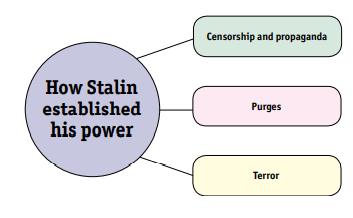
What other methods did Stalin use to establish and maintain his power?
The Cult of Personality
As early as December 1929 and Stalin’s 50th birthday, the Party and the media began consciously to build up Stalin as a hero and to equate his political thinking with that of Marx and (especially) Lenin.
Pravda called on the party and the people to unite around ‘Lenin’s most faithful and dedicated pupil and associate’.
- Elements of this had already emerged during the power struggle, as Stalin tried to portray himself as a true ‘disciple’ of Lenin while branding all his opponents as ‘anti-Leninists’.
During the upheavals of collectivization, the Five-Year Plans, and the purges, references were made to a ‘Lenin–Stalin partnership’, and it was claimed that ‘Stalin is the Lenin of today’.
The photographs or faces of Stalin’s opponents who had been defeated in the 1920s were ‘airbrushed’ out, simply torn from books or blanked out with pens.
During the 1930s, a ‘cult of personality’ developed: Stalin was portrayed as the ‘father of the nation’ (like the Tsar!!!) who had saved the Soviet Union from its enemies, and as an expert in science and culture.
Posters, paintings, and statues appeared everywhere, in streets, factories, offices, schools, and even in Soviet homes.
The media referred to Stalin in glowing terms, such as ‘Universal Genius’ and ‘Shining Sun of Humanity’.
He was credited with having made the Soviet Union the envy of the world through the achievements of the Five-Year Plans.
Artists, writers, and film directors were ordered to produce work in praise of Stalin and his achievements. Children were specifically targeted with this kind of propaganda in schools (like in Germany!) and the Komsomol.
After the Second World War, Stalin moved quickly to portray himself as the one who had saved the Soviet ‘motherland’ and, in June 1945, he promoted himself to ‘Generalissimo’ (like Mussolini proclaiming himself il duce!).
Many Soviet citizens did see Stalin as a national hero but, to counter any possible threats from the armed forces, he encouraged this ‘cult of personality by making sure he took pride of place in the victory parades.
What was the position of women in Stalin’s Russia?
There were fundamental differences between fascism/Nazism and Marxism/ communism over the emancipation and role of women in society.
1926
A new Family Code consolidated earlier rights, and also gave women in ‘common law’ marriages the same rights as those in registered marriages.
- In Muslim regions, where feudal forms of the social structure remained, women were a subject class.
- The communists raised the minimum age of marriage in these regions to 16 (it was 18 in the European parts of Soviet Russia), and polygamy and bride money were banned.
- They also organized mass political activity, known as the khudzhum, to mobilize women to oppose traditional practices.
- Education was provided equally for both males and females.
- State nurseries and workplace crèches and canteens were provided to enable mothers to work outside the home.
However, under Stalin, some of these reforms and benefits were reduced or removed.
Fear of war was growing following Hitler’s rise to power in Germany in 1933, and Soviet population growth was in decline. For these reasons, from 1935, Stalin decided on policies to promote ‘traditional’ family values in order to increase the Soviet population.
1936
Although most of the rights established by the 1926 Code remained intact, a new family law was introduced in 1936.
- Made divorce more difficult
- a rising fee for each divorce
- Restricted abortion to those required for medical reasons only.
- In order to encourage bigger families and so raise the birthrate, tax exemptions were given to families with large numbers of children (Germany did that too!)
1944
- Only registered marriages were recognized
- Children born outside marriage were no longer allowed to inherit property from their father
- Divorce became even more difficult and expensive
- During the Second World War, medals were awarded to mothers with large families (like the Cross of the German Mother)
- Unmarried people were taxed more heavily.
However, women in particular benefited from new welfare reforms introduced under Stalin:
- Free health service
- Accident insurance at work
- Expansion of kindergartens for working mothers with children
- Paid holidays for many workers
- Equal educational provision continued
Nonetheless, the provision of sufficient and adequate housing continued to be a problem.
- In employment, women had traditionally been found mainly in agriculture, textiles, and services. Their position improved considerably under the Bolsheviks, and even more so under Stalin’s rule.
- Women were actively encouraged to play their part in the economic development of Soviet Russia, and all employment was thrown open to women, who had the same rights as men.
- By 1939, a third of all engineers and 79% of doctors were women.
1928
The number of women listed as ‘workers–employees’ had been 2,795,000.
1939
The number had risen to just over 13 million.
1933
Women made up 33% of the industrial workforce.
1940
Women made up 40% of the industrial workforce.
Despite the emphasis on family life during the 1930s, women of all ages continued to work. There were many women ‘hero-workers’ in the Stakhanovite movement, though in a smaller proportion than men; by 1936, a quarter of all female trade unionists were classified as workers who had exceeded their production targets.
However, access to higher administrative posts was unequal and the patriarchal tradition was still widespread in society, leaving many working women with the bulk of household chores.
Despite these realities, the attitude of the Stalinist state to women was very different from that in Nazi Germany.
- Nazis considered women to be inferior to men and thought they should be confined mainly to domestic concerns. Communists believed in total equality between the sexes in education, employment, and the law
What were Stalin’s policies towards religion and ethnic minorities?
Religion
Under the tsars, the Russian Orthodox Church had been the national Church of the empire. As Marxists, the Bolsheviks had always seen religion and the Churches as aspects of class-divided societies that tried to reconcile the lower classes to poverty, inequality, and exploitation, and to uphold the privileges of the ruling classes.
- Marx described religion as ‘the opium of the people.’
After the November Revolution, the Bolsheviks did not see religion as a threat:
- Freedom of religion was allowed
- Churches were not closed.
However:
- Lands owned by the Churches were confiscated
- Church and state were legally separated.
- Registration of births, marriages, and deaths became secular rather than religious.
1921
The giving of religious instruction to those under 18 was banned and anti-religious campaigns were allowed.
1927
The Orthodox Church was granted official recognition in return for promises to stay out of politics and to be loyal to the Soviet regime.
1928
Stalin began a vigorous anti-religious campaign:
- The closure or confiscation of places of religious worship
- Church bells were melted down into scrap metal for use in the new blast furnaces. By the time of the Nazi invasion in 1941, nearly 40,000 Christian churches and 25,000 Muslim mosques had been closed down and converted into schools, cinemas, clubs, warehouses and grain stores, or Museums of Scientific Atheism.
1929
Worship was restricted to ‘registered congregations’, and the 1936 Constitution made pro-religious propaganda (such as study groups and Bible circles) a crime. This particularly hit the various Protestant sects, especially evangelical groups such as the Baptists, many of which were seen as having links to religious groups abroad.
1930
Church leaders were banned from conducting religious services – those who resisted were arrested and imprisoned. Many thousands of Church leaders and priests were sent to the Gulag or even killed.
1932
A new ‘uninterrupted work week’ was introduced, partly to prevent church attendance.
- The anti-religion drive spread to cover Buddhism and the Armenian and Georgian Churches, as well as Islam.
- In the Islamic republics of the USSR:
- Sharia courts were abolished
- The frequency of ritual prayers, fasts, and feasts (which interfered with the working day) was reduced
- Muslim women were granted equality
- Wearing the veil was forbidden.
1935
Pilgrimages to Mecca were made illegal. However, religious belief and worship persisted – the 1937 census showed that 57% of the population still defined themselves as believers. Stalin’s attitude to religion was variable.
1936
In the 1936 Constitution, priests regained the right to vote (which they had lost in 1918).
1937
While the central authority of the Orthodox Church was recognized, 50 bishops were imprisoned or shot for counter-revolutionary activities. Then, during the Second World War, Stalin removed many restrictions on the Orthodox Church.
1943
The post of patriarch or head of the Russian Orthodox Church (which had disappeared in 1925) was re-established as part of the new Soviet patriotism. Stalin also allowed the re-opening of churches – by 1947, about 20,000 existed, along with 67 monastic houses. Although it had some aspects of a state–Church concordat, this accommodation had its limits.
33
1944
Stalin revived anti-religious propaganda once a Soviet victory seemed certain. While Orthodox priests and congregations were still kept under observation, Protestants and Catholics continued to suffer more severe persecution, especially in Ukraine and the Baltic republics re-annexed in 1940.
Ethnic Minorities
Tsarist Russia had been a multi-national empire, with Slavonic groups in the western and central European parts and mainly Muslim and Asiatic groups in the central and eastern areas. After the 1917 Revolution, the Bolsheviks campaigned against Slav and Great Russian chauvinism.
- Native languages were tolerated and even encouraged through literacy campaigns, and a degree of self-determination was allowed.
- The early Communist Party allowed all the major nationalities – including Soviet Jews – to have separate party sections.
However, this changed in the 1930s under Stalin. Once he had decided on his ‘revolution’, Stalin’s desire for central control led to greater assimilation of the various national groups, in order to achieve a ‘Soviet’ identity. Many historians see Stalin’s policies as those of a Great Russian nationalist.
- Russification of education was accompanied during the 1930s and 1940s by a clear policy of equating Soviet patriotism with Great Russian nationalism.
- Russian became the official language.
- By 1936, Stalin had divided central Asia into five separate republics, in order to weaken any pan-Turkic loyalties (many Turkic people wanted to join together in one state). A semi-colonial relationship developed between Moscow and these republics.
- Almost 3.3 million non-Russians were deported to special settlements in the 1930s and 1940s, while a vigorous policy against Soviet Jews was also followed.
However, Richard Overy states that Stalin was not a Russian nationalist, suggesting that his policies were political and strategic rather than ethnic or racial. In the face of growing threats from Japan and Nazi Germany, Stalin was trying to construct a Soviet patriotism to unite all nationalities in a common commitment to building socialism and defending the Soviet ‘motherland’.
- Stalin’s actions were directed against what he saw as reactionary nationalism (i.e. anti-socialist and anti-Soviet; to be fair, they did sign the anti-Comintern pact).
- Many of the resettlements were due to the fear – and later the results – of war.
- For example, national groups living on the Soviet borders were moved if they shared ethnic origins with potential enemies.
- Immediately after the Second World War, there were more violent measures against ethnic groups accused of collaborating with the Nazi invaders. Thousands were imprisoned or resettled in areas far from their original homes. However, this declined after 1945.
Jews
Before 1917, there were 5 million Jews in Russia. They suffered considerable persecution under the tsars. As a result of this persecution, Russian Jews were the first to develop Zionism.
1917
All anti-Semitic laws were abolished. Many of the early Bolshevik leaders (such as Trotsky) were Jews themselves.
- However, in common with their attitudes to the Christian and Islamic religions, the Bolsheviks had opposed the activities of Jewish religious leaders and Zionists. Hence, Yiddish was an acceptable language; Hebrew – because of its religious connotations – was not.
Under Stalin, between 1926 and 1931, the number of Jewish workers in industry more than doubled, and, by 1939, 77% of Jewish workers were wage earners in industry and offices. Thus hopes for rapid and full integration and assimilation were high.
Nonetheless, anti-Jewish prejudices began to re-emerge in some sections of the population – especially in rural areas – in the campaigns against ‘subversives’ and ‘saboteurs’ during the purges. However, it is important to note that the Jews arrested in the 1930s were arrested – like Russians and other non-Russians – as suspected counter-revolutionaries or reactionary nationalists, rather than as Jews. In fact, in the Gulag population of the late 1930s, Jews were actually under-represented.
1926
Soviet Jews were granted a special ‘national homeland’ settlement in part of the far eastern region.
- In 1934, his became an autonomous republic – but only about 50,000 settled there.
1939–40
The USSR gained an extra 2 million Jews by incorporating the east of Poland and the Baltic republics – Zionism was especially strong in these areas. This, and the Nazi invasion of 1941, led to strong campaigns against Zionism – thousands of rabbis and community leaders were arrested. Those Soviet Jews who survived the Nazi death squads and were part of the intelligentsia suffered from some persecution after the foundation of the state of Israel in 1948.
- They were called ‘Zionists’ and ‘rootless cosmopolitans’, and emigration to Israel was banned.
- Following accusations that Jewish doctors in the Kremlin were planning a coup, several Jewish academic and cultural figures were sacked from positions of responsibility and several were arrested.
- Rumors began to circulate that Stalin intended to deport all Jews to the ‘national homeland’ in the far east of the USSR. Just before the ‘unmasking’ of the so-called Doctors’ Plot, 26 were executed.
This persecution ended with the death of Stalin in 1953 – although discrimination against Zionists continued because of their alleged links to and support for Israel.
- However, such policies were essentially anti-Zionist rather than anti-Semitic as far as Stalin and the rest of the government were concerned.
- Racism and anti-Semitism clearly existed against Jews and between other ethnic groups, but the Soviet state was strongly against all forms of overt or violent racial discrimination.
- Communists – unlike the Nazi Party in Germany – believed all races were equal and welcomed intermarriage as a way of assimilating the different national and ethnic groups. Hence those policies that affected many Jews under Stalin were political, not biologically, motivated, and were not intended to be genocidal.
What impact did Stalinism have on education, young people and the arts?
Education
One aspect of the crusade against religion was the spread of state education. The early Bolsheviks realized that an educated workforce was vital if they were to create a modern socialist industrial society – education was thus seen as a priority in providing the skilled workers needed for industrial and technological expansion. Mass provision of primary education – with equal opportunity for all – had been their first aim, in order to overcome the high illiteracy rate that was inherited from tsarist Russia.
- Education was made free, comprehensive, and co-educational.
- At first, the Commissariat of the Enlightenment, which organized education, tried to encourage individuality and creativity; there was little political restriction on work in science and the arts; and physical punishment was banned.
Under Stalin, the provision of secondary and higher education expanded.
1927
The 15th Party Congress greatly increased expenditure on education. As a result, primary and secondary schooling grew immensely – from 7.9 million students in 118,558 schools to 9.7 million in 166,275 schools by 1933.
1939
Illiteracy had been almost eradicated: 94% of those aged 9–49 in towns could read and write; in rural areas, the figure was 86%
- The proportion of working-class students in higher technical education doubled after 1928 to about 62% as a result of a class-quota system that operated until 1935; thereafter, the percentage dropped to about 45%. However, this was still a marked improvement from pre-1917.
Youth
From the beginning, the early communists wanted to influence and recruit young people.
1918
Formed a communist youth organization.
- At first, this was radical and, unlike Nazi youth organizations, largely independent of the adult party.
- Age of entry was 15 (reduced to 14 in 1949) and membership continued until 21
- However, membership was not compulsory.
- Again unlike the Nazi youth movements, entry was closely controlled: youths had to be sponsored by an adult communist.
1920s
A junior organization was set up for those aged 10 to 15: this was known as the Pioneers.
- By the 1940s, most children of school age belonged to this organization. During the power struggle in the 1920s, the radicalism and independence of the youth movement ended, as many sections tended to support Trotsky and the Opposition.
- In 1926, it became the Communist Union of Youth (or Komsomol).
- In 1939, it was directly affiliated with the party.
- Membership rose quickly from 4 million to 9 million by 1939, and to 16 million by the time of Stalin’s death in 1953.
- As in Nazi Germany, there was a militaristic element to some Komsomol activities, with an emphasis on national service, but unlike in Nazi Germany, this included girls as well as boys.
- In fact, all students in universities, and higher and middle schools had to do some military training.
- Stalin’s main aim concerning young people was to ensure that future workers would be skilled enough to play their part in Russia’s industrial and scientific development.
Early 1930s
Stalin insisted that education and school life became more strict. Thus the libertarian trends of the 1920s were reversed:
- School uniforms
- Report cards
- Test results
- Teaching became more formal.
1943
Co-education in urban areas was replaced with single-sex schools.
- Education was specifically geared to the needs of the state, as well as being designed to make all citizens educated and cultured.
- One aim was the creation of a new ‘socialist citizen’ who accepted collectivist rather than individualistic ideals.
- Later, as fear of war increased, nationalism was stressed in history teaching, with Tsars such as Ivan the Terrible and Peter the Great being referred to as national heroes.
- In order to ensure that he could control what people were taught and thought, Stalin had teachers and university lecturers arrested if they were suspected of opposing such principles.
However, as in Nazi Germany, there were examples of youth lifestyle rebellion. Mostly, such young people opted out by listening to forbidden music (especially jazz) or simply avoiding Komsomol activities. There were many small, secret youth organizations in the Soviet Union before 1941, and again after 1945. However, open political revolt was rare, and all rebels were quickly rounded up by state security.
Culture
During the early 1920s, there had been a flourishing of modern art. Lenin and Trotsky were just two of the Bolshevik leaders who supported avant-garde artists. They tended to let people write what and how they liked – provided it was not overtly ‘counter-revolutionary’. However, under Stalin, state control was tightened:
- All writers had to belong to the Union of Soviet Writers and to write about aspects deemed compatible with ‘socialist realism’.
- If you were not a member, your works would not be published.
- This affected newspapers, magazines, novels, poems, and plays – all of which had to show support for Stalin, the Communist Party, and Soviet Russia, and to praise ordinary workers, or show peasants as happy with their lives on the new collective farms.
As the 1930s progressed, and fears of war increased, nationalism became another theme that writers and artists were expected to portray favorably. These controls applied to all creative artists – including musicians, filmmakers, painters, and sculptors.
- All works of art had to show the progress and successes achieved under Stalin and communism.
- Those that didn’t were censored and many artists were denied work opportunities or ended up in the labor camps of the Gulag.