Using Genetics to Understand Biology: The Study of Olfaction
Course Overview and Learning Objectives
This lecture integrates several core genetic concepts including genetic inheritance, genotype-phenotype relationships, mutations, recombination mapping, molecular biology, and gene regulation.
Key Learning Outcomes: - Understand how genetic techniques and phenomena provide new insights into biological questions. - Learn the specific genetic methods used to identify olfactory receptors, spanning from mutation discovery to gene identification. - Understand the analysis of gene expression regulation through a combination of molecular biology and genetics. - Recognize the value of model systems, such as Caenorhabditis elegans, in understanding human biology (e.g., olfaction). - Understand the molecular and neuronal mechanisms of the sense of smell. - Acknowledge the significant existing gaps in biological knowledge.
Foundation: Core Genetic Concepts
The study of modern biology relies on several established genetic pillars:
Inheritance: Understanding genotypes and the results of genetic crosses.
Mutations and Complementation: Using mutations to identify genes and complementation tests to determine if mutations are in the same or different genes.
Recombination and Mapping: Determining the physical location of a gene on a chromosome.
Molecular Biology: Practical applications such as making genetic constructs, Polymerase Chain Reaction (PCR), and DNA sequencing.
Regulation of Gene Expression: How cells control when and where genes are turned on.
Application: a genetic approach to investigate biology
The Utility of Model Systems in Research
Model systems allow for experiments that are ethically or practically impossible in humans or other organisms.
Benefits of Model Systems:
Infrastructure: Extensive experimental tools and deep foundational background knowledge are available.
Fundamental Principles: Many basic biological processes are discovered first in simple organisms.
Conservation: They allow for the identification and study of genes and pathways conserved across species, including humans.
Historical Accomplishments in Model Systems:
Gene structure and the genetic code were determined using T4 bacteriophage.
Transcriptional regulation was elucidated using Escherichia coli (E. coli).
Secretory machinery was understood through the study of yeast.
The Biological Significance of Olfaction
Identification of the Chemical Environment: Detecting prey, avoiding predators, and identifying toxins.
Physiological Effects: Smell triggers physiological responses, such as the smell of food stimulating insulin secretion.
Quality of Life: Smelling allows for the enjoyment of food.
Clinical Relevance: Impairment of smell (anosmia) affects diet and quality of life and can serve as an early clinical sign of neurodegenerative disease.
Caenorhabditis elegans as a Model Organism
Basic Biology of C. elegans:
A nematode (roundworm) often referred to simply as "the worm."
Size: Small, with an adult length of approximately .
Habitat: Found globally in soil and rotting fruit.
Life Strategy: Free-living (non-parasitic), despite having many parasitic relatives.
Core Tissues: Possesses neurons, muscle, intestine, and skin.
Advantages for Genetic Research:
simple
transparent
stereotyped anatomy
fast life cycle (3-5 days)
small and cheap to culture
self-fertilising hermaphrodites
Investigating the Worm's Sense of Smell

Behavioral Assays:
C. elegans exhibits chemotaxis toward attractive odors dissolved in solvents.
In experimental setups, worms move toward an attractive odor (e.g., diacetyl) within to .
Example: Diacetyl is a chemical that provides the "buttery" flavor in popcorn and is highly attractive to C. elegans.
The "Nose" of the Worm:
The worm possesses several specific olfactory neurons: AWA, AWB, and AWC.
Each neuron is unique, and identifiable,
the sensory neurons send out neurites with access to environment
Functional Identification of Neurons:
determine the function of neuron by testing the effects of removing the neuron
Laser Ablation: Individual neurons (like AWA) can be selectively killed using a laser to observe behavioral changes.
If AWA neurons are present, worms are attracted to diacetyl.
If AWA neurons are killed by a laser, worms lose their attraction to diacetyl but remain attracted to other chemicals like benzaldehyde.
This proves that AWA neurons are specifically required for sensing diacetyl.
Identifying the Genetic Basis of Olfaction via odr-10
Genetic Screening for Mutants:
Mutagens were used to generate random mutations in a population.
Researchers screened for animals that could no longer sense diacetyl.
Multiple recessive mutants were identified.
Complementation analysis determined which alleles affected the same gene.
The odr-10 Gene:
Focus was placed on the odr-10 gene.
odr-10 mutants are specifically "diacetyl blind"; they cannot sense diacetyl but have a normal response to other chemicals, not a general inability to smell.
This gene encodes a receptor that is crucial for the detection of diacetyl, a compound associated with the smell of popcorn, highlighting its role in olfactory function.
Analogy: Just as removing wheels from a car prevents it from moving, removing odr-10 by mutation prevents the worm from sensing diacetyl, illustrating that odr-10 is functionally required for that sense.
Mapping and Identifying the Gene:
Linkage Mapping: odr-10 was mapped to Linkage Group X (LG X), located between markers sup-7stP33 and unc-6.
map odr-10 by linkage to a chromosome → finer mapping to a small region of the chromosome → follow the gene by its phenotype
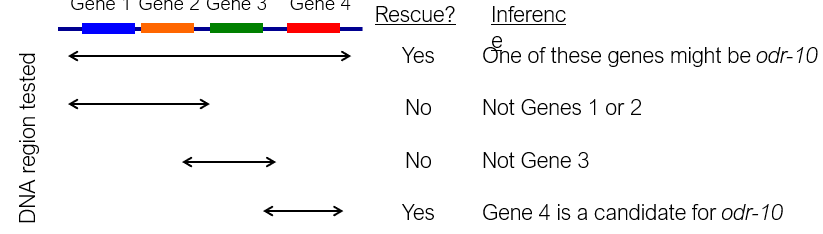
Rescue Experiments: Scientists created transgenic animals using wild-type DNA fragments. The specific fragment that restored (rescued) the ability to smell diacetyl was identified.
Narrowing down: Starting with large regions and moving to smaller genomic pieces identified Gene 4 as the odr-10 candidate.
Sequence and Molecular Structure of odr-10:

sequence the rescuing region: infer gene structure
Rescuing Genomic DNA: Approximately , containing the promoter and a coding sequence with 8 exons.
mRNA: .
Specific Alleles:
ky32: A point mutation changing CAC (His) to TAC (Tyr).
ky225: A deletion spanning a significant portion of the gene.
Protein Product: ODR-10 is a 7-transmembrane receptor (GPCR) consisting of . These receptors sit on the plasma membrane and transmit external signals (odors) into the cell.
confirms that different alleles have different mutations in the same gene
Gene Regulation and Expression Analysis
Reporter Genes:
To visualize where odr-10 is active, researchers constructed a plasmid, attaching GFP to the odr-10 promoter.
aim to drive GFP under control of odr-10 promotor and transform worms with this plasmid

Result:
odr-10::GFP → found in AWA neurons which sense diacetyl
odr-10 → required for sensing diacetyl and acts in AWA to sense diacetyl
How does odr-10 work with other genes needed for smell?
Mutants in the odr-7 gene also cannot sense diacetyl.
odr-7 encodes a transcription factor.
Hypothesis: as odr-7 encodes a transcription factor, maybe odr-7 mutants cant smell because the don’t express odr-10 in AWA neurons.
Test: odr-10::GFP reporter used to see what happens in the odr-7 mutant.
Outcome: In odr-7(-) mutants, the odr-10::GFP reporter is not expressed.
Conclusion: The odr-7 transcription factor is necessary to initiate the expression of the odr-10 expression in AWA neurons.
Connecting Worm Genetics to Mammalian Biology
7-transmembrane proteins similar to odr-10 are present in mammals
thought to be olfactory receptors
large family
expressed in olfactory epithelium
actual function not tested
no function demonstrated for candidate receptors in mammals
chemicals that they detect are unknown
no direct evidence for role in olfaction
genetic data: odr-10 is the receptor for diacetyl
the first functional evidence that show this family of receptors are involved in olfaction
Conservation of Mechanisms:
Studies by Buck & Axel (1991) identified a large family of 7-transmembrane proteins in the mammalian olfactory epithelium as candidate receptors.
However, initially, no functional evidence existed to prove these mammalian proteins actually detected odors.
The genetic data from C. elegans (specifically the study of odr-10) provided the first functional evidence that this entire family of receptors mediates olfaction (Sengupta et al., 1996).
General Principles of Smell:
7-transmembrane receptors (ODR-10 like) sense odors in olfactory neurons.
Different receptors are tuned to different odors.
Combinatorial Coding: Some odors activate multiple receptors, and some receptors detect multiple odors.

Conclusion and Future Directions
Summary of Methodology:
Identify genes via mutation screening and complementation.
Locate genes via recombination mapping and DNA rescue.
Determine expression patterns via reporter constructs (GFP).
Understand regulation by testing expression in transcription factor mutants.
Future Research Gaps:
How olfactory information is processed and transmitted within the complex nervous system.
How different smells are represented in the brain (e.g., using fMRI in humans).
Many areas of biology, including the nuances of olfaction, remain active fields of research with many unknowns.