Ch1 Multinational Financial Management Overview
LO:
Identify the management goal and organizational structure of the MNC
Describe the key theories about why MNCs engage in international business
Explain the common methods used to conduct international business
Provide a model for valuing the MNC
LO1 : Identify the management goal and organizational structure of the MNC
Multinational corporations (MNCs) : firms that engage in some form of international business
Managers conduct international financial management
International investing and financing decisions that are intended to maximize the value of the MNC
Goal : maximize firm’s value
International financial management is important even to companies that have no international business
Companies must recognize how their foreign competitors will be influenced by movements in exchange rates, foreign interest rates, labor costs, and inflation
1-1 Managing the MNC
Commonly accepted goal of MNC is to maximize shareholder wealth
Managers are expected to maximize stock price
Some publicly traded MNCs based outside US may have additional goals
Satisfying respective governments, creditors, or employees
Primary goal is still satisfying shareholders for more funds to support operations
Focus of class : MNCs whose parents wholly own any foreign subsidiaries; meaning the US parent is the sole owner of the subsidiaries
1-1a How Business Disciplines Are Used to Manage the MNC
Business disciplines are integrated to manage MNC in a way that maximizes shareholder wealth
Management develops strategies that will motivate and guide employees who work in MNC and organize resources for them to efficiently produce products or services
Marketing seeks to increase consumer awareness about products and recognize changes in consumer preferences
Accounting and information systems record financial information about revenue and expenses of MNC, used to report financial information to investors and evaluate outcomes of various strategies implemented by the MNC
Finance makes investment and financing decisions for MNC
Common finance decisions
Whether to pursue new business in a particular country
Whether to expand business in a particular country
How to finance expansion in a particular country
Whether to discontinue operations in a particular country
Finance decisions for each MNC is partially influenced by other business discipline functions
Decision to pursue new business in a particular country depends no comparison of costs and potential benefits of expansion
Potential benefits of new businesses reflect both expected consumer interest in products to be sold (marketing function) and expected costs of resources needed to pursue the new business (management function)
Financial managers rely on financial data provided by accounting and information systems functions
1-1b Agency Problems
Agency problem : conflict between managers’ personal goals and maximizing shareholder wealth
Increased agency costs for MNC
Difficulty in monitoring distant, international subsidiaries
Cultural differences leading to varying priorities
Complexity due to the large size of MNCs
Example of poor monitoring
JPMorgan Chase & Co. lost $6.2B and paid over $1B in fines due to risky trades and inadequate internal controls
Parent control of agency problems
Clearly communicate goals to subsidiaries
Oversee subsidiary decisions and align them with MNC goals
Implement performance-based compensation, such as stock options
Corporate control of agency problems
Acquisition threat : poor performance can lead to the firm being acquired and weak managers being removed
Institutional investors : influence management and board through complaints and demands for changes
Impact of Sarbanes-Oxley Act (SOX)
Enhanced transparency in financial reporting
Required internal reporting process systems and accountability measures to be monitored by executives and board of directors
Methods used by MNCs to improve internal control
Establishing a centralized database of information
Ensuring that all data are reported consistently among subsidiaries
Implementing a system that automatically checks data for unusual discrepancies relative to norms
Speeding the process by which all departments and subsidiaries access needed data
Making executives more accountable for financial statements by personally verifying their accuracy
Reduced potential for managerial financial manipulation
1-1c Management Structure of an MNC
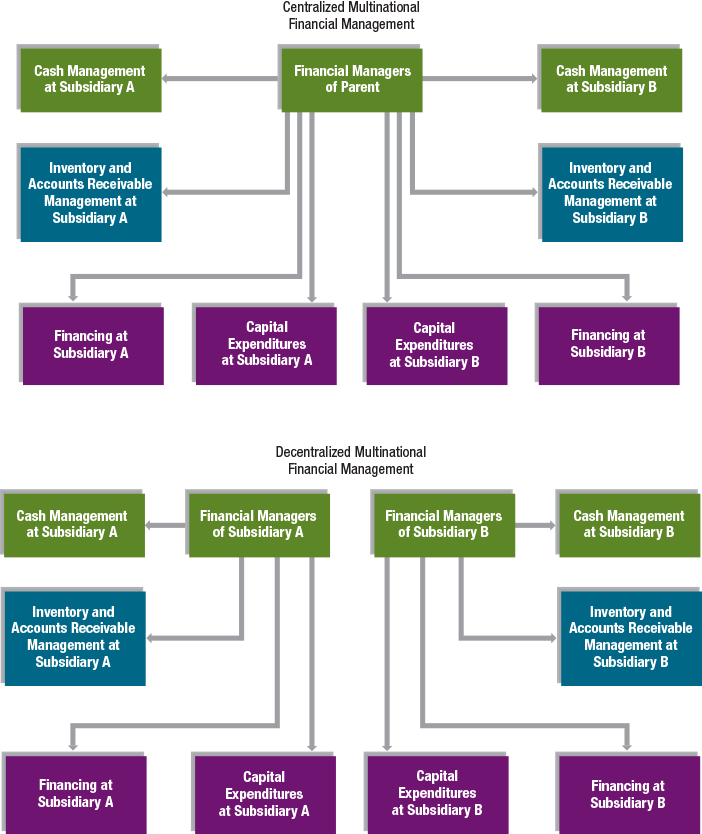
Centralized Management:
Reduces agency costs by limiting subsidiary managers' power.
May result in poor decisions if parent managers lack detailed knowledge of subsidiary operations.
Decentralized Management:
Potentially higher agency costs due to misalignment with MNC goals.
Allows subsidiary managers to make decisions based on closer knowledge of local conditions.
Can be effective if subsidiary managers are aligned with overall MNC goals and compensated accordingly.
Hybrid Approach:
Combines decentralized decision-making with centralized monitoring.
Subsidiary managers handle key decisions while the parent monitors to ensure alignment with MNC’s interests.
1-2 Why MNCs Pursue International Business
Three common theories
Theory of comparative advantage
Specialization and Production efficiency : countries specialize based on their unique advantages, improving production efficiency
Technology vs Labor Cost Advantages
Countries like Japan and the US excel in technology
Countries like China and Malaysia benefit from low labor costs
Specialization examples
Japan and the US : Large producers of electronic products
Jamaica and Mexico : large producers of agricultural and hand
Role of MNCs : companies like Orale, Intel, and IBM leverage technology advantages to expand in foreign markets
Comparative Advantage and Trade
Specialization leads to dependency on trade for other products
Classical theory of comparative advantage supports specialization and trade
Tourism example : The Virgin Islands specialize in tourism and rely on international trade for most other products, as it’s more efficient than producing everything domestically
Imperfect markets theory
Market conditions
Closed markets : if countries closed their markets entirely, there would be no international business
Perfect markets
If factors of production (e.g. labor, capital) were perfectly transferable, resources would flow freely to where they are most in demand
This would lead to equalization of costs and returns across countries, eliminating comparative cost advantages
Without comparative advantages, the rationale for international trade and investment would disappear
Imperfect markets
Real-world imperfections
Factors of production, such as labor, are not fully mobile due to costs, regulatory barriers, and other restrictions
These barriers include immigration laws, capital controls, and logistical challenges that limit the free flow of resources
Imperfect markets mean that resources are somewhat immobile, creating differences in production costs between countries
Impacts on MNCs
Exploitation of imperfections
MNCs, like Gap and Nike, capitalize on these imperfections by manufacturing in countries where certain resources (like labor) are cheaper
They leverage the specific advantages of foreign markets to reduce costs and increase competitiveness
Incentives for international business
Motivation for firms
Imperfect markets provide firms with incentives to explore international opportunities to maximize efficiency and profits
By taking advantage of varying resource costs and restrictions in different countries, MNCs can optimize their global operations
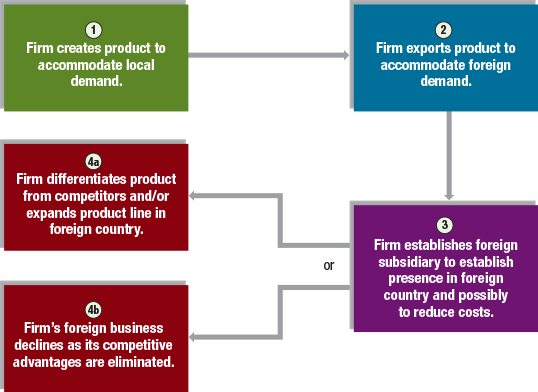
Product cycle theory
Home market establishment : firms initially establish themselves in their home market where they have better access to market and competitive information
Expansion through exporting : if the firm’s product is superior and gains popularity abroad, it begins by exporting to meet foreign demand
Foreign production : to reduce costs, especially transportation, firms may start producing the product in foreign markets once it gains substantial popularity
Prolonging foreign demand : firms may use strategies such as product differentiation to maintain a competitive edge and prolong foreign demand
Theories overlap to some extent and can complement each other
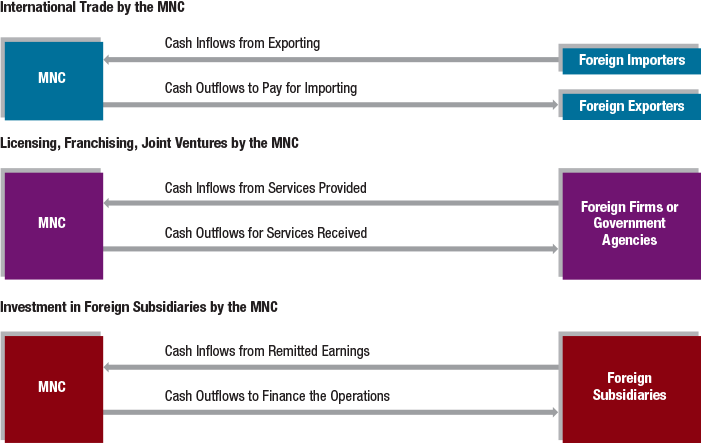
1-3 Methods to conduct intl business
Methods
Intl trade as conservative approach
Market penetration
Firms use intl trade to enter new markets through exporting, allowing them to reach foreign consumers without significant investment
Cost reduction
importing enables firms to obtain supplies at a lower cost, improving their overall cost efficiency
Minimal Risk Involvement
Low capital risk : unlike other intl business strategies, intl trade does not require firms to commit substantial capital, minimizing financial exposure
Flexibility : firms can easily scale back or discontinue exporting or importing activities if market conditions change, incurring low exit costs
Adaptability : this approach allows firms to respond flexibly to changes in demand or supply conditions without significant financial losses
Licensing : an arrangement where one firm provides its technology (copyrights, patents, trademarks, or trade names) in exchange for fees or other consideration
to generate revenue from foreign countries without establishing any production plants or transporting goods in/to foreign countries
Franchising : when a firm provides a specialized sales or service strategy, support assistance, and possibly an initial investment in the business in exchange for periodic fees, allowing local residents to own and manage the specific units
Ex : McDonald’s purchases land and establishes building, leases building to franchisee and allows them to operate the business in the building for a number of years, but franchisee must follow standards set by McDonald’s when operating the business
Direct foreign investment (DFI) : any method of increasing intl business that requires a direct investment in foreign operations
Joint ventures : business that is jointly owned or operated by two or more firms
Entry into foreign markets
Partnership with established firms : firms often enter foreign markets by forming joint ventures with local firms that are already established in those markets
Advantages
Joint ventures allow the partnering firms to leverage their respective comparative advantages, enhancing the effectiveness of the project
Investment and risk sharing
Direct foreign investments (DFI) : joint ventures typically require some level of DFI from the participating firms
Shared investment and risk
All parties involved in the joint venture share the investment costs and associated risks, distributing the financial burden
Acquisitions of existing operations
Foreign Acquisitions
Penetrating Foreign Markets:
Firms often acquire foreign companies to quickly gain a significant market share and full control over foreign operations.
Direct Foreign Investment (DFI):
Acquisitions are a form of DFI, as MNCs invest directly in foreign countries by purchasing existing companies.
Example: Alphabet's Acquisitions
Global Expansion:
Alphabet, Google's parent company, has expanded globally through acquisitions in various countries, enhancing its business and technology:
Australia, Brazil, China, Finland, Russia: Search engines and micro-blogging.
Canada, Germany: Mobile browser and software.
South Korea: Weblog software.
Spain: Photo sharing.
Sweden: Videoconferencing.
India: Artificial intelligence.
Belarus: Computer vision.
UK: Graphics processing unit reliability.
Risks and Challenges
High Investment Risk:
Full acquisitions require substantial investment, which can lead to significant losses if the acquired company performs poorly.
Difficulty in Resale:
If foreign operations are not successful, selling the business at a reasonable price can be challenging.
Partial International Acquisitions
Lower Investment and Risk:
Firms may opt for partial acquisitions to gain a foothold in foreign markets with a smaller investment, reducing potential losses if the venture fails.
Limited Control:
Partial acquisitions result in shared control, limiting the firm’s ability to fully manage foreign operations.
Establishment of new foreign
New Foreign Subsidiaries:
Firms can enter foreign markets by setting up new operations in other countries to produce and sell their products.
Direct Foreign Investment (DFI):
This approach, similar to foreign acquisitions, involves a significant level of DFI.
Advantages over acquisitions
Customization:
New operations can be specifically tailored to meet the firm’s requirements and business model.
Potential Lower Investment:
Establishing a new subsidiary may require less investment compared to acquiring an existing company.
Challenges
Delayed Returns:
Firms must build the subsidiary and establish a customer base before they can benefit from the investment, leading to slower initial returns.
Time and Resources:
Establishing new operations requires time and resources to develop infrastructure, hire staff, and build market presence from scratch.
Summary of methods
Valuation Model for MNC
Intl financial management should be conducted with goal of increasing MNC’s value'
Domestic valuation model

E(CF$,1) : expected cash flows to be received at the end of period
t/n : number of future period where CF is received
k : weighted average cost of capital/required rate of return by investors and creditiors
Dollar cash flow
t = funds received by firm less funds needed to pay expenses of taxes or investing in firm (e.g replace computers)
All other factors constant, increase in ECF = increased value of firm
Cost of capital (k)
Cost of capital includes both cost of debt and cost of equity
Multinational valuation model
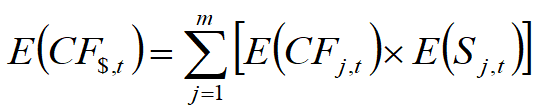
CFj,t : foreign currency j at end of period t
Sj,t : exchange rate where foreign currency is converted to dollars
Ex
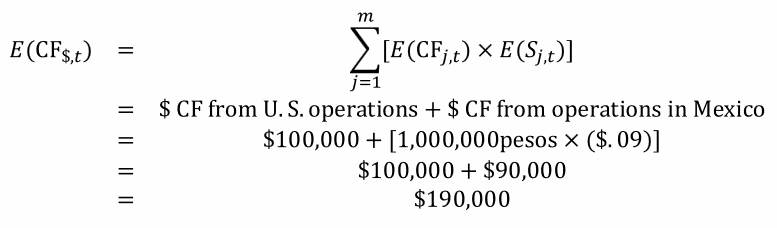
If it’s already in US dollars, doesn’t need to be converted
Valuation of an MNC’s CF over multiple periods

v = value
Ex: Austin Co. is a U.S.-based MNC that sells video games to U.S. consumers; it also has European subsidiaries that produce and sell the games in Europe. Last year, Austin received $40 million in cash flows from its U.S. operations and 20 million euros from its European operations. The euro was valued at $1.30 when the European cash flows were converted to dollars and remitted to the U.S parent.
What was Austin Co.’s cash flow last year?
Assume that Austin Co. plans to maintain its business operations in the same way in the United States and Europe for the next three years. Suppose no other future cash flows will be generated afterwards and Austin Co.’s cost of capital is 10%. What is Austin Co.’s firm value?
Uncertainty surrounding an MNC’s cash flows
Exposure to domestic/intl/politic economic conditions and rate risk
Intl economic condition : cash inflows MNC gets from foreign country sales during a period depends on demand by that country’s consumers for MNC products, also affect by their national income
If conditions weaken in foreign country, country’s consumers may suffer decrease in income and employment rate may decline = less money to spend and less demand for MNC products
Intl economic condition can affect home economy; when country’s economy strengthens, consumers buy more from other countries and other countries experience stronger sales and CF
Intl political risk
Foreign government may increase taxes or impose barriers on MNC’s subsisiary
Also boycott if friction between two countries
Exchange rate risk
Foreign currencies to be received by US based MNC suddenly weaken again the dollar
How uncertainty affects the MNC’s cost of capital
More uncertainty about MNC’s future cash flows, then investors would require higher expected rate of return
Lower uncertainty, lower required rate of return and cost of capital for MNCs
Valuations of MNCs increase