Week 1 Quiz
A common procedure for determining whether an animal likes or dislikes a particular tastant is the two-bottle technique. For this technique, the animal is provided equal access to two bottles: one contains water, and one contains the tastant dissolved in water. Researchers measure how many times the animals drink (or lick) from each bottle and calculate a ratio (tastant:water). A ratio of 1.0 means that the animal had no preference for the tastant compared to water; a ratio less than 1.0 means the animal disliked the tastant; and a ratio of greater than 1.0 means the animal liked the tastant. In a 2011 study published in Journal of Gerontology, using two-bottle experiments, researchers measured the taste preference of mice for sweet, salty, sour, and bitter compounds as a function of age. As you can see, only preference for sweet taste changed significantly with age, with older mice liking sucrose significantly less than younger mice. Provide a reasonable explanation for this observation.
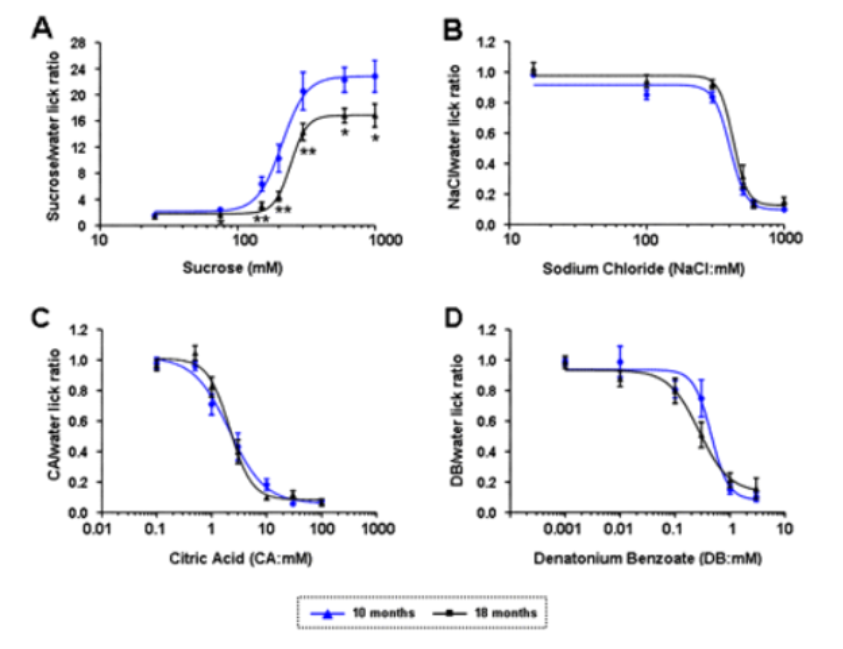
Preference for sweet taste changed significantly with age, where younger mice (10 months) had a ratio greater than older mice (18 months). An explanation for this observation might be that since the younger mice need to grow, they require more energy from sugars (that provide a sweet taste). Therefore, to get energy to grow, younger mice had a stronger preference for sugars. Sour, salty, and bitter sensations benefit both generations, relatively equally, this explains why there isn’t a significant difference between ages for these categories.
Oysters are one of the most frequently eaten shellfish in the world, and marine aquaculture is the most common source of oysters for the food industry. Many marine aquaculture facilities raise triploid (rather than diploid) oysters because they grow faster, allowing food-quality oysters to reach the marketplace more quickly. In a 2002 study, researchers from the Ocean University of Qingdao in China compared the taste of triploid and diploid oysters, using blind taste comparisons. Which do you suppose were found to taste better? Justify your answer.
Triploid oysters have another 3 copies of their genome. Therefore, they have a greater amount of nucleotides than diploids. I would assume that triploid oysters would taste better as they would have a more desirable taste when nucleotides are sensed by umami receptors. Triploid oysters also are more likely to have a provide greater protein content because of the greater nucleotides to synthesize proteins. The amino acids within proteins will contribute to the umami taste which is a desirable taste.
A 2014 paper published in FASEB Journal showed that stimulation of T2R receptors in humans led to a significant decline in plasma levels of thyroid hormones. Provide a reasonable explanation for this observation.
Thyroid hormones are used to regulate basal metabolic rate. Since TR2 receptors detect bitter, toxic compounds, then as the stimulation of TR2 receptors occur, the body senses toxic compounds. Therefore metabolic rate needs to decrease to reduce the amount of food needed. In return, the organism will consume less food as its metabolic rate decreases. protecting the animal from further consumption of the toxic compound. This is done by a decrease in secretion of thyroid hormones which decreases metabolic rate.
The figure below has been reproduced from a 2016 study published in Laryngoscope. It shows the effect of radiation (Rad) and chemotherapy (Chemo) on the expression of taste receptor genes in Japanese patients with head and neck cancers. Based on the results of this study, if you were an oncologist using radiation and chemotherapy to treat patients with head and neck cancer, what might be you be concerned about with regards to your patients' eating habits? Explain.
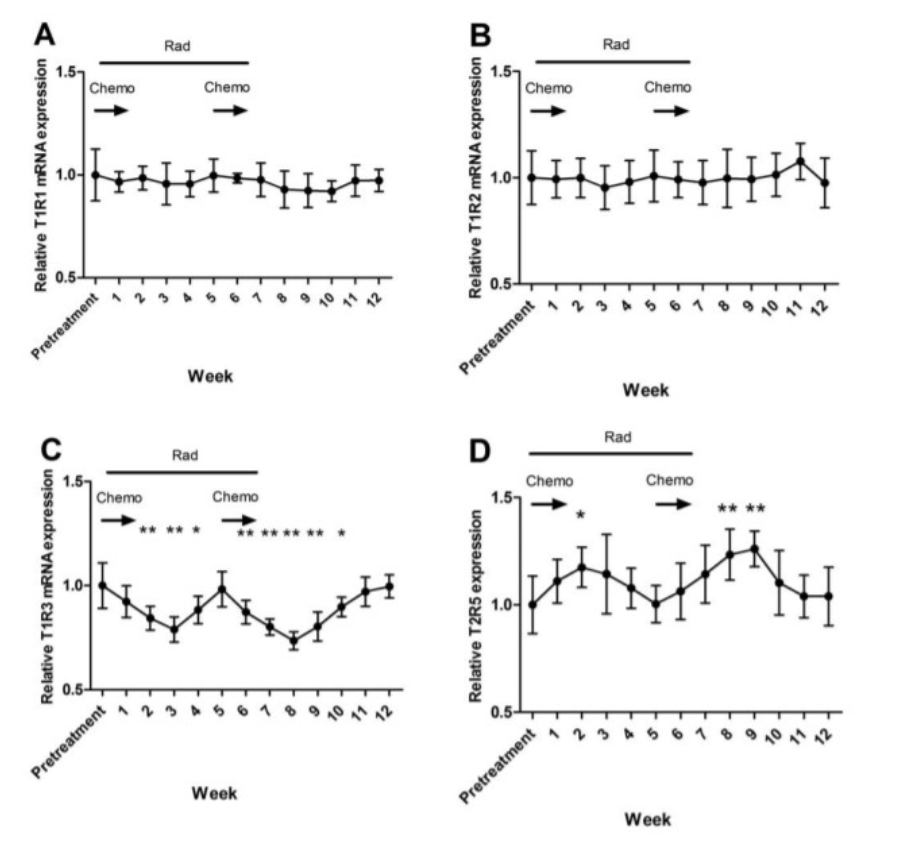
According to this diagram, there seems to be a decrease in T1R3 receptors, which are the receptors that sense sweet and umami tastes (which are desirable). Therefore, it is good to inform the patient that during chemo they might not be able to taste things they prefer, which could lead to eating less, and then weight loss. In addition, there seems to be an increase in expression of T2R5 receptors which are used to detect bitter compounds. Because of this increased expression, they might taste the bitterness in foods more intensely than on a regular. This could also lead to eating less as they would lose their appetite quite quickly.
Essential amino acids (EAAs) must be obtained from the diet because they cannot be synthesized in the body. On this basis, one might expect that the umami receptor (T1R1+T1R3) would have evolved to detect EAAs better than non-EAAs; however, in humans, glutamate is the particular amino acid that binds most strongly to the umami receptor (hence the use of monosodium glutamate (or MSG) as a common food additive), yet glutamate is not an EAA in humans. Provide a reasonable hypothesis to explain why the human umami receptor may have evolved to best detect a non-EAA, such as glutamate, rather than any EAA.
An explanation for this phenomenon might be that glutamate is a very common or abundant amino acid, although it is a non-EAA. Since it is at higher concentration, it is likely that it would be detected. The umami receptor might have evolved to just sense glutamate because of its abundance and it gives a higher chance of detecting any protein at all. Amino acids are present in proteins, with a lot of other amino acids. So if the receptor detects glutamate, it is likely that there would be other EAA that are also present within that protein.
Hyperemesis gravidarum (also known as "morning sickness") is a condition characterized by severe vomiting during pregnancy. Seeking to unravel the etiology of this condition, in a 2000 study published in Physiology & Behaviour, researchers recruited 60 women and classified them based on their self-reported vomiting frequency across all previous pregnancies. Subsequently, they subjected each woman to a PROP paper test, which determines one's capacity to taste 6-n-propylthiouracil, a bitter tastant. The researchers observed that those women who had a low vomiting frequency during their pregnancies had a small response to the PROP paper test (i.e., they could hardly taste 6-n-propylthiouracil), whereas those women who had a high vomiting frequency during their pregnancies had a strong response to the PROP paper test (i.e., they could taste 6-n-propylthiouracil considerably). In light of these findings, what is likely the underlying cause of hyperemesis gravidarum?
Consumption of toxic compounds could lead to vomiting and nausea as the body attempts to eliminate it and minimize absorption by the body. Toxic compounds normally taste bitter as a way for us to detect that it is not something we want to consume. These bitter compounds are detected by T2R receptors. Considering some women had the capacity to taste 6-n-propylthiouracil, a bitter compound, and that it led to vomiting, then it is likely that T2R receptors were activated. Therefore, perhaps these women had a greater concentration of T2R receptors than the women who couldn’t taste the compound and also did not vomit. It might also be that these receptors were found on both the tongue and the stomach (anywhere on the digestive tract) for the women that vomited, but not for the women that didn’t.
In a 2021 paper published in Science, researchers from University of Tokyo examined the capacity of T1R1-T1R3 receptors within various bird species (shown below) to be stimulated by sucrose, fructose, and glucose. For which species do you suppose that the stimulation of this receptor by these compounds was found to be the strongest? Justify your answer.
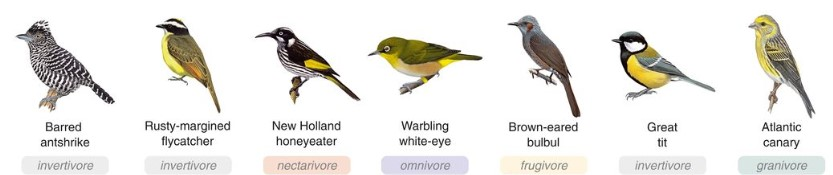
T1R1-T1R3 receptors are stimulated by amino acids that detect umami tastes, typically found in proteins of animal bodies. If the species’ T1R1-T1R3 receptors were stimulated by sucrose, fructose, and glucose, then it is likely that the species evolved to detect sugars by these receptors and comsume a lot of sugars. Brown-eared bulbul (fructivoire), which eats fruits, and New Holland honeyeater (nectarvoire), which eats nectar, are both species that consume sugar-dense diets. Therefore, to is more likely that stimulation of those receptors by sugars can be strongest in these species.
A 2021 study published in Proceedings of the National Academy of Sciences showed that, although Myotis ricketti, an insectivorous bat species, has complete copies of both T1R2 and T1R3 genes within its genome, it does not show any preference for sweet taste (see results below). Provide a reasonable hypothesis to explain this observation.
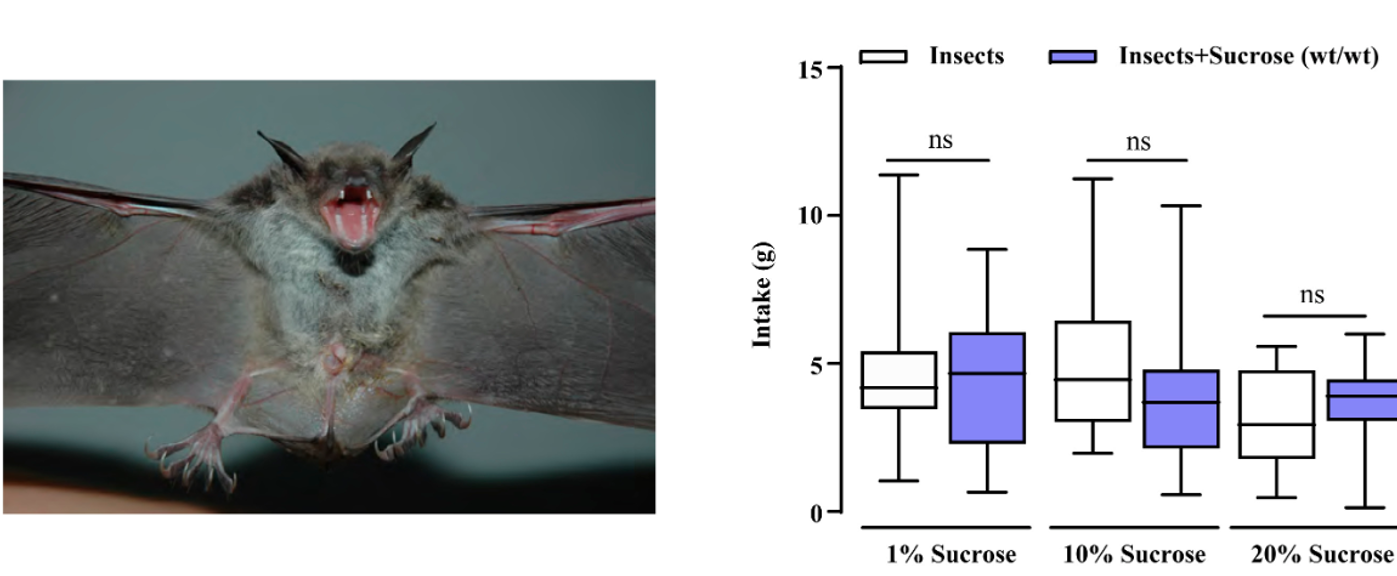
Animals are not consciously aware of taste sensations when it hits the tongue. They are only able to interpret the taste when the sensations are relayed to the gustatory cortex, where the processing occurs. While they do have complete copies of both genes within its genome, it is possible that these genes are not actually expressed in the taste receptor cells or if it is, the taste receptors cells do not communicated effectively with the nervous system. Therefore, the preference for sweetness is not present as they do not detect it.
Drosophila melanogaster has a proboscis (indicated the arrow in the figure below) that it uses for feeding. A 2021 study published in Proceedings of the National Academy of Sciences showed that the proboscis of Drosophila has a high expression of OTOP1. Are you surprised by this finding?
Drosophila melanogaster are fruit flies. OTOP1 receptor detects sour acids. Since these insects eat fruits, typically rotten fruits, it is not surprising that they express a lot of OTOP1 which detects acids in the rotten fruits. Rotting fruit might contain a lot of pathogenic bacteria, but as we discussed in class, lactic acid present in foods (generally sour foods), would be a good indication that there are reduced levels of pathogenic bacteria. Acids kill pathogenic bacteria, so it is evolutionary beneficial for fruit flies to have the ability to detect acids and know if the fruit does not contain a high level of bacteria.
In a 2020 study, researchers from Southern Connecticut State University acquired several manatee heads from animals that had died from various causes (e.g., hit by personal watercraft) and examined the distribution of taste buds on their tongues. Taste buds were only found on the tongue root (TR), i.e., the very base of the tongue, farthest from the mouth. Why do you suppose that taste buds are found only in this particular location in manatee tongues, and not widespread across the tongue, as in most mammals?
Manatees are fully aquatic animals that consume food underwater. Taste has evolved for species to sense the presence of beneficial or harmful compounds. Since this species consumes foods underwater, they take in a lot of water with their consumption. If taste buds were present along the entire tongue, it is likely that the receptors would be stimulated by compounds in the water and interfere with the compounds in foods that they actually want to swallow. At the back of the tongue, it is preferred as they can differentiate between what wants to be swallowed and it gives more time to spit the unnecessary water back out.
In a 2012 paper published in International Journal of Poultry Science, Dr. Geetha Kumar-Phillips (University of Arkansas) recommended that chicken meat should be marinated with lemon juice for 1 hour prior to cooking. What do you suppose was the basis of this recommendation?
I agree with this recommendation because acids tend to eliminate pathogenic bacteria. Most bacteria cannot tolerate acidic environments. This is why foregut fermenters avoid the consumption of acidic foods as it interferes with the bacteria in their stomach to digest foods. If chefs marinate chicken with lemon, this could kill the pathogenic bacteria that cause food-borne illnesses.
The liver synthesizes and secretes bile acids, which play an important role in fat digestion, into the small intestine. In a 2023 study published in Communication Biology, researchers found that each of eight different bile acids tested caused activation of T2R receptors in both mice and humans. What insight does this finding provide about bile acids and, by extension, the consumption of high fat diets?
T2R receptors detect bitter compounds. Since a lot of bitter tasting compounds are toxic, their bitter taste is meant to show the body that it is something to avoid. Therefore, if the secretion of bile acids causes the activation of T2R receptors, there might be an association between high fat diets and toxicity. Therefore, this endogenous compound (produced by the body) might be toxic and that a high fat diet that promotes bile secretion might be toxic.