22/03- News Values
News Values
A number of factors determine whether a story is 'newsworthy' or not. Journalists are trained to recognize or value 'good' stories. A number of media theorists have tried to define what these 'News Values' are. Here is a selected list. Please note that some of these are often called other things and that journalists don’t have a list of these: it is just understood that these are the criteria….
News Values | Explanation |
|---|---|
Conflict | This is where stories are selected because they ' have two sides'. When these two sides are in dispute there is a 'binary opposition' which enhances media interest and allows for the dramatization of the story. |
Negativity | 'If it bleeds it leads', 'Bad' news is usually favoured over 'Good'. Arguably this is for the same dramatic reasons that we prefer narratives with conflict and disequilibrium over stories 'where nothing bad happens.' |
Unexpectedness | 'Dog bites man, no news, Man bites dog, news.' 'Newness' or novelty is a preferred characteristic of most news stories. Sometimes an important story can be neglected because it is or might be seen as 'old news'. |
Consonance | Often a story is recognised as a 'good story' by journalists and audiences because it fits in with the codes and conventions of news coverage. In other words, we’ve seen this kind of story before. ‘Snow’ stories would be a classic. |
Timeliness | News that happens within the time frame of the news media (mainly 24 hours) is more appealing to news providers than stories that develop very slowly. As an example, a hurricane is more likely to lead than gradual global warming impacting on the weather. |
Continuity | Whilst the media likes stories to be 'unexpected', they also like ongoing stories so that they can anticipate and preschedule their coverage of events. Ongoing wars like Syria are covered because news providers know that the war won’t stop suddenly. |
Proximity | 'Hit and run in Mexico. Local man feared hurt'. News stories tend to favour geographically close 'home' issues over distant 'foreign' ones. However, if the scale of the event is big or the ‘hit and run’ in this case was a British tourist, that would make it more ‘valuable’ to UK news. |
Cultural Similarity | This is the idea that stories are more likely to be picked if they occur in places with similar cultures. Distance can be cultural rather than geographical, Australia is further away than Albania, but events in Australia can be seen as 'closer to home' because of shared history, language and ethnicity. |
Relevance | News providers are more likely to select stories which might directly affect the lives of the news audience. A crude (but genuine) example of this was when the Gulf War 1990-1991 impacted on the cost of oil and thus 'War in Gulf puts 1p on Litre of petrol'. |
Simplification | Stories will be preferred if there is clear issue involved. News headlines are particularly likely to be simplistic. |
Composition | News items tend to be selected as part of a 'balanced menu' (Foreign Story, Political Domestic Story, Celebrity Story, 'Dead Donkey' Story etc). This can have serious consequences when there are 'too many' foreign stories. The Malaysian aeroplane issue for instance, took some news coverage time away from the problems in Ukraine and Crimea for instance. |
Personalisation | 'Human Interest' stories are often preferred, even when this approach leads to simplistic or over emotive coverage. |
Elite Nations | Events in 'developed' countries such as the USA and Europe are almost always treated as more significant than those in the 'developing' or 'third' world (unless they affect US or European interests). |
Elite Persons | Famous people, politicians; the Royal Family; celebrities get news coverage time than the average person. This is partly due to public interest; journalists having easy access to these people and partly due to the fact that public relations companies and communications people, ‘release’ information to the news to keep their clients in the public arena. |
Footage/strong images | this is particularly the case with television news and stories that lead on the front page. A strong image can help to sell a paper and good footage, to engage and audience, so if these are available, they are likely to be selected. |
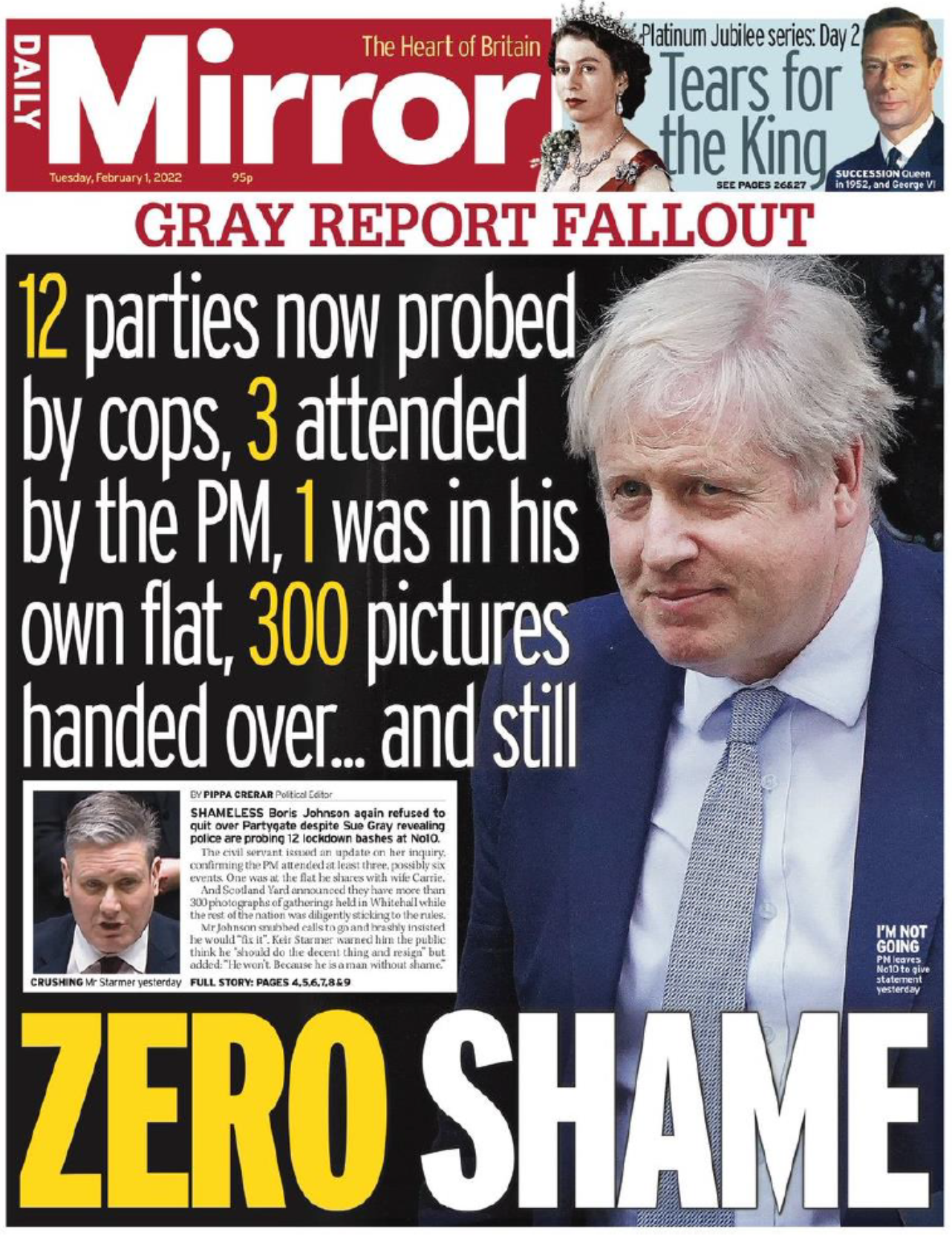
The Daily Mirror Front Page: Media Language analysis