Sandy Shores - Environment, Organism, Adaptations
Shores composed of sand/mixed sand and rock are a common habitat which comprises around 75% of the worlds ice-free coastlines. They are marginal environments for marine organisms.
This is because they are covered and uncovered by the tides as well as being a dynamic and unstable environment
Sand
sand is a mixture of Abiogenic and biogenic particles
abiogenic - Non Living - Rocks e.g. Quartzite, angular or rounded
Biogenic - living - shell fragments e.g. mainly calcium carbonate originating from molluscs and crustaceans
Sands are also composed of organic materials and microplastics
On the wentworth scale, sand consists of sediments with particle sizes within the range of 62.5 micro m to 1 mm in diameter.
in order to determine the diameter of different particles a washed, dry sample through seives of increasingly fine mesh size. This is called Granulometry
Sand has many different properties including porosity (30-40% by volume), permeability (darcys coefficient), penetrability (thixotropic - dilatant) and organic matter content
porosity is the percentage of volume of the sediment that consists of the interstices between grains. In beach sand porosity is typically 30-40% which affects the amount of water within the sediment and acts as a habitat for interstitial organisms
permeability is a measure of how readily water can pass through sediments - this affects oxygenation. darcys coefficient is determined by applying a column of water of known height/pressure to the sediment and measuring how quickly is permeates into the sediment
Penetrability is a measure of the force required to push an object into or through the sediment which is important for burrowing organisms and birds. Thixotropy means reduced viscosity and in extreme cases this causes quicksand - Dilatant sediment is less penetrable when pressure is applied causing water to be exluded and particles to pack together (usually coarse well sorted sands)
All of these qualities are affected by grain size and sorting of sediments from water movement
Sandy Shore Biota
at first glance there may not be signs of life on a sandy beach, this is due to sand being mobile which doesnt allow seaweed and sessile animals to attach. The surface of the beach can end up looking barren due to this.
Furthermore any mobile vertebrates crawling on the surface would be easy prey for birds so most inhabitants stay buried in the sand.
Sandy beaches are three dimensional environments where most of the inhabitants are animals in addition to possible single celled algae in the form of benthic diatoms which grows on the sand surface.
Amphipods:
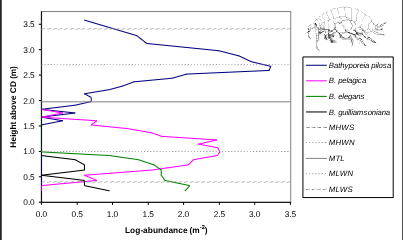
Amphipod crustaceans are ususally abundant on sandy beaches and consist of various body sizes and feeding modes - this occurs in relation to height on shore
Amphipods are important for recycling organic matter and are prey for specific species of shore birds
Eurydice Pulchra (isopoda) :
these isopods live in the sand at low tide which emerges at night into the water and become voracious carnivores
they migrate upshore on spring tides
Polychaete Worms:
polychaete worms are a conspicious component of sandy shore fauna and comprise of deposit feeders, scavengers and predators, there are 3 main species: Magelona (spionidae), nereis diversicolor and ophelia
Lugworms:
lives in u-shaped burrows