(PSYA01) Psychology Textbook
Introduction to Psychology
Notes Through The Textbook
Chapter 1: WHAT IS PSYCHOLOGY?
Psychology: Study of behaviour and mind
Psychology is considered the union of physiology and philosophy
Aristotle thought of the mind like a blank slate = Tabula Rasa
Empiricism: View that knowledge comes from directly what we observe and experience (Observational in nature)
Behaviour is used with psychologists making inferences through responses, actions and words.
Dualism = behaviour and mind (mind and body are separate entities)
3 Broad study process = Basic Research, Application and Clinical Work
LIST OF BASIC PSYCHOLOGY:
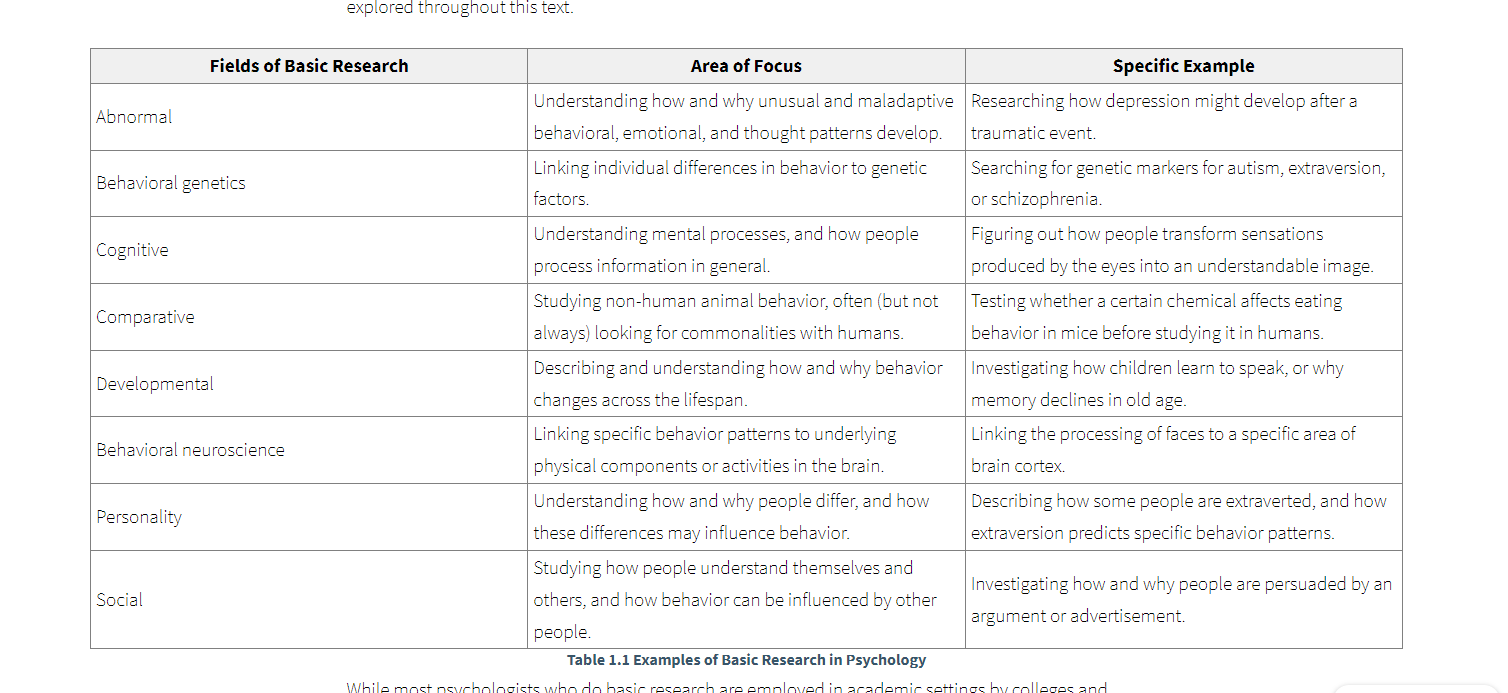
Basic Research: Aren’t trying to solve an issue, but solely understand it
Applied Psychology: Solving practical problems
2 PARTS
Applied Research: DIscover new and practical ways
Applied Practice : Using new techniques to solve problems
Translational Research: Applying basic research to practical problems
Clinical Psychology: Focus on identifying and preventing distress of a psychic function.
Phrenology: phrenologists believed that knowing about the shape of a person’s skull could tell you about the person’s mental capacities as well. (early unscientific ideas)
Empiricism: All skills learned from experience and observation
Nativism: All skills are inherent
Systematic Introspection: Standardise some conscious experiences throughout people
Structuralism: Elementary parts of conscious experiences
Break down conscious experiences into basic parts
Functionalism: based on Darwin’s theory of evolution
functional nature of traits and describes how adaptive traits exist to solve specific problems.
(Fear of dangerous man)
Behaviourism: focuses on the idea that all behaviours are learned through interaction with the environment.
Cognitive science contains these other fields -- computer science and artificial intelligence, linguistics, and neuroscience, among others.
Psychology PROCESS TIMELINE
- Structuralism
- Functionalism
- Behaviorism
- Cognitive Revolution
- PsychoAnalysis
- Humanistic Psychology
- Modern Approaches
Psychoanalysis: (Freud) How the unconscious mind affects individuals mentally
Humanistic Psychology: (Maslow) creativity, choice, and the potential for growth. People have their own choice to serve their basic needs of survival. (The following of Self Actualization)
Positive Psychology: What can lead to positive achievements and outcomes of individuals
Wilhelm Wundt (CONSIDERED FATHER OF MODERN PSYCHOLOGY)
Eclectic Approach: (“Eclectic” means that ideas are taken from a variety of sources.)
Levels Of Explanation: Ultimate AND Proximate explanations divide the primary ways of explaining causes
Ultimate Explanation: attempt to address the reasons why a psychological phenomenon occurs by appealing to its role in the process of evolution.
(Babies cry as a signal for support from caregivers)
(THE GENERAL)
Proximate Explanation: attempt to describe an immediate cause of a psychological phenomenon.
Functional Explanation: Proximate explanations that seek to identify a specific problem with a reason (HOW IT WORKS SYSTEMATICALLY)
Process-Oriented Explanations: Are proximate explanations that focus on how a specific mental or physical process explains a psychological phenomenon (Detailed) → Crying happens because of tear duct.
(PHYSICAL PROCESSES)
Evolutionary Psychology: how mental processes and behaviour have developed over the course of evolutionary history.
(Rely on an incomplete understanding of our evolutionary past)
Culture: Shared beliefs, attitudes, cultures
Discovering “Psychological Universals” that exist across cultures
Feminist Psychology: analyses the role that gender plays in a person’s development and behaviours, appealing to cultural differences in the ways societies raise and treat men and women.
-> Similar approaches exist like the LGBTQ
Intersectional Approach: to studying issues related to culture and cultural identity, emphasising that people are not defined by any single aspect of their identities
(Ex: Not only black issues, but issues of Black women)
INcludes multiple factors: race,gender,class, etc
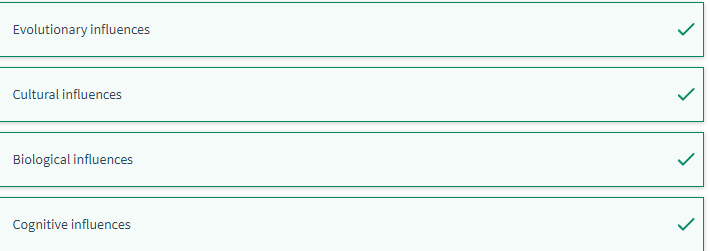
Cognitive Influences: The role of information processing on a problem or situation
Rank of most interesting to least
Chapter 2: METHODS
2.1 “Psychology has a long past, but a small history”
Philosophers understood psychology through “RATIONALISM”
the view that reason and logical argument, but not experience, is most important for how we acquire knowledge.
Aristotle recognized the heart as a central part of our being, both literally and figuratively. Instead of the brain
Our heart is specifically connected by blood throughout our body and generally (Our senses). The beating of the heart is affected by our emotions. This thought process by Aristotle used the brain as a secondary thought with less importance to our emotions and scientists weren’t knowledgeable in the abilities of conducting experiments on the mind.
The flaw in rationalism is clear: What we “think” is true about behaviour is often different from how we actually behave.
Scientific Mind:
Psychology uses experience-driven approaches to understand behaviour
Research Method Term:
Participants - people or subjects in study
Sample/sampling - sample set of participants or things taken from a population. Sampling refers to the selection of participants
Population - is the large set of individuals from which a sample was taken
Representative sample - a sample that accurately reflects the larger population
What is a representative sample?
A representative sample better reflects the participants of a population compare to an unrepresentative sample
Therefore, whatever research result you find, the results will be able to be generalised to the population
Random selection - every member of the population has an equal chance of being selected
Stratified Sampling - a process that allows a researcher to ensure the sample represents the population on some criteria
Operational Definitions:
Hypothesis - if people are given money, they experience greater happiness than if given candy.
How do we measure happiness?
Operational Definitions (IMPORTANT)
Definition of variables in research need to be quantifiable (countable) and observable. They need to be operationally defined.
Example happiness: how many times someone smiles, survey them, etc,.
Scientific Process
- Identify the problem
The first step in the process is to identify the problem of interest, which may be based on observation, previous research, established theory, or intuition.
- Gather Information
Once the topic of interest is identified, it is important to review the scientific literature and examine existing theories of behaviour.
- Generate a hypothesis
After evaluating available information about the area of investigation, researchers develop a hypothesis, or an educated prediction, about the outcome of the experiment.
- Design and conduct Experiments
After evaluating available information about the area of investigation, researchers develop a hypothesis, or an educated prediction, about the outcome of the experiment.
- Analyze Data and formulate conclusions
This step involves determining whether the findings support the experimenter’s predictions.
- Restart the process
The process starts over again at the point where the researcher reconsiders the original question/problem
Replication: Redo with modifications
Descriptive Methods: Find what something is
They’re any means to capture, report, record, or otherwise describe a group. Descriptive research is usually interested in identifying “what is” without necessarily understanding “why it is.”
Naturalistic Observation:
is best described as observation of behaviour as it happens in a natural environment, without an attempt to manipulate or control the conditions of the observation.
Field Experiments:
In which a researcher manipulates and controls the conditions of the behaviour under observation.
Operational Definition: An operational definition is how a researcher decides to measure a variable.(the measure that varies in the context of the study)
Reactivity: Changing behaviour once realising they’re being observed
(Hawthorne Effect)
Naturalistic Observation Disadvantages: researchers lack control over the environment and the many different factors that can affect behaviour. Therefore, we may not always be sure of what is influencing behaviour.
Interrator Reliability: Data and observations that are similar with others which will help ensure validity. Seeing the extent to which observations are correlated.
Participant Observation: is a research method in which a researcher becomes part of the group under investigation. Sometimes this is the only way to gain access to a group.
Ex: Researchers having to pose as cult members to understand what occurs in cults.
To test the lack of Psychiatric determinism for mental issues (pseudopatients) false patients went in to pretend to be mentally ill to notice that it would take an extremely long time for them to be released.
Rosenhan suggested that physicians operate with a strong bias toward what statisticians call a “false positive”—in this case, the inclination to call a healthy person sick.
Participant observation was used to demonstrate that clinicians, at the time, could not reliably tell the difference between people who are sane and those who are insane.
Case Study: is an in-depth analysis of a unique circumstance or individual. Analyzing events that rarely occur. For instance, what happens when a child is raised without human contact?
Example: Henry Molaison—usually referred to as “H.M.”
Henry started to experience mild seizures after falling off his bike and hitting his head
It kept getting worse until On the advice of his neurosurgeon, his last resort was bilateral ablation (remove tissue) - Can damage Hippocampus: Part of cerebral cortex moving certain memories long-term. & Entorhinal Cortex: behaviour and memory.
Procedural Memories: Remembering the motions of tasks (cycling)
Surveys: Using questions to know how people think and act. Most efficient way to collect and gather the current state of people's opinions.
Sample: Subset group of the total population
Sampling Error: A sample that doesn’t reflect the true diverse population
Bias: Flawed sampling strategies or mistakes that led to unequal or unfair.
Specifically choosing your sample
Wording Effects: The key questions being said that the people are responding to.
Response Bias: Feeling to answer questions that are “systematically correct” and they are expected to answer.
Acquiescent Response Bias: Tendency to agree to every question in a survey and ignoring their opinions.
Socially Desirable Bias: Answering what would make them look good to others and what’s socially right as an answer.
Illusory Superiority: Our habit of thinking we’re better than average.
Volunteer Bias: Those who are actually motivated to participate join and it’s not random.
(A survey about sex, only those that are sexually active would respond)
Research Ethics: ethics is a set of general principles that outline how people should be educated, treated, and respected when participating in any study.
American Psychological Association (APA) has developed a series of five ethical principles to help psychologists develop their research practice
- Principal A
- Beneficence: Researchers strive to do “good” in a study
- Maleficence: Intentionally acting on harm
- Principal B
- Fidelity and responsibility: The responsibility of having trusted relationship with the participant and researcher (Honest and reliable)
- Principal C
- Integrity: Accurate, honest and unbiased practices
- Principal D
- Justice: Equality and making a diverse and neutral sample
- Principal E
- Respect for people's rights and dignity: Explain details to the study before beginning. should take measures to respect and protect participants' rights, privacy, and welfare.
Institutional Review Board: Review board that assesses and makes sure that the project includes ethical principles.
- The proposed study will use sound research design.
- Risks associated with participation in the study are minimized and reasonable.
- The benefits of the research outweigh any potential risks.
- All participants can make an informed decision to participate in the study, and that decision may be withdrawn at any time without consequence to the participant.
- Safeguards are in place to protect the well-being of participants.
- All data collected will be kept private and confidential.
Informed Consent: Must be obtained, the participants learn and understand the process of the projects and the risks involved too.
Vulnerable Positions: Group of people unable to provide free and informed consent during participant research.
THIS IS BASED OFF OF 2 Criteria :
Decisional Impairment: This refers to any instance when a potential participant has diminished capacity to provide informed consent. Ex: mentally disabled participant unaware of the risks and rights.
Situational Vulnerability: This refers to instances when the freedom of “choice” to participate in research is compromised as a result of undue influence from another source.
Ex: Prisoners only being involved for the fear of not doing so.
- No study should ever be conducted on vulnerable populations if the research question could be reasonably carried out using participants without these vulnerabilities.
- When research is carried out with vulnerable populations, researchers should be responsive to the needs, conditions, and priorities of these individuals. IRB committees should include members with expertise on these populations.
- In instances of decisional impairment, consent to participate in the research process requires that two types of consent are acquired: Parents and guardians must provide informed consent on behalf of the participant and the participant must provide assent (affirmative permission to take part in the study).
- In cases of situational vulnerability, additional safeguards should be put in place to prevent exploitation. For instance, a study may include an impartial third party to advocate on behalf of individuals who might not otherwise feel comfortable doing so.
USing Deception
Deception: IRB Approval to withhold information about the procedure during the consensus to avoid ruining the procedure.
- The research poses no more than a minimal risk to participants. This means that the research is unlikely to cause emotional or physical discomfort to participants.
- The deception does not affect the well-being and the rights of the participants throughout the study.
- Researchers must provide justification that using deception is the only way to conduct the study. There should be no other reasonable alternative approach to addressing the research questions.
- After the participant’s role in the study is finished, participants should be debriefed by researchers and provided with information about what the researcher was investigating and how their participation will contribute to the research question. Let them ask questions and understand why they’re being deceived.
Milgram Experiment: Confederate = Researcher acting like a participant
The Participants were shocked and the researchers were pretending to get shocked.
Memory study The learner was instructed to study a list of word pairs, followed by a memory test where the “teacher” (the real participant) would name a word and ask the learner to recall. The confederate, who was hooked up to the mock-shock generator, made several wrong answers, and for each the teacher-participant believed that they were delivering a stronger and stronger electric shock (in fact, no shocks were ever applied).
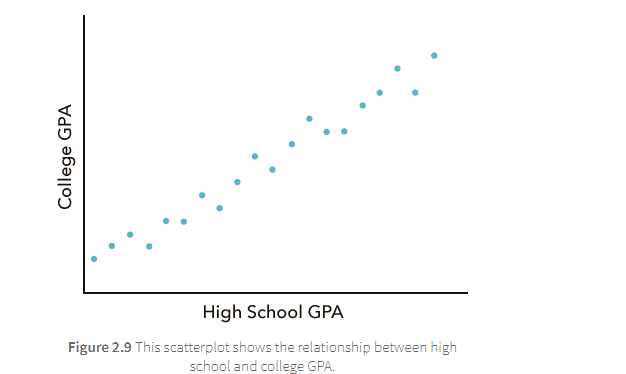
Correlation: Relationships between 2 or more variables. When one variable changes, so does another.
Scatterplot: type of graph that has one variable on the x-axis (the horizontal axis) and the other variable on the y-axis (the vertical axis) and provides a visual representation of relationships between variables.
Directions Of Correlations:
Positively Correlated: They change the same, they either increase and or decrease the same.
Negatively Correlated: Opposite changes, One goes up and one goes down
Zero Correlation: There is no relationship and is random.
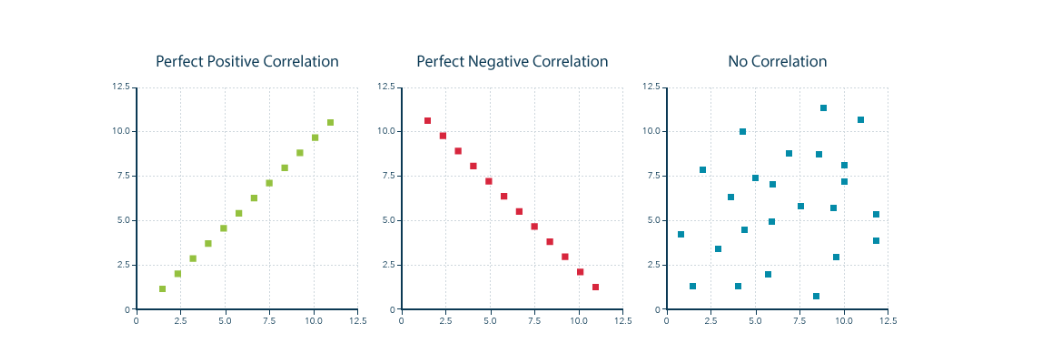
Line Of Best Fit: Straight line that represents the general direction of the data
Correlation Coefficient: Numerical representation of the strength in the relationship
The value of a correlation coefficient ranges from –1 to +1. Keep in mind that the positive and negative signs indicate the direction of the relationship,
(R = +1)
(R = -1)
(R = 0)
Between -1 to +1 can’t go past it Ex: (0.8 ✅ 1.5 ❌)
Misleading Correlations: Correlations are not causations. Correlation is merely a relationship between two variables.
Confounding Variable: Another variable that may influence one or both variables that we are measuring.
Ex: Ice cream doesn’t give an urge to kill. Rather, it may be more relevant to consider a type of confounding variable in which a third variable, like temperature, influences both eating ice cream (Staff & Marriott, 1993) and homicides (Tiihonen et al., 2017).
Causality: the notion that one variable directly affects another variable. Correlations provide predictions, but causations are directly what is affecting a variable.
CORrelation Doesn’t conclude relationships, just that they’re associated.
Hypothesis: Generated after seeing correlations. Educated prediction for the outcome in an experiment.
What Hypothesis Requires:
- consistent with prior observations or an existing theory.
- simple as possible. (only 2 variables too much complicates)
- Specific
- Able to be tested
- Can be falsifiable (reason why we can distinguish fact from myth is because we know we’re not always right)
EXPERIMENTAL VARIABLES:
Independent Variable: variable that the experimenter will manipulate
Dependant Variable: The effect made by the changes from the independent variable
Extraneous Variables: (CONFOUNDING VARIABLES)
variables that are not the focus of study, but that may influence the outcome of research if not controlled. Ex: Distinguishing men and female in a study
Placebo Effect: Ideally seems like the real “pill” treatment, but we believe they’re effective. Changing our perception of how a product is.
Internal Validity: the degree to which results may be attributable to the independent variable rather than some other effect of our experiment. How “right" it is.
External Validity: How relevant that conclusion is and how generalizable that conclusion may be is another concern.
Analyzing the data:
Descriptive Statistics: Describe data in a simple way. This includes information like the mean, median, and mode and the frequency of certain demographics
Inferential Statistics: Test and analysis that let us draw our own conclusions from the data.
Central Tendency: There are three types of central tendency: the mean (the average score), median (the middle score in an ordered set of data), and mode (the most frequently occurring number in a data set).
Variability: Variability is a term we use to describe how similar or different the scores in a dataset are from one another -- how spread out (or not) they are.
When mean is the same, but data set is different you use variability.
variability helps to fill in otherwise missing details about a data set. Although the range is one measure of variability, it is not a robust measure. The most commonly used measure of variability is the standard deviation (SD).Variance is one way to calculate variability, and it involves measuring the distance of each value away from the mean. This is the spread in values.
Variance: Average of the squared deviation scores
Probability: proportion divided by all the cards
In statistics, we use this intuitive sense to help us reach decisions about what events are “unlikely” to happen by chance alone. If the probability (p) of an event is less than 5% (represented as p < 0.05), it is typically called a statistically significant event that is unlikely to happen by chance alone.
Chapter 3: BIOLOGY AND NEUROSCIENCE
Process to create behaviour: Your brain and spinal cord are the ultimate problem solvers that send and receive information to and from all areas of your body, and your nervous system is a maze of complex cellular networks that relay and process information.
This integrated set of networks is composed of specialised cells called neurons (cells that transmit electrical impulses) and glial cells that provide support functions.
Glial cells: helper cells that aid neurons and provide structural support.
Neural: Related to nervous system and its functions
“relating to the nerve or nervous system.”
There are two main types of cells in the nervous system. Neurons act as the main communicators. The second type of cell is called glia; they perform numerous support functions in the nervous system.
Neuron: Basic building block of the nervous system
Neurons communicate with each other through chemical messages that alter the electrical activity of other neurons. (Neural Impulses)
WHAT IS A NEURON?
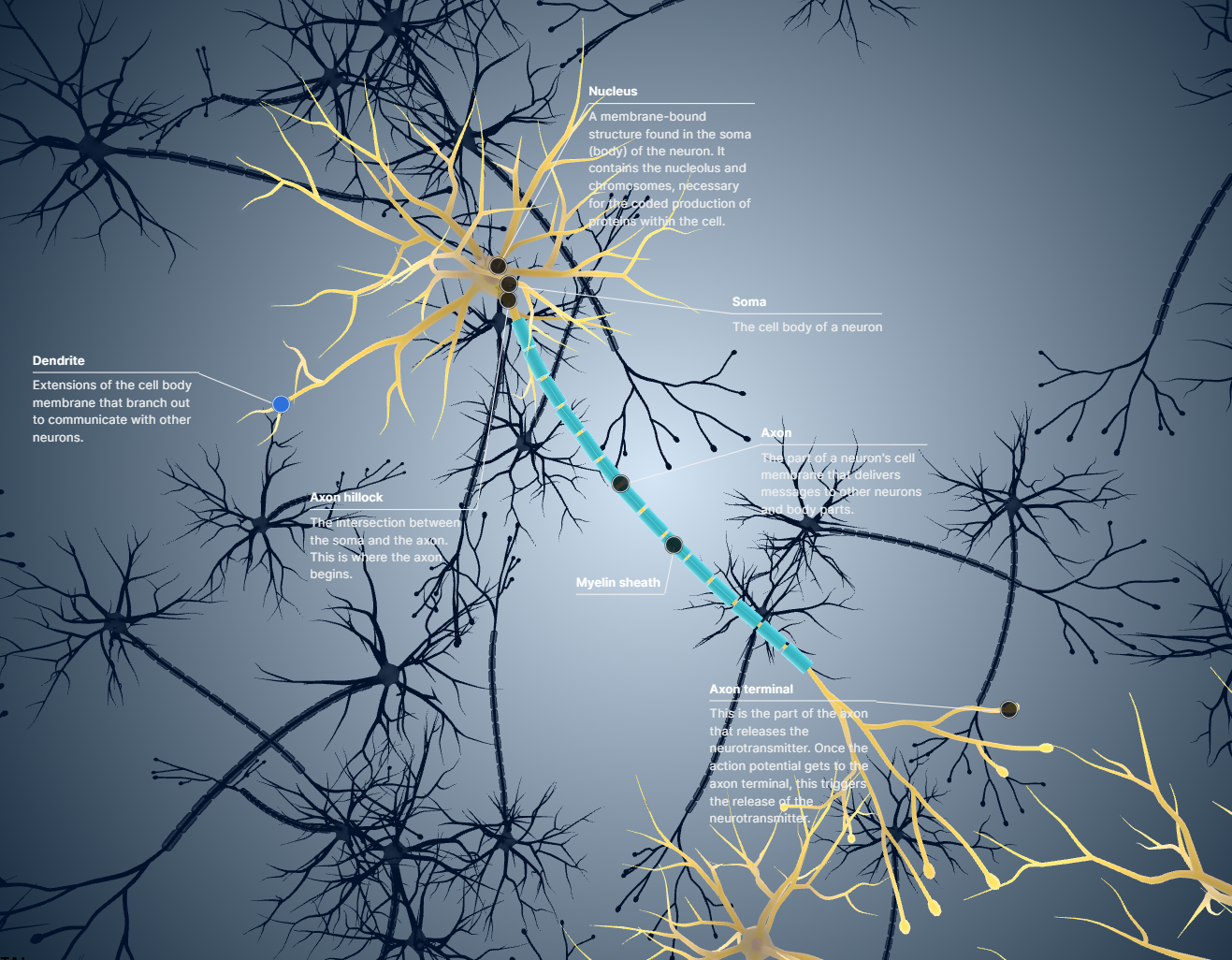
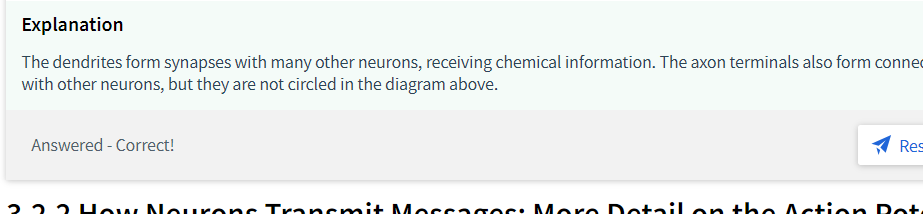
Dendrites: are extensions of the membrane of the cell body and they receive chemical messages from many other neurons.
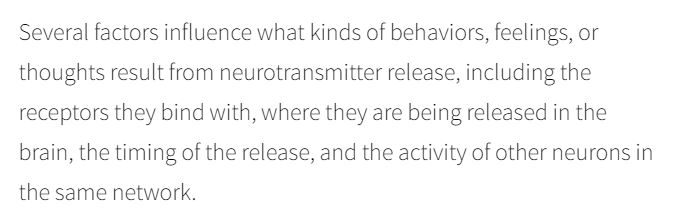
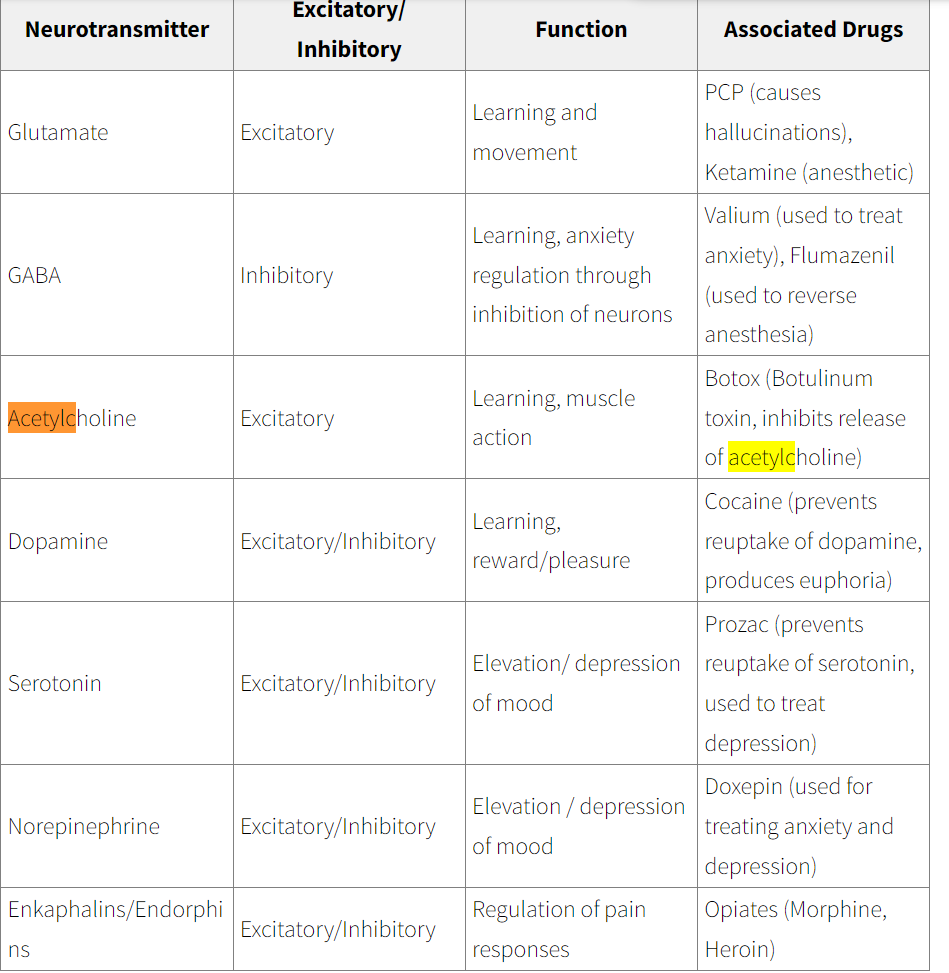
Neurotransmitter: influences action in the neuron. It can tell the neuron to "activate" (we call this excitation) or "quiet down" (also known as inhibition). Released from the end of the axon and sends messages to other neurons and body parts.
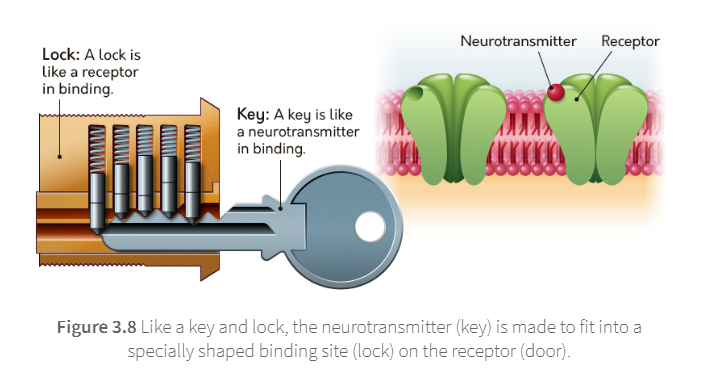
Receptors: Receive the chemical messages from neurotransmitters
Dendrites have proteins called receptors that are embedded in their membranes. These receptors bind with molecules called neurotransmitters
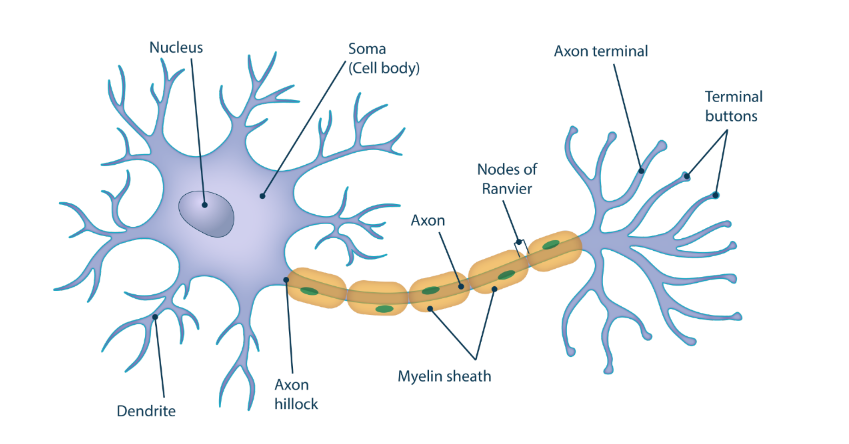
Basic Neuron Structure:
Soma: Neuron cell body controlling organelles and metabolic processing.
Axon Hillock: The beginning of the axon
Axon Terminals: End of the axon, action potential here releases neurotransmitters (neurotransmitter released here
Terminal Buttons: End of axon terminal where neurotransmitter exists
Vesicles: Bubbles at the terminal button that store neurotransmitter
At the terminal buttons the neuron will release neurotransmitters, sending the signal to other nearby dendrites.
Presynaptic Neuron: Axon terminal releasing neurotransmitter into synapse
Synaptic Cleft: Vesicles release into the synaptic cleft. IT is the space between the axon terminal and end of receiving neuron (dendrite)
Synapse: THe connection between two neurons that allow them to communicate. Small fluid gap between neurons and the neurotransmitters are released there communicating
Postsynaptic Receptors: Neurotransmitters go to vesicles to synaptic cleft and finally binid to postsynaptic receptors. Other side of the synapse dendrites ready to bind to the neurotransmitter released from the presynaptic neuron.
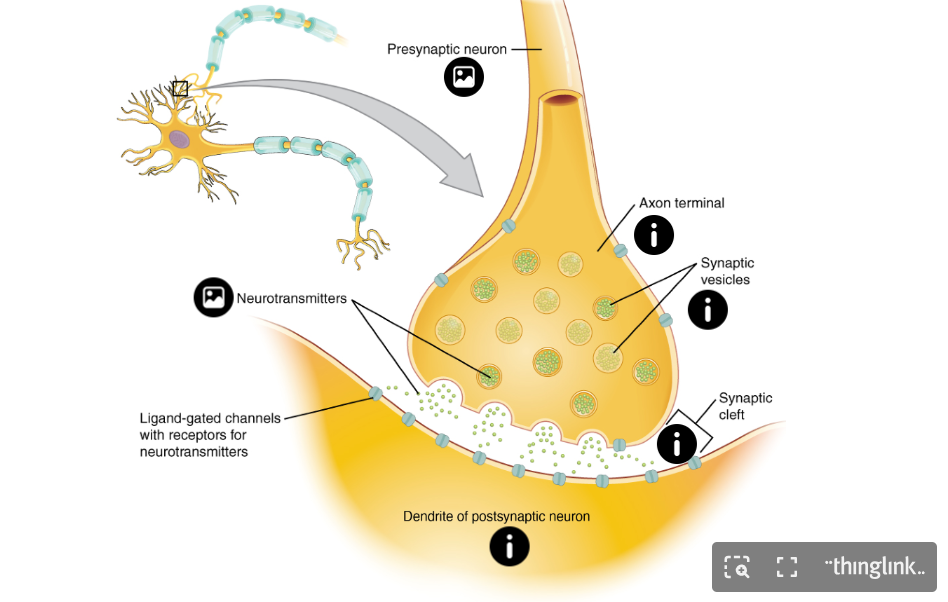
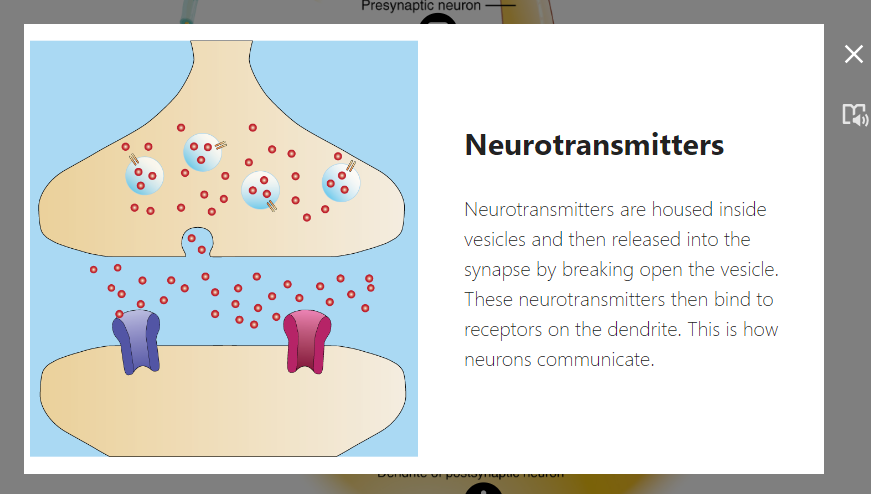
Presynaptic receptors: SEnd the neurotransmitters
Postsynaptic receptors: dendrites receiving neurons from other neuron axon terminals. The dendrites
Myelin: protein and fatty substance that wraps around axon increasing the speed of action potential (electrical impulses)
Nodes of Ranvier: gaps in myelin that allow ions to enter the axon and change the charge inside.
Ions: Electrically charged particles in our body. Positive and negative charges, movement of ions create electricity.

Polarized: Below zero and don’t release neurotransmitters (negative)
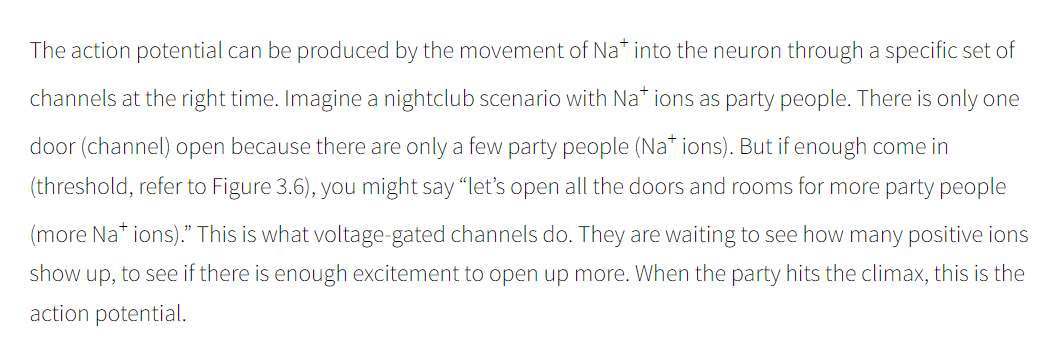
Multiple Na+ channels lined up strategically along the axon make electrical impulses continue along succession through the axon.
Propagation: The process where electrical impulses get sent to the end of the neuron.
Electrical impulse reaching axon terminal triggers the release of neurotransmitters
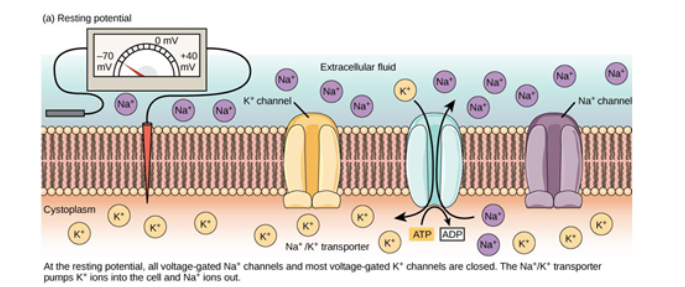
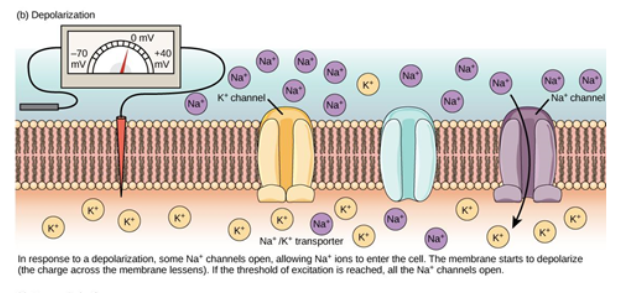
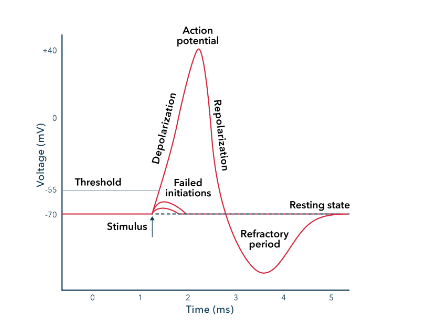
Threshold: The amount of voltage change required to trigger an electrical impulse.
Change caused by Na+ entering the cell
Depolarization: The electrical impulse voltage gates open increasing positive ions in the cell and cause the inside of the cell to become less negative or polarized compared to outside. = Depolarized happens on the node of ranvier. (BECOME POSITIVE)
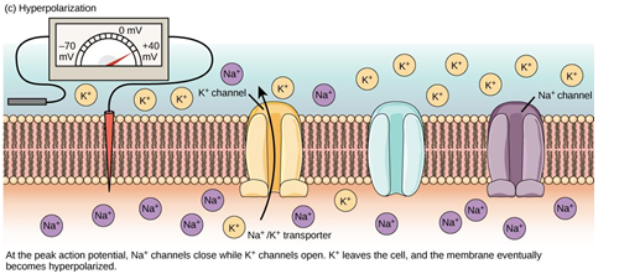
Repolarization: The Na+ channels close and trigger opening for K+ to leave the cell. Decreasing the other positive ions make the cell to be once again relatively negative.
Refractory Period: The channels of K+ are still open making it extra negative compared to the surrounding fluid making the cell hyperpolarized and temporarily makes it difficult for the cell to reach the threshold.
Resting STate: Neuron stabilises and goes back to its resting state (-70mV)
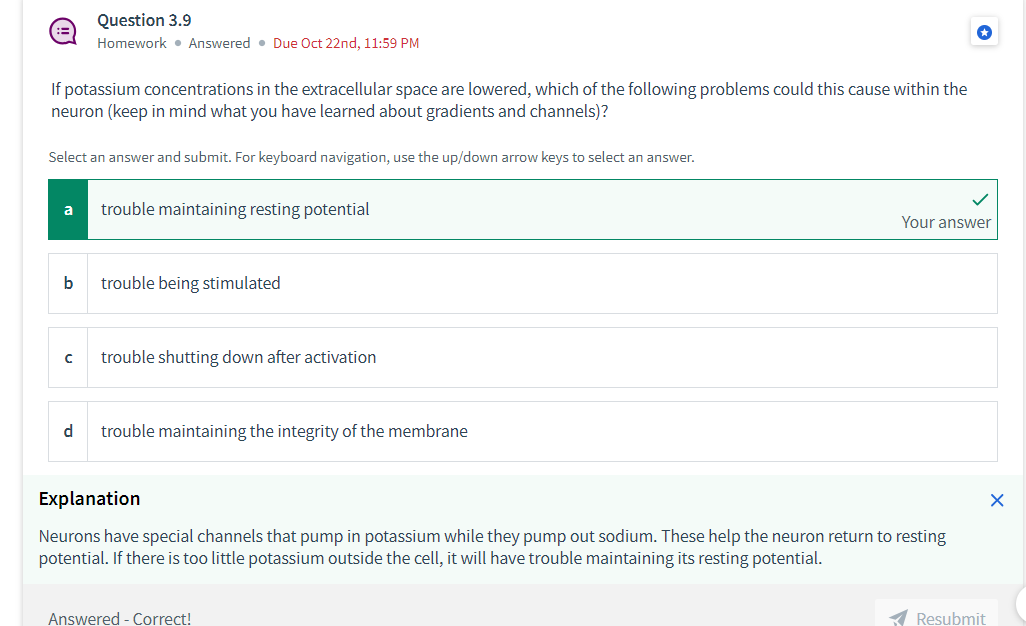

Small influx of Na+ makes more channels open voltage sensitive for more Na+ greater influx of Na+ until efflux of Ka+

Process includes electrical impulses and chemicals.
TYPES OF NEUROTRANSMITTERS:
- Excitatory: Causes neuron to activation more positive (increase the probability of the neuron to become electrically active
- Inhibitory: Move away from activation negatively. (decrease the probability that the neuron is activated.
Two connected neurons
Presynaptic: The first neuron releasing neurotransmitter from axon terminal in the synaptic space are attracted to receptors on the second receiving neuron.
Postsynaptic: Neuron with dendrites and receptors attractive neurotransmitters
How our brains are affected artificially
Agonists: Chemicals that come from outside the body that mimic the actions of neurotransmitters. (mimic either the same way, better, or less effectively) my
Endogenous: A substance produced in the body (naturally produced by the body)
Antagonists: Chemically that comes outside of the body to shut off receptors avoid electrical impulses prevent the actions of endogenous neurotransmitter
Some antagonists are competitive (direct) and compete with the same binding site on the receptor as a neurotransmitter.
Indirect ones bind at a different site
Partial agonists/antagonists: Chemicals that come from outside of the body either partially mimic, enhance or block neurotransmitter action.
Glutamate: A neurotransmitter that activates and excites neurons
Partial agonist will bind to the same receptor but for a shorter time to lessen activation
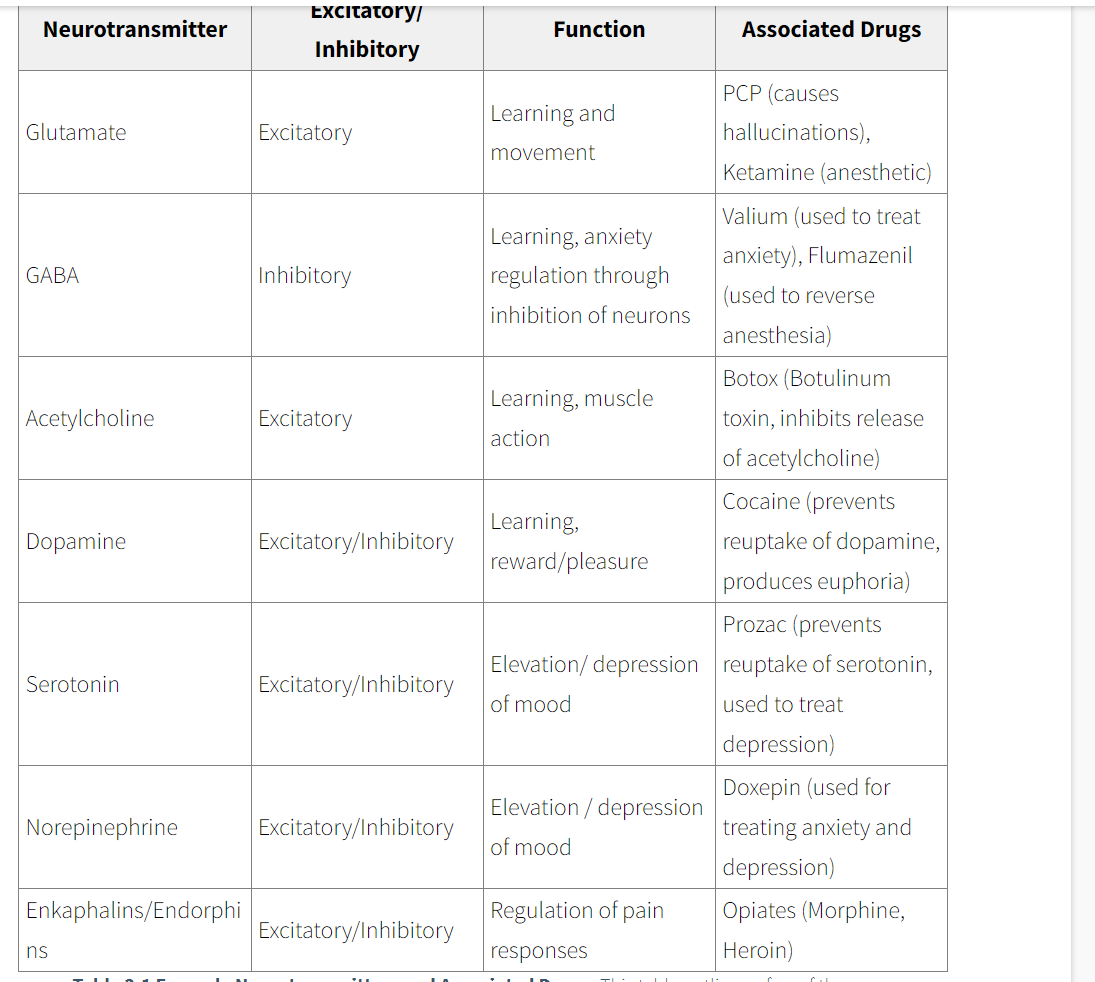
Glial cells: Caretaker of the neuron (bring nutrients, remove waste and speed up electrical impulses)
Oligodendrocytes: Myelin is wrapped around axons using glial cells called oligodendrocytes *create myelin sheath
Myelin sheath for central nervous system
Schwann cells: helper myelin sheath for nerves outside the brain and spinal cord (peripheral nervous system)
Astrocytes and Microglia: Help form the immune system of the brain. Fight infections and clean up debris that could lead to dangerous inflammation in the brain.
Astrocyte: provides structural and metobolic support to neuron,
Neurodegenerative diseases: Implications and disorders where neurons die over time and cause progressive loss of a particular ability.
Neural Networks: Complex connections between the dendrites and axons of many neurons.
Efferents: Axon carrying electrical impulses away from the CNS to trigger neurotransmitter or hormone release in an organ or muscle.
Afferents: Carry the impulses back to the CNS from the organs and muscles
Neuroplasticity: Which the ability of neurons and its networks to change
Neocortex: conscious thought/decision-making. outermost layer of the brain
Medulla (basic life function) unconscious basic like functions ex: breathing heart rate
Neuroplasticity: The process where our neurons and their networks change overtime
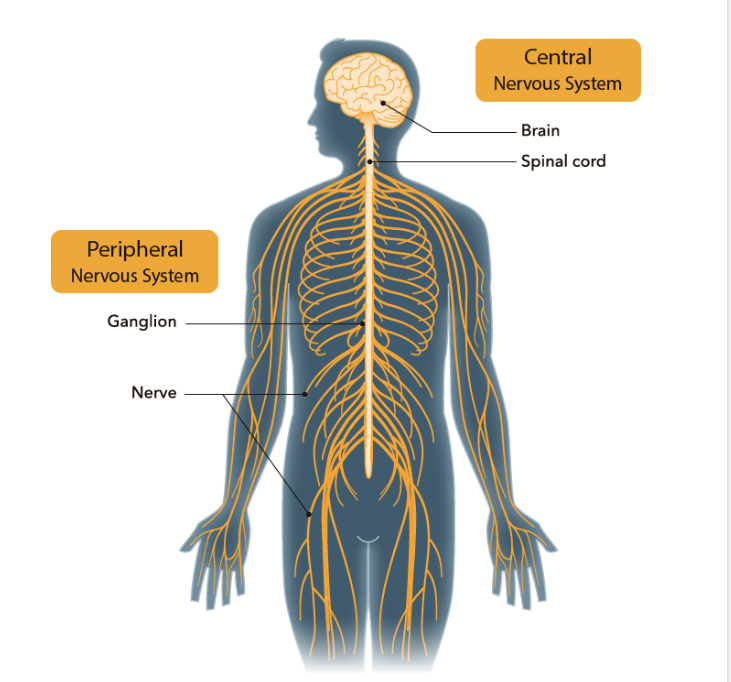
Reflexes work quickly by having the spinal cord and nerves connect to the muscles coordinated and quick.
Central Nervous system grey matter(neurons and glia) and white matter bundles of myleniated axons.
Grey - local processing of info
White - help different areas of the brain share info
Peripheral system split
Somatic: Voluntary
Autonomic: AUtomatic
Functions
Vertebrae: Ability to flex (think bending over_ and space for peripheral nerves to exit the spinal cord to communicate with rest of body
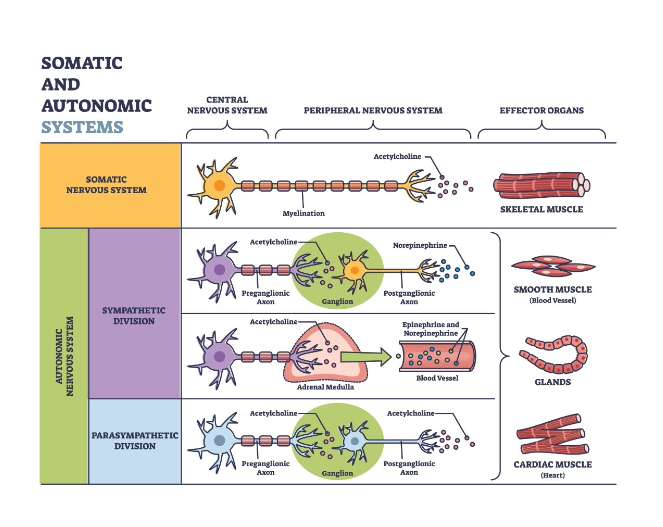
Somatic
If you throw a ball, your brain is sending commands that activate somatic neurons in the spinal cord. command impulses have been sent from the brain to neurons in the spinal cord. This stimulates neurons, whose axons are bundled into nerves that connect with muscles.
Autonomic nervous system
autonomic nervous system regulates all the automatic functions that keep you alive, functional, and healthy.
Split into 3 subdivisions
Sympathetic nervous system: cells in spinal cord. Where nervousness, fear and anxiety come. Visual field narrowed for focus, heart beating fast, producing more sweat and temperature rises. (opposite of parasympathetic and one turns off when the other turns on)
Parasympathetic nervous system: Lower spinal cord transmit commands to organs that help recover, digest and become relaxed. (CALM and REST RELAX)
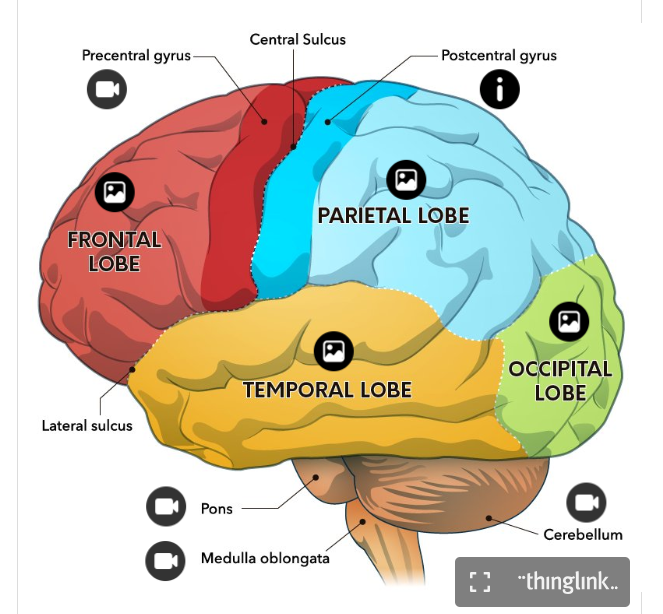
Pons: Network of cells in the brain stem that regulate awareness, sleep and motor functions
Medulla and pons: Critical sustaining basic life functions. Connect peripheral and central nervous system to regulate what we do and do not pay attention to.
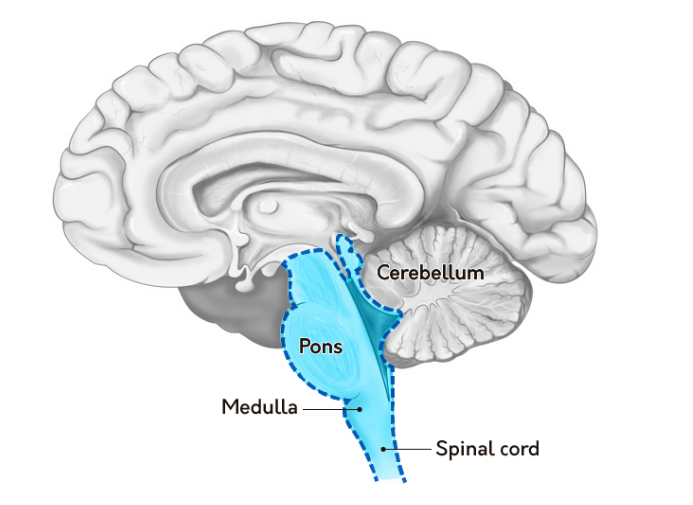
Medulla Oblongata: Lowest portion of the brain and transition point between the brain and spinal cord (the area between them)
WIthout medulla you cant breathe, your heart wouldn’t beat and you couldn’t swallow.
Pons: Info from spinal cord goes to medulla to pons and to higher order brain functions.
POns regulate arousal (level of excitement)
PONS control involuntary muscle movements (FACIAL EXPRESSIONS)
Pons coordinate the senses with cerebellum and bridge from the uppbrain to lower brain/spinal cord.
Control facial expressions and eye movements.
Vestibulocochlear nerve is here helping the brains orientation and regulation left-right coordination
Reticular Activating System: RAS : Network of neurons centre of medulla and pons REGULATE AWARENESS AND ALERTNESS
Helps regulate our level of arousal and our attention on tasks, ppl, objects
RAS filters out irrelevant stimuli on a constant and daily basis.
Nuclei or Ganglia: In the limbic system they collect info encoded by impulses from other areas of the central nervous system and help modify high level commands.
Prefrontal Cortex: The anterior portion of the frontal lobes, heavily involved in decision making
Limbic System: Using neurons and glia to regulate emotions, regulate endocrine activity and emotional memories.
Around cortex and midbrain. Includes prefrontal cortex, olfactory cortex, amygdala, hippocampus, cingulate gyrus and the hypothalamus.
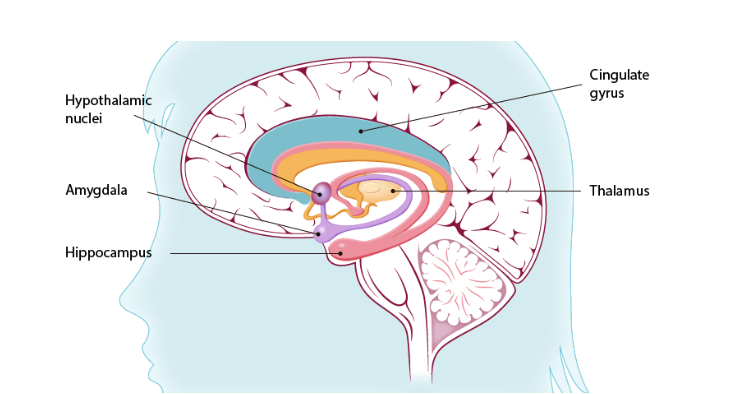
Amygdala: Increase electrical activity in its neurons when under threat. ACTIVATING FEAR RESPONSE.
Regulate emotion and encode memories
Makes increase in adrenalin in the body during flight or fight response
Forms memories tied to events of strong emotions
Gains input from all our senses it uses that info to make calculation about emotional value and intesnity of a stimulus. Outputs (axons) connect with hippocampus and thalamus to form emotional memories and coordinate behaviour.
Noticed on people with anxiety or phobias.
Hippocampus: Gateway for forming new memories. Hippocampal synapses strengthen and make more receptors, neurotransmitters when exposed to high frequency stimulation overtime.
Crucial for memory formation.
Cingulate Gyrus: When people experience physica pain and are excluded sociall. FOcus all unpleasant thoughts
Located below neocortex and front left of brain
Hypothalamus: COntrol several functions for autonomic and endocrine system. Regulates hunger responses, sexual behaviour, body temperature, aggression
Basal Ganglia: Interconnected groups of neurons that serve to modulate movements commands in the brain before they reach the spinal cord.
(initiating or terminating movement like thinking about starting to walk then stopping)
Think of it as goal directed movement
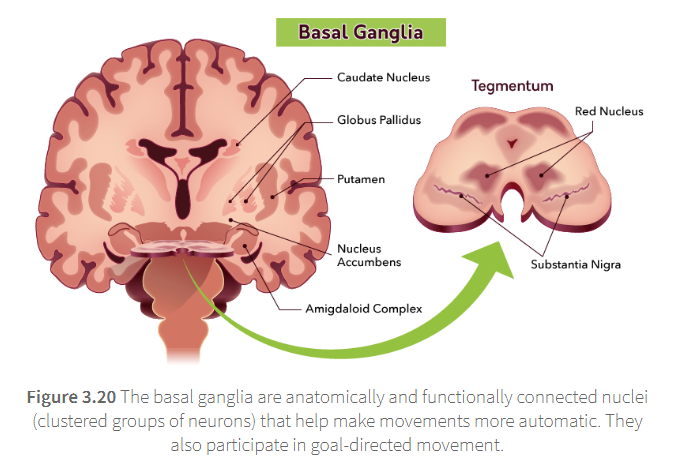
Basal Ganglia contain groups of neuronal circuits
Dorsal Striatum: Clustered groups of neurons called the caudate and putamen ROLE IN COORDINATING MOVEMENT
Ventral Striatum: Large portion of hte basal ganglia with structures of different nuclei globus pallidus, the substantia niagra and subthalamic nucleus.
Globus pallidus: Role in inhibiting circuits in the thalamus to control how sensory info is coordinated with movement.
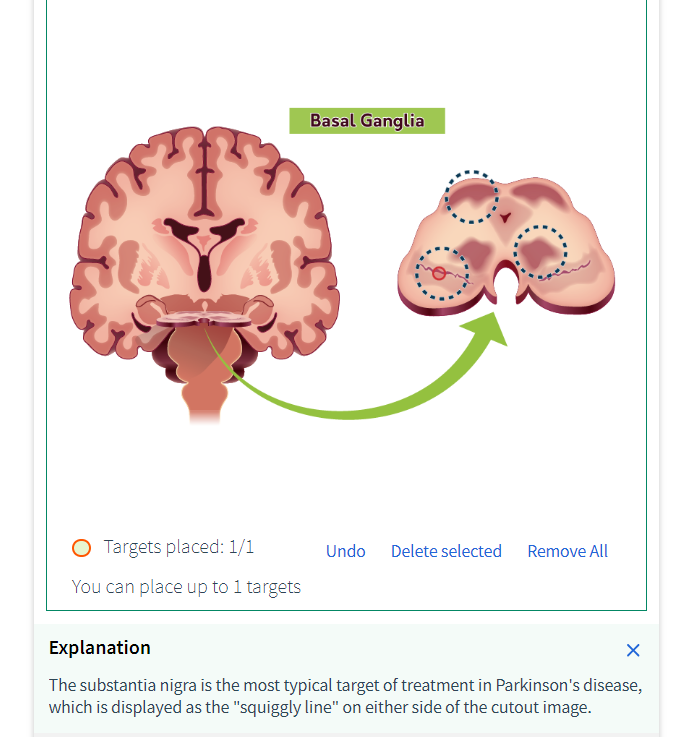
Substantia Nigra: Dark substance sending inhibitory signals to the thalamus in order to coordinate sensory info with motor(movement) plans.
Globus palidus and substantia nigra send inhibitory outputs to thalamus to help integrate sensory and motor info with motor planning, internally, the basal ganglia have two circuits that process input and coordinate output.
Direct pathway: excites thalamus
Indirect pathway: helps the basal ganglia shut down motor matters/plans thatare not right for the task at hand.
Issue for Parkinsons disease: the slow loss in movements progressive and gets worse over time.
Cerebellum: rhythm and time machine. Simultaneously receive and organize input from multiple central nervous system networks.
Cerebellum divisions:
Spinocerebellar: Match sensory input with motor plans in order to fine-tune movement patterns
Vestibulocerebellar division: processes info from the inner eat to help adjust posture and balance
Cerebrocerebellar: Division manages connections with the pons and thalamus to adjust the timing and planning of movements.
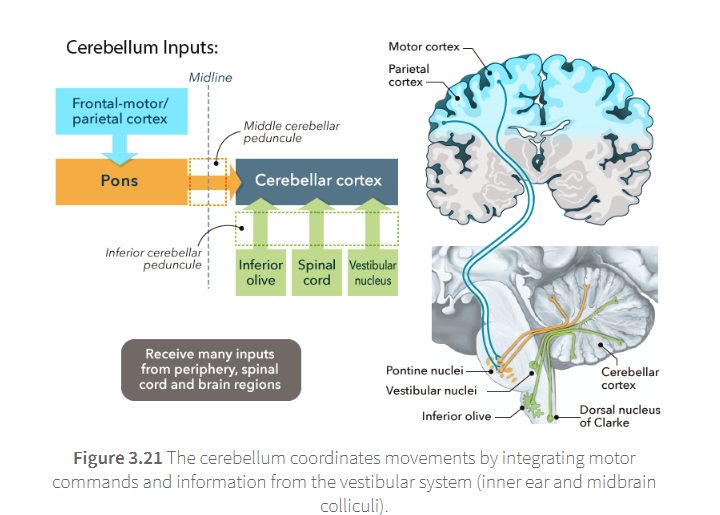
Lack and injury in cerebellum leads to issues of unbalance cant walk straight timing planning are all altered.
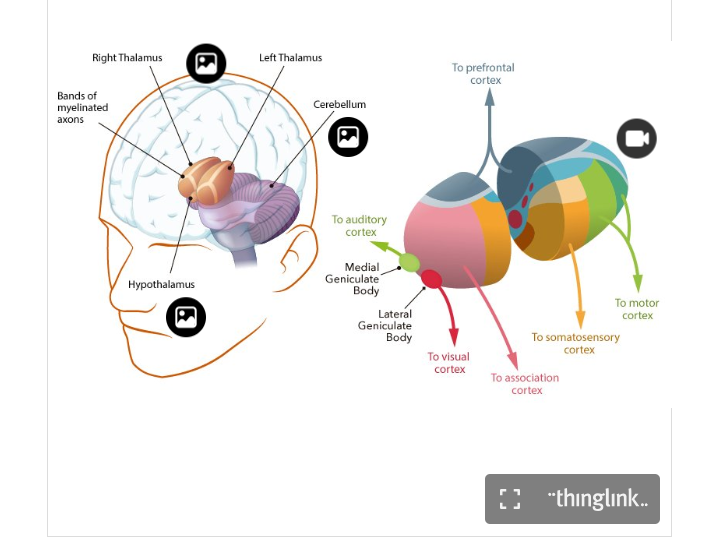
NEW BRAIN
There are 4 basic sections of the neorcortex called lobes
Neocortex looks the way it does because of 3 distinct features:
- The gyri (ridges)
- Sulci (valleys)
- Fissures (spaces between lobes)
Association cortex: Parts of the neocortex that merge info from primary areas like visual and auditory cortex. Helps us make sense of what we take in.
The lateral geniculate nucleus (body) sends projections to the visual cortex, while the medial geniculate nucleus (body) sends projections to the auditory cortex. LGN
Frontal Lobes: Primarily tasked with decision making amd movement. Seem to help encode personalities
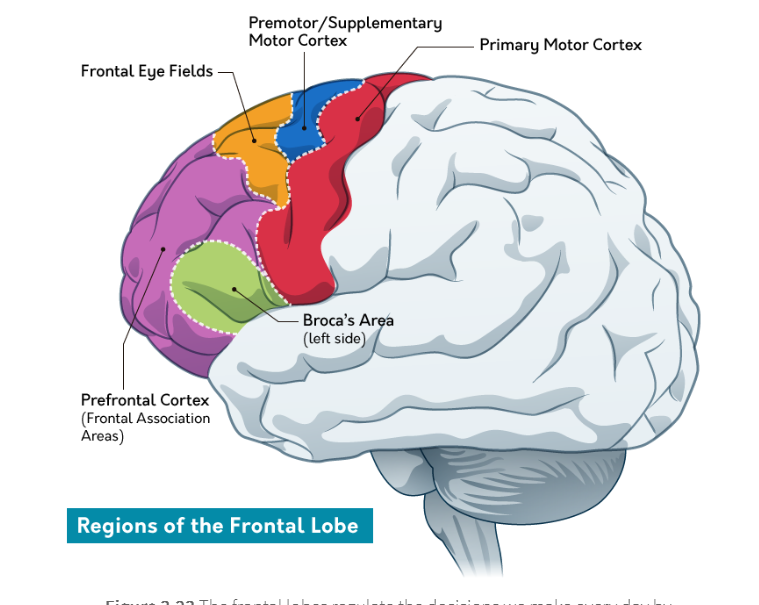
Phineas Gage: Railroad worker accint impaled metal rod in head front of his skull he survived and his brian injury perosnality changed.
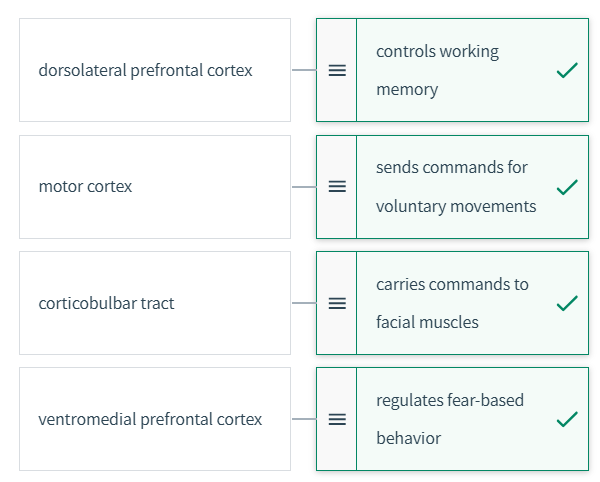
MOtor COrtex: back of head in the frontal lobes. Houses primary neurons innitaiting voluntary movement.
Primary MOtor Cortex gives 2 pathways
Corticospinal and Corticobulbar tracts
Homunculus” represent neurons dedicated to specific body parts and functions because some delicate movement need more neurons to singal that movement.
Graphical representation
Sensory homonculus created to rep sensory input in parietal lobe.
Forehead is the PREFRONTAL CORTEX (PFC)
Prefrontal cortex has both inhibitory (hyperpolarizing) and exciting (depolarizing) connecitions.
Prefrontal cortex areas even further speicalized for decision based on criteria or input
Ventromedical prefrontal cortex and Dorsolateral prefrontal cortex
Ventromedical helps modulate behaviour besd on fear and has been implicated in moral decision making.
The Dorsolateral helps maintain info in our working memory and change how ew do thing depending on what task are there to complete.
The prefrontal cortex is one of the last regions to undergo the process of myelination, where oligodendrocytes wrap myelin around axons to speed up the transmission of impulses.
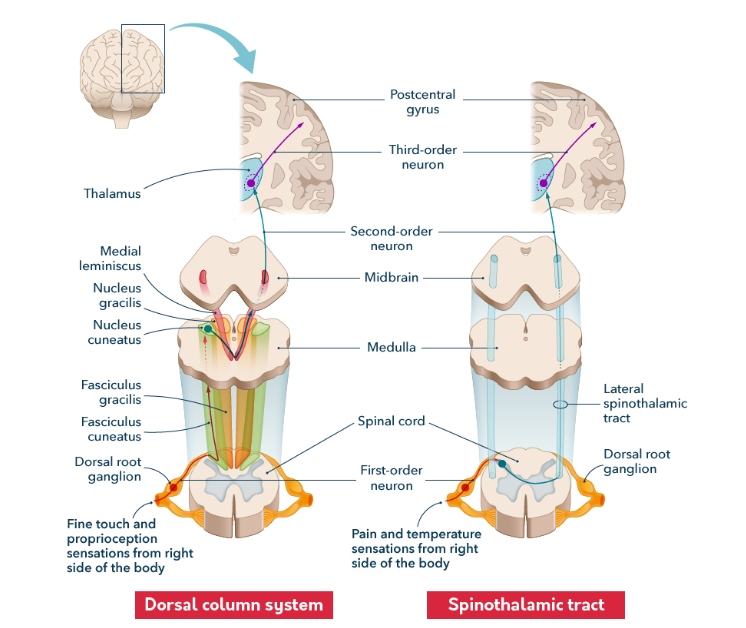
Parietal Lobes: Back of the head heavily involve functions like processing numbers and performing calculations.
Right side of parietal lobe: Navigating the space around us sensations on our left side
Sensory cortex in anterior position receive info from CONTRALATERAL opposite sides of the body. Because nerves taht cary sensation of body and motor commands of brain cross at the level of the brainstem.
Crossing heps us coordinate both sides of the body. Humans do lots of cross-lateral movements
Temporal Lobes: Part of brain above ear. Form memories and process sounds input from the auditory nerves.
Lesions: Temporal lobe focusses areas where cells have died. Loss of ability to form new memories. (Trauma, drug overdose, stroke) This is wher ethe brain neurons die
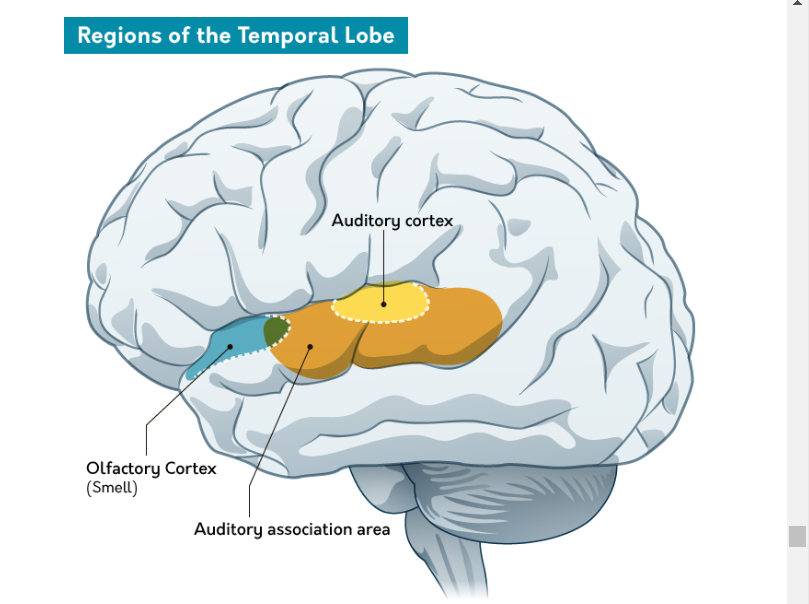
Primary Autitory cortex: Circuits of neurons in the temporal lobe dedicated to receiving and processing messages fro m the ears thru axons of the vestibulocochlear nerve.
Damage can lose all ability to perceive sound
SOunds are translated using frequencies of action potential originating in the axons of the cochlear nerve.
LEFT TEMPORAL Lobe also houses WERNICKE's AREA: Important area for language processing people who had strokes or injuries in neural networks had trouble with auditory processing and comprehension of speech.
Temporal lobe also houses smell and taste synapses
TEMPORAL LOBE IS NEAR THE FRONTAL LOBE
Occipital lobes: primarily concerned with light stimuli
Optic nerves: occipital cortex: Light in left visual field contract left eye and right eye retina
You know you saw something on your left side because of neurons on the right side of the brain initiating electrical impulses.
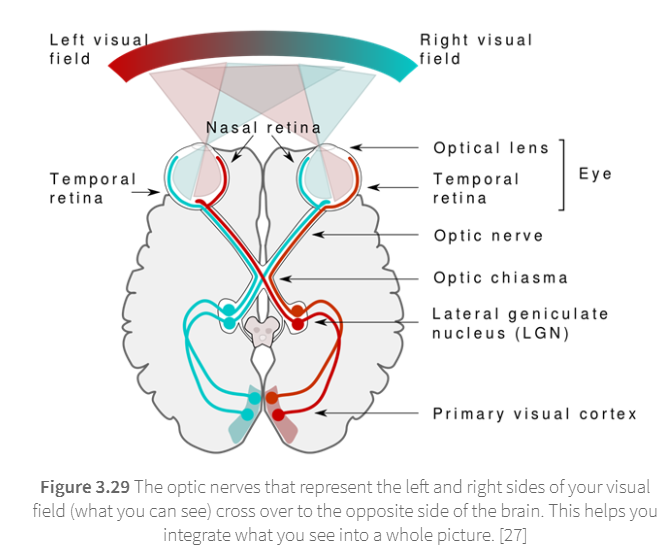
Danger in occipital love thru stroke seizure trauma can rob sight or ability to see specfici faces.
Laterality: The myth
Concept of artistic and creative = right brained Analytic = LEft brained
Realistically the righ brain sees globally while left brain is typical to detail and specfiics.
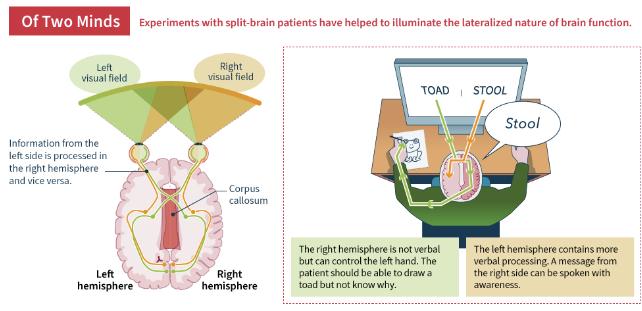
Corpus Callosum: HELPS TWO BRAINs communicate help route messages between two hemispheres of the brain
THick bundle of fibers connecting 2 hemispheres and share info
Make sense of crossing messages.
Cutting corpus callasom to treat patients result in SPLIT BRAIN
SPlit brain patients = seeing an object thru their left visual field and naming it but patients should be able to name the object because language output is regulated by Brocas area on the left.
(We interpret left images thru right visual cortex)
SO it is stuck in the right hemisphere
ENDOCRINE SYSTEM: Glands throughout the body releasing hormones. SEcondary control for feed back on nervous system. Hormones secreted by endocrine system is the neurotransmitters.
There arre 3 major endocrine control centers
- Hypothalamus : Secretes hormones and controles the pituitary gland via direct nerve stimulation and chemicals
- Pineal gland : Which secreates melatonin for regulating sleep cycles
- Pituitary gland : Which secretes host of hormones that affect sexual behaviour reporduction cirucalotry function hunger and responses to aggression.
Hypothalamus has the oxytocin the LOVE HORMONE released during orgasm when we look at pictures of loved ones.
Hypothalamic-pituatury-adrenal axis chronic stress HPA
Hypothalamus is parto the LIMBIC SYSTEM
Regulate endocrine function. Control pituitary gland (adrenal gland)
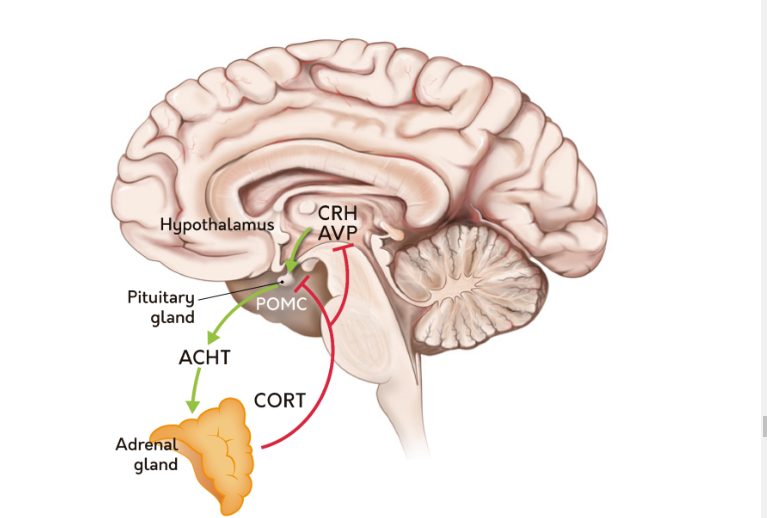
Chronic stress = Affect more neurons in the hypothalamus actively
Addrenal glands : stress
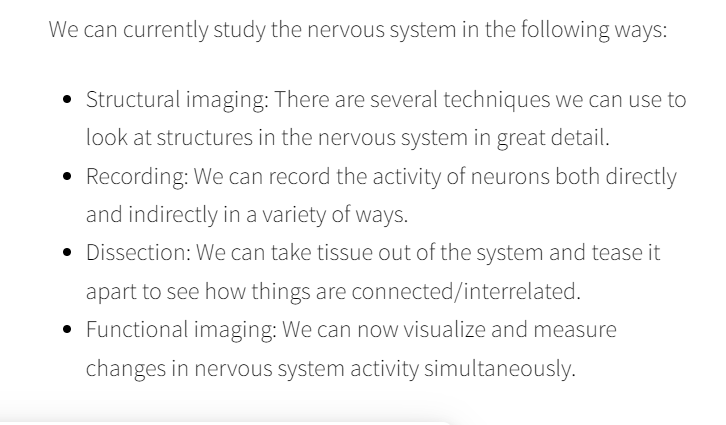
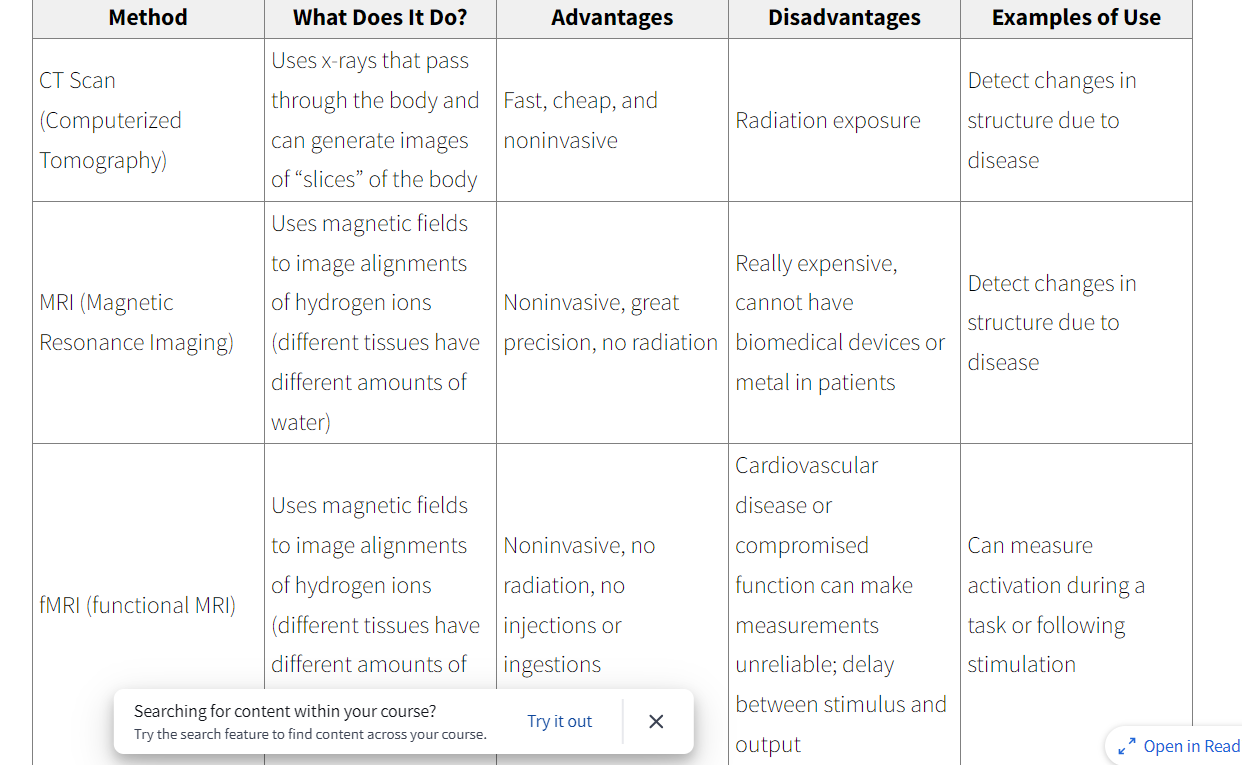
How methods are used to study
EARLIEST RESEARCH BRAIN STUDY CAME FROM EGYPT
Staining method: A way of using dye to make neurons , asxons and dendrites visible under a microscope
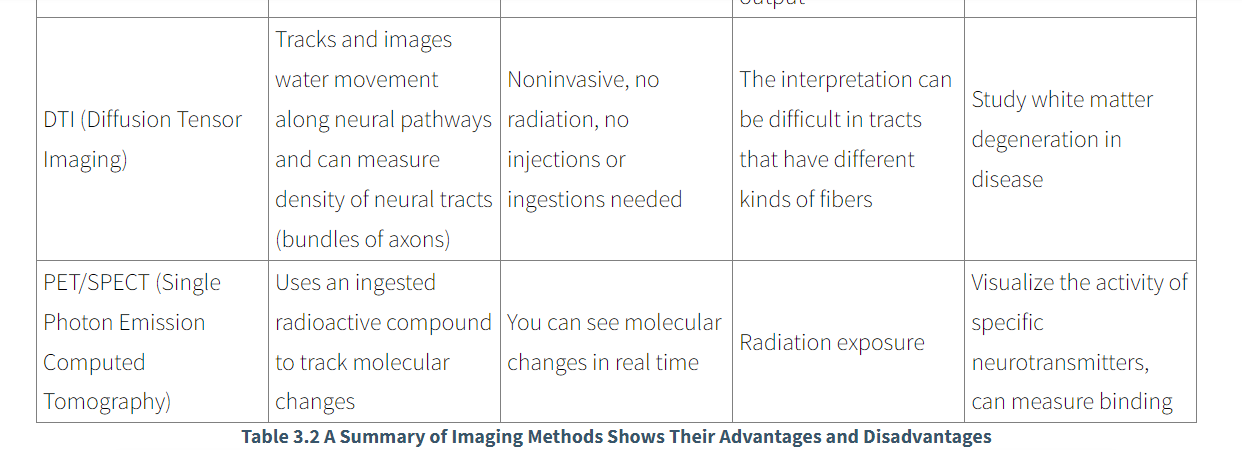
Diffusion Tensor Imaging: A method used in combination with MRI scans that allow white matter (axons with myelin) to be seen on the scan
CHAPTER 5: SENSATION AND PERCEPTION
Sensation: Features of parts of the environments that the brain uses to make meaning out of.
Electromagnetic wavelengths of light air pressure changes for sound all used to create an understanding of the world.
Perception: The brain takinga given message like a sensation and combining it with previous experiences to create a powerful sensation. Processing stimuli to create a sensory understanding of the world.
Once you’ve perceived and understood what you see you can’t undo the knowledge. The brain uses prior understanding from years of reading experience to make a guess.
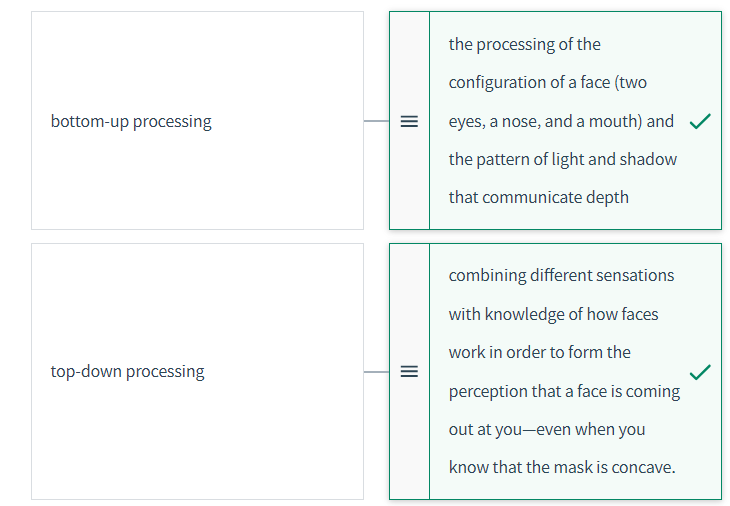
Bottom-up-Processing: Neural processing that starts with the physical message or sensations delivered to the senses.
Top-Down Processing: Combine incoming neural messages with understanding of the world to interpret info in a way that has value. Beliefs memories and expectations into their sensory experiences to make perceptions.
Principals of Gesalt. Believe that perception was more complicated than simply assembling messages as a puzzle (born with specific predisposed ways of oragnizing info).
Principal of figure-ground: Organize info by giving priority over the background.
Principle of proximity: States that objects that are close to one another will be grouped together

Proximity would group these circles into two
Principle Of Similarity: Objects are physically similar to one another are grouped together.

Group the circles based off colours.
Principal Of Closure: People tend to perceive whole objects even if part of the info is missing. Despite missing info the info available make a coherent image

Its missing but we still identify this as a circle and a square.
Principal OF Good Continuation: If info is interrupted or cross each other people continue to follow what is shown.

Principal Of Common Fate: Objects that are moving together will be grouped together. (flock of birds moving in the air are grouped together instead of individually)
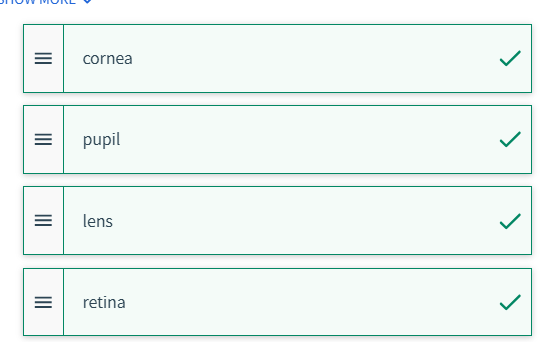
Retina: Thin layer of tissue on back of each eye that contains photosensitive receptors.
Cornea: Outermost transparents protective layer covering the eye contributes to 80% of focus of a visual image
Pupil: A hole that expands and contracts based on the environment. This hole allows light to enter.
Iris: The ring of pigment tissue is where the colour comes from surrounding the pupil. Responsible for controlling diameter and size of pupil (controlling amount of light reaching retina). Does not play a function in vision.
Lens: flexible pieces of tissue layers behind the pupil to refract light. Ensures light focuses on the retina.
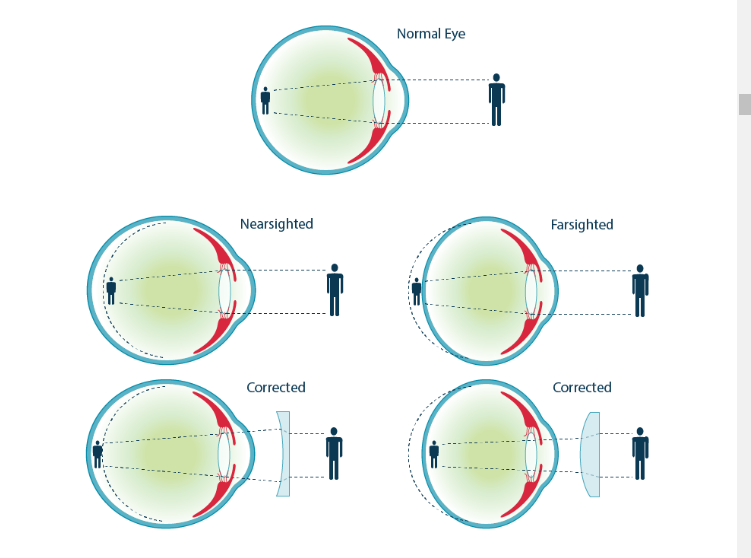
Accommodation: The process where the lens changes shape to bring objects into focus on the retina. Determined by distance of lens and object of view. Lens is thicker and rounded on bigger objects and more relaxed and elongated for far objects.
Nearsighted people have eyes longer than average. Lens focus before the retina can focus. Harder to discern further objects. Farsighted is the opposite (closer is blurry)
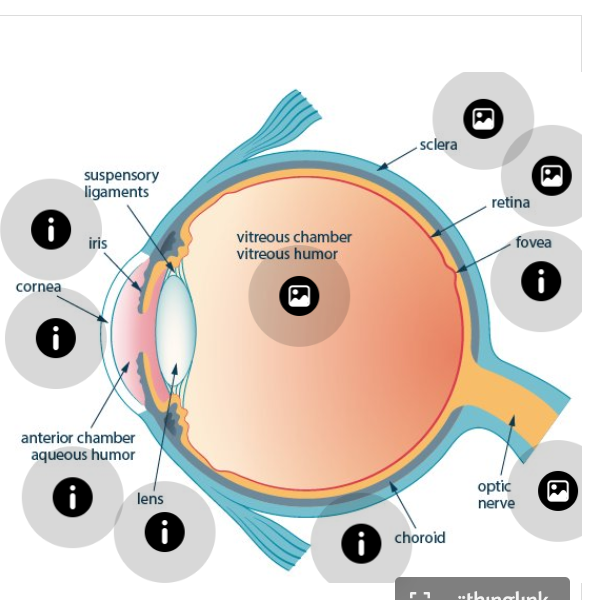
Photoreceptors (photosensitive cells): Cells specifically sensitive to exposed light. At the back of your eye last area light transduce. Image composed of patterns of neural firing.
TWO KINDS OF SPECIALIZED PHOTOSENSITIVE CELLS:
Rods: photoreceptor in the retina that is most responsive to low levels of light. Use night time
Cones: Photoreceptor in the retina that is most responsive to bright light most responsible to colour. Used day time
This translation is chemically based, as each cell contains a photopigment that is sensitive to light. The chemical reaction leads the cell to send a message to the adjacent neurons, and ultimately these neural impulses are sent to the brain.
Fovea: center of retina directly behind pupil. Dense clusters of cones respond best when there is a lot of light and has large concentrations of cones and no rods.
Visual acuity: cones transmitting info about fine detail
120 million rods in each eye are primarily in the periphery of the retina.
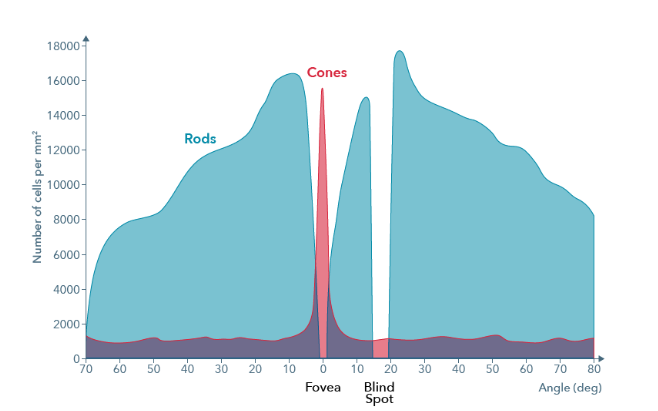
Dark Adaptation: Occurs as rods and cones adapt to changes in light. As time goes by you can see better in the dark adaptation.
cones are the only cells that communicate information about the wavelength, perceived as color, of an object. The rods respond to the amount of light, but do not communicate information about the quality of that light.
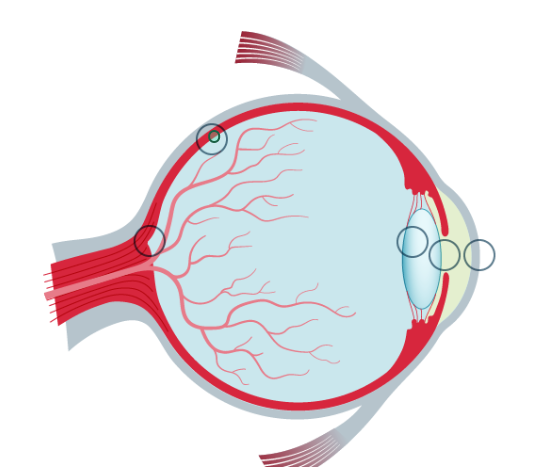
Rods location periphery of retina
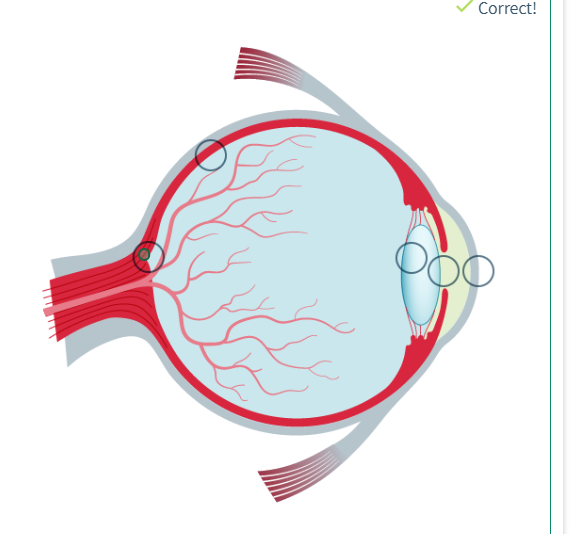
Cones are on the fovea which is at the retina (back of eye)
Bipolar cells: WHen rodes and cones react to light they senf their messages to bipolar cells. Begin to inteerpret the info entering the eye
Diffuse BIpolar Cells: Bipolar layer of retina. Receive signals from the rods and send their messages to large ganglion cells. Receive messages as many as 50 rods.
RODS MESSAGE
Midget Bipolar Cells: Cells receive signals from cones and send their messages to the small ganglion cells.
CONES MESSAGE
Receive input from only a single cone and only to one single ganglion cell.
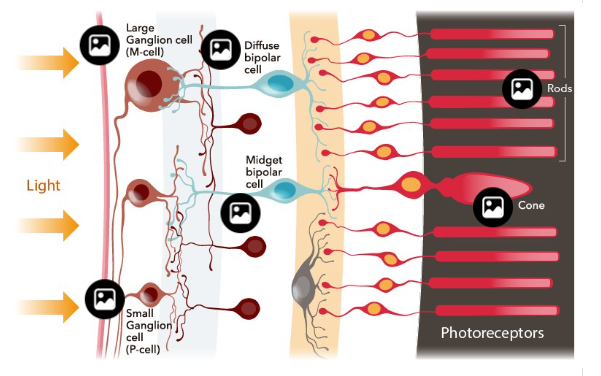
Process of ganglion cells.
Parvo cells: small ganglion cells receive info from the midget bipolar cells. 70% of ganglion cells in the retina and send singal to brain about qualities of colour
Magno Cells: Large ganglion cells found in the periphery and receive singal from diffuse bipolar cells. Send info about motion and visual stimuli in the periphery. 70% of messages created from small portion of retina covered by cones and 30% from 120 milion rods.
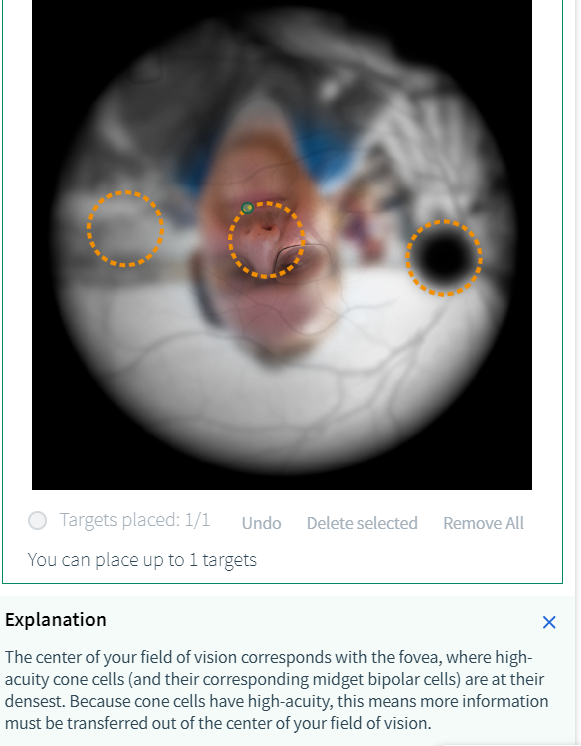
70% of information.
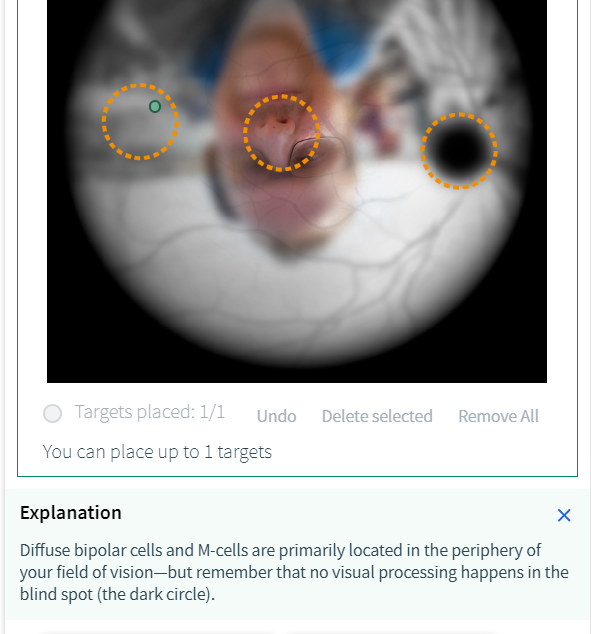
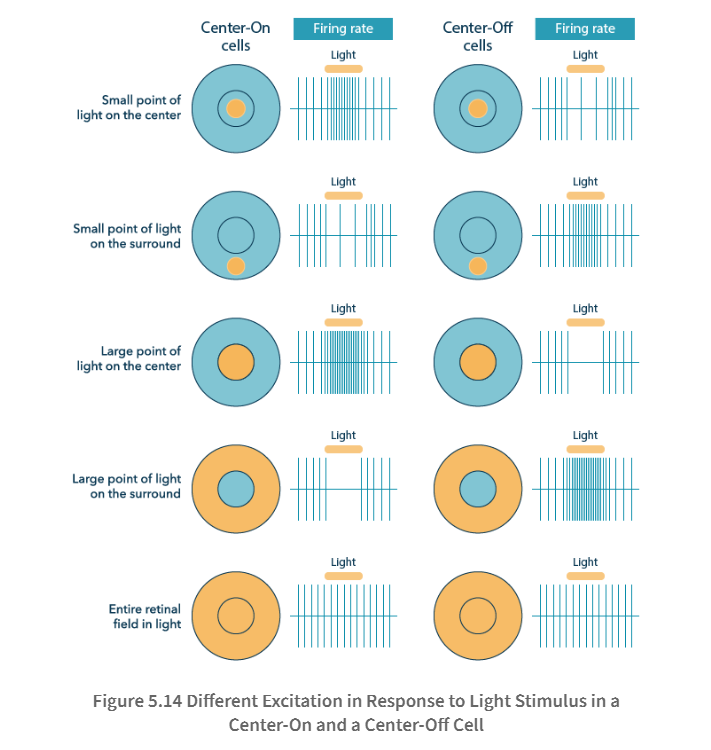
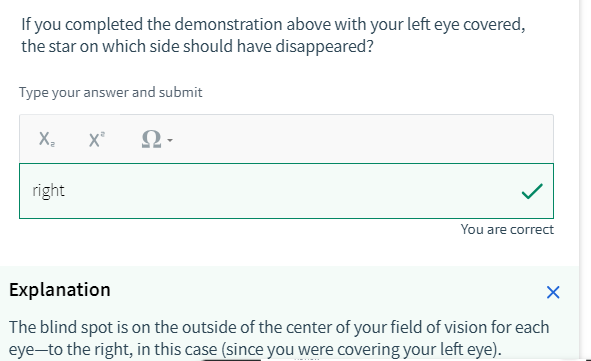
Blind spot: small blind spot in each eye; it is not noticed because the brain uses information from the other eye and the assumptions about the world to “fill in” the gap.
At the place where the axons of these cells leave the eye THE GAGLION
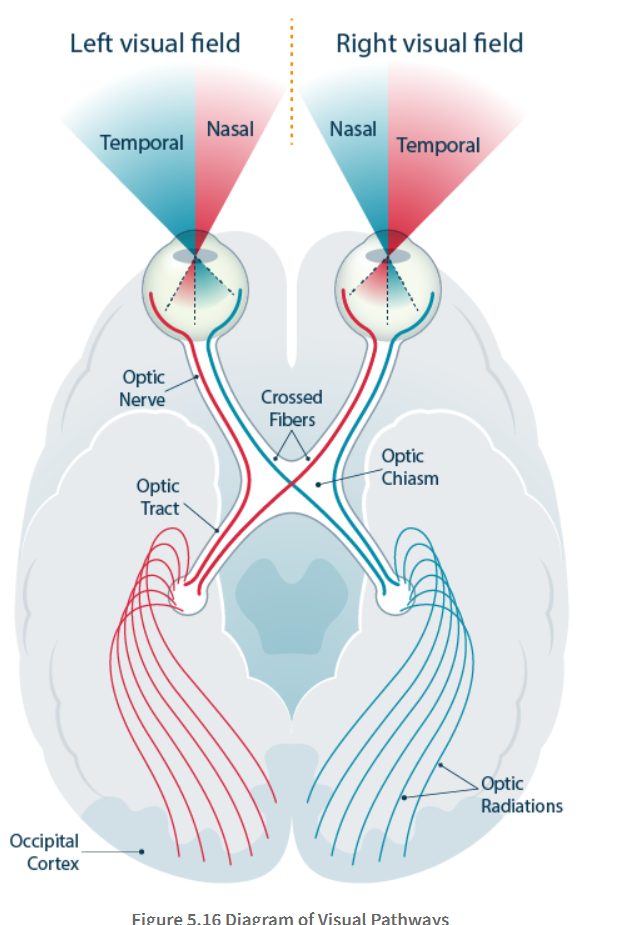
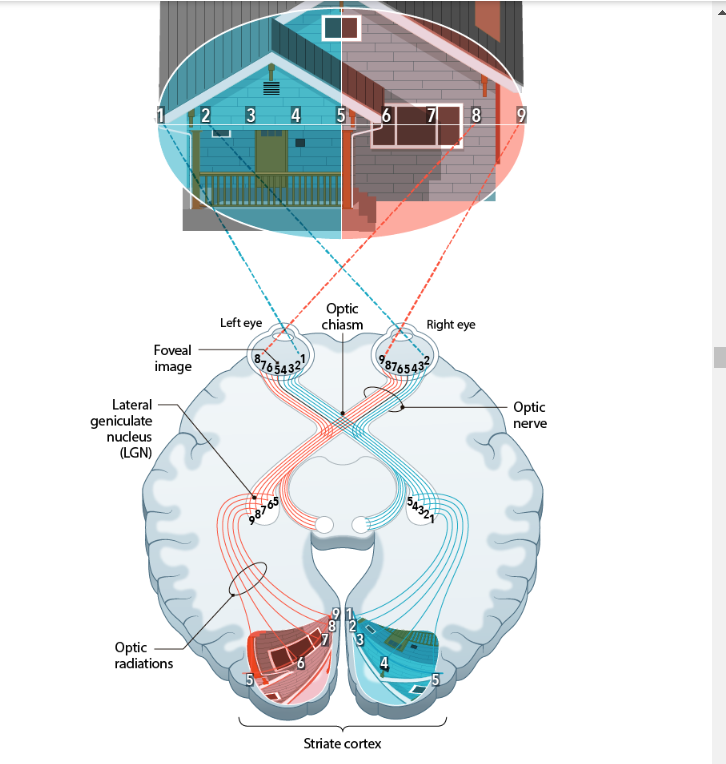
Optic Chiasm: MEsssage from optic nerve travels here. X shaped structure where the optic nerves from each eye cross before the message is sent to thalamus.
Axons of eye are reorganized for processing info from right side of both eyes is sent to the left hemisphere and other way around.
Lateral Geniculate nucleus LGN: OF the thalamus the six-layered portion of the thalamus that processes and organizes visual info
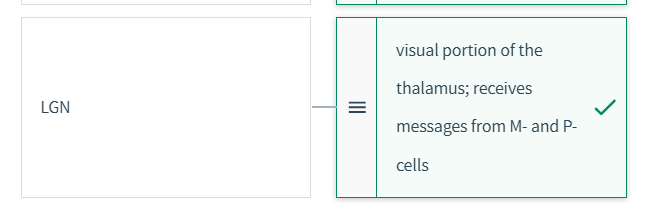
6 sublayers each dealinging with specific sensation to M and P cells.
Send back of brain in the cortex
Visual Striate Cortex: The location in the occipital lobe where visual info is organized and analyzed. THIS IS VC
30 areas in back of brain dedicated to analyzing and organizing visual info.
Retinotopic Orginization: Spacial Orginization of the retinal image maintained through visual pathway.
Maintains the origination of the info in the retina as its processed to both LGN and striate cortex.
Feature Detectors: Points of light assembles into lines and edges. Specialized cells in the VC that respond most actively to specific stimuli
SPECIALIZED cells in the visual cortex that respond most actively to specific stimuli.
Simple Cell: Type of feature detector cell. Responds to small stationary bars of light oriented to specific angles. Detect cells in the visual striate cortex that respond to lines of specific orientations.
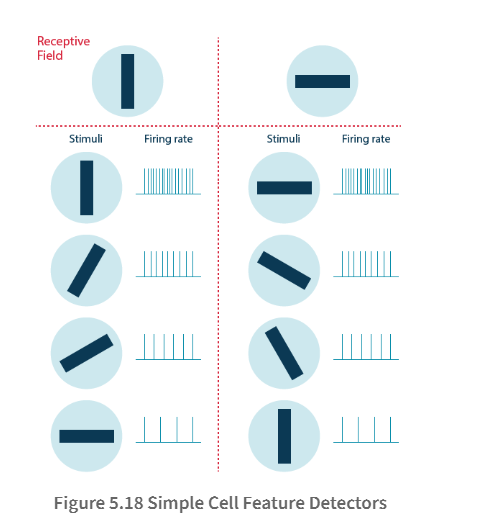
Moving orientation changes firing rate.
Complex Cells: Respond to lines of particular orientations that are moving in specific directions. Visual striate cortex area is where it is and responds to the lines of orientations in motion.
(walk a person walk down the street)
2 Pathways after
Ventral Stream: Info is then sent to other regions of cortex. And this stream is the “what stream” to the temporal lobe.
Takes info from occipital lobe to temporal lobe where we identify an object.
Dorsal Stream: “Where pathway”. Carry visual info to parietal lobe where visual info understand the location. IDENTIFIES THE LOCAION
Pathway light travels to reach VC:
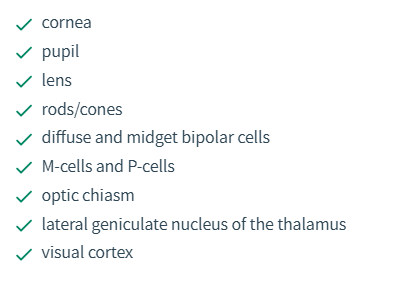
Color Vision: Qualities associated with color processed at each step along the visual pathway starting form cones of the eye.
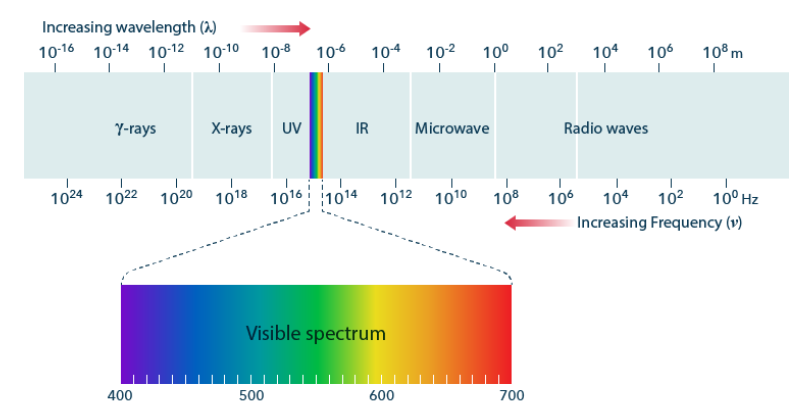
Wavelength: How colour is perceived. Longer wavelengths create perception red(670 nm)
Medium wavelengths produce green (530 nm)
Shorter Wavelengths create Blue (450 nm)
Physical distance from one energy cycle to the next. Changes in wavelength are perceived as changes in colour.
Rainbow comes from the light refracting thru the water in the air so the brain creates rainbow.
Human eye has 3 types of cones
ONE MAXimize short wavelengths blue
S-Cones Short cones: Cones in the visual system that respond maximally to short wavelengths BLUE Ones. 430nm
M-COnes Medium wavelength cones: Respond to green maximally medium wavelength GREEN and yellow
530nm
L-Cones Long wavelength: Respond to oranges and reds. COnes respond maximally to long waves of light 670nm
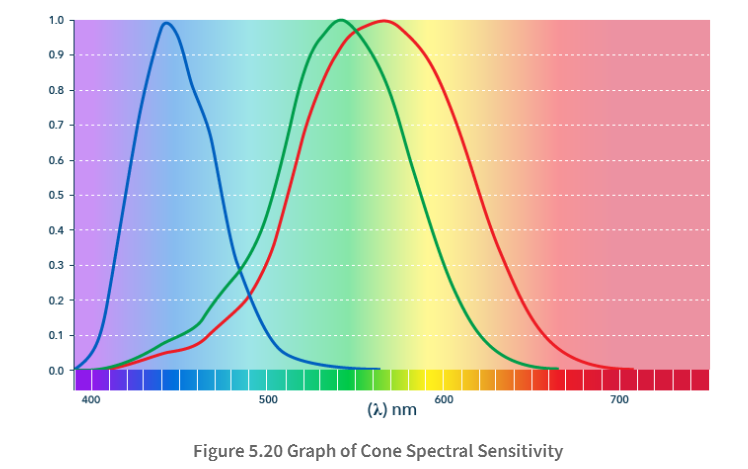
Trichromatic Theory: Color info is identified by comparing the activation of different cones in the retina
Colour info is identified by comparing the activation of different cones.
Ex: blue car - reflecting short wavelengths to eye. ACtivate S-cone
Pumpkin more than one cone is active
Explains colour blindness when some cones are gone
Two types red-green color blindness
Cones send message to midget bipolar cells then p cells who operate vigorously to one wavelength.
Colours paired so that the cell will increase firing erate from one colour. 6 colours made red and green paired, bleu and yellow, black and white.
Opponent Process: Image after affect maintained in the LGN of thalamus. Suggest that cells i nthe visual pathway increased their activation when reicevingi info from one kind of cone and creacease when they see a second colour.
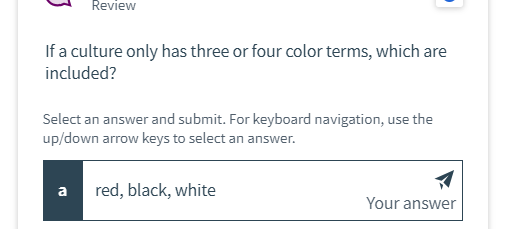
These 3 colours recognized by all cultures
WHat are the opponent colours of red, white and blue?
Green, black and yellow
Berlin and Kay talked about: culture and language influencing how colour is received
A flaw is how they only tested participants from industrial societies.
People from industrial countries all experience formal education. This might bias their answers in ways that you would not see in other groups of people.
The brain uses reliable cues when using info to understand what theyre viewing (someone far appearing tiny)
2 types if depth cues
Monocular depth cues: Require only one eye. Known as pictorial cues that require one eye to understand the depth of messages.
Binocular Depth cues: Require both eyes. Comparing an image as it falls on both eyes to understand how far away an object is.
2 depth cues
Monocular depth cue:
Occlusion: occurs when one image partially blocks the view of the second. The partially view of a object is seen as farther awy that the whole object.
Relative height: Use our knowledge of the horizon. Objects close to the horizon will appear farther away. Greater the distance the closer it will appear.
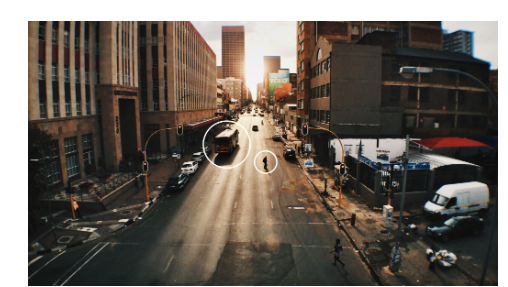
We perceive the man as closer because hes lower.
Relative Size: Also relies on nour knowledge of the world. When two objects are equal size the one farther will take up a small part of the retina.
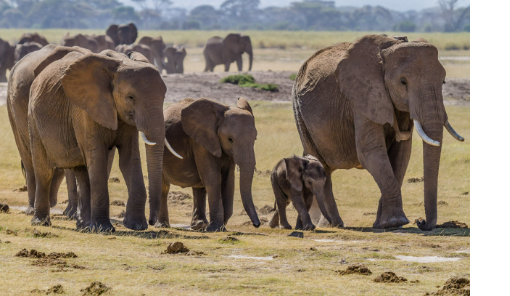
The elephants in the back look like the small one because they’re further but we perceive this based off relative size.
How does the Ames Room illusion work: The Ames room illusion works by creating a distorted, trapezoidal room that tricks the viewer's perception of depth, making one person appear significantly larger or smaller than the other when viewed from a specific angle.
Perspective Convergence: Common cue used for landscapes lines that move away from us into the distance seem to converge or come closer together.

Familiar size: Understand that a lighthouse is not tiny even tho it looks so small far away.
Atmospheric Perspective: more distant objects appear hazy like mountains in a distance particles dust water droppets occupy the space between our eyes and the object distorting it slightly.
Binocular depth cues:
Input both eyes brain makes a comparison of both eyes to understand depth.
Retinal Disparity: Each eye has a slightly different image of the world. Brain uses disparity to calculate the distance between an object and an individual.
Hearing and sound
Richard Dawkins has famously pondered whether bats hear in colour—and they might, when you consider that using only high-frequency clicks they can navigate a three-dimensional world, avoiding one another and any obstacles in their way
Frequency: The sound is determined by the rate of vibrations. WE perceive high-freuqnecy sounds as a higher pitch.
People can hear between 20 and 20 000 hertz but we hear best between 1000 and 5000 Hz
Intensity: The wave which we perceive loudness increased intensity causes the amplitude of waves to increase. The wave arrives in our ear with more force. When a sound above 100 dB eaches our ears, the force of the pressure can cause damage to the structures in the middle and inner ear.
WE feel discomfort in our ears with rapid elevation shifts pressure sensor.
When sound Enters the Ear:
Pinna: External part of the ear
sound enters here it is the part of the ear pierce and shaped in such a way that helps to filter the sound into the ear canal toward the tympanic membrane.
Tympanic membrane: Referred to the eardrum. This structure transfers energy to the 3 smallest bones of the body known as ossicles. WOrks like the surface of a drum transferring energy to 3 small bones in the body the ossicles
Ossicles: THe middle ear they consist of malleus the incus and the stapes
- Malleus
- Incus
- Stapes
These bones help amplify the vibrations as sound waves travel further in the ear.
The stapes is connected to a small membrane called the oval window.
Oval window: transfers these vibrations to the bony sound processor of the ear THE COCHlea
COchlea: Here the sound is transferred into the neural language of the brain. Snail-shaped structure in the inner ear where the auditory hairs are located.
What affects pitch because of the hairs
Basilar membrane: THe tissue inside the cochlea where hair cells are located.
Transduction: The process where external sensation are converted into neural firing in the brain. Vibrations agains the oval window cause fluid inside hte cohclea to move. THe fluid pushes thin fibers known as cilia attached to sensory hairs.
Sound causes the basilar membrane to :ripple:. THe motion makes cilia bend, ccausing excitittory messages to cascade from ear via auditory nerve.
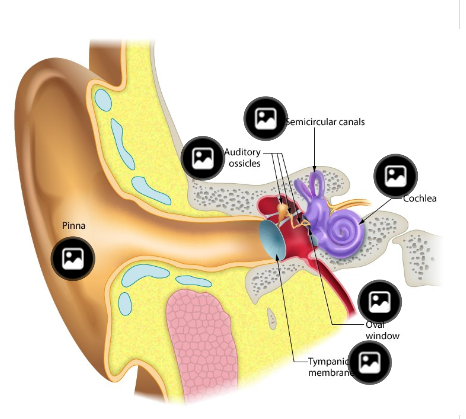
Hair cells: AUditory sensory neurons inside the inner ear that convert sound into neural firing. Other parts of the brain make sense of it.
Membrane in ear where hair cells are organized. Higher frequency sounds make cells close to oval window excite. Lower frequency sounds excite the cells deeper in the cochlea.
Brain uses location of neural firing to understand sound.
Place: THe theory that audition suggest we understand pitch because of hte location of hte firing on the basilar membrane.
We have a specific pitch because cells at a specific place on the basilar membrane fire.
One problem is that hair cells do not operate independently. Often, many are activated at the same time. The brain uses additional information to code pitch perception.
Frequency Theory: suggests that we understand pitch because of hte rate of cellular firing on the basilar membrane. Uses info related to the rate of cells firing. THe more rapid the cells fire THE HIGHER THE PITCH.
Auditory COrtex: The location in the temporal lobe where auditoroy info is porocessesed.
Medial Geniculate Nucleus: Diff components of sounds are organized and analyzed here. OF THE THALAMUS. Evaluates and organizes auditory info before sending it tothe auditory cortex.
Compares sounds with pure tones and complex sounds
Tonotopic orginization: The spatial orginization of the basilar membrane maintained thru the auditory pathway.
Basilar membrane to the auditory cortex. THe auditory system also has what and a where stream.
The organization is hierarchical, with simpler sounds, like pure tones, being processed in lower regions and more complicated sounds, like human speech, being processed higher up.
Binaural Cues: Auditory cues that require comparisons from both ears to understand an objects location.
2 KINDS OF BINAURAL CUES are used for sound localization.
Interaural Time Differences: Comparisons between the arrival time of a sound in each ear. Small differfences from the arrival sound in eahc ear.
The brain localizes sounds form the right and left accurately when a sound is infront of u it will arrive at both ears at the same time.
Binaural recording: Two microphones arranged to record sound in the approximate location of hte human ears.
Second queue: Interaural level differencesL Intensity difference of sound. The brain compares intensity differences of sound as it arrives each ear in order to understand objects location.
The head absorbs a small portion of the sound and the ear further away from the source of hte noise. THE ear closest to the sound will perceive the noise as slightly louder than the sound arriving on the second ear.
How music is used:
Perception of melody: Our exspeirences with music and the sequence of notes that give them coherence
Oliver Sacks: sticky music cant get song out of ur head
Involuntary musical imagery: Also known as earworm. The auditory experience of an inabilities to dislodge a song from ones consciousness
The production of speech has three basic component parts: respiration from the lungs, the vocal cords, and the vocal tract.
McGurk Effect: Example of how visual info can be used too help supplement the sounds coming into our ears.
Perception of smell and taste begin with the activation of chemoreceptors.
Chemoreceptors: Sensory cells in the nose that respond to air molecules that we interpret as smell and taste.
Only thing that requires to ingest physical stimuli in order to analyze incoming info
5 basic tastes sweet,salty,sour bitter and umami(savourful)
Similarly, smell plays an important role in how we choose our mates and maintain romantic relationships. Components of human odor convey information about a person's diet
he following video shows more on how rats were taught to sniff out landmines. Perhaps what is most important to take away from this video is that the rats were able to accomplish something with their noses that trained human technicians are not able to do with their eyes
iOlfactory mucosa: Tissue contains the chemoreceptors of the nose
Olfactory receptor neurons: Neurons that are specifically responsive to oderants.
Located in the olfactory mucosa.
Send their signals to glomeruli in olfactory bulb. Cells consolidate all messages from a particular receptor type.
Taste
Taste and smell both need u to pull stimuli in ur body making it “gatekeepers”
What we should ingest and what to leave out
Papillae: little bumps on the tongue the location of our taste buds.
The bumps arent the same because theres 4 categories of papillae
- Filiform papillae: Found over entire surface of tongue and give tongue fuzzy appearance dont contain taste buds
- Fungiform papillae: Tips side of tongue they look like little mushrooms
- Foliate papillae: Back of tongue little folds
- Circumvallate papillae: back of the tongue shaped like mounds
Each taste buds contains 50-100 taste-sensitive cells
Taste Pore: The location of taste-sensitive cells on the tongue
Transduction: when chemicals bind to the receptor sites on the taste pore
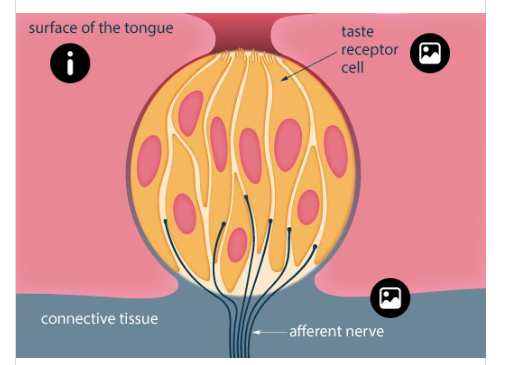
Afferent neurons, also called sensory neurons, are the nerve fibers responsible for bringing sensory information from the outside world into the brain.
Orbitofrontal cortex (OFC): Region receives information from visual “what” pathway. The region that analyzes both taste and smell.
OFC contains bimodal neurons respond ot more than one sense.
Specialize for sensations that occur together.
Because flavor is a complex perceptual experience, it occurs in the brain—the orbitofrontal cortex (OFC) to be precise.
Largest organ in the body is the skin.
Pressure the physical measure of touch
Message travels from touch to spinal cord to the
Somatosensory cortex: Parietal lobe from the responses of four types of mechanoreceptors.
THE location in the parietal lobe where touch and motion is processed
Mechanoreceptors: located in the skin that sense diff pressure.
Merkel Receptor
Located close to the surface of skinn and fires continuously while the skin is in contact with an object
Meissner Corpuscle
Located close to the surface of skin and repsond to pressure that is applied and then removed.
Ruffini Cylinder and Pacinian corpuscle DEEP IN THE SKIN.
Ruffini Cylinder: Deep in skin associated with stretching of the skin
Pacinian corpuscle Feels vibration and texture.
Somatopic Orginization: The spatial orginzation of touch: two adjacent points on your skin represented by adjacent points on somatosensory cortex.
Sensory Homunculus: A visual depiction of what our bodies would look like ifthe yywere build in proportion to their representation on the cortex.
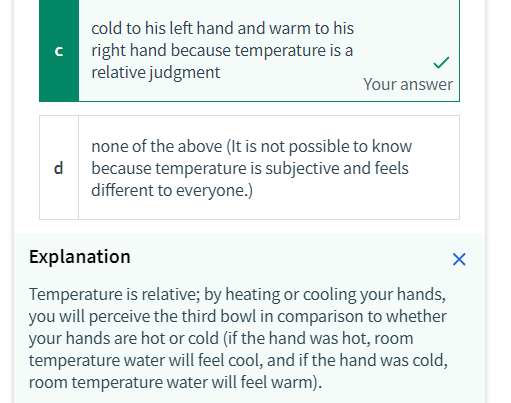
Temperature
Thermoreceptors: Recel=ptors in the skin specifically designated to detect temperature changes
Pain
Pain is an adaptive response to tissue damage
Nociceptors detect pain and send a singal to our brains
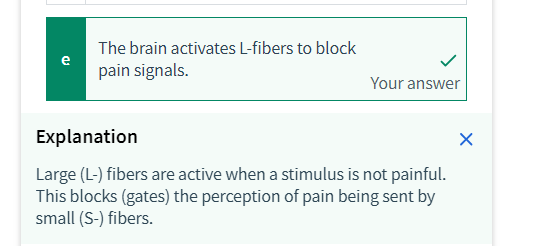
Gate COntrol Theory Of pain: Perception that suggests that painful stimuli cam be blocked in the spinal cord when u are engaging in other activities.
Life WWithout Pain
Congenital Analgesia: Rare condition with 2 features: inability to perceive pain and inability to perceive temperature. People are unable to experience pain
Kinesthetic Sense: Sense of where our bodies are in space and how to move the body to accomplish specific tasks. Basic understanding of where our body is in space and how to move our bodies to accomplish specific tasks.
if kinesthetic relies heavily on our sense of touch, other receptors are involved as well. Receptors in the joints and muscles both send and receive information about where the body is in space.
Works with our sense of balance or Vestibular sense
Vestibular Sense: Sense of balance sensory cells are located in our cochlea.
Semicurcular Canals: Sense changes in acceleration and rotation of head.
Haircells: the canals are filled with it and this responnds to foce of gravity
Vestibular sacs: Responds to cues associated with a sense of balance nad posture. Inner ear structure that respond to cues associated with balance and posture.
Psychophysics: Evaluate the wayt he physical experience of sensation is translated into perceptions.
Stimulus detection attempts to answer hwat is the minimum amount of stimulus required to generate sensation.
Absolute threshold for the stimulus: Level of intensity required to create a conscious experience.
GLIAL CELLS = LOCATED IN CENTRAL NERVOUS SYSTEM AND THEY PROTECT SUPPORT AND NOURISH NEURONS
GENERAL NOTES FOR HWAT I WANNA REMMEBER
GLIAL CELLS are found in the central nervous system CNS and peripheral Nervous system PNS (brain to rest of body is PNS)
- Astrocytes: most abundant glial cells in the CNS. They provide physical and metabolic support to neurons. They help regulate the extracellular environment by maintaining ion balance and provide nutrients to neurons. Astrocytes also play a role in repairing and scarring after neural injury.
- Oligodendrocytes and Schwann Cells: Oligodendrocytes CNS responsible for myelination
- Schwann cells PNS responsible for myelination
- Microglia: first line of defense against pathogens and damaged cells, and they are involved in the immune response and inflammation within the brain. Microglia also contribute to synaptic pruning during development.
COntengia; ganglia
SYSTEMATIC INTROSPECTION IS HWAT? :
It is compare experience more effectively

Tuskegee Syphilis study
Participants' informed consent was not collected. Researchers told the men they were being treated for “bad blood,” a local term used to describe several ailments, including syphilis, anaemia, and fatigue.



Relates connects mind and body
Perception: aristotle said heart not brain
Weird Bias: WEstern educational industrial rich democratic
CHAPTER 6: STATES OF CONSCIOUSNESS
Split Brain: A type of surgery that cuts the connections between the two hemispheres of the brain
Corpus Callosum: where the two split brains are located and where it’s connected. The band of axons that connects the two hemispheres of the brain.
Hemispheric Specialization: the brain is split into two hemispheres; some abilities are processed more on one side than the other.
2 components of conscious experience
Conscious content: subjective experiences of your internal and external world. Your “sense of self” resides in your conscious content, as do your plans, dreams, and day-to-day perception of space and time
State of Consciousness: different levels of arousal and attention. Interestingly, your experience of a particular state of consciousness is based on several processes.
time when you found yourself unable to sleep despite feeling tired and wanting to rest. In both instances, your state of consciousness was influenced by factors beyond your “control.”
Unable to realise how much time has passed by gaming.
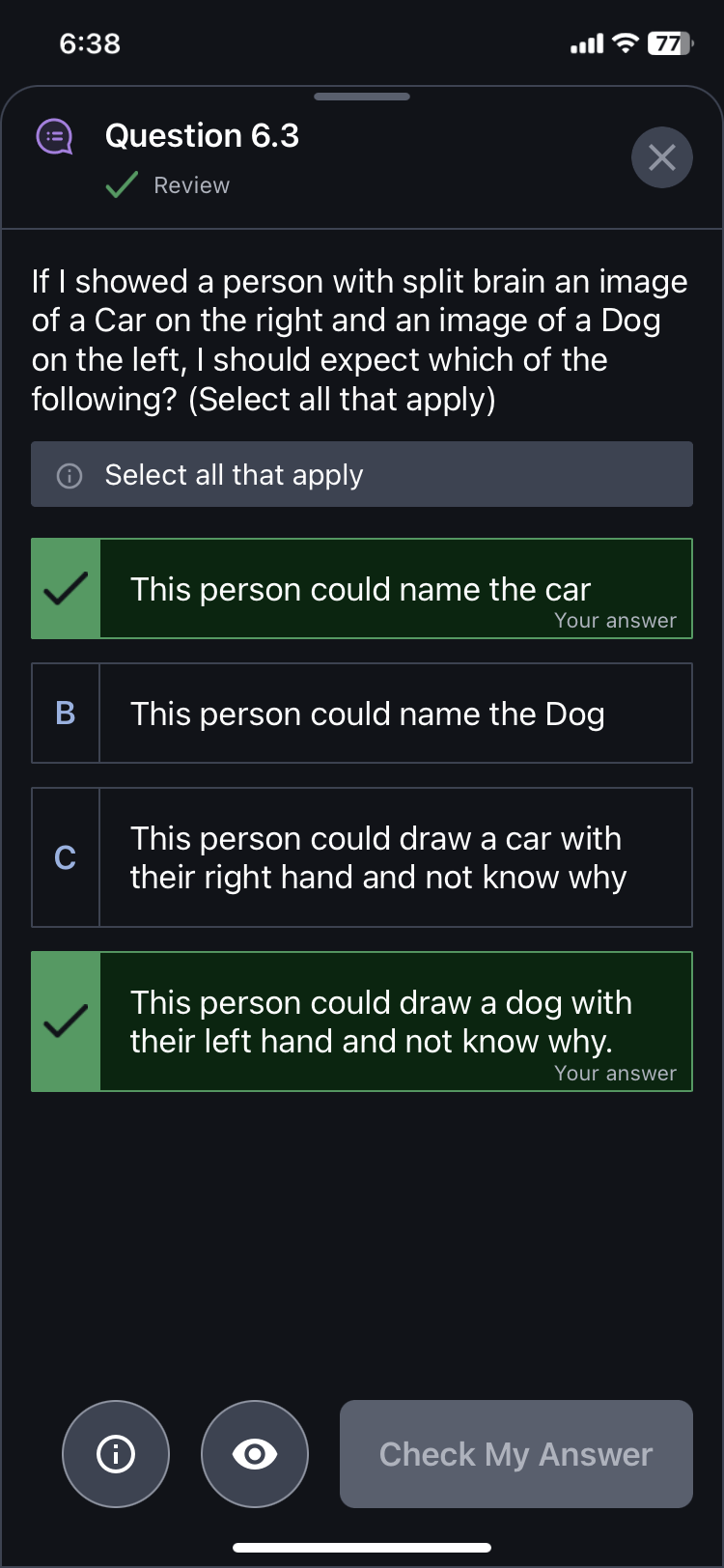
LEFT RIGHT HEMISPHERES
RIGHT SIDE U SPEAK
LEFT SIDE DRAW
Left hemisphere = verbal
Right hemisphere = draw
Attention: process of selecting information from the internal and external environments to prioritize for processing.
Passive Attention: When it’s involuntary and automatic. Occurs when attentional priorities are set by bottom-up information from the environment.
Active Attention: directed by goals and top-down processing. When you search a cluttered table for your keys, you are using active attention.
Selective Processing: A form of attention that occurs when a person attends to some information while ignoring other information
Stimulus Salience: refers to the bottom-up qualities of a scene that influence how we direct attention.
Some stimuli in the environment capture attention by virtue of their physical properties.
Attentional Capture: When attention is diverted because of the salience of a stimulus. Occurs when attention is diverted because of the salience of a stimulus.
Cocktail Party Effect: Describes a situation associated with selective attention. At a party, a person can be engaged in a conversation and suppress/ignore all the information going on around them and attend to the conversation
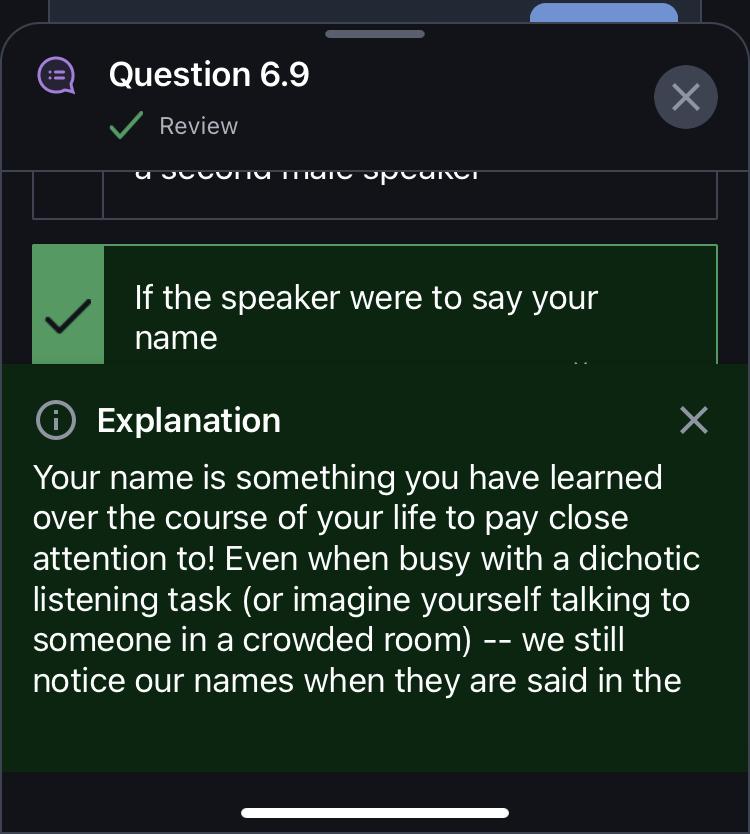
Example: the dichotic listening task (Broadbent, 1952; Cherry, 1953). In this task, participants are asked to wear a pair of headphones that will play one message in one ear and a second, different, message in the other (Figure 6.7). Participants are asked to attend to and repeat one message and ignore the second.
Dichroic Listening: An attention task where one stream of information is presented to one ear, and a different message is played in the other ear. The participant is asked to attend to only one message. Later the participant is asked information about the unattended message.
Divided attention: Multi Tasking. when we simultaneously attend to two (or more) tasks at the same time
Automaticity: Fast and effortless processing information that can be accomplished without conscious thought.
Inattentional Blindness: When we are focussed on one task we completely miss other information. Miss changes of some kinds when your attention is fully engaged elsewhere.
Flicker Task: A change attention task used to study intentional change detection and inattentional blindness.
Intentional change detection: Attention test that makes the participant actively search for a change made to the stimulus. Because she is intentionally looking for changes, this is an intentional change detection task.
Subliminal Stimulus: sensory stimulus that is processed but does not reach the threshold for conscious perception.
Subconscious Processing: Happens when we are aware of information from the environment but are not aware that it is influencing our behaviour.
French music being played made people purchase French wine more than German wine.
Subvisual Messages: Visual images that are presented too quickly for the brain to perceive in conscious awareness
Subaudible Messages: Auditory messages that are played too quietly in such a way that the brain cannot consciously be aware of the content.
Low volume things have louder messages played over it.
DURING SLEEP
VIsual neglect: While visual neglect patients do not notice that the house is burning (or at least fail to report noticing it), their actions are affected by it (they say they would not like to live in the burning house).
Fatal Familial Insomnia: A rare hereditary disease affecting the thalamus which causes individuals to die from lack of sleep. They gain weight loss and are unable to maintain homeostasis. Death happens 12-18 months after symptoms begin.
Electroencephalograms (EEGs) : Device that measures the sum of electrical activation across the surface of the cortex.
Electrical activity
Electrooculogram: Device measure eye movements
eye
Electromyogram: A device used to measure muscle tension around the jaw
Muscle
STAGES OF SLEEP
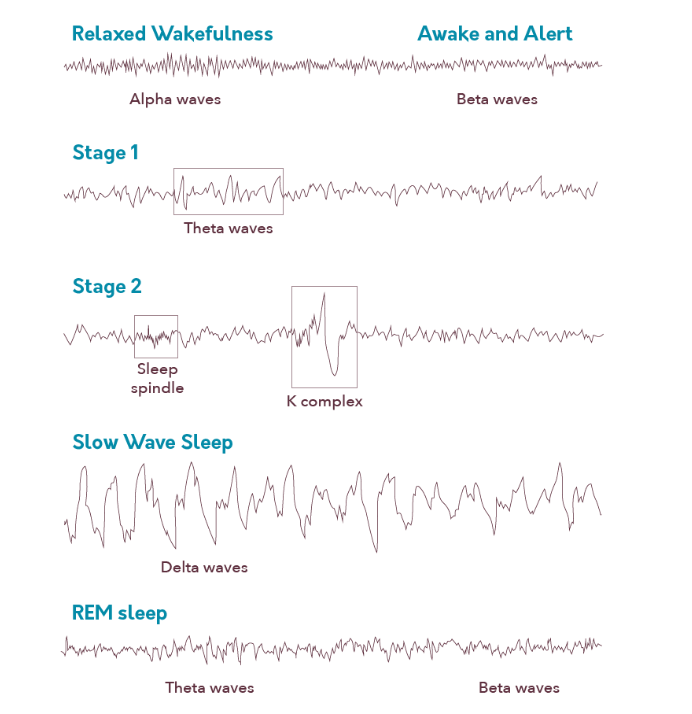
Frequency of the waves: number of up and down cycles of the wave per second.
Regularity of the wave: Our measure of how consistent or erratic the waves appear.
Beta Waves: Appear on EEG (electrical activity monitor area) when a person is alert and actively processing information.
HAPPENS IN THE REM SLEEP (sort of awake attentive)
Alpha waves: Brain waves that appear in the EEG when a person is relaxed awakeful
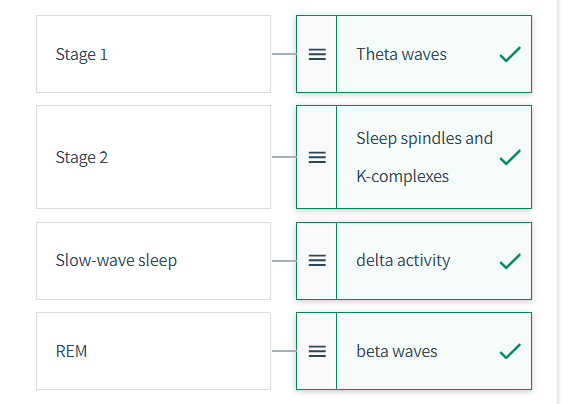
Theta Waves: Brain waves that appear on EEG when a person is deeply relaxed or falling asleep, they are present throughout the sleep cycle. Beginning in Stage 1
Sleep Spindles: Brief bursts of activity that occur two to five times per minute during non-REM sleep. Noticed in Stage 2
K-Complexes: Pattern of neural excitation followed by neural inhibition occurring during stage 2 sleep. They are bigger appearing frequency of waves. Only in stage 2 sleep about once per minute.
Delta Wave: Brain waves that appear on EEG when a person is deeply asleep. THey occur during the late stages 3-4 (slow wave sleep). They're the deepest sleep.
Slow-Wave Sleep (SWS): Broader name for sleep occurring in stage 3-4. In this stage, EEG shows dela waves.
Rapid Eye Movement (REM) t: When dreaming is occurring. In this stage EEG becomes highly irregular and the persons eye move from side to side rapidly.
REM sleep. Beta and theta activity are common in this stage, as is a reduction in signals sent from the brain to the body.
Hypnogram: A graphic depiction of a person's progress through the sleep stages over the night
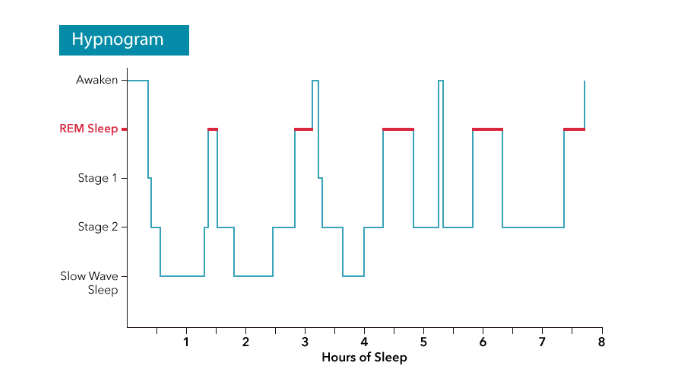
non-REM sleep. For instance, nightmares often occur during slow-wave sleep
While REM is important (for the consolidation of skills), slow-wave sleep seems to be most important for maintaining explicit memories.
REM: Best for skill retention
Slow-Wave sleep: BEST for memory retention
DREAMS TAKE ON 2 PERSPECTIVES
Activation-synthesis Hypothesis: A hypothesis about dreaming that it has no purpose and meaning, but happens because of other processes that happen in the cortex during sleep.
Evolutionary hypothesis of dreams: Hypothesis that dreaming has biological significance. Dreaming is directly related to survival. Emotional problems are matched with the dreamer.
It is typical to dream about threats that were relevant in our ancestral past, such as threats of predation.
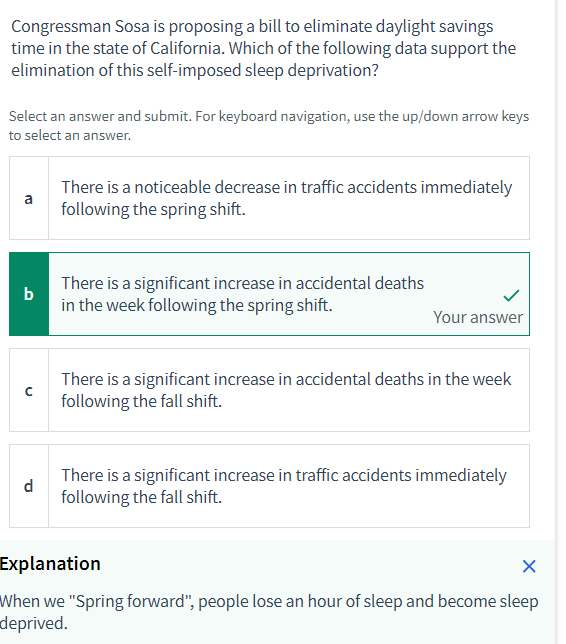
Insomnia: THe inability to fall asleep or stay asleep
Insomnia CAN BE BROKEN DOWN -
Sleep Hygiene: Habits and behaviours practices that promote the ability to fall and stay asleep. Ex: sleep routine
Conditional Insomnia: Form of insomnia that occurs when cues that are usually associated with falling asleep cause anxiety making you unable to sleep. Ex: your bed
Idiopathic Insomnia (child onset insomnia): Neurological condition resulting in inability to sleep. Begins from childhood and throughout adulthood. Harder to treat
Hypersomnia: Excessive need for sleep or sleepiness in daytime. (commonly because lack of sleep at night)
Sleep apnea: Medical condition where the patient stops breathing during the night and gets short intake of oxygen. This makes the patient wake up. Results in long-term health problems and poor rest at night.
Narcolepsy: Rare genetic neurodegenerative disorder made by several symptoms. (sudden and extreme need of sleep) REM states losing all muscle tone while unconscious they get sudden sleep attacks and fall asleep.
Cataplexy: Symptom of narcolepsy. Experience of muscle weakness or paralysis during the waking hours.
Hypnagogic Hallucination: Vivid sensory hallucinations that happen right before the onset of sleep. (right before sleep) gogic = before sleep
Hypnopompic Hallucination: Vivid sensory hallucinations that happen right before waking up
(right before waking up) pompic = before walking up
REM Sleep Behaviour Disorder: A neurodegenerative disorder that results in the inability of the brain to effectively paralyse the body during sleep. Moving through responses of dreams instead of being stuck still.
Night Terrors: Disorder of slow wave sleep. Frantic panicked screaming but no memory of what caused it in the first place once the individual is fully conscious.
Somnambulism: Sleepwalking that happens in the slow wave sleep state. People are not acting out dreams but are able to execute complicated behaviours.
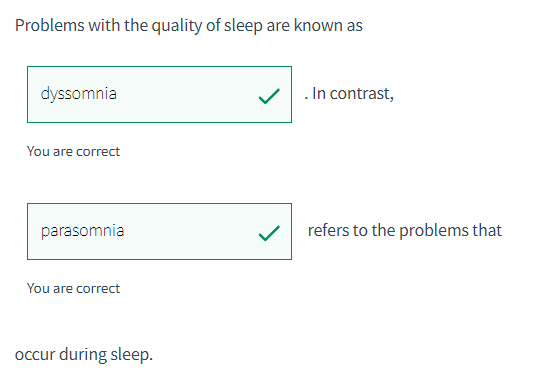
Dyssomnia = problem with quality of sleep
Parasomnia = problems occurring during sleep
Biological Clocks: Internal clocks that prepare the body for daily, annual rhythms.
Circadian Rhythms: Daily body blocks that tell the body when to sleep and when to wake up
Zeitgebers: Cues from the environment that set biological clocks. (time givers)
Without time cues like light, humans would revert to a clock with 25 hours
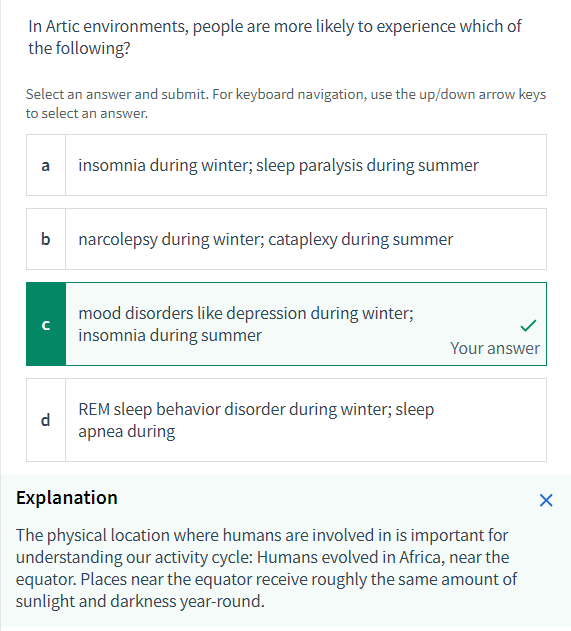
Jet Lag: Occurs when you travel to a different time zone, your body is out of sync with the time cues from an external world.
Suprachiasmatic Nucleus (SCN): The structure in the brain next to the optic chiasm that sets the body’s circadian clock. (located in the bodies timekeeper)
pineal gland. In response to the light/dark cycle, the pineal gland secretes melatonin. Melatonin levels are highest right before bed and seem to signal to the brain that light is absent.
ALTERED STATES OF CONSCIOUSNESS
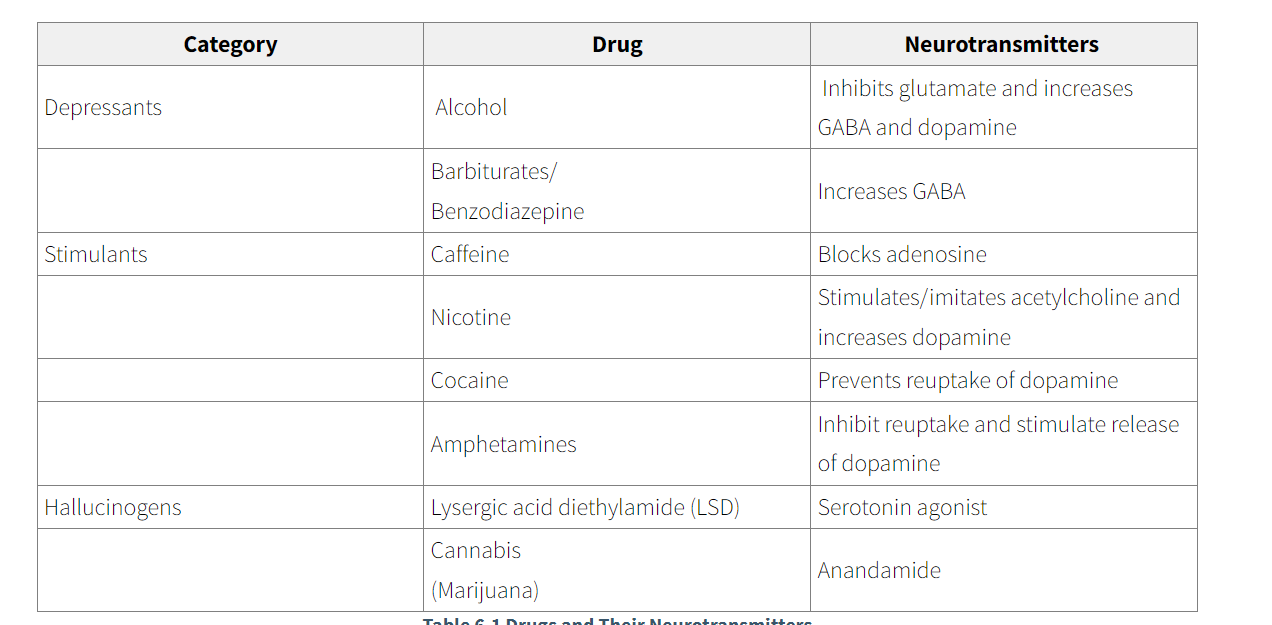
Psychoactive Drugs: Substances from the environment other than food that influence mood, thoughts, behaviour.
Drug Tolerance: Increased ability to tolerate a specific drug. Occurs after repeated ingestion.
Dependance: When an individual requires a drug to maintain normal functioning. Without the drug the patient may experience symptoms of withdrawal.
WIthdrawal: Symptoms of distress, restlessness, irritability when there is a reduction or to addictive substances.
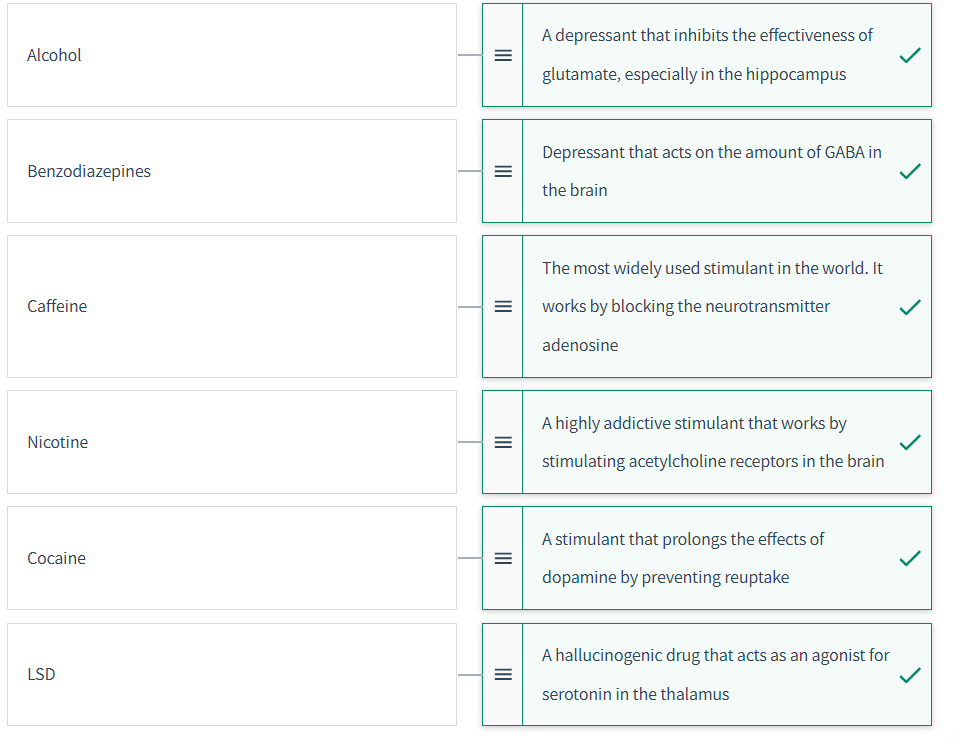
DEPRESSANTS
Glutamate: Neurotransmitter that creates excitatory effects on the nervous system.
GABA: Neurotransmitter that often creates inhibitory effects in the nervous system.
Dopamine: Reward states of the brain from the effectiveness of drugs
Barbiturates: A group of drugs that cause sedation and induce sleep. Anxiety disorder related.
Benzodiazepine: A group of drugs used for treating anxiety. Fast-acting and highly addictive.
STIMULANTS
Stimulants: Drugs that increase the activity of the nervous system. (Caffeine, nicotine)
Adenosine: A neurotransmitter that often creates inhibitory effects in the brain.
Acetylcholine: A neurotransmitter that often creates an excitatory effect in the brain.
HALLUCINOGENS
Psychedelic drugs: Directly influence the sensory systems and interpretation of reality.
Synesthesia: Experience where senses seem to merge. Music may create experiences of seeing colours or tactile sensations.
Serotonin: A neurotransmitter that is implicated in mood and also in organzation of sensory information.
CHAPTER 7: LEARNING
Learning: Change in behaviour from experiences. Events that change how we perceive the world
Behaviour: Observable action (words, gestures, responses) that are affected by a situation to produce or remove certain outcome. Behaviour produces effects to the environment.
(Behaviour includes reading, answering, responding, texting)
Ex: Texts making environmental events
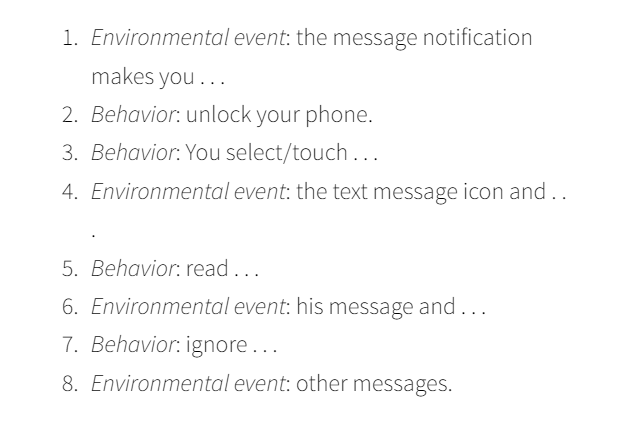
Innate: Something like skills you’re born knowing to do.
(not a result of learning)
Reflexes: Can be learned or innate and is a behaviour that occurs automatically in response to its stimulus.
Reflexive Responses are NOT learned. We’re born with automatic reflexes.
Operant conditioning: (instrumental conditioning) How we learn what happens when we do something.
Ex: Your cat learns to run to you when you shake treats because you give him treats.
Social (vicarious learning): We learn something by watching others
Latent learning: Something we learned but dont show it until there is an actual reason to use that knowledge.
Types of learning include:
Pavlovian conditioning
operant conditioning
latent learning
Social learning.
ALL OF THESE ARE EQUALLY IMPORTANT
Pavlovian (classical) Conditioning: An initially unimportant event signals an important event.
Instrumental (operant) Conditioning: An event signals that behaviour will have a specific consequence.
Social Learning: We learn what to do by watching someone else respond and earn something good.
Pavlovian Conditioning: Associating two events that occur together.
Type of learning where associating an insignificant event signals an important event.
A conditional stimulus provides information about the presence or absence of unconditional stimulus.
Stimulus: Anything in the environment that we can detect, is measurable and can evoke a response or behaviour.
Unconditional Stimulus: A type of stimulus where a biological important natural event affects our behaviour. (Detecting food displayed in front of us)
Unconditional Response: An innate reflex to that unconditional stimulus. (Saliva)
Conditional Stimulus: Signal and predict the unconditional stimulus. Ringing a bell to show that food is coming. Bell is the stimulus.
Conditional Response: COnditional reflex. THe learned that response to now the association of the conditioned stimulus. Salivating is a conditioned response to the bell because the bell means that the food will appear.
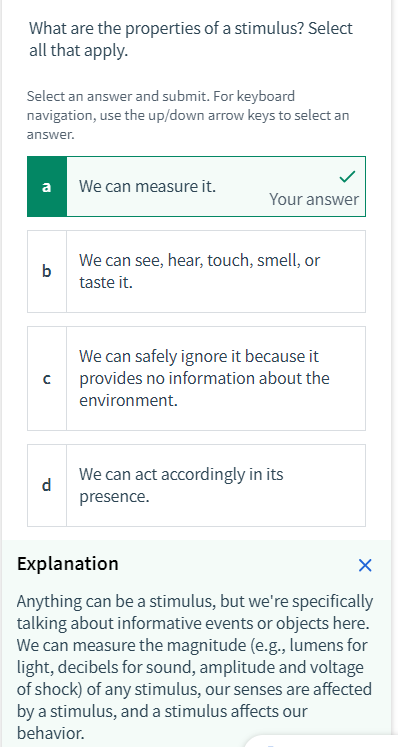
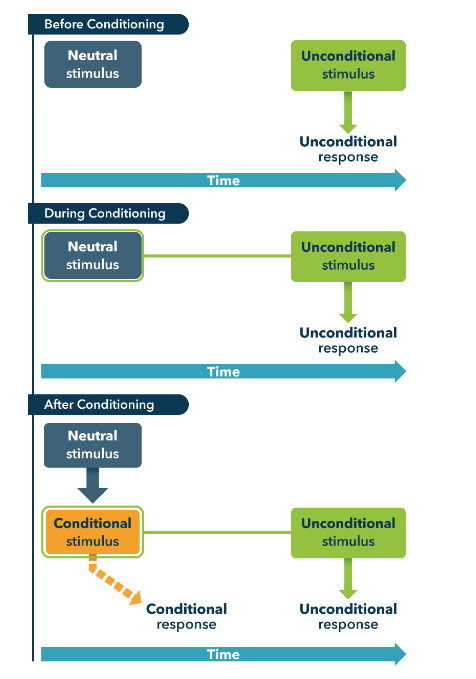
Elicits (trigger): The involuntary response
A descriptor for behaviour which indicates the response to the stimulus is involuntary.
"Conditioned" means that something was learned, but "conditional" refers to the probability of learning occurring if the unconditional stimulus does or does not occur.
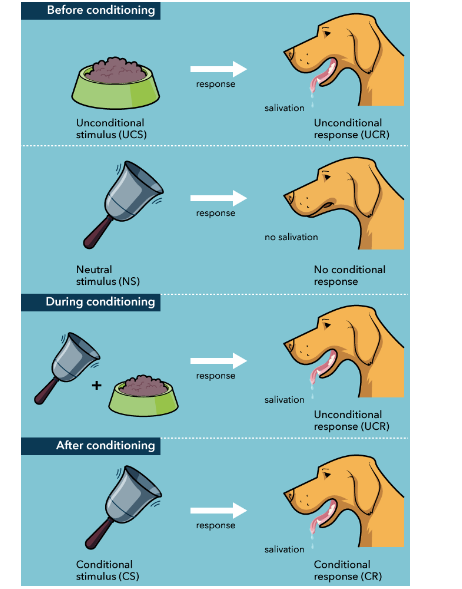
Neutral Stimulus: Type of stimulus where environmental events have no meaning. No response
How we feel before a conditioned stimulus is introduced
ORDER
Conditional Stimulus
Conditional Response
Unconditional Stimulus
Unconditional Response
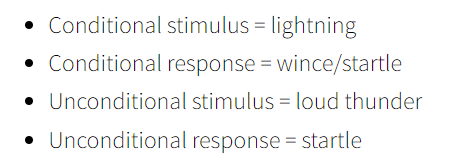
Excitatory Conditioning: Conditional stimulus is shown before the unconditioned stimulus.
Short-Delayed Conditioning: Unconditional stimulus occurs a few seconds after the conditional stimulus. (thunderclaps come right after seeing lightning)
Long-Delayed Conditioning: Unconditional stimulus occurs after the conditional stimulus has been there for a while. Usually several seconds instead of right away
Trace Conditioning: Unconditional stimulus occurs minutes even hours after the conditional stimulus has stopped.
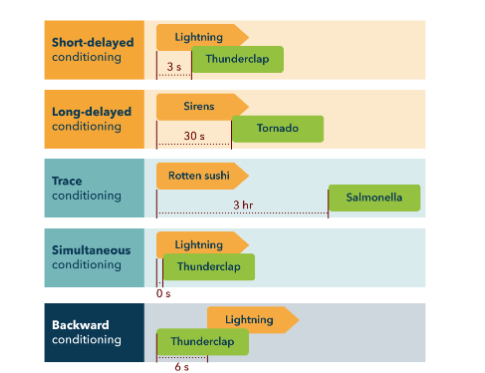
Inhibitory: Negative correlation between the conditional stimulus and the unconditional stimulus.
Simultaneous Conditioning: Conditional stimulus and unconditioned stimulus occur at the same time together.
Backward conditioning: The unconditional stimulus comes before the conditional stimulus instead.
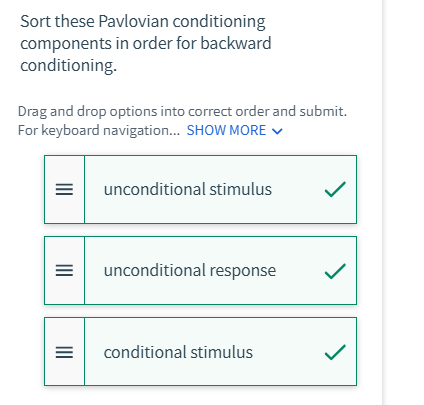
Flavour aversion: Occurs with new foods because we haven’t safely eaten it without getting sick like we’ve seen with familiar foods.

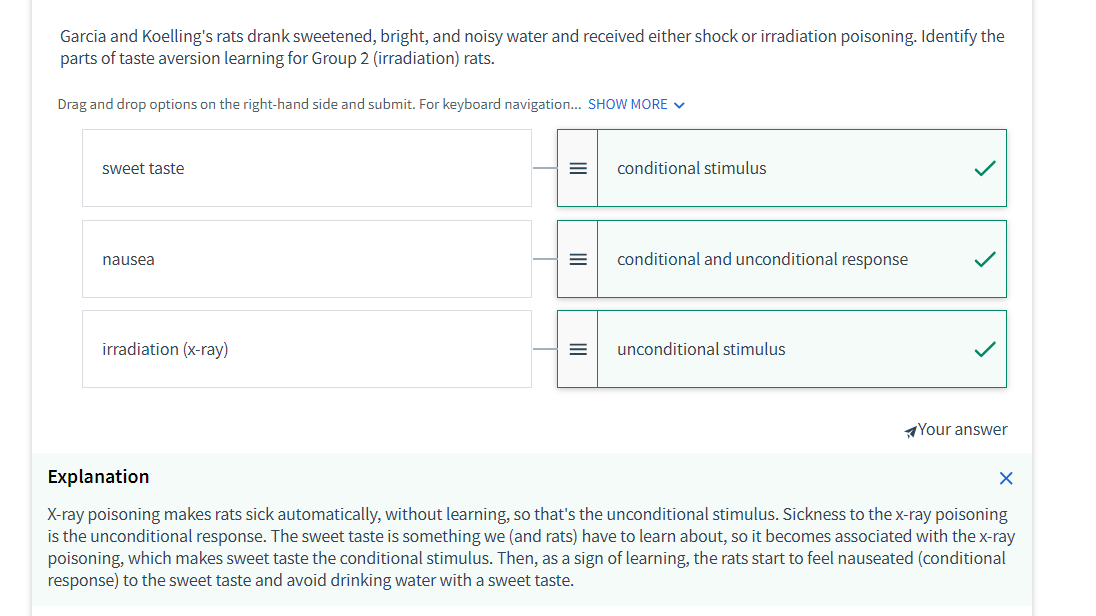
Extinction: Losing the meaning for a conditional stimulus because the unconditional stimulus doesn’t respond to it. We see a loss of associative strength.
Spontaneous Recovery: An effect in which, after extinction and a break presenting a conditional stimulus will bring back a conditional response because the original association was not forgotten.
Appetive: pleasant stimuli (freshly baked cookies)
Aversive: Unpleasant stimuli (stinky fart)
Stimulus Generalization: Responding similarly to conceptually or physically similar stimuli. Similarities between objects and responds to them as if they were the same. Finding the commonalities. Can be natural or unconditional.
With a spider phobia, you might also fear objects or locations associated with spiders: webs, attics, and basements.
Stimulus Discrimination: Responding differently to different events. Opposite of stimulus generalization. Objects not similar are treated differently.
Higher-Order COnditioning: Procedure in which an already conditioned signal is paired with a neutral stimulus or meaningless event. Neutral stimulus is repeatedly paired with a conditional stimulus.
Little ALbert Experiment: Little Albert was shown a variety of animals such as dogs, rabbits, white rats, and objects such as fire and a fur coat. Albert was not afraid of them and seemed to like the rat. then made Little Albert afraid by striking an iron bar with a hammer in the presence of a white rat. The loud, unexpected noise made Little Albert cry. After several rat–loud noise pairings, Little Albert would start crying at just the sight of the white rat; the rat signalled the loud noise. Little Albert demonstrated stimulus generalization—crying and crawling away from objects similar to the furry rat (i.e., the rabbit, dog, or fur coat).
He used stimulus generalization to furry objects, but not all white objects.
Phobias: Extreme and irrational somewhat uncontrollable fear. More intense than other realistic threats.
Operant Conditioning: (instrumental). Consequences of our behaviour matter. Situations where we choose among different options based on previous consequences that we learn.
Watson = behaviourism
EDWARD L THORNDIKE = operant conditioning
Pavlov = classical conditioning
Instrumental Learning: The process of interacting with some response options that has an effect on the environment.
Thorndike’s LAW OF EFFECT: Finding that we learn about situations and behaviour which can lead to something that we like. Can think of it like the law of consequences
The law of effect was twofold: (a) Behaviours that yielded satisfying consequences are more likely to recur, and (b) behaviours that result in discomfort are less likely to be repeated.
Satisfaction: An effect also known as stamping in. We associate a situation with behaviour when that behaviour leads to something pleasant. We learn to repeat it
Discomfort: Or stamping out. We do not associate a situation with behaviour when that leads to something unpleasant. We learn to not repeat it
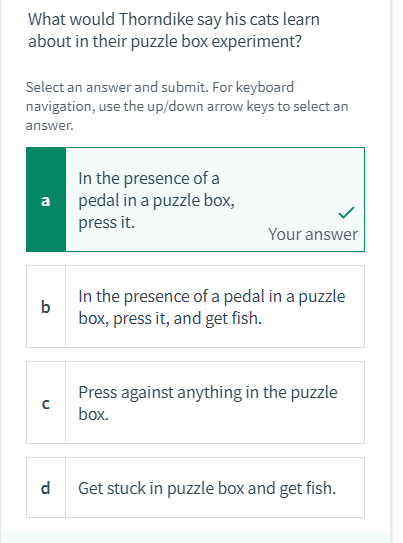
SKINNER OPERANT PROCESSES
Skinner and THorndike both recognized the importance of operant conditioning
Antecedents: Anything in the physical environment that we can detect that tells us about the consequences of our actions.
Behaviour Anything we can do that is affected by the environment, can be repeated and counted and affects the environment.
Litt and Shriebman (1981): Tested whether we learn about antecedents and consequences of behaviour like Skinner suggests. Taught children of autism how to label different items
Differential consequences: When different actions result in different consequences
Nondifferential consequences: Similar actions that produced the same consequence.
Dead Man Test: Term used to help define behaviour. If a dead man can do it, it is not a behaviour
REINFORCEMENT
Contingencies: “If” “then” rule. If you do this behaviour then that will happen consequence.
Reinforcement: When a behaviour produces this consequence that behaviour will occur in the future. Increasing the probability of a behaviour
Punishment: Decreasing the probability of a behaviour. When a behaviour produces this consequence then it will not continue and occur in the future.
Positive Consequence: Addition of a consequence
Negative Consequence: Removal of a consequence.
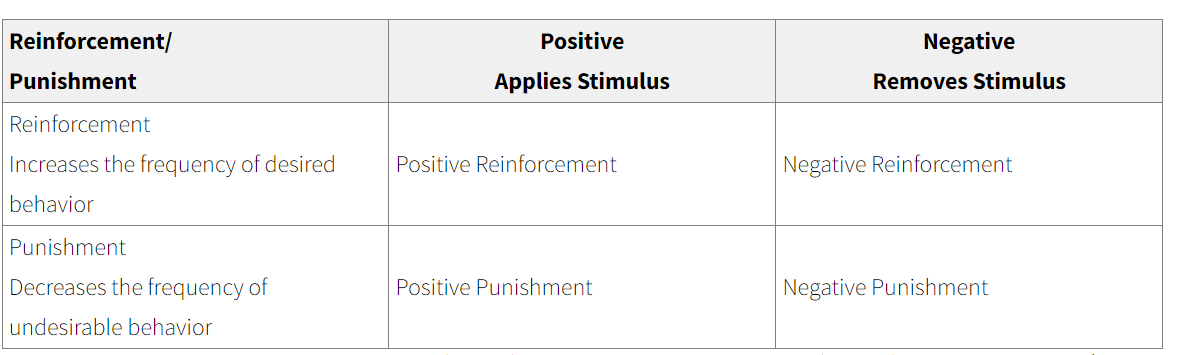
Positive Reinforcement: Behaviour produces a consequence and that behaviour will continue to occur in similar situations in the future. Adding a consequence to increase that behaviour.
Negative Reinforcement: Removing a consequence to make the response more likely to occur in the future.
Positive Punishment: Behaviour produces a consequence to ensure it doesn’t continue in the future.
Negative Punishment: (also called response cost, omission, or time-out)
Behaviour removes a consequence and makes your response less likely to happen in the future.
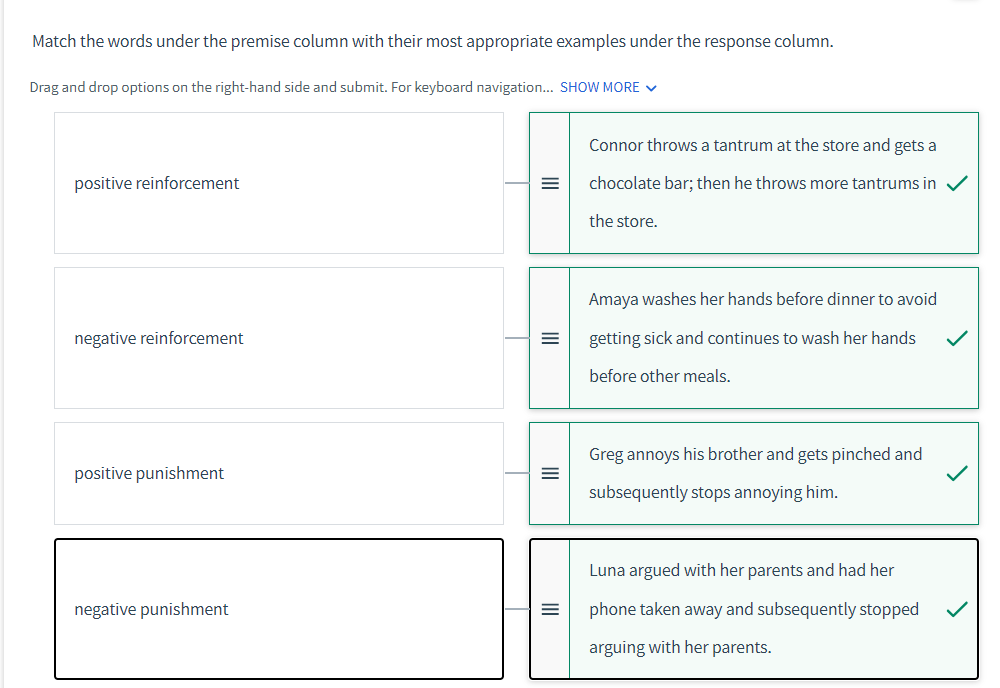
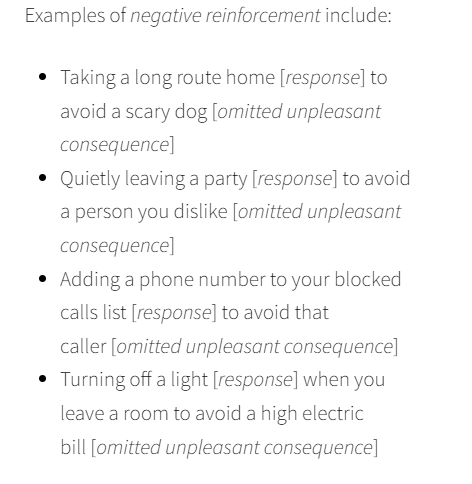
Escape: Situation where the aversive stimulus is already present and a response removes or stops the unpleasant stimulus. Something you want to stop is happening, your response makes it stop and you are more likely to respond similarly in the future.
In escape, the operant response removes an already-occurring aversive stimulus. That is, you get away from or escape the thing you don't want happening.
Avoidance: Situation where something you don’t want will happen if you don’t respond. So you only respond to prevent it. We must experience the escape situation before meeting the avoidance situation.
I go to my physician when I am sick so the doctor's treatment will remove the illness—escape conditioning. I also go to my physician twice a year for checkups to detect problems early before they become unpleasant—avoidance conditioning.
Skinner thinks people should use positive reinforcement because it had longer-lasting effect on behaviour.
If a child throws tantrums to get candy, we can stop giving her candy after a tantrum and start giving her candy for eating all her lunch.
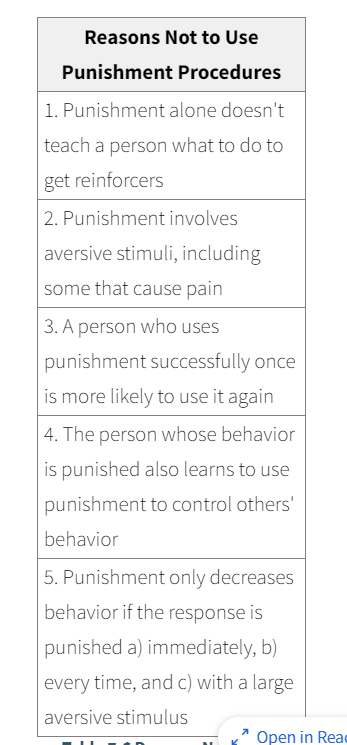
1. Identify the response or target behaviour What someone does; action
2. Identify the consequence What happened after behaviour; event
3. Determine whether consequence was added or removed added = positive; removed = negative
4. Determine what will happen to future behaviour increase = reinforcement; decrease = punishment (or extinction) 5. Identify the antecedent stimulus What happened before behaviour; event
Target Behaviour: The response we’re interested in
Operant Extinction
Extinction: Behaviour that was previously reinforced now produces no consequences and therefore goes away. It’s not reinforced and therefore decreases.
3 Behavioural Effects of Extinction:
Extinction Bursts: Temporary increase in responding
Emotional and aggressive responding
Responding eventually stops
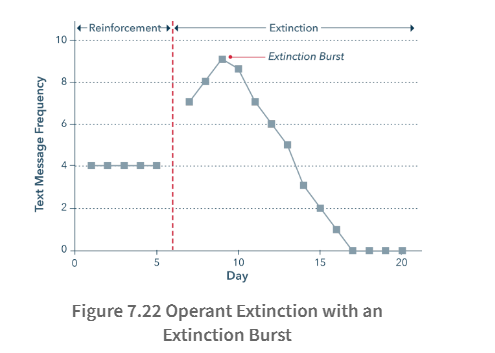
Responding a lot and still not getting the desired consequence (extinction burst)
Getting emotional and aggressive about it
Give up on responding
Partial Reinforcement Extinction Effect: Behaviour reinforced only occasionally lasts longer without consequences than a behaviour reinforced every time when consequences are no longer available.
You would notice immediately that you didn't get candy after visiting the bank if you were used to getting candy every time. You wouldn't notice as quickly that you weren't getting any more candy at the bank if you only got candy every fifth time you went.
Shaping: Procedure to generate new behaviour in which you get new responses by breaking down a complex response into smaller steps and reinforcing responses that look more and more like what you want. Selecting and reinforcing more complex responses that look like the response you want while extinguishing simpler forms of the target response.
Reinforce responses and extinguish previous unwanted responses is shaping
Reinforcers: Type of stimulus presented as a consequences that increase future probability of the behaviour
Reinforcer Test: (contingency analysis) A test made to determine if the consequence you selected is reinforced and increases the frequency of the behaviour.
Primary Reinforcer: Type of stimulus (unconditioned reinforcer) not learned. They naturally affect the responses that follow and include.
Ex: primary negative reinforcer = heat or pain
Secondary Reinforcer: Type of stimulus (conditioned reinforcer) They have been associated with primary reinforcers. They depend on what has been learned.
Ex: H means hot on a tap and C means cold on a tap (blue cold, red hot)
Generalized Conditioned Reinforcers: Paired/associated with many different primary and secondary reinforcers and not as dependent on specific motivating variables.
Got money, spent on clothes. Now I'm gonna want more money, spend on food.
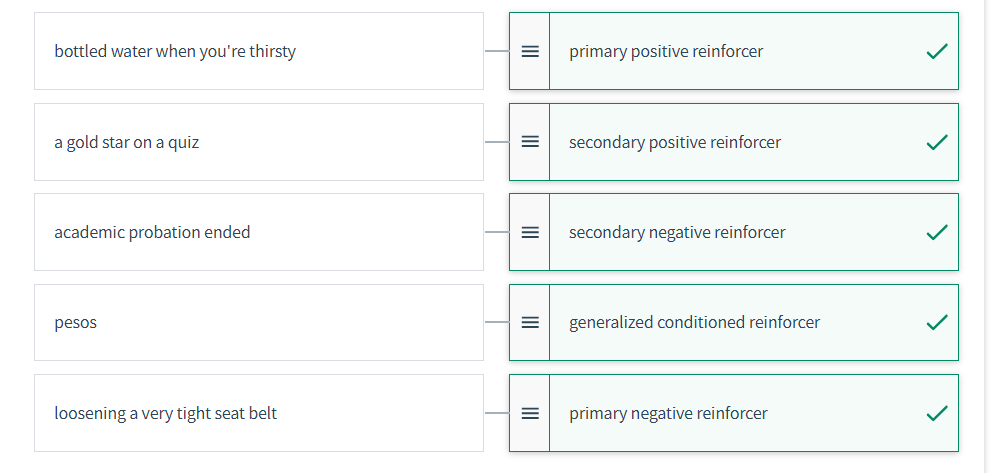
Schedules of Reinforcement: Rules that we use to determine when we get reinforcers or behaviour. Description using numbers and words of how and when we’ll actually earn the reinforcers.
Ratio: Schedule of reinforcement that delivers reinforcers produced by responses alone
SPECIFIC NUMBER OF RESPONSES
Fixed: the requirement for each reinforcer is the same
Variable: The requirement for each reinforcer is different but varies on average.
AMOUNT
Interval: A schedule of reinforcement whose reinforcers require at least 2 responses and a specific amount of time.
Fixed Ratio: (FR) A schedule of reinforcement in which reinforcers are made after a set number of responses. Produce a target response a specific number of times and that last response produces a reinforcer.
Ex: Every fifth person. Each time you purchase a cup of coffee, your coffee card is punched. Once you have 10 punches, you get a free cup of coffee.
Variable Ratio: (VR) Number of responses varies on an average for each reinforcer. Produced after an average number of responses.
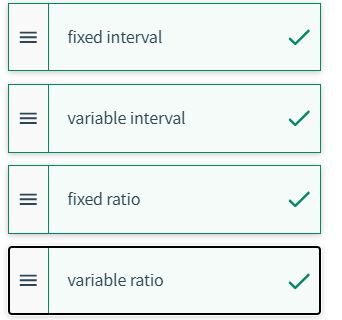
Fixed Interval: (FI) Schedule of reinforcement in which reinforcers are produced after a set amount of time
Ex: 21 minutes to finish baking cookies
Variable Interval (VI) Schedule of reinforcement where reinforcers are produced after an average amount of time and responses. Different times it takes on different variables, occasions.
Ex: pizza on monday takes 22 minutes, tuesday takes 25 minutes
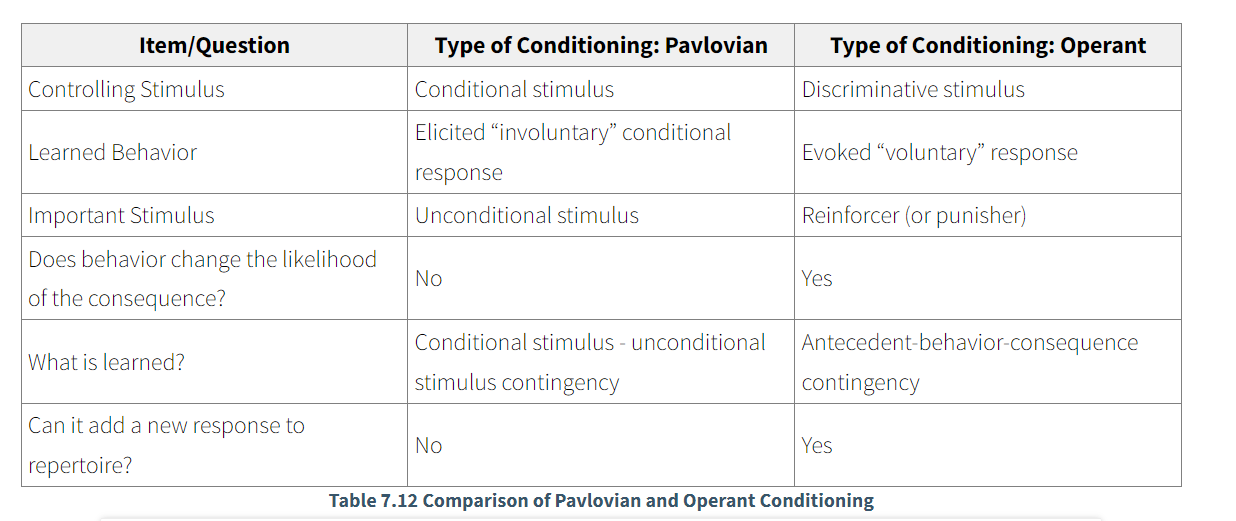
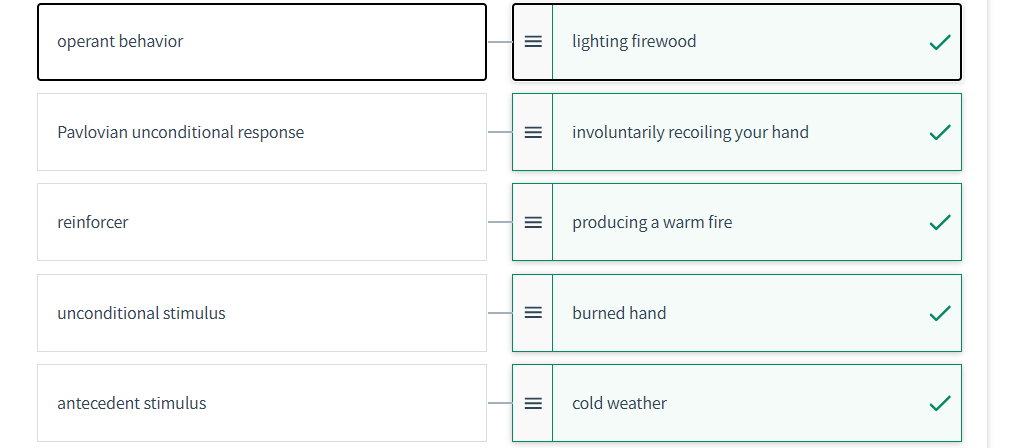
Tolman Experiments Latent learning
Latent Learning: A type of learning that has happened but hasn’t had an opportunity to actually be demonstrated. Learning we can’t see unless we’re motivated to show it.
Cognitive Map: THe assumption that we can recreate a mental image of areas in our physical surroundings.
Ex: Imagining the route it takes from the student centre to the bus stop
Social Learning: Learn from other people
Imitation: Do what others do
BOBO DOLL EXPERIMENT - Albert Bendura
Observing other beat on the doll and changing your action to imitate that
Modelling is what the observed person (Dae-Jung) is doing; imitating is what the observer (Baek-hyun) is doing. Baek-hyun is also learning from Dae-Jung, so that's social, vicarious, or observational learning.
Bandura found 4 phases of observational learning.
- Attentional: Notice the model’s behaviour. Watches someone doing something
- Retention: Think about and remember how and what the model did
- Production: Actually perform and imitate the model’s actions
- Motivational: Obtain the same response and outcome as the model. Understand the intent behind the imitation
Biological Preparedness: (cue-consequence learning or belongingness) Some events serve as better signals or conditional stimuli than others due to evolution.
Ex: 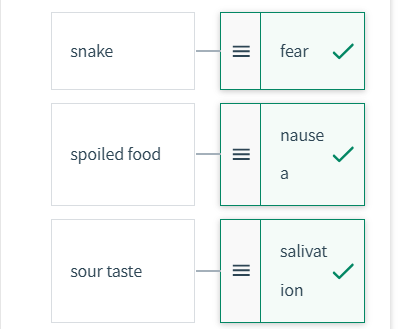
Learned Helplessness: An aversive situation where you can’t control prevents you from learning to control other aversive situations.
CHAPTER 8: MEMORY
We remember some events better than others.
Ex: Birthday Vs Lunch
Memory: Structures and processes used in the storage and retrieval of information. Examine how accurate our language surrounding memory is.
Search Metaphor: Way of describing the process involved in memory using terms and phrases that relate them to looking around in physical or virtual space. Piano keys and looking for the specific physical piano in mind to recall a melody.
Failure Of Search: We weren’t able to remember it. “Couldn’t find it”. No matter how hard we tried.
Reconstruction Metaphor: Describes how we primarily use memory to cobble together useful responses using both what we know and the situation around us. Our brains make their “best guesses” about what happened in a situation when we try to remember it.
ENCODING MEMORIES
Encoding: Process of how information is initially learned. Acquiring information
Encoding PRoblem: The problem that our brain has to solve in order to encode an experience into memory.
Storage: Maintaining information about an event over time (both short term and long term). How information is physically represented in the brain.
Storage Problem: The problem the brain has to solve to maintain information in the brain over time (both short term and long term)
Sensory Memory: System that keeps information translated by the senses briefly active in a relatively unaltered, unexamined form.
Sensory memory is what allows us to perceive the world as a unified whole rather than a series of staggered images and sounds.
Iconic Memory: Fleeting afterimages. Stores visual information for a very brief duration, allowing for the perception of continuous visual experiences. Ex: The outline of your computer screen when your eyes are closed.
Echoic Memory: Brief memories of sound. temporarily holds auditory information, allowing individuals to retain and process sounds for a short duration after their initial presentation. Ex: Someone asked you a question and you forgot about it after.
Sperling (1960) had an experiment where he showed letters for brief seconds and tried to get people to remember them in that short duration.
Partial Report Technique: Wanting people to remember a specific part of a broader memory, but only after viewing the broad memory.
Immediate Memory: The system that actively holds information at the front of your mind. THe short-term or working memory.
RAM (random access memory)
Immediate memory has 3 main properties: Representation, duration, capacity.
Representation: How information is represented or “coded”
Inner Voice: The mental experience of hearing yourself talk “in your head”. The inner voice is taken as evidence for verbal representation in memory.
Ex: SOmeone asked for your name and when you spell it out their inner voice tells them a different letter or a different name from what you said. “Amar” No “Amad”
Inner Eye: The mental experience of seeing someone using your imagination. We compare the mental images in our minds with different perceptions of sizes. When a mental image is bigger it’s easier to answer questions about the image.
Ex: Cat next to mouse vs Cat next to horse
Ex: Duck compared to fly (we think of the duck being humongous compared to the fly)
Duration: How long a memory system can contain information before it is forgotten. Indefinite with rehearsal but without rehearsal is only 3 seconds or so.
How long can information stay in immediate memory before it’s forgotten is duration
Rehearsal: The process of repeating information to yourself over and over again to make it retain in immediate memory. “Re-hear” the information over and over.
Three seconds without rehearsal can be enough to significantly degrade information in immediate memory.
Capacity: How much information can be held in the memory system at one time. Capacity is typically considered to be whatever you can rehearse in roughly 2 seconds.
George Miller - Magic number 7 is usually the capacity that can hold.
Memory Span: How many items can be kept active in the mind at one time.
Chunking: Arranging information into compact meaningful “chunks'' so they can be more easily rehearsed in immediate memory. Making meaningful structures to increase the capacity of our immediate memory.
Ex: Having to remember a list of letters that's more than 7 and chunking it into a word to remember.
Working Memory Model: Model of immediate memory that emphasizes its role as a system for manipulating information in consciousness. In Baddeley’s model, immediate memory is not simply a place for the storage of information, but primarily a place for the manipulation of information
Working memory resides in one of 2 places:
- The Phonological Loop
- The Visuospatial Sketchpad
Phonological loop: Auditory and verbal information is temporarily stored and manipulated. Manifestation of the innervoice.
Visuospatial Sketchpad: Representation of the inner eye. A place where visual and spatial information is stored and manipulated.
Bradley and Hitch (1974) PROPOSED a mechanism
Central Executive: Directs the activities of the working memory, the sketchpad and loop and the information that stems from the working and long-term memory. This is what allows you to manipulate information when you recall them in the immediate loop and sketchpad.
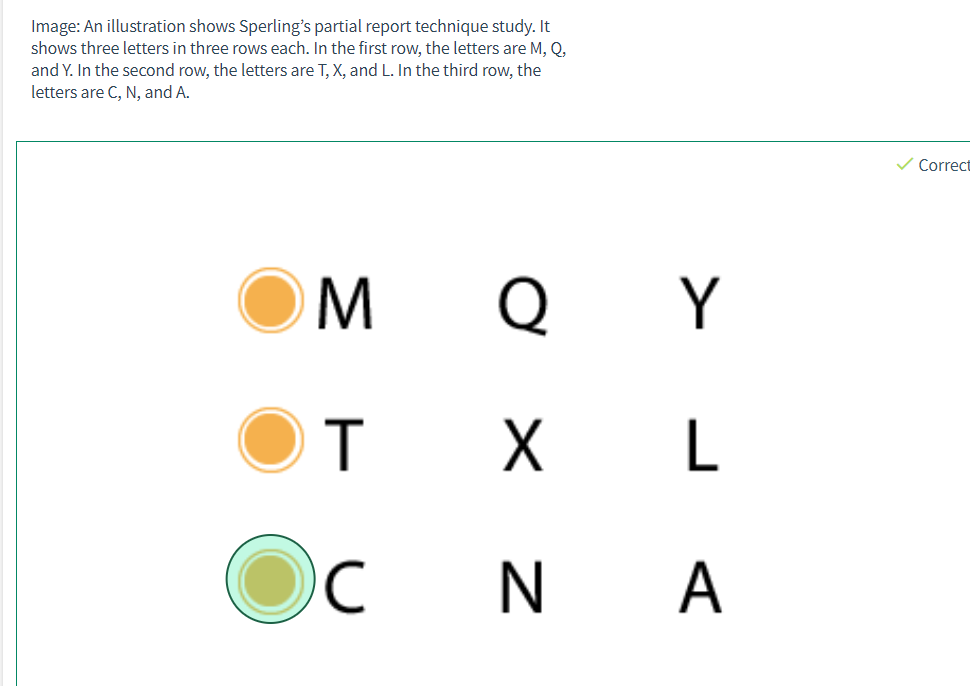
Long-term Memory: Systems we use to store and recall information over lengthy long periods of time. Is said to be practically limitless in its storage capacity.
Episodic Memories: (episodes) Contents of specific events. Ex: last birthday party.
Semantic Memories: (facts) Relate to specific facts and pieces of meaningful information not based on personal experience.
Ex: Knowing that your dog Sophie is a dog is semantic, remembering playing with that dog is episodic.
Procedural Memory: (Process) How a task is completed. Ex: how to ride a bike.
TRANSFER TO LONG-TERM MEMORY
Elaborative Rehearsal: The process of actively manipulating information in immediate memory to meaningfully connect it to other information already stored in long-term memory.
Deep Processing: Encoding new information through making meaningful connections to existing knowledge.
Shallow Processing: Encoding information based only on its surface characteristics
Imagine trying to learn the following list of words: COMPUTER, PENCIL, TEA, NOTEBOOK, KEYBOARD, TEXTBOOK, BARISTA.
Elaboration can contribute to meaningfully encoding list for better recall
Types of elaboration:
Imagery
Organization
Distinctiveness
Self-Reference
Organization and Distinctiveness are 2 elaborations recommended by psychologist to use in combination with one another
ENCODING STRATEGIES
Massed Practice: (cramming) Repeated exposure to information to be remembered over a very short period of time or without gaps between repetitions.
Ex: practising for the exam a day before it and understanding every concept then.
Spacing Effect: Learning is most robust when repeated exposure to information to be remembered occurs over a long timeframe. Helps with all semantic, episodic and procedural memory.
Mnemonic: Techniques used to improve memory that provide a framework for encoding and recall. Ex: BEDMASS
Adaptive Memory: In an evolutionary standpoint. Research focussed on investigating how the brain is designed to learn and remember given evolutionary considerations. Adaptive memory strategies are ways to remember information that matches up with the way our brains are designed to remember information.
Ex: Living things are more memorable than non living inanimate things.
Retrieval Practice: (testing effect) Repeated retrieval of information is more useful for long-term memory than other tasks, such as repeated reading of the same information.
Retrieval Problem: The problem the brain must solve to recover information from long-term memory.
CENTRALITY OF CUES
Cues: Pieces of information in the present that helps us remember events from the past.
They can be specific or broad.
Ex: The song that reminds you of your time with your girlfriend
Free Recall: Remembering previously-learned information without any other context to aid in remembering.
Cued Recall: Remembering previously-learned information with the aid of a clue or information that helps provide context.
Encoding Specificity Principle: (encoding retrieval match) The idea that retrieval cues are only useful as long as they match the original context of how information to be remembered was originally learned. Cues are designed to help as hints similar to the objective you are trying to remember.
(being in the place I lost my phone to help remember where it was)
Transfer-Appropriate Processing: The observation that engaging in similar processes at both encoding and retrieval tends to enhance recall on a final test.
Ex: Study Mc questions so it's best to come up with mc questions yourself and study by highlighting differences in terms.
Explicit Memory: Remembering what occurs consciously with intent. Intentionally trying to recall information.
Implicit memory: Remember what occurs without conscious realization or intent.
Implicit memory performance is assessed by determining whether a person's actions or responses are influenced by previous experience, without specifically asking the person to recall the experience.
Ex: SHowing half of the word “GRE” and seeing if they complete the word “GREEN”
MEMORY ERRORS
Schacter calls “Seven sins of memory”
2 types of errors:
- Error of omission
- Error of commission
Error of omission: Memory errors where information cannot be brought to mind
Error of commission: Wrong or unwanted information is brought to mind.
3 Errors of omission
- Transience
- Absent-mindedness
- Blocking
Transience: How the memory for any particular event or piece of information tends to degrade over time, “forgetting”.
Decay: The theory that memories fade away due to passage of time alone.
WHAT LEADS TO TRANSIENCE (forgetting)
Retroactive Interference: Newly learned information makes it more difficult to recall older information.
New memories affect old ones
Proactive Interference: Old information is interfering and making it difficult to retrieve newer information.
Old memories affect new ones
Absent-mindedness: Information is not encoded to begin with. Memories are unavailable because of a failure to encode them.
Ex: Misplacing your keys
Blocking: Cues we have available are enough to help us remember a piece of information. In some cases, not enough distinctive cues are available to help us recover a specific memory.
Tip-Of-The-Tongue State (TOT): Cannot remember a piece of information, but have a powerful feeling they know what they are trying to remember. They can’t find the cues to remember it.
ERRORS OF COMMISION
- Misattribution
- Suggestibility
- Bias
- Persistence
Misattribution: We incorrectly recall the source of information we are trying to remember
Deja Vu: “Already seen”. Feeling that one has already experienced a sequence of events.
Flashbulb memories: Memories for the details surrounding events that are both surprising and particularly significant.
Examples of flashbulb memories throughout American history include events like the assassination of President John F. Kennedy
Suggestibility: Requires information that is misremembered to have been suggested by an outside source. Memories can be altered by context in which they are remembered to better fit a current scenario.
Misinformation Effect: Where misleading information alters subsequent memory. An eyewitnessing account typically.
Elizabeth Loftus implies that many “repressed memories” in therapy are the result of the therapist unintentionally guiding clients to imagine events that had never occurred.
Recalled information is also affected by what information we already have available to us.
Bias: Memories can change as a result of the influence of our knowledge and beliefs. Common biases in remembering are caused by what are called memory schemas.
Schema: A highly organized knowledge structure that contains many pieces of information. Highly organized sets of facts and knowledge about specific kinds of information. They help put information into context, however they often lead to over-generalization.
Persistence: Description of how memories are sometimes retrieved when they are not wanted. Ex: PTSD and traumatic thought’s continuously coming into your mind.
Hyperthymesia: Exceptionally rare medical condition that leads to near perfect autobiographical recall. Hyperthymesia heavily involves parts of the brain that process emotional information -- the amygdala does this, and connects with the hippocampus excessively to lead to the overly emotional encoding of memories.
Ex: Remembering every time her mom called her overweight as if it just happened moments ago.
Amnesia: Memory loss due to physical damage or problems in the brain.
Come in 2 primary forms:
- Retrograde
- Anterograde
Retrograde Amnesia: The loss of memories before a specific traumatic event. Ex: Before the blow to the head
Anterograde Amnesia: Inability to encode new information into long-term memory. Inability to make new memories. Only comes from brain damage to the hippocampus.
Henry Molaison (H.M) removes his hippocampus because he suffered from severe seizures. This resulted in him having both retrograde amnesia and anterograde amnesia.
Alcoholism can lead to anterograde amnesia
CHAPTER 9: LANGUAGE AND THOUGHT
What is Language?
Language: Grouping of spoken, written, or gestured symbols used to convey information.
We use language to convey our inner world to others, expand on our experiences, argue, and sometimes even influence others through persuasion.
Important role of language = Social communication
Productivity: The creation of new messages. Humans can connect unrelated information to form new ideas or messages.
Children haven't yet learned how to use language to help them find missing objects, which is further explained in the next section. Children, like rats, will use the shape of the room and their memory instead of language to find the missing toy.
Children at this age have not yet developed the language and associative skills required to do this task easily and are therefore less capable of naturally creating representations or fully linking one thing (blue wall) to another (reward corner).
Koshik’s language Koshik learned korean words He mimicked language sounds to socialise with his trainers by using his trunk to manipulate his mouth.
Humans undergo rapid development of language abilities early in life.
Koshik used language to mimic sounds that he overheard, however
Humans Use Language: To not only share ideas but also improve on the ones we share. They influence decision-making and problem-solving skills.
Characteristics of Human Language
- Productivity
- Imitation of gestures or words sounds
- Use of symbol or representation
- Naming objects
- Social communication
At Birth children undergo rapid = LANGUAGE ACQUISITION
Early around 3-4 month old children
WHat birthed children are exposed to dictate what they’re tuned to later in life. Children exposed to tonal languages become skilled at detecting pitch differences and are substantially more likely to exhibit perfect pitch compared to those exposed to intonation languages.
ARound 3-4 month children: Show the ability to connect speech sounds with objects.
Tonal Language: Primarily rely on specifying word meaning.
Grammar: The general rules of language. Systematic rules for language like words, tenses and syntax (structure and consistent ordering of words)
Syntax: Structure and order of words within a language.
Birth - 3 months: Baby sounds that do not mimic the morphemes in any language before 3 months of age.
- Orienting to sounds in environment
- Making cooing and gurgling
- Crying
4-6 Months:
- Crying expressively
- Responding to name
- Early vowel and consonant sounds
- Mimicking sounds
7-18 months: Learn what they are not supposed to do from their caregivers.
- Copy hand gestures
- Gesture meaningfully by pointing
- Responding to simple commands and understanding no
- Mimic words and not just sounds
- Can use simple one word phrases
- 50 words, 6 per day
- Less sensitive to non-native vowel and consonant sounds
2-3 Years: can comprehend prepositions if a caregiver explains that a bear is hiding under the table.
- Match objects to names
- 2-4 word sentences to communicate
- Follow multi-step instruction and prepositions (the ball is inside the box)
4-5 Years: can remember and perform simple songs.
- Begins using grammar
- Memorise and recite simple songs
- Speech becomes more clear
- Uses full sentences
- Draw pictures and elaborate on meaning behind image
10+ Years
- Now speak language easily store 50 - 100,000 words
B.F SKinner - Argued that environmental influences strongly dictate language development
Chomsky - Urged that biological constraints on development.
Verbal Behaviour: Ideas from operant conditioning are applied to language to focus on language as a form of behaviour. Language is formed from a series of reinforcements. children begin to gesture or utter phrases and repeat those phrases if reinforced
External changes modulate speaking behaviour and may improve ability.
- Speech defined as Verbal behaviour (skinner) - ideas from operant conditioning (reinforcing behaviour) are applied to language to focus on language as a form of behaviour. Posits that language is form form a series of reinforcement
- Applied to acquisitions of children's language, arguing that children begin to gesture or utter phrases and repeat them if reinforced
- Verbal behaviour strengthened or weakened depending on consequences of environment
- EXAMPLE: baby points at bottle for them to bring it and encourages her to communicate again when she is hungry
- Scolded if swearing so no more
- Pitch conveys emotion
- Happy tone and high pitch = rewarding, low pitch low tone = scolding
- Speak fast with speech deficient kids they struggle, speak slow easier for them to learn
- Environment with praise and encouragement, kids reach language milestones faster than those who do not respond to them.
Nativism: Biological, predetermined nature of language. THe belief that certain abilities are built into our brains.
Language Acquisition Device (LAD): Hypothetical mechanism in the brain responsible for the faculty of language.
Our brains are “ready” to acquire language at birth.
Critical Period: Babies undergo a relatively slow period of acquisition until the age of 7–12 months, but then shift and absorb words at a lightning pace until around age 5. Stage when it is necessary for children to receive environmental stimulation in order for healthy development.
After puberty, if an individual has not learned a second language, they will struggle to learn another later.
Sensitive Period: What the critical period is often referred to as. The neurological system is more malleable during early development, but is still modifiable later in life with the proper environmental stimulation.
Subject-Object-Verb (SOV): ex: boy - water - dumps. Typical order.
All language follow 2 main pattern, SOV and SVO
Typically, the critical period is referred to as the sensitive period. However, in the case of Genie, we revert back to referring to the critical period because the lack of communication in her early life seems to have directly resulted in her lifelong language deficit.
SKINNER IS A BEHAVIOURIST. Operant conditioning of language
Emergentist Perspective: The emergentist perspective is that language is a uniquely human attribute but that our exposure to a specific language helps us learn that language but may interfere with easily learning the phonemes of other languages.
LANGUAGE PROCESSING AREAS
Broca’s Area: Frontal lobe region to contribute to speech production
Wernicke’s Area: Temporal Lobe region to contribute to speech comprehension. (language comprehension)
Aphasia: The inability, difficulty to produce speech.
Ex: Tan was kicked by a horse and discovered damage to lower frontal lobe affecting the now Broca area.
Broca’s Aphasia (non-fluent Aphasia): Difficulty with the motor production of language
Broca’s 2 Important findings:
(1) There may be a module in the brain controlling speech
(2) language production is predominantly controlled by the left hemisphere
Hemispheric Lateralization: Functions like language are more dominantly controlled by one hemisphere of the brain compared to the other.
Left-Hemisphere = Language oriented
Wernicke’s Aphasia (fluent aphasia): Patient has ability for physical production of speech, but communication lacks meaning.
Prosody: Speech patterns or melody of speech.
After our minds know what to expect, it is easier to comprehend these messages.
Wernicke’s area and other temporal lobe regions actively differentiate the initial vocal sounds, provide context, and distinguish it from nonsensical sound bites
“Backmasked Music”: playing songs that appear to have violent messages when played backwards. The listeners are capable of hearing the message when provided the lyrics.
WERNICKE: SPEECH MEANING
BROCA: SPEECH PRODUCTION
Mental Lexicon: The storage of words and related concepts. Can fully recognize a word within 80 milliseconds.
Phonemes: Smallest sound unit of language. Sound a letter represents.
Morphemes: Smallest unit of language comprehension and meaning of words. Smallest portion of a word.
Phonemes: “Match” (“ma-ch”)
Morphemes: segments of a word “incoming” (“in-come-ing”)
Semantic: The meaning of a word. Allows us to put a word in context. Retrieve relevant responses, and detect errors in usage.
Primary storage of conceptual knowledge is stored in our left temporal lobe.
Prototype: Most common, typical form a word assumes when we imagine it. Ex: “bird” what comes to mind is pigeon.
Mental Lexicons: organizations of similar words like red, yellow, blue, and green versus university, school, college, year versus birds, bats, and bugs.
Sapir-Whorf Hypothesis: (linguistic relativity) Theory which says the structural difference in language can alter one’s perception and understanding of reality.
Linguistic Relativity: Language we use influences how we understand the world around us. (different shades of colours)
PROBLEM SOLVING
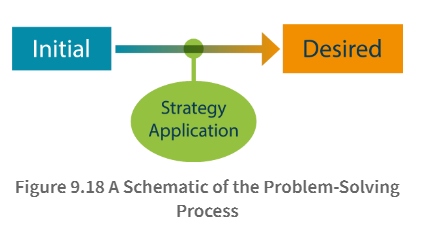
Process involving initial motivational state and desired end-goal state.
Mental State: A person’s expectation of how to solve a problem. Expectation of how to solve a problem was influenced by their prior interaction and created a set effect or fixation, limiting their application of new solutions.
It narrows focus and decreases ability to select and try new strategies.
Functional Fixedness: Limiting us from using objects for purposes outside of their normal use. Tendency to view an object as only having one function. Neglecting to see other possible uses.
STRATEGIES
Algorithms: Precise set of rules applied in order to solve a problem.
Trial-And-Error: Trying multiple attempts.
Heuristics: Used to help create shortcuts to lengthy judgement and decision-making processes. Short-cut rule applied to solve problems. They help to work to provide quick and efficient solutions.
Means-End Heuristic: (means-end analysis) Problem solving strategy where the problem solver envision the desired goal-state and take whatever measures necessary to attain that goal.
Heuristics For Artificial Intelligence: used a new, fluid storage of memory that more closely mimicked humans’.
Representative Heuristic: Problem-solving strategy involving the problem solver mentally comparing something to our stored prototype of an event,object, person. This involves us mentally comparing something to our stored prototype of an event, object, or person, such as the depictions of typical engineers and lawyers
Availability Heuristic: Thinking about the most recent or salient events to base decisions on.
Confirmation Bias: Tendency to pay attention to information consistent with one’s existing beliefs and ignore or discard information inconsistent with their beliefs. We have a high tendency to seek out information that already confirms our ideas or beliefs.
THE DUAL PROCESS OF DECISION MAKING
SYstem 1 Thinking: Making decisions based on a quick, automatic system. Rely on emotional systems stored experiences to guide thinking. Intuitive
System 2 Thinking: Relies on logical, rational thinking. Rational