12.1 & 12.2
Origins of the Presidency:
- under the AOC there was no executive branch, although they did use the term ‘president’ to designate the presiding officer of the confederation congress
- Presidency proposed by Virginia’s Edmund Randolph
- New Jersey’s William Paterson proposed: executive branch made up of a committee elected by a unicameral Congress for a single term, under this proposal the committee could be removed at any point if a majority of state governors agreed
- Hamilton suggested executive power to be given to one single person chosen by electors, would serve for live, and would exercise broad powers like the ability to veto, power to negotiate treaties, and grant parties, and act ac commander in chief
- James Wilson proposed a system of electors after his first proposal of a direct election was denied
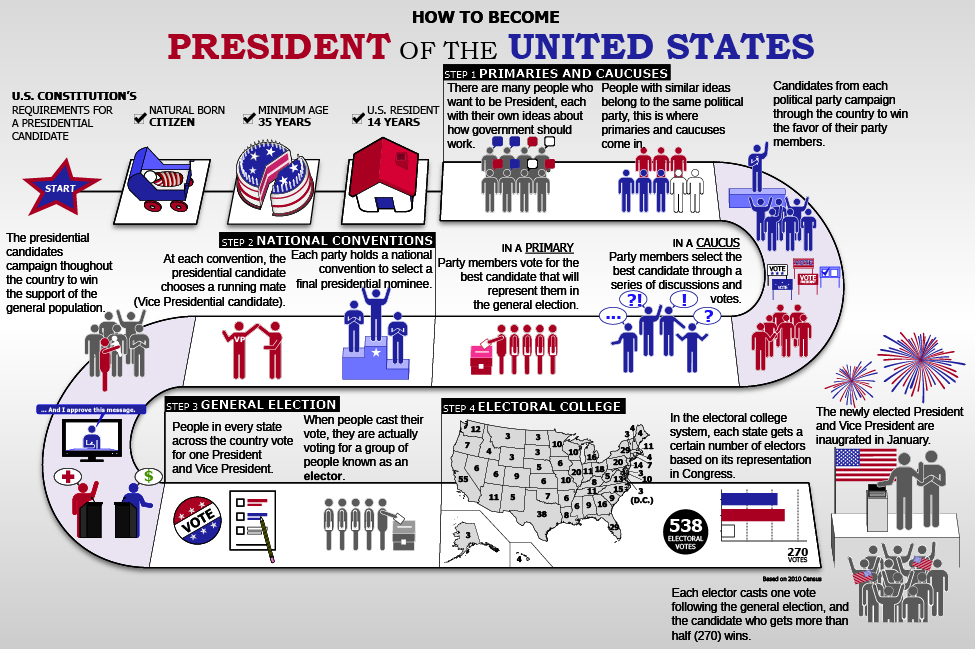
- today the electoral college consists of a body of 538 electors, each representing one of the fifty states or the District of Columbia
- in 48 states & the district of Columbia the candidate who wins the popular vote in Nov gets all the states electoral votes, however in Nebraska and Maine the electoral votes are divided, the candidate who wins the popular vote gets 2 electoral votes and the winner of each congressional district also receives an electoral vote
- OG design for the first 4 presidential elections: electors cast 2 ballots (but only one could go to a candidate from the elector’s state, and the person who received a majority won the election. The runner up became vice president. If no candidate received a majority of the votes cast, the House would select the president with each state casting a single vote, while the senate chose the vice president
- While George Washington was elected president twice with this approach, the design resulted in controversy in both the 1796 and 1800 elections. In 1796, John Adams won the presidency, while his opponent and political rival Thomas Jefferson was elected vice president. In 1800, Thomas Jefferson and his running mate Aaron Burr finished tied in the Electoral College. Jefferson was elected president in the House of Representatives on the thirty-sixth ballot. These controversies led to the proposal and ratification of the Twelfth Amendment, which couples a particular presidential candidate with that candidate’s running mate in a unified ticket.
- Article II of the Constitution says: the president must be at least 35 and a natural born citizen of the US who has been an inhabitant of the US for at least 14 years, the 22nd amendment says the president can serve 2 terms only
- Impeachment requires the house to impeach the president by a simple majority vote, then the Senate could remove the president from office by a 2/3s majority, with the chief justice presiding over the trial, upon conviction & removal the vice president would take over
- 4 presidents have faced impeachment, none has been both impeached & removed
- Andrew Johnson: congressional contempt for decisions made during reconstruction
- Nixon: faced an overwhelming chance of impeachment for his cover up of key info relating to the 1972 break-in at the Democratic Party’s campaign HQ a the Watergate hotel, also was likely to be removed by the Senate as there was bipartisan support, instead he resigned
- Clinton: lying about extramarital affair with White House intern Monica Lewinsky, Clinton’s trial in the Senate went nowhere
- Trump: impeached twice, one for Ukraine and a “abuse of power” & “obstruction of congress”, second for incitement of insurrection
- Constitutional powers president has:
- pardon those convicted of federal offenses
- commander in chief
- negotiate treaties with advice and consent of the Senate
- receive reps of foreign nations
- Call Congress into session when needed
- Veto
- Nominating federal judges
- Nominate officials to their Executive office of president
- Washington established a cabinet, today the 15 executive department heads serve as the presidents advisers
- Jackson used Veto’s due to political disagreements, but they were originally intended to be used to protect against encroachments by Congress on the presidents powers