Module 1
Foundations of Propositional Logic
Definition of a Proposition:
A sentence that is true or false, but not both, is a proposition.
True proposition example: "Oregon is a state in the United States of America."
False proposition example: "."
Non-propositions include questions and commands.
Self-referential paradoxes are not propositions. For example, in the sentence "This statement is false.", it is logically impossible for the sentence to be true, and it is impossible for it to be false. Therefore, it is not a proposition.
Labels: Conventional notation uses lower-case letters like to denote propositions (for example, may denote "").
Compound Propositions and Logical Operators:
Propositions may be combined or manipulated using logical operations to produce a compound proposition.
Let and be propositions.
Negation: Creates a proposition that is true when is false, and false when is true.
Notation: denotes "not ".
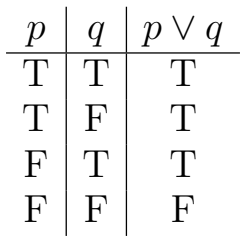
Disjunction: A compound proposition that is false when both and are false, and true otherwise.
Notation: denotes " or ".
Conjunction: A compound proposition that is true when both and are true, and false otherwise.
Notation: denotes " and ".
Truth Tables:
Truth tables display the truth value of a compound proposition based upon all possible combinations of truth values of its component propositions.
In a truth table, denotes true and denotes false. Using binary symbols (for true) and (for false) is also common.
Truth table for :
,
,
,
,
Order of Operations:
is performed before and .
By default order of operations, evaluates as .
To apply negation to the disjunction , grouping parentheses must be used: .
The precedence between and is always determined explicitly by parentheses.
Conditional and Biconditional Statements
Conditional Statements (Implications):
The sentence "If then " conveys that if is true, must be true for the sentence as a whole to be true.
Definition: "If then " is defined to be false if is true while is false, and true otherwise.
Terminology:
Called the conditional of by or the implication of by .
is the hypothesis or antecedent.
is the conclusion or consequent.
Notation: or .
Truth table for :
,
,
,
,
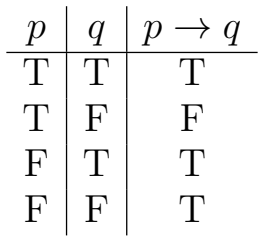
Vacuous Truth: When is true because the hypothesis is false (the final two rows of the truth table), it is described as vacuously true or true by default.
Precedence: The conditional operator resides on the same level in the order of operations as and .
Linguistic Formulations of :
" if "
" whenever "
" only if "
" implies "
Example: "It is raining only if there are clouds in the sky" conveys the exact same conditional as "If it is raining then there are clouds in the sky."
Caution: "If there are clouds in the sky then it is raining" is not the same conditional statement.
Related Conditionals to :
Converse:
Inverse:
Contrapositive:
Weather Example:
Original statement: "If it is raining then there are clouds in the sky."
Converse: "If there are clouds in the sky then it is raining."
Contrapositive: "If there are no clouds in the sky then it is not raining."
Store Purchase Example:
Original statement: "If Jack bought beer then Jack went to the store."
Hypothesis (): Jack bought beer.
Conclusion (): Jack went to the store.
Original form:
Converse (): "If Jack went to the store then Jack bought beer."
Inverse (): "If Jack didn't buy beer then Jack didn't go to the store."
Contrapositive (): "If Jack didn't go to the store then Jack didn't buy beer."
Necessary and Sufficient Conditions:
Necessary condition: A necessary condition of is a condition that must be satisfied given is true. The conclusion of a true conditional statement is a necessary condition of the hypothesis.
Sufficient condition: A sufficient condition for is a condition that suffices to guarantee is true. The hypothesis of a true conditional statement is a sufficient condition for the conclusion.
Mathematical example: Consider the true proposition: "If is a non-zero whole number, then is a positive whole number."
" is a positive whole number" is a necessary condition of " is a non-zero whole number".
" is a non-zero whole number" is a sufficient condition for " is a positive whole number".
Demonstration of non-necessity: " is a non-zero whole number" is not a necessary condition of " is a positive whole number". If , then (which is a positive whole number), even though is not a non-zero whole number.
Biconditional Propositions:
The sentence " if and only if " is a biconditional proposition defined by .
Common abbreviation: " iff ".
Notation: .
Logical Equivalences, Tautologies, and Contradictions
Logical Equivalence:
Definition: Two compound propositions and , made up of propositions , are logically equivalent if and have the same truth values for all possible combinations of truth values for propositions .
Notation: .
Immediate equivalences:
Double negation:
Commutativity of disjunction:
Commutativity of conjunction:
Equivalence of the contrapositive:
De Morgan's Laws:
Disjunctive Equivalence and Negation of an Implication:
Disjunctive equivalence of the implication:
The only case when is false is when is true and is false (which occurs when is false and is false).
This corresponds to the disjunction: .
Negation of an implication:
Application to negating statements with necessary conditions:
Statement: "A necessary condition of Serena buying the car she wants is that Serena passes the credit check for the car loan."
Standard conditional form (necessary condition placed in the conclusion): "If Serena buys the car she wants then Serena passes the credit check for the car loan."
Symbolic setup: Let denote "Serena buys the car she wants" and denote "Serena passes the credit check for the car loan". The statement is .
Negation calculation: .
Negated statement in words: "Serena buys the car she wants and Serena doesn't pass the credit check for the car loan."
Tautologies and Contradictions:
Tautology: A compound proposition that is always true regardless of what the truth values of its component propositions are.
Example:
Contradiction: A compound proposition that is always false regardless of what the truth values of its component propositions are.
Example:
Quantified Logic
Propositional Functions (Predicates):
A sentence that contains a finite number of variables that becomes a proposition when specific values are substituted for the variables.
Domain: The set of all values that may be substituted for a given variable in a propositional function.
Numerical example:
Let be "" where the domain for both and is the set of whole numbers .
is "", which is false.
is "", which is true.
Natural language example:
Let be " is a former president of the USA" where the domain is the set of humans.
is "Barack Obama is a former president of the USA", which is true.
is "Tom Cruise is a former president of the USA", which is false.
Universally Quantified Statements:
Definition: The statement "for all , " is a universally quantified statement defined as a proposition that is true if and only if is true for every in the domain .
Notation: or (when is implicitly understood).
The symbol is read "for all" or "for every".
Truth conditions:
True: Must show is true for any arbitrary choice of from .
False: Must produce at least one counterexample, a choice of for which is false.
Evaluations over the set of real numbers ():
Problem 1: Determine and justify .
Status: True.
Justification: Let (an arbitrary real number). Then . By adding one to both sides, . Thus . Because this holds for an arbitrary real number, the proposition is true.
Problem 2: Determine and justify .
Status: False.
Justification: Let . Then . Adding one to both sides gives . Taking the reciprocal of both sides gives . This counterexample ( is false) proves the proposition is false.
Existentially Quantified Statements:
Definition: The statement "there exists such that " is an existentially quantified statement defined as a proposition that is true if and only if is true for at least one in the domain .
Notation: or (when is implicitly understood).
The symbol means "there exists" or "for some".
Truth conditions:
True: Must show is true for a particular witness from .
False: Must show is false for every choice of in .
Evaluations over real intervals:
Problem 1: Determine and justify .
Status: True.
Justification: Let . Then . Choosing proves the proposition.
Problem 2: Determine and justify .
Status: True.
Justification: Let . The hypothesis () is false. Because the hypothesis of the implication is false, the implication is true by default (vacuously true).
Problem 3: Determine and justify .
Status: False.
Justification: Let , so . Then . In particular, . Therefore, , which is equivalent to . Because holds for all , the statement is false for every element in the domain.
De Morgan's Laws for Quantified Logic:
Negation of universal quantifier:
Negation of existential quantifier:
Example: Consider the statement "All mammals cannot fly."
Symbolic setup: Let be the statement "mammal cannot fly". The statement is .
Negation: .
Interpretation: "There exists a mammal such that the mammal can fly." In common language, "Some mammals fly."
Linguistic Parsing of Negated Statements:
Statements parsed as (which is equivalent to ):
"Not all satisfy ."
"Not each satisfies ."
"Not every satisfies ."
Statements parsed as (which is equivalent to ):
"Not any satisfies ."
"No satisfies ."
Nested Quantifiers and Advanced Applications
Nested Quantifier Structure and Operator Order:
Multiple quantifiers can be nested within a single quantified proposition.
Example: "For every positive real number there exists a positive real number such that ."
Symbolic form:
This true proposition expresses that all positive real numbers possess reciprocals.
Impact of quantifier order:
Reversing the quantifiers produces:
Truth value: False.
Reason: In , the variable may depend directly on . In , the variable must be chosen independently of . There exists no single positive real number that yields when multiplied by any arbitrary positive real number .
Rule: Switching the order of quantifiers usually alters the meaning of the statement, even when the truth value does not change.
Evaluations of Nested Propositions over :
Statement:
Status: True.
Justification: Let . Choose , which is also a real number. Then since .
Order reversal: is false (no single real number is strictly greater than every real number).
Statement:
Status: False.
Justification: Let be any real number. Pick . Then . Because , this shows that for all , the negation of is true via the counterexample .
Order reversal: is also false (for example, selecting requires , which has no solution in ).
Step-by-Step Negation of Nested Quantifiers:
De Morgan's Laws can be applied sequentially inward through nested quantifiers:
Formal Calculus Limit Definition and Negation:
Definition: Let be a function from the real numbers to the real numbers, and let be fixed real numbers. Then is defined as: "For every , there exists such that for all , ."
Symbolic setup using propositional functions:
Full symbolic expression:
Step-by-step derivation of the negation:
Negate the outer quantifiers:
Substitute the disjunctive equivalence of implication ():
Apply De Morgan's Law to the negation of the disjunction:
Verbal translation of the negated limit statement: "There exists such that for all , there exists such that and ."
Analytical meaning: When this negated condition holds, the limit of as is not .