FW 404: Wild Turkey Management, 11/6
Wild Turkeys in North Carolina
Restoration
Current Status
Biology and Habitat Use
Habitat Management
Some other turkey stuff
Restoration
The wild turkey restoration program has been one of the most monumental and successful wildlife management programs in the history of the Commission
1970
Statewide population estimated to be 2k turkeys
R. Wayne Bailet hired as the WRC’s full-time Wild Turkey project leader
Restoration
fall hunting seasons closed and shifted to more conservative spring hunting
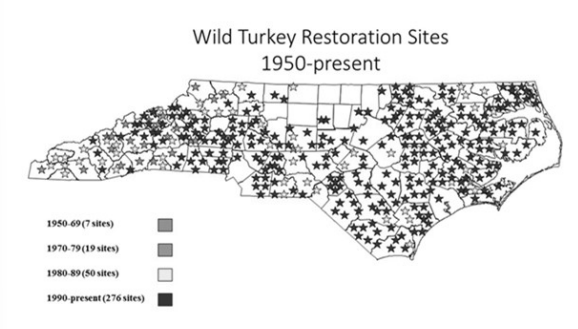
trapped and relocated 6031 wild turkeys to 358 restoration sites
Current Status
What areas and habitats support the highest numbers of turkeys?
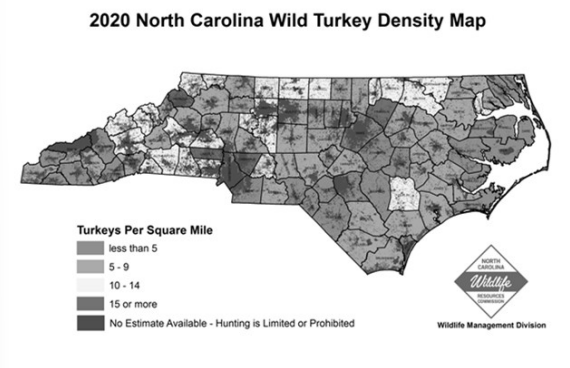
Sandy Mush Game Land—2795 acres
reported harvest in 2020 was 36 turkeys (8.2 turkeys/square mile)
reported harvest in 2021 was 11 turkeys (2.5 turkeys/square mile)
Biology and Habitat Use
What are the limiting factors and how do we improve them?
The Omnivorous Turkey
90% plant material
mast, fruits, seeds, green, and ag crops
acorns make up 1/3 of diet
soft-mast producing shrubs like wild grape, dogwood, black gum, black cherry, hackberry, are also important especially when hard mast crops fail
grasses and seeds are important winter and spring foods
10% animal matter
insects comprise the majority of the summer diet for young turkey poults
Poult Foods
Insects are critical for poult growth and development
beetles
true bugs
grasshoppers
leafhoppers
Diversity is Key
A mixture of forested and open land provides the best turkey habitat
diversity in structure, age (uneven) and vegetation
diversity in uses
foraging, nesting, breeding, cover, roosting, bugging, etc
think landscape
Nesting Habitat
Turkeys prefer mature woodlands comprised of a mixture of tree species with open understories growing with herbaceous (nonwoody) plants
Turkeys usually select areas with dense brush, tall grass, fallen tree-tops (recent clearcuts) for nesting
Brood Habitat
Forested areas with moderate herbaceous understories, forest clearings, forest savannahs, power line right of ways, old home sites, and spring seeps
These areas usually have an abundance of insects
The moderate vegetation allows the young poults to move freely
Brood range can be created in forested stands by thinning to a basal area of 40-60 ft/acre and control burning the thinned stand
Forested Lands
Timber lands should be managed to optimize hard and soft mast production and to provide a dispersed system of permanent forest openings
create a mosaic
longer timber rotations
Hardwood Stands
Roughly 60% of the trees on your property should be in mast producing age (50+ years)
protect soft mast producing shrubs, vines, and forbs
mixture of hard mast producing species
Pine Stands
Promote herbaceous understory vegetation
Increase sunlight to forest floor
Thin heavy and often
Prescribed fire
rotation 3-5 years
Wider tree plantings
Open Land
should comprise 10-50% of the area
size and distribution is important, well dispersed smaller openings is best
turkeys typically do not use the center of clearings larger than 20 acres
management should not be conducted during the nesting season (May to June)
Predators
Predators that have been known to prey on turkeys include:
Bobcat, coyote, red fox gray fox, opossum, raccoon, skunk, rodents, hawks, owls, eagles, crows, ravens, snakes, dogs, and many others.
Survival—Adults
For an upland gamebird, survival rates for adult turkeys are quite high
higher in late summer, fall, winter
naturally lower during reproduction in spring and early summer
Survival—Poults
Poults not able to fly during first two weeks of life—high mortality
once they can roost in trees, survival rates improve, but still low
Habitat Management
What tools do we have for improving habitat, and when, where, and why should we use them?
Fields
Umbrella effect:
overhead cover
horizontal cover
movement
Disking
exposing bare soil
forbs and cover
timing is key
Fire
control woody plants like trees
promote forbs and native grasses
timing and frequency vary depending on site
selective use to improve plant composition
frequency varies, but generally 3-5 years
very little direct impact to nesting
Forest Management
ground cover
hard mast
soft mast
basal area
commercial vs non commercial harvest
Some other turkey stuff that wildlife students should know
NCWRC’s Goal for Wild Turkey Management
The goal for wild turkey management in NC is to emphasize spring gobbler hunting by managing the population below MSY in order to:
maintain high quantity spring hunting and
maximize continued increases in population size and distribution
Multi-Scale Assessment of Wild Turkey Ecology in NC
4 year project (2020-2023)
Three study areas (1 study area/region)
Capture and radio telemetry of 480 wild turkeys
TOPHAT
Which of the following is a true statement about wild turkey?
A
hens typically lead their broods to roadsides, field borders, and fallow fields
B
urban development is not a real threat to sustaining wild turkey populations
C
prescribed fire generally is not used to manage turkey habitat
D
all answers are correct
E
no answers are correct