Period 9: 1980-Present
 9.2 Reagan and Conservatism
Ronald Reagan and the Election of 1980
Attacked Democrats for expanding gov’t and undermining U.S. prestige abroad
Nearly 91% of the electoral vote
Republicans gained more seats in the House + had a majority in the Senate
The Reagan Revolution
Survived assassination attempt with humor and charm → more popular
Aimed to: lower taxes, reduce gov’t spending on welfare, & build up US armed forces
Reaganomics
Supply-side economics: tax cuts + government spending → increase investment, which would increase production, jobs, and prosperity
Contrasted Keynesian economics + critics referred to it as “trickle-down economics”
Economic Recovery Act of 1981: 25% decrease in personal income tax over 3 years
Conservative S. Democrats + Republicans cut more than $40 billion from domestic programs
Increased military spending + no cuts in Medicare & Social Security
Reduced federal regulation on business + industry
e.g.) Reduced regulations on auto emissions + safety
Tough stand against unions; decertified PATCO
Many businesses hired striker replacements → decline in union membership
1982 recession reduced inflation & the economy rebounded by 1983
Widened income gap b/t rich and poor
Social issues
Appointed conservative justices to Supreme Court
Scaled back affirmative action + limited Roe v. Wade
Budget and Trade Deficits
Tax cuts + increased military spending → larger federal deficits & national debt nearly tripled
Tax cuts seemed to increase consumption & the U.S. became a debtor nation in 1985
Congress passed several bills to increase taxes, which reduced deficit
Impact of President Reagan
Reduced economic restrictions, placed more money into the hands of investors, & reduced growth of New Deal/Great Society welfare state
Reaganomics made people focus on what gov’t programs to cut and by how much
President George H.W. Bush
Won 1988 election, but Democratic majorities in the House + Senate
$133 billion in new taxes (e.g. top income tax rate increased)
1990 recession & prosperity under Reagan began to end as unemployment increased
Americans with Disabilities Act: prohibited discrimination against citizens with mental and physical disabilities
Budget issues + declining gov’t trust → difficult to carry on Reagan’s cut on federal programs
Political Polarization
Overall growing partisan divide
Democrats typically controlled the House + Senate from WW2-1980s
Southern conservatives → Republicans gave the edge to Republicans (esp. in electoral college)
District of Columbia v. Heller: 2nd amendment provides an individual the right to possess a firearm unconnected with service in a militia
More women in the labor force → lack pay equity + face gender discrimination (led to #MeToo movement)
Emergence of Black Lives Matter movement in 2013 to reform police training + arrest procedures
Clinton implemented “Don’t Ask, Don’t Tell” to end LGBTQ+ discrimination in the military
2015: Gay marriage became legal
9.3 The End of the Cold War
Foreign Policy During the Reagan Years
Began his presidency with building up the military → more flexible foreign policy by his 2nd term
Renewing the Cold War
Strategic Defense Initiative: high-tech system of lasers + particle beams to destroy enemy missiles before reaching U.S. territory — “Star Wars”
Reagan supported “friendly” right-wing dictators to keep out communism
Supported Nicaragua against a Marxist regime & provided financial aid to El Salvador
Settled a coup for a pro-Cuban regime in Grenada — reestablished a pro-U.S. gov’t
Iran-Contra Affair: Reagan sold antitank & antiaircraft missiles to Iran to free Americans held hostage in Iran
Lebanon, Israel, and the PLO
Israel invaded S. Lebanon to stop PLO fighters from raiding Israel
U.S. sent peacekeeping troops
Arab squad bombed U.S. embassy in Beirut & drove a bomb-filled truck into U.S. Marines barracks
Improved U.S.-Soviet Relations
Gorbachev changed USSR’s communist political + economic system (2 major reforms)
Wanted to end arms race; Reagan challenged him “tear down this wall”
3 summit meetings b/t US and USSR: INF agreement (remove + destroy all intermediate-range missiles)
George H. W. Bush and the End of the Cold War
Persian Gulf War
Built a coalition of UN members to pressure Iraq’s dictator to withdraw from Kuwait
Desert Storm: 500k+ Americans & military units from other nations defeated the Iraqi army and ended the conflict
The Collapse of Soviet Communism and the Soviet Union
Students + workers protested for freedom in China’s Tiananmen Square → Chinese gov’t crushed the protest with tanks & killed hundreds
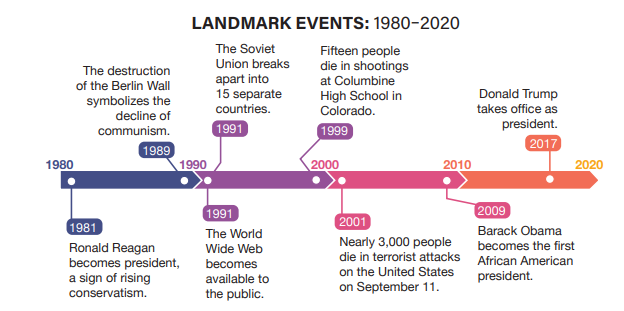
Communist party fell from power through E. Europe → Berlin Wall torn down in 1989
Germany was reunited
1991: USSR broke into 15 separate countries
Start I: reduce # of nuclear warheads for each side
Start II: reduce # of nuclear weapons for each side
Aftermath of the Cold War in Europe
EU was established w/ 15 countries in 2002 → grew to 27 in 2007
Putin strained relations w/ the US due to conflict with NATO
War in ex-Yugoslavia: dictator suppressed protest independence movements
Thousands were killed in an “ethnic cleansing”
9.4 A Changing Economy
Bill Clinton won 1992 election: focused on economic issues (jobs, education, and health care)
Clinton’s Focus on the Economy
Brady Bill: background checks + 5 day waiting period for the purchase of handguns
NRA: mobilized its supporters to overturn the bill & defeat politicians who supported it
Anti-Crime Bill: $30 billion for more police protection and crime-prevention programs
Banned the sale of most assault rifles
Reduced federal deficit: spending cuts and tax increases + strong economic growth
Congress + Clinton implemented legislation that cut taxes on estates and capital gains and gave tax credits for families with children and for higher education expenses
1999: impeached for lying under oath + abuse of power
Technology and a Changing Economy
Major tech (e.g. Internet, computers, etc) + medical innovations (e.g. DNA testing)
Low inflation + unemployment rates
Globalization: NAFTA (free-trade zone with Canada + Mexico), IMF + World Bank (supervised economic policies of poorer nations w/ debt)
G8: world’s largest industrial powers; controlled 2/3 of the world’s wealth
Income and Wealth
Concentration of wealth represents inequalities as the top 20% had the majority of America’s wealth
9.5 Migration and Immigration in the 1990s and 2000s
Changing Immigration Policies
Immigration and Nationality Act of 1965: gave preference to potential immigrants w/ relatives in the USA & with occupations deemed critical by the Department of Labor
High # of Hispanic + Asian immigrants
Immigration Reform and Control Act of 1986: fair entry process for immigrants, but failed to stop people in search of work from entering the USA without authorization
Illegal Immigration Reform and Immigrant Responsibility Act of 1996: strengthened U.S. immigration laws & limited immigration
DACA (2012): protected undocumented young people brought to the US as children; allowed them to continue education + apply for work permits
Influence of the American South and West
Sun Belt was booming: friendly business environment of small government, low taxes, weak labor unions, and low-wage economies
Gained more seats in the HOR + more electoral votes
Country + western music became more popular
Conservative attitudes toward gender issues, and opposition to regulations on gun ownership spread
Fastest-growing regions of the United States in the 1990s
American Society in 2000
Falling birth rate + increase in life expectancy → aging population
Growth of single parent families