Unit 10
Cell division When a cell divides, or splits in half, in order to create new cells
Reproduction when an organism creates new offspring
Organism
Unicellular:
when they reproduce, they perform cell division. The mother cell divides into two daughter cells
Multicellular:
Asexual; involves one parent, and produces clones with no genetic difference
Sexual: involves two parents, produces offspring with genetic differences
Performs cell division for
Repair
Growth
Maintenance
Budding: when a unicellular organism has a growth appearing in one side that develops into a new individual and falls off; exp: Hydra
Yeast
When conditions are favourable, yeast will reproduce by budding
When conditions are not favourable, yeast will produce sexually
Why? If they aren’t doing well and the condition is bad, they don’t want to clone themselves because they know their offspring will have the same bad condition. If they reproduce sexually, there becomes a chance that the mix of genetics can create a version that will survive the condition
Fragmentation: when a piece of an animal is cut off, and it will grow to become a new individual, exp, star fish
Vegetative propagation: a survival mechanism where a broken piece of plant will grow to become its own individual
Chromosomes
A molecule of DNA (double helix)
Prokaryotic,
Each prok cell will have one circular DNA molecule
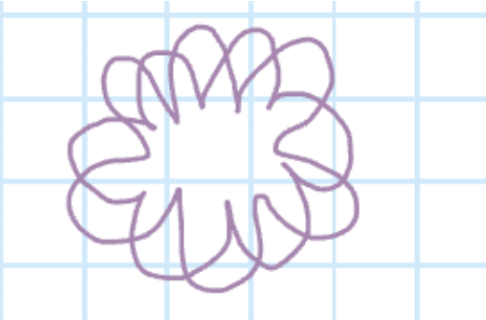
Eukaryotic,
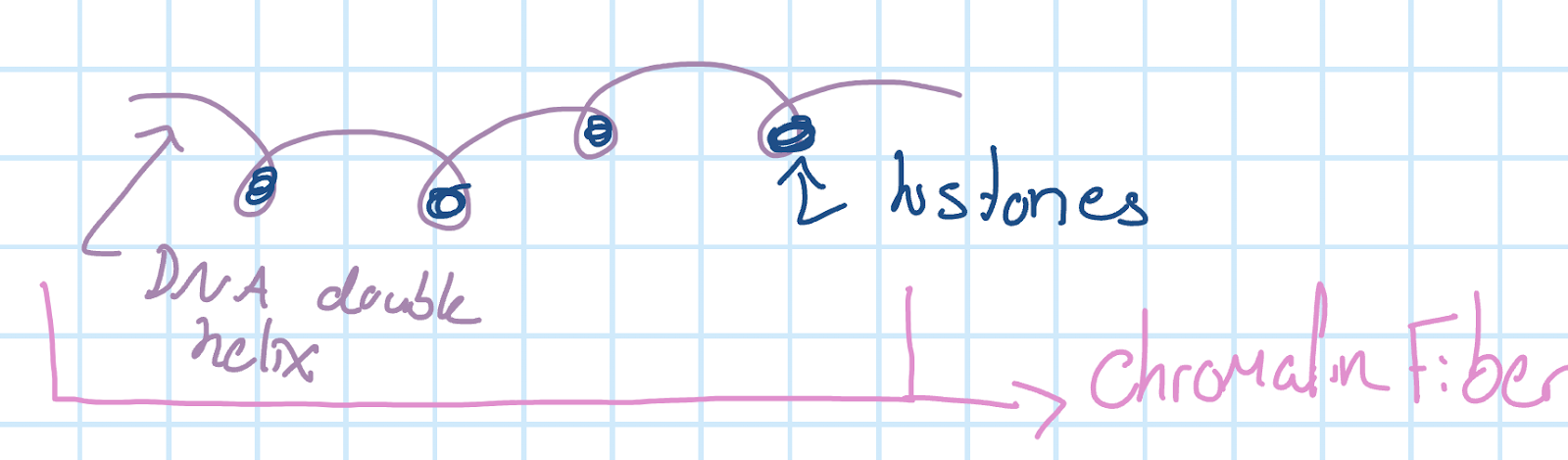
Each eukaryotic will have several linear DNA double helices, each one wrapped around groups of proteins → histones to create chromosomes
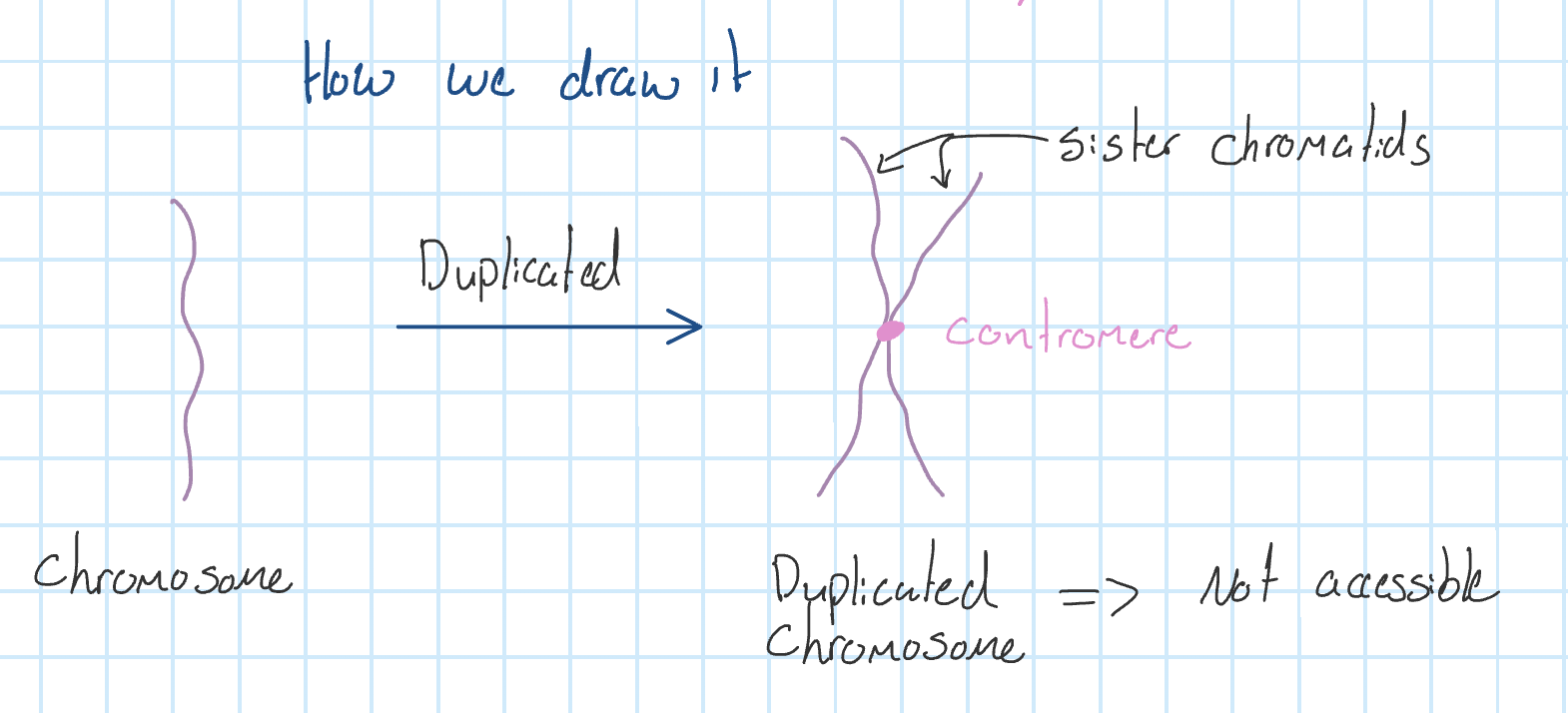
When one chromosome is duplicated, it becomes a set of sister chromatids held together at the centromere, the centre point.
When it is duplicated, the information is no longer accessible
Forms of DNA depending on cell activity
When a cell is NOT dividing
DNA exists in the form of chromatin, the chromosomes are spread out, and the information is easily accessible
When a cell IS dividing
DNA exists in the form of chromosomes that are condolences, wrapped up tightly. Information is no longer accessible
Cell cycle
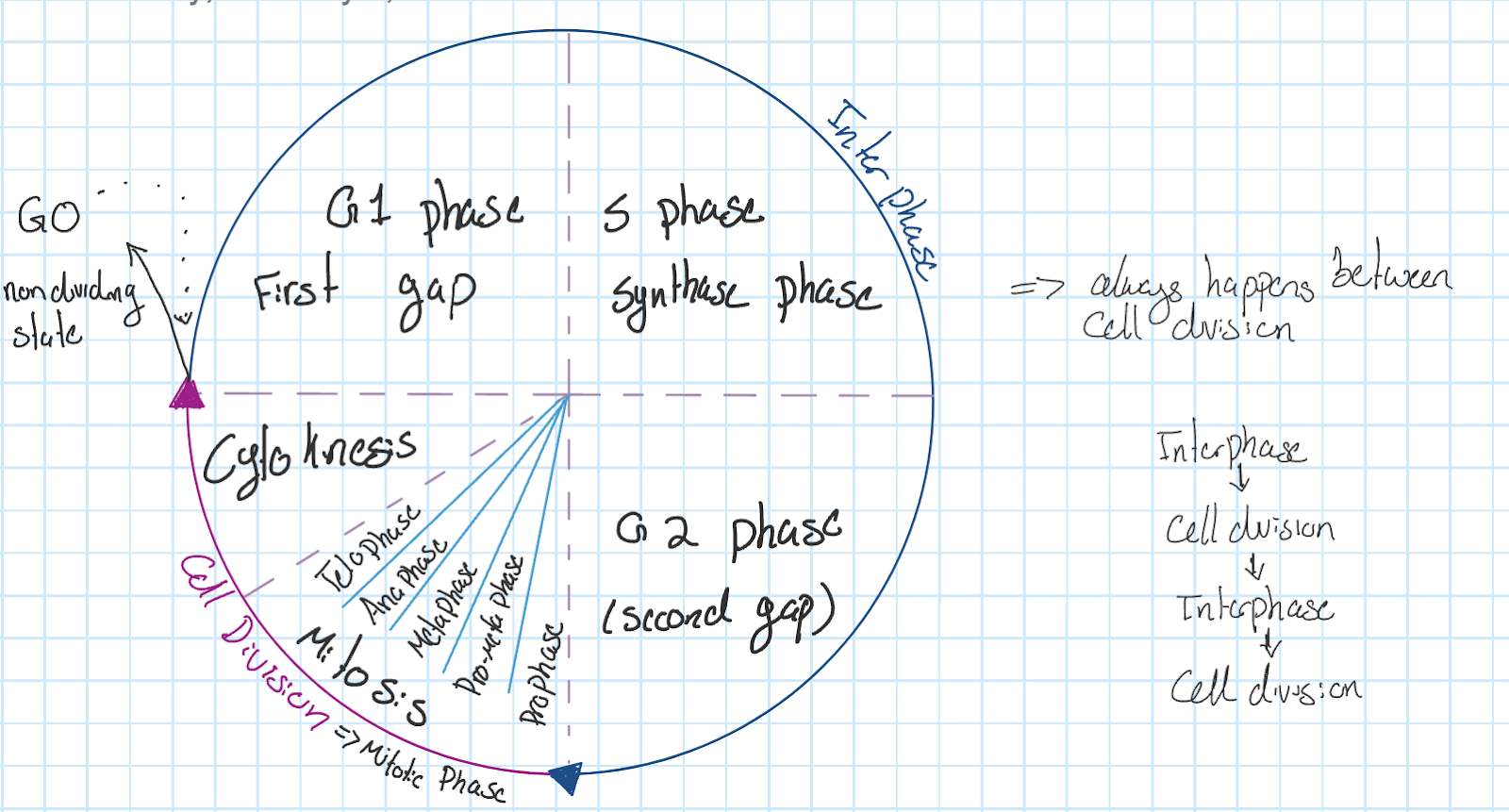
The most basic function of the cell cycle is to duplicate accurately the vast amount of DNA in the chromosomes and then segregate the copies precisely into two genetically identical daughter cells.
Steps of the cell cycle
Interphase
G1 phase, first gap
S Phase, synthase phase
G2 phase, second gap
Celldivision→ mitotic phase
Prophase
Prometa phase
Metaphase
Anaphase
Telophase
Cytokinesis
Functions in each step:
First Gap
Brings in lots of nutrients
Generates lots of energy
Organelles/proteins & other structures will duplicate
Cells grow in size
Synthase phase
DNA is duplicated
Second Gap
Everything in the first gap will continue if it is not finished
Checks and corrects any error found in DNA
If the error cannot be fixed, the cell enters apoptosis; which is cell suicide
Mitosis Phase
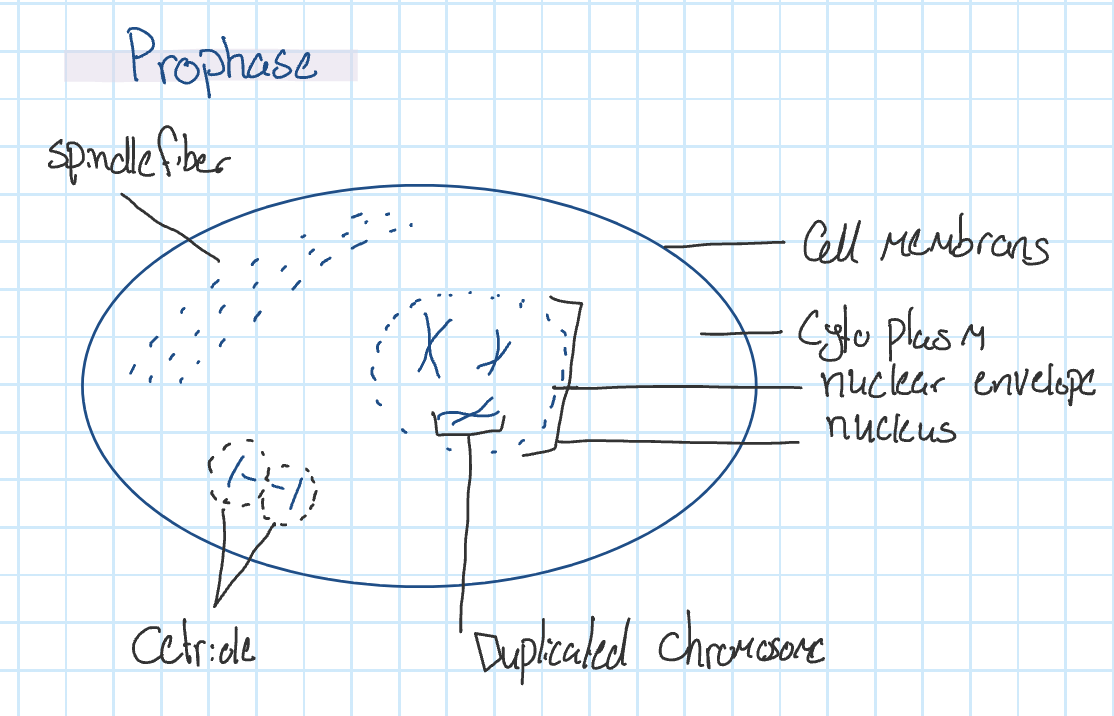
Pro phase
DNA condenses from chromatin into duplicated chromosomes
The nuclear envelope disintegrates, allowing access to the information
Centrioles begin to move away from each other to opposite poles
Spindle fibres, microtubules, begin to form. (from the cytoskeleton)
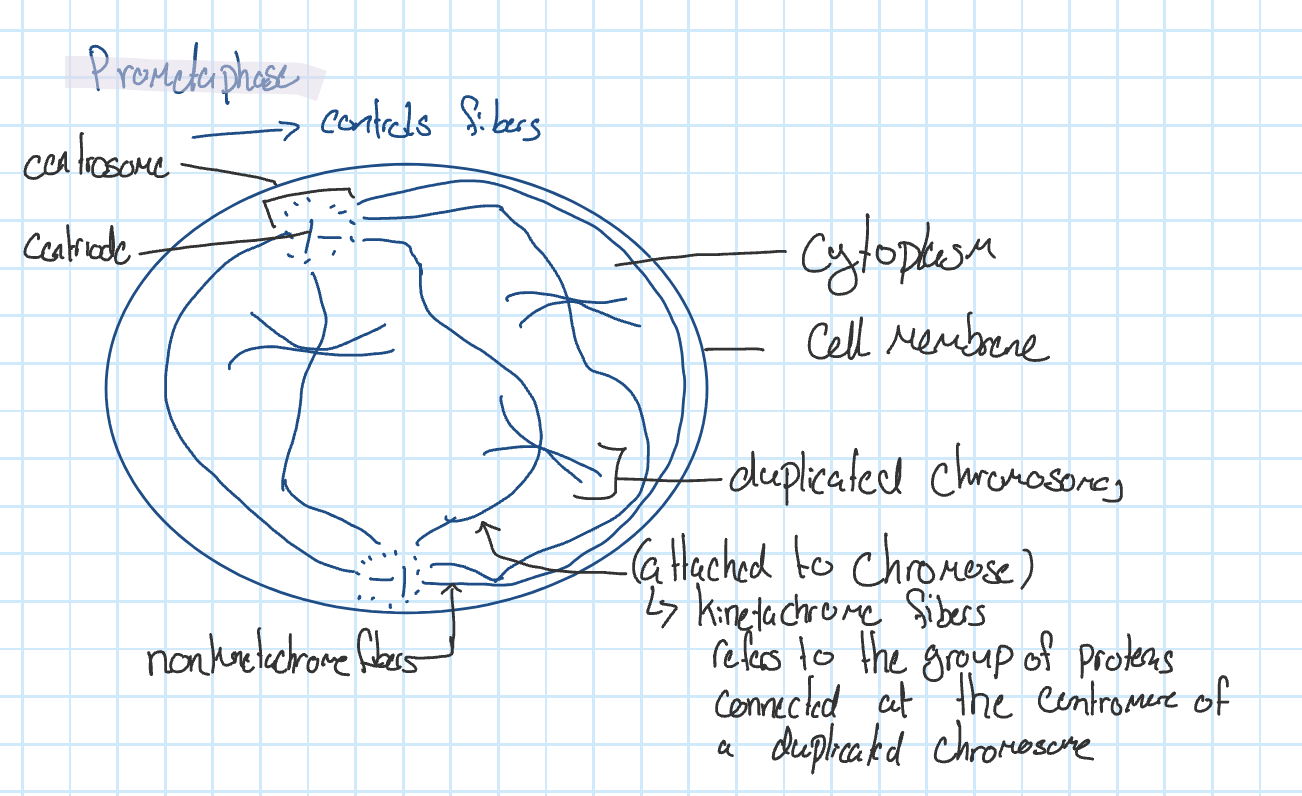
Prometa Phase
Nucleus disappears
Centrioles continue to move to the opposite pole
Kinetachrome fibres from each centrosome connect to the centrosome of each duplicated chromosome and begin to move them to the equator of the cell
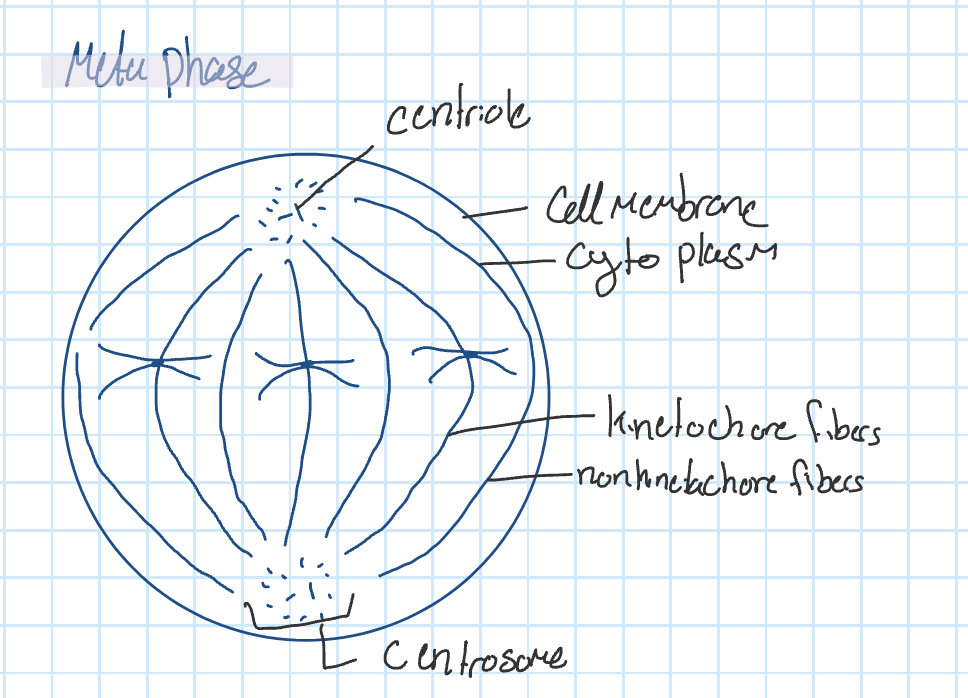
Meta Phase
Duplicated chromosomes are lined up at the equatorial plane
Centrioles have reached opposite poles
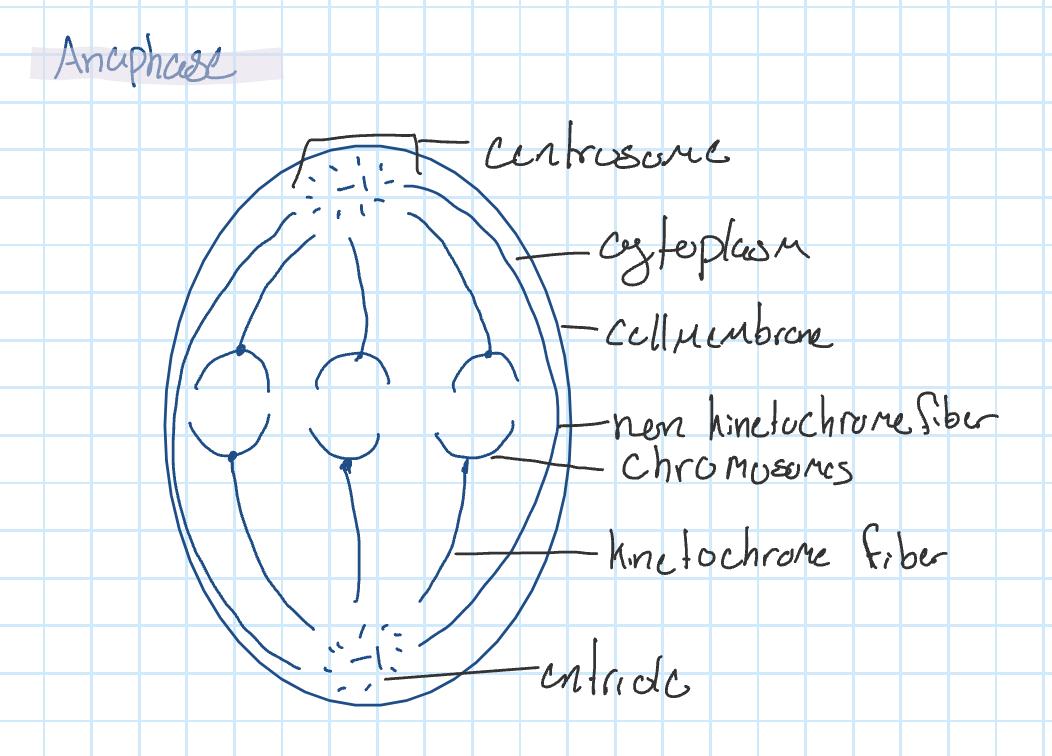
Ana Phase
Kinetochore fibres shorten, pulling sister chromatids apart & moving the chromosomes away from each other
Non-kinetochore fibres lengthen, stretching the cell
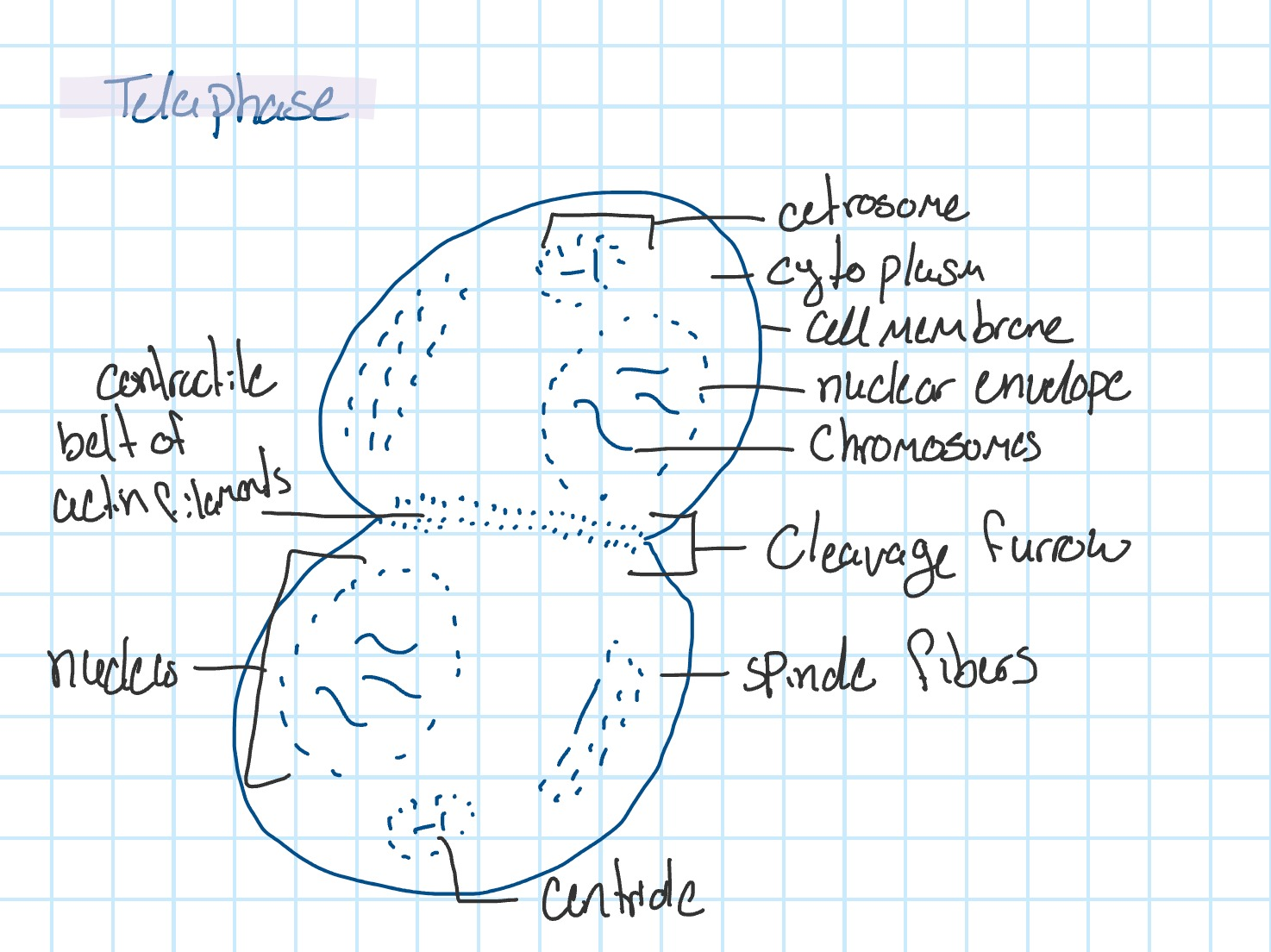
Tela Phase
The appearance of the cleave furrow indicates the start of cytokinesis
Spindle fibres disintegrate
Formation of nuclear envelope around each set of chromosomes
DNA unwinds from chromosomes and into chromatin
Mitosis
Duplication of the nucleus
Cytokinesis
The division of the cytoplasm of the cell
Animal cells
rely on a belt of proteins known as the contractile ring, which is made from actin
Plant cells
does not rely on a contractile ring because the cell is way too rigid.
Golgi apparati at each end of the cell will produce transport vesicles that fill with pectins that move to the centre of the cell
at the centre of the cell, the transport vesicles fuse with each other to create the cell plate
the cell plate lines up in the middle of the cell to become the new cell wall
the cell plate continues to grow and reach the cell membrane to become the cell membranes of the two new cells, the cells will be attached by the middle lamella that is filled with pectin
cellulose is secreted by each new cell to create its own cell wall
Drawing of the cells;
Factors that control the cell cycle (environment)
space is required around cell for them to divide; density-dependence
in tissues, cells form layers and not clumps; cells do not grow on top of each other
a rigid surface is needed for attachment before cells can divide; anchorage dependence
signal molecules called growth factors inform cells that they need to enter the cell cycle
Controlling the cell cycle checkpoints
G1 checkpoint, specialised proteins (cyclins) determine the appropriate conditions, for cells to enter the cell cycle
G2 checkpoint, proofreading enzymes, checking to make sure DNA has no errors, cell has all organelles duplicated
M checkpoint, proteins will make sure that the duplicated chromosomes are all on the equatorial plane and attached at the centromere by the kinetochore fibres.
Proteins involved in the cell cycle
Cyclin; is produced when the growth factor informs cells they need to enter the cell cycle
these regulate when the cell moves from one stage to the next
cyclin-dependent kinases; enzymes that are activated by cyclins that cause the cell cycle to advance
Genes controlling the cell cycle
proto-oncogenes; normally inactive, but are turned on by growth factors to produce cyclins
cancer cells have mutated versions of these genes, so a mutation in this gene leads to having a cancerous cell
a cancerous cell doesn’t mean you have cancer, it just means they are stuck in the cell cycle
tumour-suppressor gene; normally an active, inhibitor, keeps the cell out of the cell cycle
produces proteins called p53, p21, & retinoblastoma (RB)
p53 stops transcription and stops the cell cycle from moving forward. Due to low level oxygen, damages, or errors. It tries to fix it, if it cannot, then it goes through apoptosis
if p53 is malfunctioning, it will continue to divide with the errors that can create cancerous cells
Cancerous Cells
Tumour: a clump of constantly dividing cells,
Benign, localised in one part of the body
Malignant, spreading to multiple parts of the body by a process known as metastasis, this is called cancer
To spread, cancerous cells need access to the bloodstream
Most common cancers;
male; colon cancer
female; breast
unisex; lung
Prokaryotic cell dividing
Binary Fission;
Binary: two-parts
Fission: Splits into to (do not confuse with fusion)
The process used by bacteria to divide because they do not have a nucleus, asexual reproduction
Steps:
The cell enlarges, and the circular chromosomes duplicate
Each circular chromosome will attach to the cell membrane at opposite ends, and the cell continues to enlarge, separating the two circular chromosomes
the cell membrane and cell wall are pulled inwards to create a septum that splits the cell into two new daughter cells that are identical to each other (clones)
the cell wall will weaken due to enzymes allowing it to fold on itself