Lipids
%%Nutrition and biological structures%%
^^Molecular structure^^
What are lipids?
- Lipids, also known as fats, are a group of primarily consisting of ^^carbon, hydrogen, and oxygen^^.
- All lipids are .
- %%Most of the fat we consume is triglycerides%%, which are used as an energy source.
- When fat is not burned, it gets deposited into %%fat deposits%%, where the energy is stored and used as isolation. The energy stored can after that be burned whenever the %%body lacks an intake%% of food.
Fatty acids
- Fatty acids are carbon chains with a ^^-COOH (carboxylic acid group)^^.
- ^^The hydrogen atom can split off from the rest of the molecule^^, so the fatty acid can bind with other molecules.
- Fatty acids vary in length, with the shortest being only 2 carbon atoms wide and the longest having above 22 carbon atoms. %%Most natural fatty acids have between 16 and 18 carbon atoms%%.
- The %%more carbon atoms%% a fatty acid has, the %%less likely%% it is %%to dissolve in water%%.
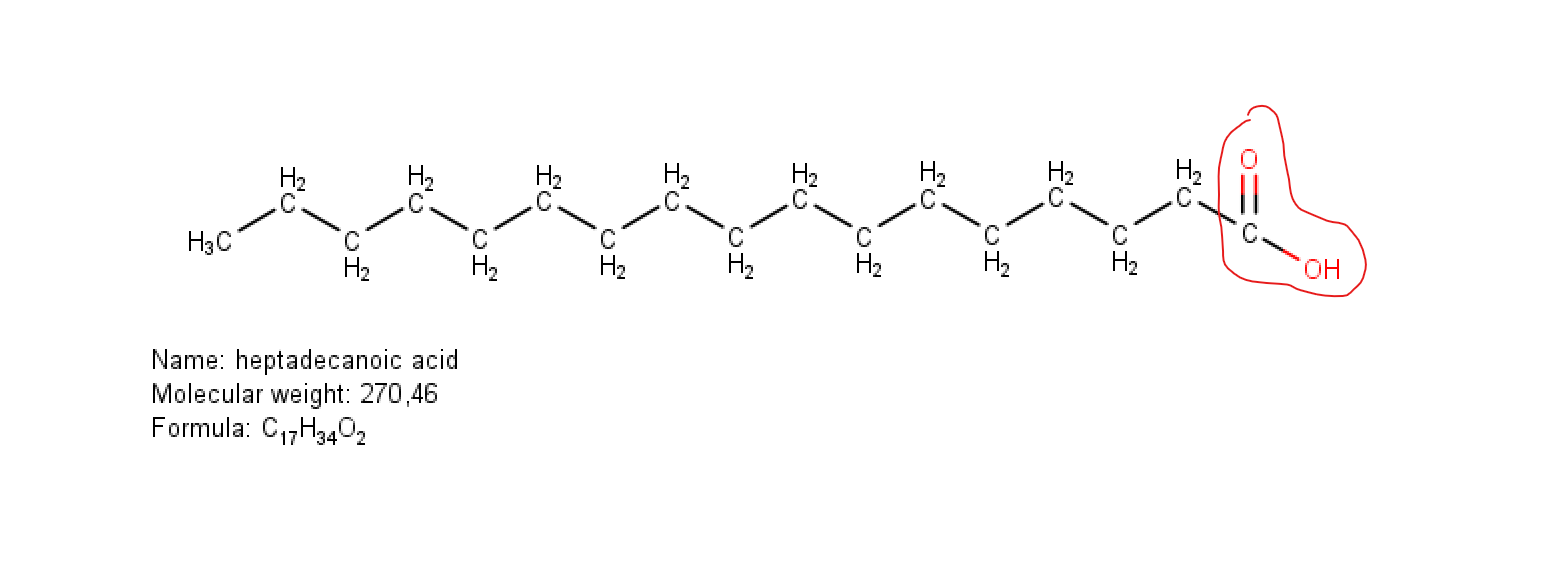
Fig. 1 shows a picture of a ^^straight-chain^^ fatty acid. A straight chain has ^^no side chains^^. The carboxylic acid has been marked red. Heptadecanoic acid is also known as .
Saturated and unsaturated fats
Saturated and unsaturated fats are two different types of fatty acids. They from each other in their . The main way to differentiate the two is that ^^saturated fats have no double bonds^^, whereas ^^unsaturated fats have at least one^^.
Saturated fats
- Saturated fats have ^^no double bonds^^ between their carbon atoms.
- They are at room temperature.
- They are %%primarily found in animal products%% like butter and meat but also a few vegetable oils like coconut and palm oil.
- Saturated fats can %%increase LDL%%.
Unsaturated fats
- Unsaturated fats have ^^at least one double bond^^ between their carbon atoms. Depending on the number of double bonds in their molecular structure, they are called something different.
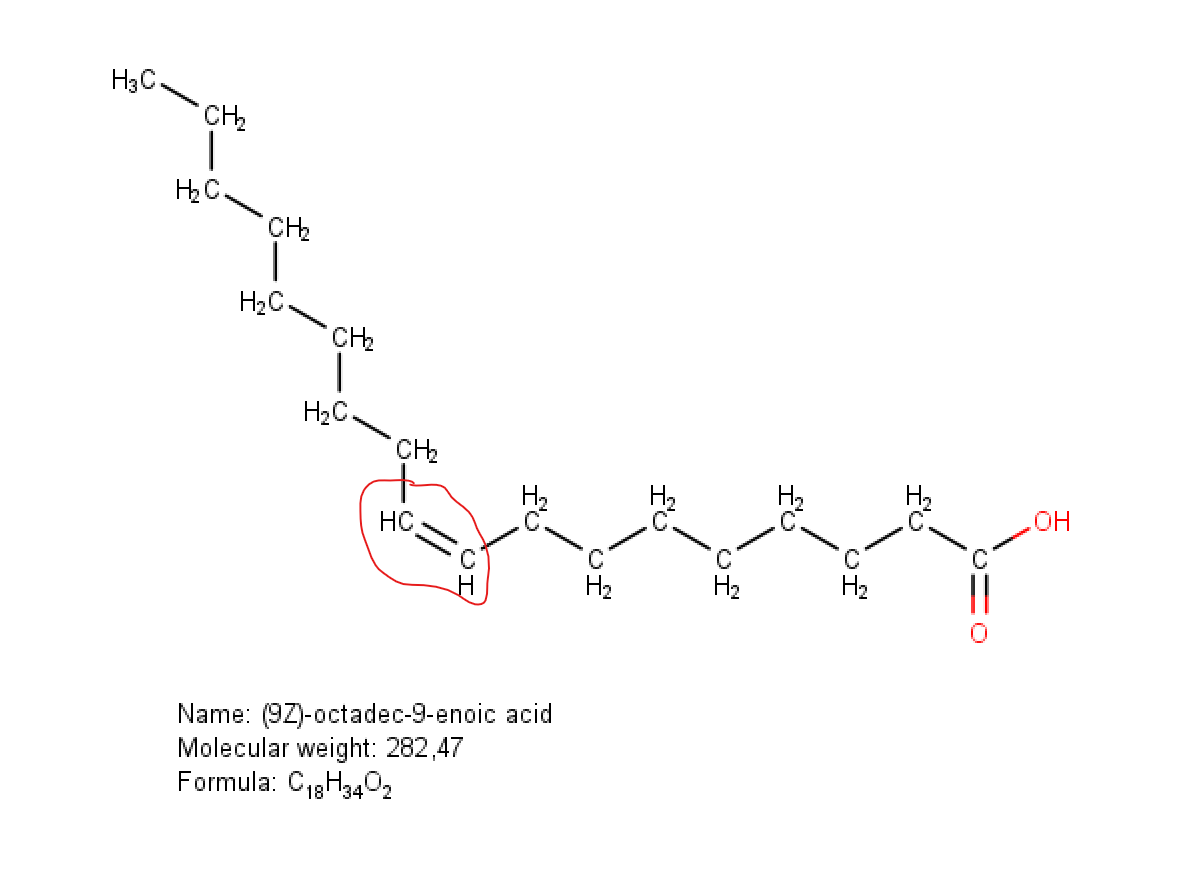
- ^^Monounsaturated^^: one double bond between carbon atoms. (Fig 2.)
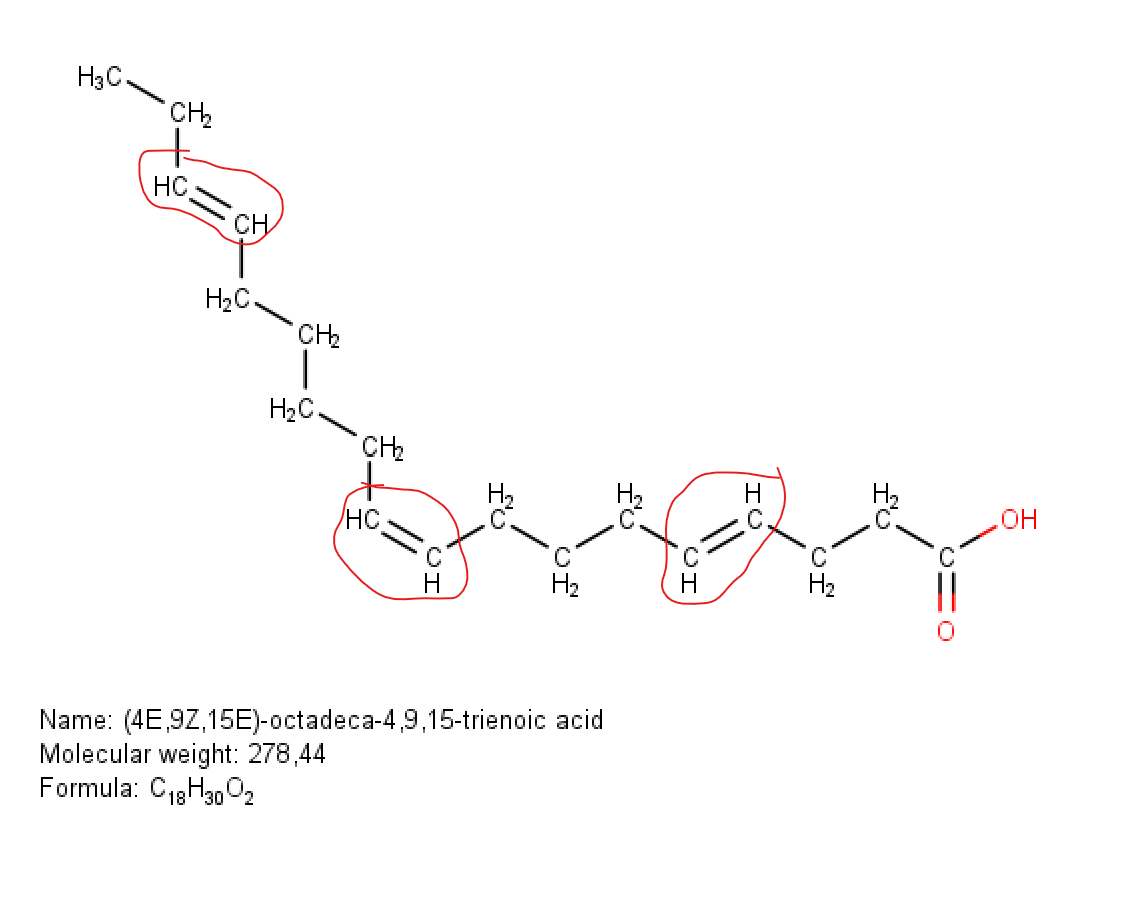
- ^^Polyunsaturated^^: two or more double bonds between carbon atoms. (Fig 3.)
- They are .
- They are %%primarily found in plant-based food%% and vegetable oil like nuts, kernels and olive oil.
- Unsaturated fats can help %%lower LDL and increase HDL%%.
LDL and HDL
- LDL and HDL are two types of lipoproteins that in the blood.
- LDL is often known as the worst of the two since it .
- A too-high LDL level can lead to a %%buildup in the arteries%% that can cause %%cardiovascular disease and stroke%%.
- HDL is often known as the best of the two, as it .
- A high HDL level can %%decrease one’s chance of cardiovascular disease%%.
Cis- and trans configuration
- Unsaturated fats either have a (Configuration) around their double bonds.
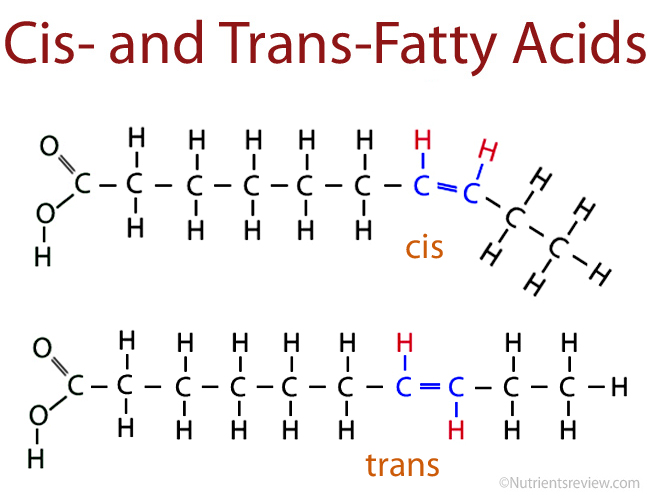
- In cis config. fats the ^^hydrogen atoms that sit on the double bond point the same way^^. Cis config. fats, therefore, have a crack in their molecular structure.
- The crack makes the unsaturated fats have a %%lower boiling point%% than unsaturated fats with a trans config.
- In trans config. fats ^^the hydrogen atoms on the double bond point in different ways^^. Trans config. fats, unlike cis config. fats since their structure makes it look like they have straight chains.
- Trans config. fats can %%increase the chance of cardiovascular disease%%.
- When cis config. fats are heated up, their , and they turn into trans config. fats. .
Lipids are hydrophobic
- Lipids are , meaning they are water-repellent.
- They are hydrophobic because of their structure, where the atoms form ^^covalent bonds^^, creating an electronegative difference in the molecule. ^^The electronegative difference makes the molecule electrically non-polar^^.
- This means the lipids ^^neither have any positive nor negative partial charges^^ that can interact with water molecules (^^water molecules are polar^^).
- The ^^non-polar part of^^ the fat molecule is ^^the carbon chain^^.
- Because ^^carbon and hydrogen^^ have ^^similar electronegativity^^ their ^^covalent bonds are non-polar.^^ Therefore the fatty acids carbon chain is hydrophobic and cannot form hydrogen bonds with water molecules.
Phospholipids contain both polar and non-polar groups and can therefore interact with water and lipids.
Structure and function
Triglycerides
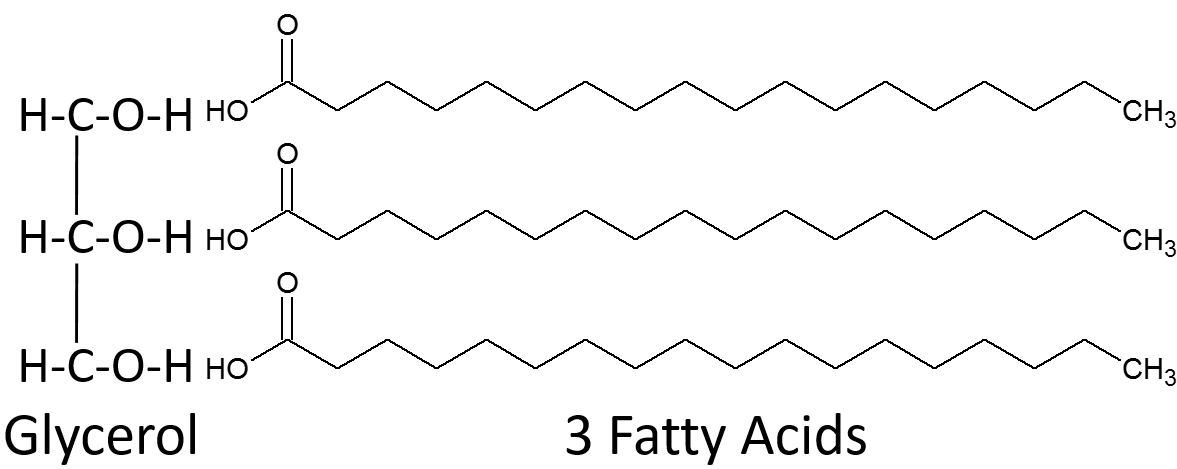
- Triglycerides are made of ^^3 fatty acids^^, that are bound together in a ^^glycerol molecule.^^
- Triglycerides are the in the body and are an %%important energy source%%.
- When broken down ^^triglycerides turn into fatty acids and glycerol^^ that can be used as %%fuel for muscle cells%% and other types of tissue.
- Triglycerides have %%high amounts of energy%% %%(37kJ/g)%%, whereas carbohydrates have much lower amounts of energy (17kJ/g).
- Because of their high energy amount and their hydrophobia, . Therefore %%when the body needs energy, triglycerides can release from the tissue and break down into glycerol and fatty acids%%, which can be transported through the blood.
- High amounts of triglycerides in one’s diet can %%increase the risk of cardiovascular disease%% and other lifestyle diseases.
- . fats. Examples include %%meat%%(beef, lamb and pig), %%fatty dairy products%% (cheese, butter and cream) %%and deep-fried foods%%.
Phospholipids
- Phospholipids constitute a vital role in the of all living organisms.
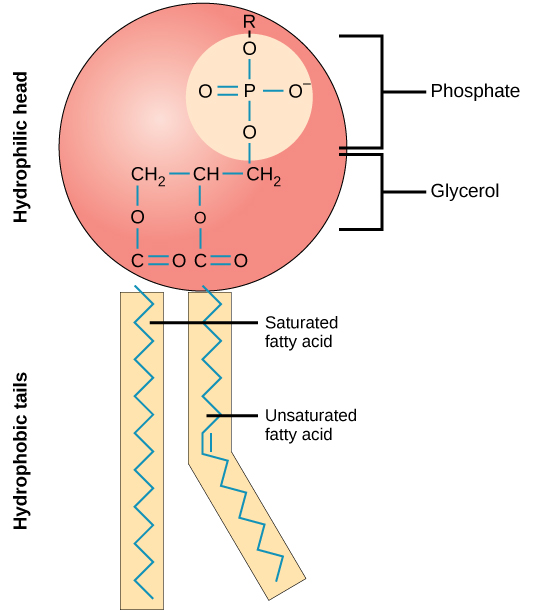
- A phospholipid consists of a ^^glycerol molecule bound to 2 fatty acid molecules and a phosphate group^^. There is also an ^^organic group bound to the phosphate group^^.
- The phosphate group makes the phospholipid hydrophilic\*(“water-loving”)\*, and the .
- Because the phospholipids build, it makes them ideal as cell membranes. %%In cell membranes, phospholipids form a double layer, where the hydrophilic “heads” points outward and the hydrophobic “tails” points inward.%% This makes the cell membrane selectively permeable, meaning the cell membrane can regulate what substances enter and leave.
- Phospholipids are often found in foods such as %%soybeans, peanuts, eggs and liver%%.
Sterols
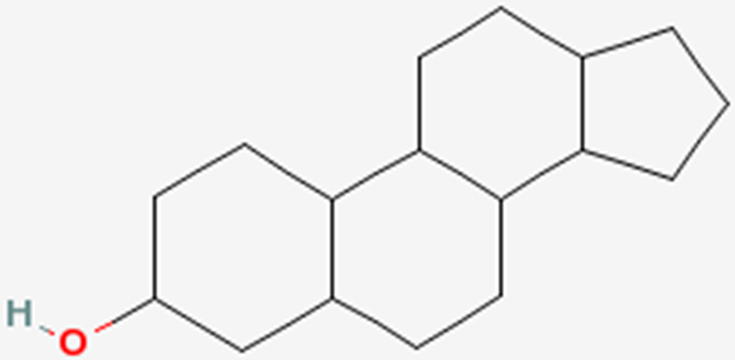
- Sterols are a type of lipid that contain ^^4 carbon rings and an -OH group^^ ^^(hydroxyl group)^^. (see fig. 7)
- The which plays an important role in eukaryotic cells.
- .
- Sterols are often found in foods such as %%meat, cheese, egg, nuts, oils and kernels%%.
Cholesterol
- Cholesterol is a sterol. Cholesterol contains a ^^long carbon chain^^, which makes them .
- Cholesterol is the . (including testosterone, estrogen and adrenocortical hormone).
- Cholesterol help %%regulate the cell membranes’ fluidity and permeability%%.
- .
- It is %%primarily found in animal products like meat and dairy products%%.