US History Notes
The steady population growth after 1450 caused a greater demand for land, which meant prices and rents rose. As trade increased, credit also expanded as banks lent more money. Great financial houses emerged as they supported overseas trade and exploration in the pursuit of national and individual glory. Increased income led to a higher demand for luxury items from Asia. Europeans desired spices, silks, and jewels that returning Crusaders and adventurers initially introduced. During the 1400s, the Ottomans and Venetians were the middlemen in Eastern trade. The fall of Constantinople in 1453 hampered European trade and expansion, as Muslim expansion in the East meant that new trade routes were necessary- ones that bypassed North Africa and the Near East.
In the late 1400s, political relationships changed as feudal barons consolidated power under one ruling authority, often through force. The New Monarchs of Europe shifted traditional loyalties from local nobles and began to establish the concept of a nation. They recruited armies from a wider geographical area, solidifying loyalties across a wider expanse of territories; raised taxes to support new national structures and institutions; and established a system of courts to enforce national laws.
France - Louis the Eleventh reorganized the nation’s financial structure and consolidated his power
England - The Tudors ended the Wars of the Roses with the coronation of Henry the seventh in August 1485
Portugal - John the Second and Manuel I increased royal authority and encouraged overseas exploration.
Spain - This is the best example of centralization of political power. It began with the marriage of Ferdinand and Isabella in 1469, which united the kingdoms of Aragon and Castile. The political and military consolidation led to the Spanish Reconquista, or the reconquest of the Iberian Peninsula from Muslim peoples and rulers. With the completion of this Reconquista in 1492, modern-day Spain was under the complete control of Christian monarchs for the first time in centuries.
The fifteenth century saw the beginnings of the Renaissance, a rebirth of the knowledge and wisdom of the ancient world. IN 1406, a Latin translation of Ptolemy’s Geographia, a second-century text, became widely available among European scholars and helped them understand world geography. Ancient geographers had demonstrated that the world was round as early as the second century and even mapped the known world. The Crusades allowed this old knowledge to migrate back to Europe, where it revived a spirit of inquiry among the elite. The invention of the movable-type printing press by Johannes Gutenberg enabled intellectual and technological advances to reach a wider audience. Books became cheaper to produce and purchase, and therefore, became available to more people.
The Portuguese developed the caravel, a small ship strong enough to withstand the open ocean but maneuverable enough to navigate crowded harbors.
Another development was the Chip Log, which measures a ship’s speed. To use this tool, a sailor would attach a log to a rope with knots tied at regular intervals. They would throw the log behind the rear of the ship while holding the rope. TO determine the ship’s speed, the sailor would hold the rope and count the number of knots that passed through his hands in a given amount of time. Other important nautical instruments included the compass, the astrolabe, and the quadrant.
Quadrant - measures latitude.
Compass - finds north
Astrolabe - measures the angle of the horizon
Chip log - measures a ship’s speed
The First Americans
The reason we don’t know much about the native americans is that they don’t have an historical record. They possessed no written language, as far as we know. But we do have some idea of how they lived through archaeology. Archaeology is the scientific study of material evidence of the past. Recent evidence of early native amergican settlement has been discovered in Sussex County, Virginia. Cactus Hill has some of the oldest evidence of human settlement in the New World, dating almost to the time of the pharaohs in Egypt and their great pyramid. The largest American city north of Mexico before the eighteenth century was in the modern state of Missouri. The city of Cahokia was built by the Native Americans of the Mississippian culture and boasted a population of 20,000 before the 1490s. It is famous for having over eighty manmade mounds. The region’s geography heavily influenced their culture. Some were nomadic hunter-gatherers, while others were fishers or farmers.
INUIT
Alaska and the Far North
Lived in harsh environments
Ice igloos provided shelter in winter, and animal skin huts protected them in the summer.
Used kayaks made of animal skin to fish and hunt seals, which provided oil for lighting and waterproof furs and skins for clothing
The struggle to survive left little opportunity to leave cultural and artistic artifacts.
KWAKIUTL
pleasant but somewhat rainy climate
lived near the coast from modern-day California to southern Alaska
dense forests, rivers, and oceans allowed for a wide variety of food sources
wore little clothing, mostly woven from the fibrous inner bark of cedar trees
homes and canoes were made of wood from the forests
large settlements
the most prominent artifacts from their culture were large totem poles
INTERMOUNTAIN TRIBES
lived in modern-day Southern California and among the Rocky Mountains
harsh landscape
the landscape was mostly desert, where it was difficult to find food or water, which meant most tribes were small and nomadic
PUEBLO - SOUTHWEST
desert and high areas near cliffs and mountains
a dry climate, but enough moisture to farm and raise their animals
adobe houses
many cliff dwellers with large settlements built into cliff faces
distinct aspect: women owned family property and held some political power
some tribes (Navajo and Apache) were more nomadic, living in teepees for at least part of the year.
LAKOTA
various tribes of the Great Plains
flat prairies - long dry grasses
farmers and hunters
lived in villages perched atop the hills along the rivers
Hunters followed the herd of buffalo across the plains, living in teepees when necessary.
Buffalo provided almost everything the Lakota people needed for survival: skins for clothing and shelter, bones and sinews for tools, and meat for food.
EASTERN WOODLANDS
encompasses many tribes and people groups, including the Cherokee, Iroquois, and Algonquian
Lived in permanent housing: the longhouse, which sheltered several families in one dwelling
Hunters and farmers
Grew the “three sisters”—corn, beans, and squash, together in small mounds.
Notably, the women in these tribes owned the property, were the primary farmers, and chose members of the ruling council.
When Christopher Columbus could not gain support from King John II of Portugal, he petitioned the monarchs of Spain for their blessing to explore under their authority. In return, Columbus promised they would receive a share of any profits or goods from exploration and discovery.
After 33 days at sea, Columbus landed on the island named San Salvador, in the Bahamas. They had traveled 180 miles per day in well-stocked ships with pleasant weather. Columbus and his men believed they had landed on an outlying island off the coast of Asia. Hoping to reach the mainland, they sailed to Cuba, which they assumed was China.
On his second voyage, the people he left behind were dead and the settlement gone, so they resettled. His third and fourth voyages were primarily exploration.
Amerigo Vespucci was a Florentine agent for the Medici family whose primary job was to equip exploration vessels in Spain. Because of the popularity of his accounts and his insistence that Columbus had not reached China but had discovered a new world, he received primary credit for the discovery of the land that was later named for him: America.
The exploration and settlement of the New World can be attributed to the religious transformations that occurred in Europe during the sixteenth century. Theological differences challenged the traditional authority of the church, prompting individuals and groups to question the state’s authority as well. European Christians feared encirclement by the Islamic powers of the Ottoman Empire and the emirates in parts of southern Spain. The perceived threat of Islam brought a response from Christian Europeans. The exploration and conquest of the world would provide a way to forge new alliances in the spiritual struggle with the muslim world. This was to be a new crusade- and the point of the Reconquista.
Martin Luther’s call for debate regarding several practices of the Catholic Church sparked discussions that altered the political and religious makeup of Europe and, later, America. Throughout the 1500s, several nations separated themselves from the church in Rome.
Northern Europe primarily followed the Lutheran faith. The 1534 Act of Supremacy named Henry VIII and all subsequent English monarchs the head of the church of England and the state. The separation from Rome was in name only. the church of England kept many of the forms, rites, and rituals of the Catholic Church. Maintaining the appearance of teh roman faith while being officially protestant later led to trouble with the Puritans and other dissenting groups.
In France and Switzerland, John Calvin expanded Luther’s doctrine of election, predestination, and personal morality and piety. He established a theocracy in Geneva, and his teachings gave rise to the Reformed churches on the European continent and the Presbyterian churches in the British Isles.
There was also an evangelical element to the exploration and settlements of lands to the west. even though some Europeans committed many evil deeeds in the new world several christains traveled there with goof intentions to fulfill teh great commission. one of the evangelists was bartolome de las casas, a domicinac missionary who treid to fight against the oppression of native americans and called for an end to slavery.
In response to the Reformation, the Counter-Reformation, also known as the catholic reformation, began in the mid-sixteenth century and continued until the end of the European Wars of Religion. Following the protestant reformation and the Catholic Counter-Reformation, a fierce evangelical competition ensued between the protestant and catholic factions to win more converts in the New World.
European Wars of Religion.
England
The reign of Bloody Mary. Upon the death of Henry the Eighth, his son, Edward the Sixth, took the throne. The sickly young man reigned for only six years. During this time, his regents took the country deeper into protestantism. When he died in 1533, his sister, Mary, daughter of Catherine of Aragon, took power. She was a devout catholic and, in her five-year reign, attempted to revive the old laws and traditions. Under Queen Mary, persecution of protestants commenced, giving inspiration to one of the most popular works of the age, Foxe’s Book of Martyrs.
France
The french wars of religion
Over 36 years, violence between the French Protestants and French Catholics rocked the nation.
Holy Roman Empire: The Thirty Years’ War
Although this war was much broader in scope and cause, it began primarily as a religious conflict between catholics and protestants. The widespread devastation of a sizable portion of the German states, Italy, and the Low Countries changed the political and economic makeup of the area. The destruction and persecution brought about by the conflict drove religious minorities to look for safe sanctuary elsewhere.
New Spain
Caribbean, Mexico, Central America, and northern portions of South America. The successful colonies established there brought prosperity to the Old World and the New. The conquest of New Spain spanned several decades. The Spanish established the encomienda system, land grants that demanded tribute in labor from the natives. Under this system, agricultural and mining work was done by forced labor at no cost to the Spanish. Laborers were chosen randomly and not necessarily bound for their entire lives. The encomienda system was not slavery or indentured servitude; it was a new system that exhibited characteristics of both.
Hernan Cortes - conquered Mexico between 1519 and 1521
Francisco Pizarro - conquered the Inca in Peru between 1531 and 1534
Pence de Leon - discovered the Florida Peninsula. The first extended contact between Europeans and native americans in the modern-day United States occurred in 1513 when once de Leon explored the Florida Peninsula for Spain. He traveled the land, meeting and trading with tribes as he went.
Hernando de Soto - from 1538 to 1542, he explored the gulf costal plain and crossed the Mississippi River into modern Arkansas
Francisco Vázquez de Coronado - tried to find the cities of gold between 1540 and 1542. He explored from Mexico through the southwestern United States as far south as central Kansas, finding only the wichita indians living in small huts along the rivers and on the plains.
North america
Spain
Initially, European interaction with North America was primarily focused on exploration rather than colonization. Failure to find the wealth of the cities of gold decreased the Spanish drive to explore and settle North America. They concentrated on maximizing profits from holdings in South and Central America, while maintaining a presence in southern North America to protect their interests.
France
The French began exploration efforts in 1524 when Giovanni da Verrazzano sailed for King Francis I. Between 1534 and 1543, Jacques Cartier led several expeditions to the New World. He explored the Gulf of Saint Lawrence and sailed up the Saint Lawrence River to the areas of modern Quebec and Montreal. Cartier established a post in Quebec as the foundation for a colony. The settlement disappeared due to domestic concerns and mixed messages from the French crown, which limited colonization efforts. The permanent settlement of Quebec would not be established until 1608.
Robert de La Salle would undertake further French exploration of the North American continent. Between 1666 and 1687, the adventurer would lead expeditions that ranged from the Great Lakes through the Mississippi River valley and to the Gulf of Mexico. His efforts led to a network of French forts and outposts that bisected the North American continent and would remain into the late colonial period.
England
After Columbus, most exploration focused on finding a direct route to Asia. In England, Henry the seventh, who protected Venetian merchants, allowed John Cabot and his sons to explore the seas to the west. To gain the monarch’s permission, they promised Henry twenty percent of all profits from their efforts. This was important to a leader who needed money for his treasury, especially since the Spanish crown grew wealthier every day.
Cabot sailed on May 2, 1497, reaching the North American continent on June 24. Cabot’s expedition explored North America from Labrador to potentially as far south as Virginia. Storms in the Atlantic destroyed all but one ship; Cabot disappeared. Ten years later, his son, Sebastian Cabot, returned to the coast of North America, still looking for the Northwest Passage his father had been sure of. English exploration languished during the reign of Henry VIII, who was too concerned with domestic issues to settle the unexplored territory. The king’s daughter, however, would contribute to the permanent settlement of North America.
First Contacts
European-Native American Relations
Unlike the Spanish or the French, the English settlers were not overconfident imperialists or conquerors, especially in North America. They were supplicants in need of assistance from native american people to survive. Some of the earliest English writers of this period struggled to explain the challenges and opportunities available in North America. They wanted people to see what could be and entice them to settle, but they sometimes minimized the negative aspects of settling a new land that lacked the basic foundations. Many who wrote negatively about the native tribes never left England and instead wrote secondhand, adding details from their imagination. Others wrote more positively about the societal and cultural aspects of native americans.
In the earliest days of settlement, Europeans and native americans established mutually dependent societies. native americans actively participated in European economic and material culture for many years before the arrival of physical European settlement on the American continent. This made them linked to and somewhat dependent on Europeans from the earliest stages of contact. That dependence, along with ecological and epidemiological changes, reshaped indian society and culture.
When Europeans first made contact, they sought to exchange goods with one another, utilizing the bartering system for trade. native americans sought European goods to enhance their lives and prestige among neighboring tribes. If they could trade an iron cooking pot instead of making their own clay pots, for example, they would receive a more durable good without putting in the effort of creating anything besides what they needed for the trade.
After initial settlement
Things did not remain positive as time passed. Both Europeans and native americans expected the other to live according to their particular perception of the rules. A lack of understanding regarding politics, economics, religion, lifestyle, and cultural norms resulted in a clash of cultures that led to much of the later violence and hostility between the two groups.
Columbian Exchange
a process by which many aspects of the Old World came to the New World.
the earliest settlements
The first English attempts at colonization occurred on the islands of what is now the Outer Banks. Specifically Roanoke Island. In 1584, England was not yet a superpower.
jamestown
The Virginia Company of London was a joint-stock company, an entity that sold shares in the company to raise capital and divide the financial risk. Many individuals could pool their money to invest in the hope of seeing a return without being financially ruined should the venture not succeed.
On May 14, 1607, they landed on an island about sixty miles up the James River and established a settlement named Jamestown, both named in honor of King James. The settlers chose this site because ot the nearby deep river channel, which could easily accommodate large ships and was easily defensible against Spanish attack. The settlers immediately began work on a wooden fort that enclosed a church, storehouse, and a few other shelters. The island was surrounded by wetlands, making much of the area swampy and difficult to farm. There were swarms of mosquitoes and the worst drought in centuries, which caused the well dug on the island to be contaminated with brackish water from the nearby Chesapeake Bay.
Early conflict and crisis among the Jamestown colonists almost spelled disaster as soon as they arrived in Virginia. John Smith was able to bring order from chaos. In his records of the early period of the colony, Smith wrote that the men were becoming lazy and unwilling to work.
In 1609, relations between the Powhatan Co and the English were more strained than ever. C and John Smith were nearly at the point of wanting the other dead when a gunpowder accident injured Smith so severely that he was forced to return to England for his health. The winter of 10609-1610, known as the starving time, came partly because of the relations between the natives and the English.
The people who settled in Plymouth faced unique challenges upon their arrival in 1620. Those who formed a settlement at Massachusetts Bay in 1630 benefited from the experiences of those who came before. Regardless of whether the settlements began as a commercial venture or a religious refuge, the Jamestown
and Massachusetts Bay colonies became the foundation of what would become America
understanding puritan calvinism.
They believed in the total depravity of man. This is the idea that man had a sinful nature, inherited through Adam’s fall, and that life is a constant struggle between good and evil. In daily life, that meant that the Puritans expected evil, so bad things came as no surprise. Their entire social structure was based on the concept of covenants, unbreakable agreements that bound them to god and one another. One of the key tenets of Puritan faith was the doctrine of election. As the Puritans understood the Bible, only a chosen few were admitted to the covenant and given God’s gift of grace, meant only for the elect.
the pilgrims
These separatists were Puritans who believed that there was no hope of reforming the established church, and that the only way to preserve the practice of the “true faith” was to withdraw entirely from the church of England. The Pilgrims received a grant from the Virginia Company of London to settle in Virginia, which still encompassed most of the eastern seaboard of North America. The land he promised them was at the far northern reaches of the Virginia Company’s holdings, near the mouth of the Hudson River in modern New York. In that area, there would not be an undue influence on the Anglican settlers of Jamestown and the environs.
The journey to America was terrible. There, the sailors often taunted the pilgrims; it took sixty-five days for the Mayflower to reach land. The colonists faced a significant dilemma. The charter for the colony did not permit them to settle where they had landed, but they had no other option. William Bradford replaced John Carver as governor when he died. he is known for keeping a detailed history of the colony. Bradford was also key in promoting peaceful relations with the native americans. During the first winter, nearly half the colonists died.
Once Jamestown was established as a thriving colony and Plymouth began to show promise, others began to consider settling in English North America. The establishment of the Massachusetts Bay Colony resulted from several factors that both pushed them out of Europe and pulled them to America. One of the primary factors that prompted the Puritans to migrate to the New World was political in nature. From 1629 to 1640, King Charles I governed without Parliament, and he removed all Puritan members from leadership within the anglican church. The Puritans were convinced that they could purge the church of all remaining appearances of the catholic religion, including rituals and vestments, but that it could only be managed from within the entity itself. In addition to the factors that prompted the Puritans to leave England, some aspects of colonization drew them to America. The Puritans saw the native american population as a vast mission field and expressed a clear desire to convert them to Christianity. Their attitude toward the natives was one of superiority, but not overtly racist.
Each of the earliest English colonies in North America had its own unique character and purpose. While Jamestown was primarily an economic venture intended to generate wealth for those who invested in the Virginia Company and the colony’s settlers, the primary motivation in what would become New England centered on religious practice. That is not to say that the people of the northern colonies did not have a notion of economic prosperity. Material success, as a result of challenging work and sound decisions, was an outward sign of obedience to god. As the seventeenth century progressed, Virginia and Massachusetts would become the two most powerful and wealthy colonies in British North America.
Virginia
Population
The first permanent English settlement in the New World barely survived for the first few years. Disease, poor sanitation, and indian attacks killed many settlers within the first year. Those who survived the “seasoning” process over the first year or so still faced a significantly higher mortality rate than most people in the world. Of the original 104 colonists, only 38 survived the first winter. Even after 300 more arrived in 1609, the colony’s population had only grown to 60 by 1610. Then about 10,000 settlers arrived between 1610 and 1624, but only 1200 were still living in 1624.
Political and Religious Structure
From the beginning of the Jamestown colony, Anglicanism was understood as the official religion of Virginia. An Anglican minister performed the only sanctioned religious services in the earliest days in the Jamestown church. By the mid 1600s, Anglicanism had become the established religion, as Puritans and Quakers attempted to settle the area. Under Governor William Berkeley, the establishment of the Church of England became solidified. The church received its support from the colonial government; attendance at religious services was mandatory at least once a month, and Puritans and Quakers were expelled from the colony.
The Virginia government adopted the parish system from England, which established an Anglican parish in each new county as the colony expanded. Parish leaders, called vestrymen, ensured that tithes were paid and that members attended services. There was no choice regarding church attendance. If you lived in the confines of the parish, you were a member of that church. This system would remain intact until the 1780s.
Virginia led the way in establishing a representative government in the New World. Once the colony was firmly established and private land ownership was permitted, the need for a system of government, loosely based on England’s, became apparent. In 1619, the Virginia General Assembly was established. It consisted of the Virginia House of Burgesses, a body consisting of elected representatives voted on by white, male landowners in a particular area, and the Governor’s Council, a group of elite members of society chosen personally by the governor and approved by the Crown.
The structure loosely resembled the English parliamentary system, with the governor paralleling the king, the governor’s council paralleling the House of Lords, and the House of Burgesses paralleling the House of Commons. Other colonial structures existed elsewhere in the English colonies, but the Virginia House of Burgesses was the first representative assembly and set a precedent for that form of government for future generations.
Native Relations
For most of the early period of the colony, relations with the native americans remained relatively peaceful following the marriage of John Rolfe and Pocahontas in 1614. There were tensions, but no open violence occurred until 1622, when Opechancanough, Chief Powhatan’s brother, led a surprise attack that killed 347 people in a single day. More would have died, but a Powhatan youth living with an English family warned the settlement, saving many lives. Things settled down again for more than two decades until Opechancanough (now probably in his nineties) led a second massacre that killed another 400 colonists; for this attack, there was no warning.
Agriculture, Industry, and Labor: Tobacco
Virginia colonists had attempted various ways to make the colony profitable after they realized they would not find gold or a water route to Asia. They had tried silk production, glassmaking, lumbering, sassafras, and the production of pitch and tar. Although there was limited success, nothing generated enough revenue to justify the expense of maintaining the colony. The crop was initially introduced to Europe from the Caribbean by the Spanish. The smoke of the plant was palatable to Europeans, but the Spanish ensured it remained expensive. Tobacco was grown by Virginia’s native population, but the Englishmen could not grow accustomed to the harsher taste. In 1612, John Rolfe planted tobacco seeds smuggled to the colony from the Caribbean. By 1617. tobacco exports totaled 20,000 pounds, doubling the following year. The product of the Virginia Colony became so popular that by 1630, over 1.5 million pounds were exported across the Atlantic.
Labor Issues
There were two issues with tobacco for the Virginia colonists. First, it depleted the soil, which means that large tracts of land are necessary to rotate crops and manage the land effectively. Another critical issue was the need for people to work in the tobacco fields. With limited numbers of colonists in the early years, the necessary labor was not available. The solution to the problem arose when leaders introduced the headright system. A headright is a legal grant of land to settlers. Under this system, fifty acres of land were granted for each peasant settler brought to the colony. If an individual could pay for his passage and for that of his family, he would receive land for himself and any family members who arrived with him. Most could not afford it. In return for passage to Virginia, indentured servants signed a contract that promised five to seven years of labor. The individual who paid for the passage received the fifty-acre headright but promised freedom dues, typically land and money, to the indentured servant, to be received upon completion of the contract. Indentured servants were typically young men prohibited from marrying while under contract. They were usually poorly fed, barely clothed, and housed in subhuman conditions. Many died before they completed their contract.
Bacon’s Rebellion
By the mid 1600s, the Virginia Colony had become a thriving contributor to the expanding English empire. There were relatively few problems as the settlements expanded and the government’s authority extended across more territory. Other than a random indian attack, peace seemed to reign across the region. Once considered the first American Revolution, Bacon’s Rebellion is now clearly seen as a power struggle between two stubborn Englishmen from the same prominent family. The Governor of Virginia, Sir William Berkeley, had an iron grip over the colony. His younger cousin, Bacon, who had created significant legal and social issues for his family, had been sent to Virginia to mature in a rough landscape of the colony under his older relative’s supervision.
During a skirmish with some local native americans in 1675, a few Englishmen were killed. In response, Nathaniel Bacon Jr. wanted retribution for the lives lost, while Governor Berkeley wanted to make a compromise to maintain peace. a series of actions and reactions led Bacon to initiate open rebellion against Berkeley in 1676. This conflict ended with the burning of the thriving capital of Jamestown, and Governor Berkeley on the run.
Massachusetts
Political and Religious Structures
The church and state were unified under another established church. The Puritans, though they did not officially separate from the Chruch of England, established Congregationalism with taxes funding ministers’ salaries and supporting churches. The legal code regulated public and private life, instituting required church attendance and setting punishments for drunkenness and card playing. Married couples could even be fined for kissing in public. Only full members of the local church were eligible to vote, and ministers were not permitted to hold public office. Roger Williams disagreed with certain policies and practices in the church and government and was expelled from the colony. Anne Hutchinson was tried for heresy during the Antinomian Controversy. It seemed that the Puritans left England to escape persecution and find the freedom to practice their brand of religion, but they were not themselves religiously tolerant. Despite internal issues, the population of Massachusetts and later New England continued to grow. The larger consequence of growth and outward migration was a change in the makeup of the community left in Massachusetts.
Anne Hutchinson and the Antinomian Controversy
Anne Hutchinson is remembered in history for her trial in November 1637 in Massachusetts Bay, an event that was part of a religious conflict called the Antinomian Controversy. Hutchinson arrived in the colony in 1634 and was a follower of John Cotton, one of the most prominent Puritan preachers of the day. Hutchinson’s problems started rather quietly. A dedicated student of the Bible, she organized meetings with the women of the colony to discuss the previous week’s sermon. She began to speak about her own theological views, sometimes in opposition to those of prominent men in the colony. Hutchinson argued for a personal relationship with God, which should be more important than a reliance on ministers to pronounce God’s Word and interpret its meaning. She believed the ministers were preaching a doctrine of works rather than the grace that brought an individual to salvation. She emphasized this as a natural outgrowth of a C theological tenet of predestination rather than a new idea. When word of her opinions reached Governor John Winthrop, he took issue with her.
Native Relations
Relations between Native Americans and settlers in the Massachusetts colony were generally good, but deteriorated over time. The most significant episode in the early days of the colony came in the 1630s. as the population grew and settlements expanded, there were too many Europeans in the C for the P tribe to feel comfortable. They were threatened by colonial growth, and in 1637, the Pequot War ignited. it began with a minor attack in which only one colonist was killed. The colonists retaliated by attacking the Pequots at their encampment at Mystic River. they burned the village, trapping many inside the pa area. As many as 400 Pequot people died in the attack.
Agriculture, Industry, and Labor
The characteristics of New England differ significantly from those found in Virginia. the areas soil is rocky and challenging to manage. A key societal difference between Virginia and New England would also affect agriculture. In Virginia, inheritance practices followed the English tradition of primogeniture, where the oldest son inherited the entire estate. In New England, they deviated, dividing farms amoung siblings in equal shares. The most valued exports of New England were fish, lumber, tar, and pitch. Shipping and merchant ventures eventually became the economic basis for the New England colonies, making them the financial and cultural centers. Although they did not need slave labor for farming as they did in Virginia, there were instances of slavery in some roles requireing manual labor. The primary source of labor in the region came from indentured servants, as well as apprentices for the necessary trades that sustained the industry.
Maryland
Sir George Calvert, Lord Baltimore, was the driving force behind the foundation of the colony of Maryland. He was a favorite of James the First of England and held a position as his secretary of state. In 1624, Calvert converted to Catholicism, forcing him to resign from office. in 6125, Calvert received the title Lord Baltimore and began his search to find a colony where catholics would be welcomed. George’s son, Cecil, would become the new Lord Baltimore, and in J 1632, Charles I granted Cecil Calvert a charter to establish a colony north of the Virginia colony. Calvert chose to name the colony Maryland in honor of Henrietta Maria, the queen, who was also a catholic. In addition to being a haven for persecuted catholics, the colony of Maryland was also intended to be a commercial venture. Leonard Calvert, Lord Baltimore’s brother and Maryland’s governor, received instructions not to alienate any protestants who might settle in the new territory. Tobacco had created a thriving economy in neighboring Virginia, and the Protestant work ethic prevalent among many Virginians would make them valuable to the colony’s success.
Upon the arrival of new settlers, they purchased land from the Yaocomico Indians and established St. Mary’s City, which would be the colonial capital until 1695.
The charter of Maryland was a throwback to the days of feudalism. Lord Baltimore was a proprietor with far-reaching powers. Each of the settlers swore an oath of allegiance to Lord Baltimore, not the king, and he held absolute authority over all who lived in the colony. Each colonist paid a fee to Baltimore called a Quitrent, which by 1642 had been established at two shillings per hundred acres of land. There was only one guarantee, each colonist was to live under the same rights as the citizens in England.
The social structure established in Maryland was quite elaborate. “Lord of the Manor” purchased at least 1000 acres from Baltimore and were permitted to establish local courts and rule over their domains like medieval barons. For those who could not afford large tracts of land, each settler received 100 acres of land for himself, his spouse, and each servant, and 50 acres for each child. The headright was reduced to 50 acres within a decade of the settlement, and by 1683, the system had been abandoned.
Religion in a Refuge
Religious toleration and cooperation were necessary from the beginning of the Maryland colony. Lord Baltimore took proactive steps to guarantee that no person who professed to be Christian could be harassed because of the way they chose to practice their religious faith. In 1649, he introduced the Act of Toleration, which legally established the right of all Christians to practice their faith freely.
Commercial Growth
Tobacco was the commercial mainstay of the Maryland colony. Tobacco is a year-round, labor-intensive crop, and the need for n sources of labor caused problems for Calvert’s proposed manorial system in the days before slavery became the standard. Indentured servants were the primary labor source in the early days of the American colonies. Once a servant worked out the length of the contracted time, he was free to purchase and work his own land. Most people chose to work for themselves rather than labor on another person’s land for little reward. With so many large tracts of land held by a few people, smaller farmers soon moved toward developing southern colonies, such as the Carolinas, Virginia, or Maryland’s expanding backcountry. The economic divide between the rich and poor grew wider for a time, but Maryland’s social structure eventually became more equal.
New England Expansion
Religious adherence was a primary aspect of the Puritans’ lives. Although this had many upsides, it also caused problems in their communities. Despite Winthrop and his fellow colonists’ dreams of establishing orthodox religious communities in New England, religion soon became a divisive issue. Diversity of thought and opinion cannot be avoided, and it often gives rise to disagreements even within devout communities. Massachusetts Bay was no different. The very basis of the colony proved to be the source of division, resulting in the development of several additional colonies surrounding Massachusetts Bay.
New Hampshire
The colony of New Hampshire was different from other New England colonies in that it didn’t begin as a haven for religious dissenters, but rather as a commercial venture. It began in 1622 with a land grant by the Council for New England to Sir Ferdinando Gorges and John Mason. It originally encompassed the land from the Merrimac River to the Kennebec River but was later divided between the two founders. Gerage’s portion of the grant became the territory known as Maine, while Mason named the western portion of the grant for his home in Hampshire, England. the first settlement in the colony was established in 1623 at Little Harbor, located at the mouth of the Piscataqua River. the hlarger settlement of Dover was founded by Edward Hilton within a few years, six miles upriver. In 1629, the Laconia Company sent more settlers, who went on to establish Portsmouth. Several men explored the interior reaches of the colony, but they sent back such a negative report to England that the colony was all but abandoned and left to its own devices. Conditions improved when John Wheelwright, the brother-in-law of Anne Hutchinson, arrived. He established the settlement at Exeter between the Merrimac and Piscataqua rivers. The primary issue in New Hampshire was the lack of a centralized government. All the towns in the colony were independent of one another under the proprietors. This left the government unstable and the settlers without a clear direction. In 1639, the towns agreed to join under a single government, but Massachusetts claimed the territory as part of its jurisdiction. After two years of debate, they reached an agreement that each town would be granted limited autonomy and permitted to send deputies to the General Court in Boston. This system worked well until 1579, when Charles the Second made New Hampshire a separate royal colony.
Connecticut
Unhappy with the Puritan government in Massachusetts Bay, one hundred settlers established Connecticut under the leadership of thomas hooker. hooker has arrived in Boston in 1632 and became the pastor in nearby Newton. A forward thinker in matters of government, hooker believed that freemen should be granted political power as soon as possible. Governor Winthrop wanted to restrict the right to vote to those who were full members of the church, keeping the vote from many of the citizens of Massachusetts Bay.
in june 1636, hooker and his emigrants settled south of the Massachusetts Bay Colony in the Connecticut River Valley. The area they chose was fertile, and the land abundant. They settled the town of Hartford on the site of an old Dutch fort; other colonists soon settled nearby towns of Windsor and Wethersfield. The growing colonial settlement was so attractive to many ordinary new englanders that nearly 800 people migrated there within a year. The colony maintained a political connection with Massachusetts, operating under a provisional government until the towns decided to band together in 1639 and form their own. When they decided to create their own government, they passed the Fundamental Orders of Connecticut as a way to provide a solid structure for their colony. The model of government created was similar to that of Massachusetts Bay. Unlike them, however, their governor could not serve two consecutive terms; there was no religious test for citizenship, they formed a general court with broad powers; and they chose a purely representative government. The Fundamental Orders did not contain any mention of the king.
Rhode Island
the colony was founded in 1636 by Roger Williams. williams had been ordered to return to england but escaped into the wilderness, where he eventually founded the town of P. Each of these tiny towns immediately established a system of government seperate from the others. Additional people quickly joined the original settlers in the growing Rhode Island towns, including the excommunicated Anne Hutchinson. The primary characteristic of the growing Rhode Island colony was complete freedom of conscience; however, the differences of opinion often led to chaos within the colony. More often than not, men who hadn’t agreed with authorities in their former colonies couldn’t agree with one another. in 1643, roger williams went to England to get a charter for his colony. the original charter guaranteed the right of self-government but did not porvide a land grant to any individual or group. The later royal charter established a system of government, gave land grants to the people of the colony, and declared that no person would be harassed for differences in religion, except for catholics.
Free Will and Religious Freedom
Free will means God has given us a choice to do good or evil. god allows us to make these decisions because, without free will, there can be no true love. genuine love comes from a choice. if people were unable to make such a choice, then the love would not be authentic.
Religious freedom follows the same logic as free will. P must be free to choose which religion they follow. A forced choice by the government would take away the authenticity of the choice.
The Carolinas
Early Settlement
The lost colony at roanoke was a disaster long remembered, and no one wanted to repeat the experience. The waters of the Outer Banks were treacherous to navigate and the local tribes remained hostile to any European who dared to make any attempt at settlement. The Spanish made at least two efforts to colonize the Atlantic coast north of Florida, but abandoned their efforts by the mid-sixteenth century. When the Virginia Company lands became royal property, King Charles I granted Sir Robert Heath the right to settle the territory between 31 and 36 degrees latitude in mOctoberesh 1629. A Huguenot colony was planned for the area, but efforts never moved past the planning stages.
Pennsylvania
Quakers
The colony of Pennsylvania was intended as a haven for Quakers. The Society of Friends, known commonly as the quakers, was founded in 1647 by George Fox. Fox taught that “every man is enlightened by the divine light of Christ” and that quiet contemplation and reflection would allow that inner light to be revealed. these beliefs were an example of the mystical pietism that had gained popularity among Protestants and catholics in Europe. The foundational tenet of the Society of Friends were considered by many to be detrimental to civil and ecclesiastical authority.
The Quakers were one of the most persecuted groups in England, often facing imprisonment for merely meeting for worship. since 1664, the Conventicle Act declared that any assembly of five or more people for worship other than in an anglican service to be illegal. Between 1661 and 1685, local English courts imprisoned nearly 15000 quakers. Many of the beliefs of the Quakers made them suspect to both ecclesiastical and political authorities.
Pacifism - the Friends would not bear arms against anyone for any reason. Although avoiding voilence might seem admirable, in colonial America, it became a problem.
No oath-taking - they would not swear an oath of loyalty to any person or institution.
No sacraments - they refused to observe the sacraments, including baptism and the Lord’s Supper.
no priesthood - they saw no need for a minister or other ecclesiastical leader in their meetings. most quaker meetings were times of quiet contemplation, interrupted when a member felt compelled to share a truth revealed by the inner light.
No rites or rituals - the Friends did not follow an official prayer book or order of service in their meetings. They chose to conduct their worship in whatever way the spirit or god moved.
no tithes
women speaking - women were also welcome to share the truths revealed by the “inner light”.
William Penn
As the son of the Lord High Admiral under Charles the Second, he studied at Oxford but was expelled for his nonconforming religious views. he studied law for a short time at Lincoln’s Inn, London, but his studies were cut short by the Great Plague outbreak in 1666. His father gave him the responsibility of managing the family’s holdings in Ireland, giving him an occupation and removing him from the reach of the disease. There, he met a group of Quakers that impressed him so much he converted to the faith. Penn would find himself imprisoned for publishing and speaking his riligious convictions. in response to his work, the bishop of London had him imprisoned in the Tower of London. After his trial, penn was acquitted and immediately petitioned Charles II for a land grant in the americas. He asked for the land between Maryland and N.
Under the royal charter, Penn enjoyed teh same authority granted to other colonial proprietors. He collected quitrents from settlers, paying the Crown 20% of any gold or silver collected in addition to two beaver skins per year. There were some restrictions to penns charter. It clearly stated that the Navigation Acts were to be obeyed, granted the Privy Council in England the right to veto colony laws, specified that any laws passed in the colony should be consistent with those in England, and provided that any additional taxes should be laid on the colonists by an act of Parliament. It was the most defined charter of any of the proprietary colonies.
Settlement
William Penn was an active promoter of his colony in the Americas. The terms for lan purchase were favorable; one hundred acres could be purchased for only five pounds with a quitrent of one shilling per hundred acres. If the settler could not afford the five pounds, free homesteads were available for a higher quitrent of one penny per acre. several pietist groups who suffered discrimination and persecution in europe, including dutch, German, and Welsh, helped increase the population at a rapid rate. immigration was heavy. As the population grew, Penn increased his holdings by purchasing land from the native americans and established treaties that ensured peaceful relations until the mid-eighteenth century.
there were four separate constitutions under which Pennsylvania was governed. the first three were entitled Frame of Government and issued in 1682, 1683, and 1695. The fourth, titled Charter of Privileges, was issued in 1701. Under these documents, all inhabitants were obliged in conscience to live peaceably and justly in civil society and were granted religious tolerance on a broad scale. The 1695 Frame of Government established the right of the legislative assembly to propose and ratify legislation, and the 1701 charter severely limited the rights of the proprietor and the g council while raising the power of the unicameral (one-house) legislature. William Penn, as proprietor, retained the right to appoint the governor of Pennsylvania, who was also governor of Delaware. The Penn family held possession of the proprietorship until the War for American Independence, when the Commonwealth of Pennsylvania was created.
Georgia
Motivation for Settlement
The colony of Georgia was the last of the English colonies in North America. it was the only one conceived as a humanitarian experiment, not as a refuge or commercial enterprise. in 1729, James Oglethorpe, a philanthropist and social reformer, was named chairman of a parliamentary committee to investigate the state of English prisons. The committee determined that there were terrible problems with the conditions faced by debtors and the urban poor and suggested that the vast expanse of American territory might be an answer to the situation. There were other motives as well. the colony could be a lucrative commercial venture. there were stands of lumber, sources of n stores, land that could grow staple crops to benefit the mother country, and trapping opportunities that could compete with spanish trade. T colony could also serve as a southern defense against the Spanish, who still inhabited florida.
Forming the Colony
In June 1732, a group of trustees received a twenty-one-year patent for land between teh Savannah and Altamaha Rivers from the Atlantic to the Pacific. These men would oversee the colonization efforts of England. The proprietorship of Georgia was different from any of the previous grants. The trustees were not permitted to own land in the colony, nor were they allowed to hold any office that might profit from the colonists efforts. the charter banned rum and slavery and limited land ownership to 500 acres per person. A variety of religious groups were tolerated, except for catholics, who were feared because of the colony’s proximity to the Spanish in Florida.
Settlers
The stated goal of the colony was to provide a haven for E debtors and the urban poor, but these groups were not the immigrants to georgia. although there were some, many English colonists were laborers and artisans from London. Most immigrants to Georgia came from outside England, including Germans, Lutheran Salzburgers, and Scottish Highlanders.
the city of Savannah was the first settlement in the colony of Georgia. James Oglethorpe himself planned the city in a grid patter, with lots evenly divided along the streets marked by squares and plazas. In 1737, Augusta was established in much the same way and quickly became a busy indian trading post. Oglethorpe took a strong hand in governing the colony as its president and primary decision maker. one os his decisions, placing military outposts on the A and st. johns rivers, brought the colony into conflict with the Spanish in the 1840s.
Overall, the Georgia colonists were not happy with their absentee government and Oglethorpe’s dictatorial attitude. In 1738, the colonists formally requested the same rights enjoyed by other american colonists. The ban on rum was lifted in 1742, and slavery was permitted in 1750. In the same year, the trustees called for Georgians to name delegates to t first representative assembly. These men were not to propose or enact legislation, only to advise the trustees on colonial matters. the assembly met and passed some resolutions regarding trade. But most importantly, they requested permission to pass and enforce local laws. The trustees, however, would not make further decisions for georgia since they returned their charter to the king in 1752, and the colony of Georgia became a royal colony under the authority of the board of Trade.
The Context of the Great Awakening
The religious revivals that swept through the American colonies were only a small part of the global evangelical awakening that included many leaders across several protestant denominations. T Enlightenment, also known as the Age of Reason, was another eighteenth-century event that changed the way people saw and interacted with their world. There were many different strains of the Enlightenment, focusing on various areas such as science, government, and religion.
The Enlightenment and the Great Awakening
The late seventeenth and early eighteenth centuries brought changes for colonial America as settlements became more established and the population increased. Larger seaports sprang up along the soast and interior settlements saw more prosperity with increasing commercial agriculture. The colonies, which had once been separated by geography, religion, and culture, started becoming a bit more unified. indian wars occurred throughout the colonies, giving them a shared experience. By the mid-1700s, all the colonies were coming under the direct rule of the Crown and the ministers of the king. they improves communications by developing better roads, publishing newspapers, and establishing commerical links through trade. New ideas traveled along these commercial networks, allowing more people to participate in the developing Age of reason. the age of Reason spans a period roughly from 1715 to 1789. The Enlightenment began in Europe and was marked by a renewed interest in education, science, and literature, with a focus on observation, reason, and logic. The subject of religion did not escape scrutiny, and skepticism encouraged by thinkers ofthe time. Theological ideas were examined through the prism of reason, which gave rise to rational Christianity. this theological argument said that salvation was available to all, not just to the elect. This kind of rational Christianity, when taken to the extreme, became deism. Benjamin Franklin is the best example of an enlightenment thinker in america. He is also the best example of how rational Christianity could lead to deism and later unitarianism. Rational Christain thinkers argued that god gave men reason, which allows them to see the truth of jeses christ and follow him with a conscious decision to repent. These beliefs presented a challenge to the role of religion as it had been established, but because the englightenment and its ideas were limited to educated elited, this challenge was not viewed as a significant problem.
The First Great Awakening
The awakening was simulateously a uniting and dividing factor in the colonies.
The State of Religion in Colonial America
Despite regional differences in style and theology, nearly all colonists adhered to some form of organized religion, and religious institutions remained central to community life throughout the colonies.
The Awakening Begins
Colonial americas most remembered evangelical leader was Johnathan Edwards. Edwards was born in Connecticut in 1703, and in 1729 he became teh minister of one of the largest congregations in Massachusetts. He immediately undertook efforts to revive the religious devotion of his congregation. the revival began with young people after he expressed concern with their devotion and frivolity adn “company keeping” instead of the things of God. He preached sermons that emphasized god as a jealous and absolute creator and that centered on guilt damnation and salvation. this preaching style quickly returned the young and old to a more focused spiritual devotion.
Edwards theology taught that grace extended to all but he stressed that praching itself was an attempt to find the elect who would eventaully receive revelaton. To this end he retained the puritan “plain” preaching style with sermons read in a moderated tone from the pulpit.
The most notable international figure of the great awakening was an anglican minister named George Whitefield. entering oxford in 1732, young whitefield learned innovative ideas from pietist convictions as a member of john whesleys holy club. these ideas would make him perhaps the most important evangelical leader of his time. whitefield first came to the colonies in 1738 when he visited the New Colony of Georgia and conceived the idea of founding an orphanage.
One of the most cirtical assets that Whitefield possessed was theatrical training, which allowed him to rpoject his voice to be heard by large audiences and to use inflections to make a point. his preaching style also deviated from the norm in that he spoke extemporaneously, using no written text or notes. To build awareness of his upcoming speaking engagements, Whitefield used advanced publicity and advertising to notify people in a specific geographic area about his visit.
Revival movements of the time were not without their opponents. whitefield was barred from preaching in some churched and often preached in the open when no building was available. many established clergy had serious issues with itinerant miniters, claiming there were winning converts who would quickly backslide when no one was there to shepherd the flock for the long term. the perception that evangelicals threatened the established churched brought government interference. colonies passed laws against itinerant preaching, and ministers soon found they needed permission from local clergy or a sanctioned license before they entered any parish. the debate raged regarding whetehr the revivals were the workof god or jsut displays of extremem emotion. In 1714 johnathan edwards attempted to address tehse fears with his work “the distinguishing marks of the work of the spirit of god.” in it, he noted that awakenings produces fruits of the spirit in the long term.
The Presbyterians
The great awakening in the south was primarily centered in Virginia and North Carolina. The movement swept across the southern colonies in phases. the presbyterians first settled in the backcountry of Virginia and North Carolina in the 1730s. they were allowed to worship in cirginia with the assurance that they would abide by the laws of the 1688 Act of Toleration, swear allegiance to the crwon, and register each meeting place with the government. teh presbyterian phase of the Great Awakening in Virginia lasted until the 1760s and perhaps the most influential preacher of this period was samuel davies. In 1747, he was sent to virginia as an evangelist.
The Baptists
in the late 1750s baptists were a small minority in virginia and carolina, but by the 1770s there were more than 10,000 who counted themselves among the most persecuted of teh dissenting religious groups in the region. the seperate baptists were the primary evangelical force in virginia. they did not recognie the authority of any civil government over religion and refused to license their ministers or places of worship.
Life in Eighteenth Century America
Competing Interests in the Americas
At the start of the 18th century, european powers still competed for control in the americas. Most successful french settlements were placed along the trade routes, allowing them to grow into large towns and cities. the fur trade also directly impacted teh French’s relationship with the native americans. though france has conflict with the local tribes, their relationship in the earth 18th was very different from the british colonies. New France’s location often brought it into conflict with the british, particularly as they fought to maintain their hold on disputed land and protect the fur trade. due to the nature of the fur trade, the French were not as expansionist as the british were, nor were they as hard on the local ecosystems and natural resources.
Economics: Americans in the Marketplace
British colonization of north america led to the development of a consumer culture. before this occurred, europeans wealth was measured primarily by land ownership. when global trade expanded, consumer goods became the new symbold of wealth and refinement. the consumer revolution that took place alongside colonial expansion at the end of the 1600s left people wanting to use their wealth to buy goods like clothing, silver, and china that would show off their social status to the world. these tiems were not accessible to many in the colonies, especially in North America, where the absence of a traditional aristocracy made conspicuous consumption a key means of signaling elite status
FaSHioN became important as teh demand for luxury goods grew. Once one luxury became common, poeple wanted a different luxury. fashion trends started in cultural centers of the world and spread to the colonial areas. These trends were encouraged thanks to improvements in transportation and communication. this new elite class began to distinguish itself through possessions and behaviors like elegant tea service and skilled dancing. these social rituals reinforc class boundaries. the colonies, particularly virginia, saw the rise of a money system built around tobacco exports, in which planters received tobacco notes to purchase goods, further embedding the colonies in a transatlantic consumer economy.
Mercantilism was the dominant economic philosophy of the time. according to the philosophy of mercantilism, colonies existed to enrich the mother country by supplying raw materials and providing a market for finished goods. england applies this principle rigorously in its american colonies. ventures like tobacco exports generated wealth for England and justified laws such as the Navigation Acts, which restricted colonial trade to english ships and merchants. these policies were designed to ensure that wealth from colonial markets flowed back to england. this prevented other countries from benefiting from english colonies.
England under king james the second created the dominion of new england in the 1680s, centralizing governamnce and eliminating local legislative assemblies to consolidate control and better enforce mercantilism. this attempt to tighten control over the colonies was overturned after the glorious revolution. even sp, england maintained economic power, and colonies like virginia remained key players int eh atlantic economy. this system of trade and consumption would later be severely disrupted by colonial resistance in the years leading up to the american revolution.
Education: Shaping the Future of the Colonies
Basic Education
Educational experience in the American colonies varied depending on geographic location, gender, social class, and race. in New England, the 1647 Old Deluder Satan Act emphasized the value of education for religious reasons and economic benefit. the law required every town of fifty or more families to support an elementary school to provide basic instruction in basic reading and writing, and every town of 100 or more families to support a grammar school that would teach latin, as well as other preparatory cources for university. under law, both boys and girls attended elementary schools, leading to hgih literacy rates among the people of those colonies.
Education in the couthern colonies differed from that in the new england colonies. because of the large plantations, the population was scattered across a rural landscape, which made organized education difficult. wealthy landowners hired private tutors to prepare their sons for a university or a profession. those of the middling sort might learn some basic reading, writing, and math skills from a parent or siblings, but little formal education existed.
Higher Education
IN colonial america, only a tiny percentage of the population could receive a university education. only young men who could afford the tuition could attend. these young men entered university at the age of fourteen or fifteen to study ancient history, ancient languages, theology, and mathematics. the first universities in colonial america were created as institutions to train clergy, but some developed programs to forward commercial, political, and legal interests as well. The first three intsitutions of higher learning created in the colonies were Harvard (1636), Willaim & Mary (1693), and Yale (1701). all three were established as places to train ministers. an important institution in shaping the emerging american nation was created as a direct result of the great awakening: the college of new jersey, later known as princeton.
John Witherspoon was born in scotland and educated at teh university of edinburgh. he was an ordained persbyterian minister. witherspoon was a popular figure and his appointment as president of the college of new jersey brought larger enrollments and more money for the college in the form of donations. he expanded the study of mathematics, extended the discipline of philosophy to include political science and law, and brought with him a new school of philosophical thought, scottish common sense, that introduces the use of reason into all academic subjects.
The Scottish Common Sense philosophy, developed by Francis Hutchinson and Thomas Reid, taught that all men can understand certain principles through God’s gift of reason. the philosophy emphasized the teaching of john locke and shaped the rhetoric of the revolutionary generation. a new understanding was taking shape, founded on the knowledge that each man possesses innate knowledge of gods law which guarantees certain natural rights, and emphaized that the law of nature places limits on governmental power.
Slavery In Early America
Transatlantic Slave Trade
The first mention of Africans in the British colonies of North America came in a document written in 1619. The Africans were cargo on a Dutch ship that arrived in Jamestown, and they were apparently traded for food. Triangular Trade is a term that describes the trading network that linked England, the American colonies, Africa, and the West Indies. Products from the colonies were traded with England for manufactured goods and with the West Indies for slaves, molasses, and sugar. New Englanders then distilled molasses and sugar into rum, which they used to purchase enslaved people from Africa. Captives were brought from various areas of the continent and loaded into ships on the West African coast.
The slave voyage known as the Middle Passage took between three weeks and three months, depending on the weather conditions and the destination. The slaves were packed tightly into the holds of the ships, often on tiered platforms that would not allow them to sit upright. they were taken out to exercise for a few hours a day, a brief respite from the horrific conditions on baord the ship. the conditions were so terrible that estimates place the mortality rate of the Middle Passage at 15%. Mortality rate for the first year after arrival was overwhelming for slaves, despite theri natural immunity to many diseases. as many as 25% of african slaves died within the first year after arriving in the chesapeake colonies, with higher rates in the carolinas and the caribbean.
The Codification of Race-Based Slavery
The codification (organized law-making) of race-based slavery mainly began in the 1660s. one of the most significant laws that would set precedents for slavery for the next two hundred years was passed in Virginia. in 1662, vigrinia passed the hereditary Slave Law which dictated that “all children borne in this country shall be held bond or free only according to the condition of the mother” This was a chnage to the english law that had been observed in the colonies, which dictated that children received their status from their father. after this law was passed, if a child was born to an enslaved woman, they were automatically enslaved for the rest of their life. this system, known as chattel slavery, treated enslaved people as property, able to be bought, sold, inherited, and subjected to a lifetime in forced servitude. throughout the 1660s and the following decades, Virginia and many other colonies passes laws that continually solidified hereditary slavery and stripped Black Americans of their rights, among other things, they were no longer allowed to own property, carry weapons, or travel without written permission from their master. in 1669, virginia made it legal to kill a slave as an act of punishment. after bacons rebellion in 1676, the growth of slavery accelerated even more as landowners began to fear using indentured servants. Many colonies followed in virginias footsteps, resulting in a restrictive for of lifelong race-based slavery in the colonies. in 1691, south carolina was the first colony to pass a comprehensive set of slave codes. these codes were revised in 1696, 1712, and 1740, becoming stricter each time.
The Growth of Slavery in the Eighteenth Century
The codification of slavery allowed the institution to grow further because it created a system of rules and regulations that made it simpler for masters to own and control their slaves. Additionally, the demand for rice and tobacco also led to the growth of slavery. slavery is often associated only with the southern colonies due, in part, to this. during the colonial era, however, slavery was an integral part of the economy in the North as well as the South.
In the british colonial era, slavery was just as crucial to northern colonies as it was to the southern colonies. Though large plantations with many slaves were rare in the North, enslaved people worked as skilled craftsmen, servants, farm hands, on ships, and at wharves. additionally, the economy of many northern colinies relied on the slave trade, as much of their industry reliedon making ships or parts needed for sailing and the making of rum. though they were not buying and selling slaves as much as slave traders and southern landowners, they were still active participants who benefited from the slave trade.
Slave Resistance
Slave resistance came in several forms that ranged from subtle o outright. the main way slaves would resist was through passive resistance. they wouldbreak tools, fake illnesses, pretend not to understand instructions or expectations, or even disappear for short periods of time. this was like running away, but in most cases, it meant hiding nearby, only to return to the farm or plantation and plead for forgiveness from the master. the most visible form of slave resistance was open rebellion. the fear of slave revolt was quite prevalent in the southern colonies, especially where the slave population exceeded the white population.
The alrgest slave rebellion of the colonial era was the Stono Rebellion in South Carolina in 1739. it took place during a yellow fever outbreak when most of the white population was weakened. it was also a period of increased hostility between spain and england, and many of the coloniests were distracted. under the leadership of a slave named Jemmy, twenty slaves broke into a store, took weapons, killed the owners, and placed their heads on display. they traveled south, stopping at plantations along the way to gather followers and kill plantation owners knwon for their cruelty. the group of somewhere between sixty and one hundred slaves continues for several weeks, making their way toward spanish florida. the local militia stopped them before reaching their goal. Following the Stono Rebellion, the colonists enacted changes to how they treated slaves, bringing the reality of slavery into teh common perception we have of it today. stricter slave codes were passed in 1740, limiting the free movement of saves between plantations. slave patrols were expanded, looking for those wandering where they didnt belong, helped by continual surveillance of slave movements on plantations and off. the restrictions were not limited to slaves. the codes instituted fines for slave owners who could not maintain control of their human preperty. these codes would provide the basis for increasingly strict measures that would arise over the late eighteenth and early nineteenth centuries.
The Colonial Wars
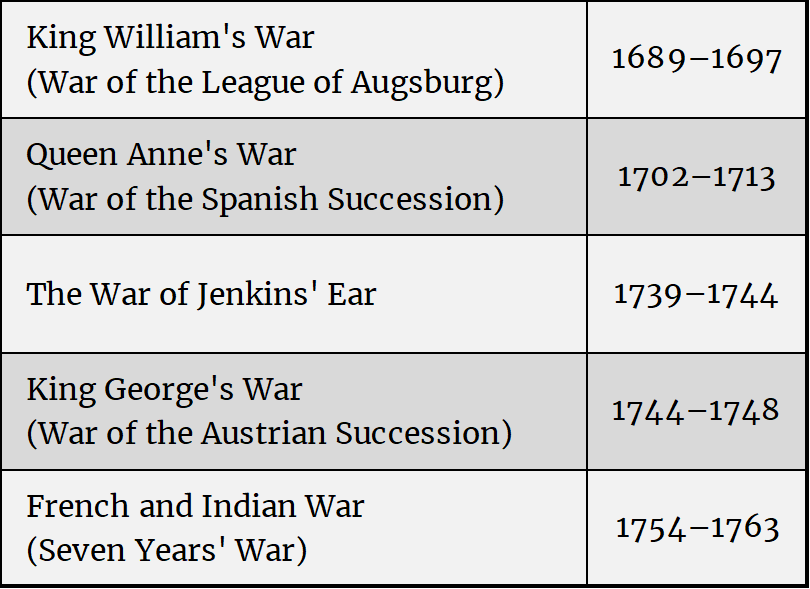
the colonial wars were often named differently in the colonies compared to Europe because they made up only a portion of each conflict. The table above lists the associated European name for each war in parentheses
The Real First World War
Conflict on the American frontier helped spark the next conflict in Europe: the Seven Years’ War. The American portion of that conflict, the French and Indian War, was primarily the result of territorial disputes in the growing colonies. These disputes were spurred on by the British Prime Minister William Pitt’s belief that the future of the British Empire lay in trade and its holdings in North America. In the mid 1750s, the French constructed a line of forts in the Ohio Valley, in what is now Pennsylvania but what at the time was part of Virginia’s land claim in the American West. In 1754, Virginias Governor Dinwiddie dispatched a young lieutenant colonel names George Washington to lay claim to the territory and build a fort.
When he arrived at his destination, George Washington discovered that the french had beaten him to the punch. they’d occupied Fort Duquesne, and a french scouting party patrolled the area. Washington attacked the small party, fearing that his men would soon be under French attack. the skirmish resulted in the death of the french ensign leading the party, at the hands of one of Washington’s Indian companions. the French forces at For Duquesne responded to the attack with an assault of their own on the Virginian’s fortifications at Fort Necessity. They were able for force Washington’s surrender and elicit a confession for “assassinating” the ensign in the first attack. Washington could not read or speak french, so he has no idea what he signed that day.
After his defeat by the french in 1754, washington returned with more men in 1755, this time led by british regulars under the command of General Edward Braddock. the action ended in disaster, primarily becasue Braddock would not listen to the advice of colonial military leaders, and the colonial militia wouldnt listen to the British officers. Most Birtish citizens felt that Americans were backward and ignorant. this translated into military leadership that refused to attribute any valu to the colonial backcountry experience. most american colonists felt that many britons failed to understand that european conditions were not the same as those in the backcountry of North America. the colonists also viewed british officers as pampered aristocrats who did not deserve an measure of respect. This combination of factors proved decisive in braddock’s campaign in the American west. braddock’s campaign would end with braddock dead and washington on his way to colonial fame.
The battles in the ohio valley were just one part of the british strategy to drive the french from north america. between 1755 and 1757, the british launched a campaign against french holdings in canada. teh results were not always positive, but in 1759, the british were well on theri way to achieving their goal. once the british controlled the st. lawrence river and then took montreal, the ultimate victory was within their grasp. their eventual victory became even more assured thanks to an alliance with the iroquois. by 1763, the british had swept the french from colonial north america and ensured british dominance of teh atlantic world.
Effects of the French and Indian War
the introduction of british regulars into colonial territory that had alwasy relied on the militia for defense created tensions that would reverberate over the coming decades. losses to the french during the early years of the war lef to a kind of blame game between colonists and the british officers. each had different expectations of their respective roles, and neither side communicated with the other when conflict arose. the british army was a professional fighting force. its officers came from the upper class, and teh military was a career meant for second sons on the aristocracy and gentry. conversely, colonial forces consisted of civilian soldiers, lef by prosperous community members, who were contracted to serve, complete theri mission, and then go home. the britons expected the same discipline of the colonial soldiers as the british regular.
Native Americans in Colonial Wars and Intertribal Conflict
Intertribal warfare existed long before European contact, however, native tribes became caught up in the european colonists wars. tribes often allied with the europeans to maintain their own interests, particularly as they competed with each other for trade with the Europeans.
The movement of more tribes into the West and the introduction of teh horse to native american tribes also added to tribal conflict. the introduction of the horse casued many formerly agriculteral nations to become nomadic. This shifted the balance of power in favor of the nomadic tribes, which now often raided sedentary villages ratehr than participating in trade. shifting relatsionships among native american tribes in the eighteenth century had a significant impact on the tribes of teh great plains, mainly as more tribes migrated westward. these shifts would ultimately impact how various tribes reacted to american settlers who poured west in the nineteenth century.
Trade & Taxes
Trouble in 1763
Beginning in 1754, Americans contributed to the war effort against the french and saw themselves as a critical and equal part of the growing british empire. In 1763, just after the end of the French and indian war, a series of policies and events created an increasingly tense environment in the British colonies: standing armies. the Proclamation of 1763, and debt.
British Standing Armies
One of the primary issues was the British government’s desicion to leave a garrison of troops in the american colonies. to many americans, this represented a iolation of long-held english tradition. there was no need to maintain a standing army in the british isles since the english channel kept the nation relatively safe from attack. to the english, a standing army meant that the king could and would use it. as brtish troop numbers increased during the war and remained inflated after the french defeat, the colonists began to fear that the military was there only to oppress them. the military presence helped create an atmosphere of mistrust in the colonies.
The Proclamation of 1763
One of the most essential british policies encated in 1763 was an attemp to pacify the Native American tribes in the western territory. this attempt became a serious item of contention between the british government and the american colonists. tribes living beyond the appalachian mountains feared that, with the removal of the french from the territory, the english settlers would puch fearlessly into the interior of north america and drive tribes off their land. The British government, which wanted to assure the native americans that they and their land would be respected, passed the royal proclamation of 1763. this proclamation closed the ohio valley to any official expanshion by the american colonists. It drew a line across the crest of the appalachians and declared that any land drained into the atlantic wass open for settlement. settling beyond the rest of the mountains was illegal. this assurance to the native americans was perceives as tyranny bu the american colonists. they was the proclamation as an attempt to keep british subjects close to the coast, which would make it easier for the british government to control them. it also seemed to correspond to the attitudes of the british regarding the contributions of americans in the french and indian war. americans sould not understand how their government could prevent them from moving into the terrioty they had spent money and lives to win from the french.
British Debt
War is expensive, and britan had been at war on and off for over a century. By 1766, the government was spending more than it was taking in, and the interest on the accumulated war debt was a significant part of the budget. over the next decade, steps taken by the british parliament and the kings ministers to alleviate the pressures of the debt would shape the course of history.
Changing British Tax policy
The french had been driven from most of the continent, and it should have been an age of growth and prosperity that brought americans closer to the people of Great Britain. that was not the case. because of the heavy burden of debt carried by the government in london, it was necessary to raise money from as many sources as possible. as a result, british tax policy became a primary issue after 1763.
The Sugar Act (1764)
Sir George Grenville proposed a plan to raise reveneu without increasing taxes on the people of the British Isles. the first was the sugar act of 1764. grenville hoped to increase revenues, increase legal sugar consuption, and discourage americans from avoiding the tax through smuggling and bribery. the text of the act also explicitly stated that its purpose was to raise funds for military expenditures.
The Stamp Act (1765)
It was a direct tax on most people in society and was more intrusive than any other attempt at taxation. the stamp act required that official documents be printed on embossed or stamped paper. documents subject to the act included newspapers, deeds, wills, official court documents, marriage licenses, tavern licenses, and even playing cards.
Reaction to the stamp act
In Virginia:
The reaction took the form of rhetorical and legislative actoin. in the virignia house of burgesses, debate raged on how best to address the hated taxation that would soon be required of every american colonist. Patrick Henry delivered his famous Stamp Act Resolves in the House of Burgesses in Virginia, challenging parliaments authority. The resolves declared that, as Englishmen, virginians had certain rights and that parliament was violating these rights. News of teh resolves spread across the colonies in newspapers. this inspired others to resist and laid the groundwork for a more unified colonial response
Samuel Adams and the Sons of Liberty
In Massachusetts, opposition turned violent. this lef to the rise of Samuel Adams and the Sons of Liberty as a powerful political force. on august 14, 1765, the sons of liberty hung an effigy of andrew oliver, the stamp master, and later destoryed hus office and vandalized his home. they also attacked the house of lieutenant governor francis hutchinson, whom they believed suppoerted the stamp act.
Stamp Act Congress
Massachusetts’s legislature urges other colonies to meet at Federal Hall in New York, leading to the Stamp Act Congress in october. representatives from nine colonies were in attendance. delegate focused on the constitutional principle that taxation required direct representation. The Congress’s Declaration of Rights and grievances pledged loyalty to the Crown while denying parliaments authority to levy direct taxes, distinguishing between taxation of trade and internal colonial taxation.
Stamp Act Repealed
Political changes and pressure from the American colonists brought the repeal of the Stamp Act in early 1766 before it could go into effect. The British government did not let the issue go easily. Parliament answered American claims with the Declaratory Act (1766), which established the sovereignty of the Crown and declared that Parliament retained power and authority regarding all colonial matters, both internal and external. It was a broad statement of royal power that was vague enough to allow interpretation on both sides.
The Impact Of the Stamp Act
British victory in the French and Indian War created a new British Empire with extensive holdings in North America, which King George III and Parliament were not ready to administer. The cost of fighting several wars and managing such far-flung territory created a financial crisis that called for innovation and leadership, qualities not readily available in London. Americans believed that their participation in the war had proven they were contributing members of the British Empire and were entitled to all the rights on Englishmen under English law. the passage of the Sugar Act and Stamp Act seemed to the American colonists to be a violation of their rights as Englishmen. It emphasized their perception of being considered less than full citizens. the Stamp Act Resolves and the Stamp Act Congress were not intended as the beginning of a rebellion. Instead, they were meant to insist that they, as British citizens, receive the same rights that their fellow citizens across the atlantic enjoyed. the real consequence was that by 1766, american colonists had opened lines of communication between the colonies and, at the Stamp Act Congress, has learned that nay united declaration would require debate and compromise because of regional differences.
The Townshend Acts (1767)
In 1767, a new chancellor of the exchequer, charles townshend, enacted a new set of legislation that regulated trade and placed new taxes on common goods imported from england. among the items that fell under these laws were goods that could only be shipped from englad, such as china, lead, paint, paper, and tea. parliament felt that colonies were still not producing enough revenue to maintain the troops stationedin America. Accustomned to defending themselves, the colonists did not want the military garrison for protection against a threat they believed no longer existed in North America. American colonists resented the taxes imposed by the townshend acts, but other provisions increased their fears that they were being treated differently from other members of the british empire. The British government issued writs of assistance to customs officials. they were open ended search warrants that allowed homes and businesses to be searched for smuggles goods for any number of reasons. the enforce the new measures, customs boards and four vice-admiralty courts were added in the colonies to bring accused smugglers to justice.
Reaction to the Townshend Acts
Many actions were repeat of the events from the Stamp Act. More pamphlets and newspaper articles against the act were printed, but americans took other measures against the policies of the british government. massachusetts took the leading role among the colonies. in december 1767, the massacusetts general court adopted the Massachusetts Circular Letter written by Samuel Adams, which called for the other colonies to join them in protest against the taxes. the letter went out to their fellow colonies in february and again in april. virginia was one of the first colonies to adopt measures that once again claimed that parliament could legislate for the empire and regulate trade, but could not tax the colonies without consent.
In January 1768, a series of newspaper articles began to appear that created constitutional arguments against all taxationjby parliament to raise revenue. the twelve pieces, now known as the Letters from a Farmer in Pennsylvania to the Inhabitants of the Biritsh Colonies, were nedded by John Dickinson, who was not a Pennsylvania farmer but a lawyer living in Philadekphia. in addition to the claims against Parliamentary taxation, Dickinson warned that continuing issues could bring conflict between the colonies anf the mother country. He advised the colonists to avoid commiting any acts of violence in response to the new policies.
While colonial legislature passed resolutions and private citizens drafted arguments published in newspapers, many merchanter in colonies began taking measures to put economic pressure on parliament to repeal the Townshend Acts. the merchants of Boston were the first to organize a boycott, structuring a non-importation agreement that asked shopkeeper to no longer import the taxed british goods beginning on January 1, 1769. the movement spread to other colonies, most notably large trading ports such as new york and philadelphia. hwen the virginia house of burgesses passed its resolution regarding Parliamentary taxation in april, Governor Lord Botetourt dismissed them. Instead of returning to their homes immediately, the members met in the Raleigh Tavern.
In England, it took some time for colonial protests to have any effect on governmental policy.
The Boston Massacre
By 1770, the British Crown felt it needed to respond to the agitation in the colonies with a show of force. Boston was the center of resistance, and since it was one of the primary port cities of the colonies, the government sent British troops to maintain the peace. Their efforts did not garner the results they had intended. as time passes, the people of boston began to resent the 1000 troops housed in their city. these actions led to what became known as the boston massacre, an event in which british soldiers fired upon and killed five colonists.
Committees of Correspondence
In Virginia, the colonial legislature, which was not scheduled to meet until June, was called back into sessoin in February to resolve an economic crisis in the colony. Whiche in Williamsburg the members met after hours in the raleigh tavern to discuss the possibility of forming a committee of correspondence to communicate with other colonies about the issues with britain. they wanted to create a unified organization to determine the best resolution for the rising tensions that threatened the peace of the british empire. by March 12, 1773, the committee was in place, and the resolutions were recorded in the journals of the house of burgesses, stating the reasons for the committee and its responsibilities.
The Tea Act
The parliamentary action that pushed colonial tensions past the breaking point was not about revenue. The tax on tea was never about the price for the american colonists; it was about principle. the tea act was a way to set a precedent of taxation that could prove to be the end of the lierty they had long enjoyed. if americans bought the taxed tea, they would be accepting the right of parliament to tax the colonists in any other way.
Colonial reaction to the tea act and everything it meant would provide the environment for one of the most famous events in American history. Opposition to the tea act led to the boston tea party. members of the sons of libery disguides as mohawk indians, dumped 342 chests of east india company tea into the harbor in december 1773. this event was a major push toward to revolution because it led to a strong english response that further inflamed tensions: the Intolerable Acts.
The Intolerable Acts
England’s reaction to the Boston Tea Party, the Coercive Acts, was set to take effect on June 1, 1774. the British government claimed that boston needed to pay for the lost tea, and the government was willing to do whatever necessary to ensure the repayment and to remind the people of Boston of royal authority.
The Intolerable Acts were a series of legislation that used economic and political means to force the people of massachusetts into accepting the right of parliament to govern all aspects of the colonies.
Closed the port of Boston to all trade. this effectively cut off merchants from lines of commerce and the people from the everyday necessities of life.
Revoked Massachusetts’s colonial charter. this dissolved the legislature and replaced the civiliam authority of the royal governor with a military governor who held all the power
Closed Massachusetts’s courts. Trials scheduled in the colony were either moved to England or other nearby colonies.
Provided housing for British troops. The 3000 British troops sent to enforce the law were to be housed (or quartered) in unused buildings in the city of boston. these were primarily government buildings that had become unnecessary.
Although Britain meant the Intolerable Acts to be a show of force that would teach Massachusetts a lesson and instill fear in other colonies, it had the opposite effect. When citizens look at what was happening in New England, they was the potential for the same reaction, which created a shared sense of unity among the colonies. Virginians took a strong stand against British policy, whihc was significant as they were the largest and most powerful colony and, despite previous rhetoric, the most loyal to the crown.
On May 24, Virginia’s House of Burgesses published a call for all Virginians to observe a day in support of the people of boston on june 1, the same day the acts were to go in effect. The members called for a day of fasting, humiliation, and prayer to ask for divine intervention on behalf of their New England brothers. When Virginia’s royal governor learned of this response, he dissolved the House of burgesses so it could not take any further actions.
While Bostonians prepared for what they considered a military siege and Virginians rallied in support of them, representatives of the two colonial assemblies used their standing committees of correspondence to communicate the desire to call a meeting of representatives of all the colonies to discuss their response to British colonial policy.
Colonial Rebellion
In early 1775, London merchants petitioned the government for reconciliation with the colonies. Exports had dropped by 90% because of the Continental Association. The Earl of Chatham and Edmund Burke proposed measures for conciliation. Burke, arguing in the House of Commons, stated, “The people of the Colonies are descendants of Englishmen…They are therefore not only devoted to liberty, but liberty according to English ideas, and on English principles.” Their proposals were rejected, and rather than attempting to negotiate with the colonies, Parliament declared Massachusetts in rebellion on March 23 and dispatched Lieutenant General Thomas Gage with more troops bound for Boston.
As statesmen argued the cause of the colonists in London and the people of Massachusetts braced for another wave of armed soldiers, the leaders of other colonies watched and prepared for what might be their own experience with British tyranny. In Virginia, the House of Burgesses, now dissolved and reformed as the Virginia Convention, met for the second time in RIchmond. They debated the need to raise a militia for the defense of teh colony against British aggression. It was at this meeting that one of the most impassioned speached of the period was delivered, addressing the state of affairs between the mother country and the colonies.
Give Me Liberty Or Give Me Death Speech
Patrick Henry, March 23, 1775
“No man thinks more highly than I do of the patriotism, as well as abilities, of the very worthy gentlemen who have just addressed the House. But different men often see the same subject in different lights; and, therefore, I hope it will not be thought disrespectful to those gentlemen if, entertaining as I do opinions of a character very opposite to theirs, I shall speak forth my sentiments freely and without reserve. This is no time for ceremony. The question before the House is one of awful moment to this country. For my own part, I consider it as nothing less than a question of freedom or slavery; and in proportion to the magnitude of the subject ought to be the freedom of the debate. It is only in this way that we can hope to arrive at truth, and fulfill the great responsibility which we hold to God and our country. Should I keep back my opinions at such a time, through fear of giving offense, I should consider myself as guilty of treason towards my country, and of an act of disloyalty toward the Majesty of Heaven, which I revere above all earthly kings.
Mr. President, it is natural to man to indulge in the illusions of hope. We are apt to shut our eyes against a painful truth, and listen to the song of that siren till she transforms us into beasts. Is this the part of wise men, engaged in a great and arduous struggle for liberty? Are we disposed to be of the number of those who, having eyes, see not, and, having ears, hear not, the things which so nearly concern their temporal salvation? For my part, whatever anguish of spirit it may cost, I am willing to know the whole truth; to know the worst, and to provide for it.
I have but one lamp by which my feet are guided, and that is the lamp of experience. I know of no way of judging of the future but by the past. And judging by the past, I wish to know what there has been in the conduct of the British ministry for the last ten years to justify those hopes with which gentlemen have been pleased to solace themselves and the House. Is it that insidious smile with which our petition has been lately received? Trust it not, sir; it will prove a snare to your feet. Suffer not yourselves to be betrayed with a kiss. Ask yourselves how this gracious reception of our petition comports with those warlike preparations which cover our waters and darken our land. Are fleets and armies necessary to a work of love and reconciliation? Have we shown ourselves so unwilling to be reconciled that force must be called in to win back our love? Let us not deceive ourselves, sir. These are the implements of war and subjugation; the last arguments to which kings resort. I ask gentlemen, sir, what means this martial array, if its purpose be not to force us to submission? Can gentlemen assign any other possible motive for it? Has Great Britain any enemy, in this quarter of the world, to call for all this accumulation of navies and armies? No, sir, she has none. They are meant for us: they can be meant for no other. They are sent over to bind and rivet upon us those chains which the British ministry have been so long forging. And what have we to oppose to them? Shall we try argument? Sir, we have been trying that for the last ten years. Have we anything new to offer upon the subject? Nothing. We have held the subject up in every light of which it is capable; but it has been all in vain. Shall we resort to entreaty and humble supplication? What terms shall we find which have not been already exhausted? Let us not, I beseech you, sir, deceive ourselves. Sir, we have done everything that could be done to avert the storm which is now coming on. We have petitioned; we have remonstrated; we have supplicated; we have prostrated ourselves before the throne, and have implored its interposition to arrest the tyrannical hands of the ministry and Parliament. Our petitions have been slighted; our remonstrances have produced additional violence and insult; our supplications have been disregarded; and we have been spurned, with contempt, from the foot of the throne! In vain, after these things, may we indulge the fond hope of peace and reconciliation. There is no longer any room for hope. If we wish to be free-- if we mean to preserve inviolate those inestimable privileges for which we have been so long contending--if we mean not basely to abandon the noble struggle in which we have been so long engaged, and which we have pledged ourselves never to abandon until the glorious object of our contest shall be obtained--we must fight! I repeat it, sir, we must fight! An appeal to arms and to the God of hosts is all that is left us!
They tell us, sir, that we are weak; unable to cope with so formidable an adversary. But when shall we be stronger? Will it be the next week, or the next year? Will it be when we are totally disarmed, and when a British guard shall be stationed in every house? Shall we gather strength by irresolution and inaction? Shall we acquire the means of effectual resistance by lying supinely on our backs and hugging the delusive phantom of hope, until our enemies shall have bound us hand and foot? Sir, we are not weak if we make a proper use of those means which the God of nature hath placed in our power. The millions of people, armed in the holy cause of liberty, and in such a country as that which we possess, are invincible by any force which our enemy can send against us. Besides, sir, we shall not fight our battles alone. There is a just God who presides over the destinies of nations, and who will raise up friends to fight our battles for us. The battle, sir, is not to the strong alone; it is to the vigilant, the active, the brave. Besides, sir, we have no election. If we were base enough to desire it, it is now too late to retire from the contest. There is no retreat but in submission and slavery! Our chains are forged! Their clanking may be heard on the plains of Boston! The war is inevitable--and let it come! I repeat it, sir, let it come.
It is in vain, sir, to extenuate the matter. Gentlemen may cry, Peace, Peace-- but there is no peace. The war is actually begun! The next gale that sweeps from the north will bring to our ears the clash of resounding arms! Our brethren are already in the field! Why stand we here idle? What is it that gentlemen wish? What would they have? Is life so dear, or peace so sweet, as to be purchased at the price of chains and slavery? Forbid it, Almighty God! I know not what course others may take; but as for me, give me liberty or give me death!”
The War Begins
Henry’s words were eerily prophetic, as fear, suspicion, and oppression would lead to armed conflict in two small Massachusetts towns on April 18 and 19, 1775. The Battles of Lexington and Concord were the final spark leading to the Revolutionary War.
On April 18, the Sons of Liberty received intelligence that the British Regulars were coming. Paul Revere, along with several tohers, famously rode out to spread the word to the colonists. The British, under orders from General Thomas Gage, had two primary objectives upon arrival. First, they would capture Smauel adams and John Hancock in Lexington and then seize a store of gunpowder in Concord. at dawn, the British reached Lexington to find that Hancock and Adams were gone. Instead, they were opposed by a group of about seventy minutemen, volunteer militiamen who were trained to be ready to fight at a moment’s notice. As the British yelled for the minutemen to disperse, a shot rang out. To this day, no one knows which side fired that shot, but after that, the British fired several volleys, leaving at least seven minutemen dead and more wounded. The British suffered only one injury within their ranks.
The British pushed on to Concord, determined to burn any gunpowder or weapons they found. When they arrived, they found only empty buildings where the munitions stores would have been. Nevertheless, the colonists took the opportunity to attack the British. Surprised, the British began retreating toward Boston but were attacked again by more colonial militiamen. By firing at the British from the forests, fences, and buildings, the colonists were able to inflict higher casualties (at least 125) as pull off the first colonial victory of the Revolution.
On April 20, only a day after the battle, Governor Dunmore ordered a contingent of British soldiers to move into the town of Williamsburg, Virginia, under the cover of darkness and remove stores of gunpowder from the colonial magazine. It was for the same purpose undertaken by Gage in Massachusetts.
The Fighting Spreads
Following the events at Lexington and Concord, Americans understood that words and negotiations could no longer solve their differences with Great Britain. They would need to take further military action to make their position understood and secure their rights as Englishmen.
The Taking of Fort Ticonderoga
The French and Indian War had left several fortifications throughout the colonies. One such place, Fort Ticonderoga, was in upstate New York. On May 10, less than a month after Lexington and Concord, Benedict Arnold joined Ethan Allen and the Green Mountain Boys on a dawn attack. They took the sleeping fort completely by surprise. This was a huge morale boost, but more importantly, it gave the colonial forces artillery. The captured artillery from Fort Ti was rolled through the countryside on the way to Boston and another famous battle of the growing American Revolution.
Battle of Bunker Hill
The colonists had learned that the British were sending troops into the coutnryside around Boston to supress the growing rebellion. Colonel William Prescott and around 1000 American troops prepared to meet the British on Breed’s Hill, which was closer to the city than nearby Bunker Hill, where Prescott had initially ordered his troops, resulting in the misnaming of the battle, whihc stuck. The next day, the British troops under Major General William Howe and Brigadier General Robert Pigot marched toward Breed’s Hill. Because the colonists were low on ammunition, tradition says that Prescott ordered his men not to fire “until you see the whites of their eyes.”
The Americans forced the British to retreat the first two times they attempted to take the hill; however, on the third attack, the lack of ammunition forced the colonists to fall back sfter engaging the professions soldiers in hand-to-hand combat. While technically a British victory, the americans inflicted heavy casualties on the British, with more than 200 killed and 800 wounded. The Americans suffered far less severely wuth 100 killed and 300 wounded. thsi battle was seen as proof that, despite the Americans lack of training, their dedication could be enough to resist the formally trained british soldiers.
The Second Continental Congress
While delegates to the First Continental Congress left Philadelphia in October 1774, they already had a standing agreement that they would meet again in May 1775 if they had not received a postitive response from parliament. When King George III opened Parliament with words that indicated the complaints of the colonies would not be heard, the delegates knew they would meet again. News of the events of April 1775 in Massachusetts reached many of the delegates on the road to Philadelphia for the Second Continental Congress, where they convened on May 10. The original goal for the representatives of the thirteen colonies (Georgia finally sent one delegate) was to further respond to Britain and seek peaceful reconciliation with their government in London.
The delegates settles into their work, making provisions for peace by selecting people to work on a draft of a document to send to England. They also rpoactively undertook measures to prepare for war by selecting one of the delegates from Virginia as the commander-in-chief of the newly formed Continental Army. They chose an experienced military man with the physical bearing and character to be a successful leader. George Washington accepted his commission from the Continental Congress and left almost immediately to meet his growing army outside Boston, fresh from their experiences on Bunker Hill.
Declaration of the Causes and Necessity to Taking Up Arms
As militia units became a formal army and rumored war became reality, Congress asked for a document that would present to the world the reasons the colonies took up arms against their government. The first draft of the Declaration of the Cause and Necessity of Taking Up Arms came from the pen of thomas Jefferson, who attempted to explain why the colonists had reacted as they had. Revisions to the draft were made by John Dickinson, who, despite initially advocating conciliation, took a stronger tone when drafting a final document. Their words provided a clear statement regarding the purpose and role of government, the rights of citizens, and the consequences of governments abdicating their authority. The document also contained a warning: “Our cause is just. Our union is perfect. Our internal resources are great, and, if necessary, foreign assistance is undoubtedly attainable. — We gratefully acknowledge, as signal instances of the Divine favour towards us, that his Providence would not permit us to be called into this severe controversy, until we were grown up to our present strength, had been previously exercised in warlike operation and possessed of the means of defending ourselves. With hearts fortified with these animating reflections, we most solemnly, before God and the world, declare, that, exerting the utmost energy of those powers, which our beneficent Creator hath graciously bestowed upon us, the arms we have been compelled by our enemies to assume, we will, in defiance of every hazard, with unabating firmness and perseverance, employ for the preservation of our liberties; being with one mind resolved to die freemen rather than to live slaves.”
The Olive Branch Petition
While Congress prepared for war and stated their intent to protect their liberties, they also presented King George III with one final appeal to intercede with Parliament on their behalf. In the Document, they did nto declare any disloyalty to the Crown or insist that any blame for the events lay with him. The Continental Congress placed responsibility for all the tensions and violence squarely on the shoulders of Parliament, the kings’ ministers, and British officials in the colonies, who did not have the best interest of citizens of sovereignty at heart. The missive document, known as the Olive Branch Petition, was hand-delivered to London by Richard Penn, Pennsylvania’s governor. Not only did the king not read or respond to the document, he also refused to receive the colonial emissary. On august 22, he declared all American Colonies in open rebellion against Britain.
Common Sense
On January 10, 1776, a small pamphlet was published that shaped many American’s opinions toward the cause of liberty. Titled Common Sense: Addressed to the Inhabitants of America, the document was a reasonable argument for the growing independence movement when most people still considered themselves British Citizens who were being denied their rights as Englishmen. The pamphlet’s author, Thomas Paine, presented his ideas on the nature and purpose of government and the reasons why America should break away from Great Britain and become a sovereign nation. The pamphlet was immensely popular with the American people. Written in a readable style, more sermon than a poitical treatise, most poeple could easily comprehend the ideas it contained. This was relatively unique for the documents written at the time. over 10,000 copies were sold in 1776 alone, and many colonial newspapers printed the text of teh document on their pages. With this kind of circulation, it is possible that most of America’s 2.5 million citizens either read the pamphlet or had part of it read to them.
Declaring Independence
While the American colonists were reading Thomas Paine’s reasons for declaring independence, events in the colonies were pushing delegates toward that end. After much deliberation in Williamsburg, on May 15, the newly formed Virginia General Assembly sent a representative with instructions to their delegation to propose American independence. The Virginians had declared themselves colonists no more; they were not a commonwealth, an independent republic. Their proposal to the Continental Congress in Philadelphia, presented on June 7 by Richard Henry Lee, was a formal request that all the other colonies join them in this action. The delegates from North Carolina had already been instructe dto vote for independence should it be proposed, but other colonies were so opposed to the idea that they threatened to abandon the meetings.
Ratehr than debate the idea of independence, Congress decided to postpone consideration of the Virginia proposal until a committee could draft a statement of why independece was a logical cource of action. The Committee of Five selected to put the ideas to paper contained the following members: John Adams - Massachusetts, Roger Sherman - Connecticut, Robert Livingston - New York, Benjamin Franklin - Pennsylvania, and Thomas Jefferson - Virginia.
Once selected, the delegates met to discuss the document’s outline, and Thomas Jefferson was chosen to provide a draft for consideration. Jefferson had distinguished himself in the first meeting on Congress and seemed like an excellent choice to take on this vital task. John Adams later reported in a letter that Jefferson at first declined the role, choosing to defer first to Franklin and then to John Adams as the elder statesmen. Franklin and Adams both refused, insisting that Jefferson was the person better suited, leaving the younger man to ask for the reasons.
Jefferson accepted the challenge of drawing up a draft. If just seventeen days, during which he was nto required to be in general or committee meetings, jefferson had a draft edited by Adams and Franklin and was ready to present to the full Congress. On June 28, the committee presented teh Declaratino of INdependence for review and debate by Congress. Over the next few days, over eighty changes were made to Jefferson’s original, the most
Natural Rights and the Legacy of the Declaration
The most recongizable line from the Declaration is this: “We hold these truths to be self-evident, that all men are created equal, that tehy are endowed by their Creator with certain undeniable Rights, that among these are Life, Libtery and the pursuit of Happiness.”
The War in the North, 1775-1778
After Lexington and Concord, the British entrenched themselves in Boston, waiting anxiously for reinforcements to arrive to release them from the siege set by American forces. The Patriots, confident in their ability to hold the British where they were, planned a daring action to invade Canada to garner the support of its people for the American cause. Initially, the Canadian campaign went well, but it failed when the siege of Quebec ended in defeat. The colonial army admitted the loss and left Canada.
The New York Campaign, July-November 1776
On August 22, 1776, British troops landed on Long Island. The Continental Army under Washington moved to counter the British force. Washington did all he could to prepare his men, but the British overran the American forces at Brooklyn Heights in less than three days. The British took advantage of a lesser-known approach, called Jamaica Pass, which had been not properly fortified and was guarded by only a handful of troops. By pushing through the pass, the British were able to outflank Washington’s forces. This forced Washington to stage a retreat to Manhattan that succeeded only due to the British commander General Howe’s failure to immediately capture the defeated American forces. The Patriot retreat was also aided by a heavy fog that shrouded their boats. During the battle, the British had only 400 casualties while the Americans suffered a loss of 1000. By September 15, New York was back in British hands. The Battle of New York ravaged the Continental Army, severely lowering its morale.
As Washinton’s tired and defeated troops settled in for winter encampment, the general knew he had a problem on his hands. The newly formed Continental Army was starving, cold, and just waiting for their individual terms of enlistment to expire so they could go home to their families. Washington needed something to inspire the men and provide a morale boost tht would help them face the long winter and the new campaign in the spring. Washing chose to launch an attack on a Hessian garrison in the nearby town of Trenton, Ney Jersey, moving his men on Christmas Day. Before doing so, he attempted to inspire his troops by having another of Thomas Paine’s works read aloud to them.
The Battles of Trenton and Princeton, December 1776-January 1777
Washington coordinated a three-pronged attack on the Hessian troops at the Battle of Trenton. First, Washington’s troops famously crossed the Delaware River. Due to frigid temperatures and ice, Colonel John Cadwalader and General James Ewing were forced to turn back, leaving Washington and his 2400 troops to make the nineteen-mile journey to face the 1400 man Hessian garrison alone. Washingtons men were also delayed due to the weather and arrived in the early hours of the morning on December 26, taking the enemy troops by surprise.
After ordering a retreat back across the delaware, knowing the continental army could not hold trenton, washington learned that General Cornwallis was marching south from Princeton. Gathering men wherever he would, washtington marched back to Trenton and engaged the british forces in several skirmishes. thinking he had Washington trapped, corwallis retired for the evening. that night, Washington left men behinf to keep the fires going to make it appear that the C was still camped at trenton. meanwhile, he marched the majority of his men north to Princeton as quietly as possible. The americans won another victory at princeton and captured supplies and prisoners. they then continued their march north rather than retreating south.
The Saratoga Campaign, June 1777-October 1777
The Battle of Saratoga included some of the most famous figures of teh american revolution. It would set the stage for america to ally herself with one of england’s most prolonged and bitter rivals, france. Following the failed invasion of canada, british general william howe gathered the remaining british troops in the north, placed them under the command of general john burgoyne, and ordered the toward teh american held Fort Ticonderoga. The fort, commanded by colonial General Arthur St. clair, fell easily into British hands. Burgoyne left enough troops to secure the forst and tehn headed south to S where he set up camp. Meanwhile, over ten thousand colonial troops under General Horatio Gates and Benedict Arnold were just a few miles away. The first battle at Saratoga occurred at Freeman's Farm on September 19, 1777. During this battle, the British sustained heavy losses due to riflemen who concealed themselves in the field's thickly wooded area. Although this first battle was essentially a British victory, the heavy casualties suffered by the British weakened Burgoyne's forces heading into the next battle. On October 7, at Bemis Heights, Burgoyne attacked the American troops again. This battle resulted in a British defeat and the first official British surrender of the war.
America’s First Government
Articles of Confederation
The first governing document of the United States was the Articles of COnfederation. It attempted to balance the need for unity with the need for a strong authority that could compel the states to do things. Proposed in 1777 and finally ratified in 1781, the government it formed was weak, awkward, and unworkable for a nation of such diversity in culture and ambition.
To keep the new United States central government from being too powerful, the new governing document severely restricted how it functioned. Under the Articles of Confederation, state representative bodies elected officials to serve in the national congress, which was a unicameral legislature with only one vote per state, regardless of the number of representatives sent from that state. There was no independent executive or national judicial branch. Any dispute between the new states could be decided in either party’s independent court system or both, creating a formula for confusion and chaos
Structure of the Articles of Confederation
Unicameral Legislature: One Vote per state
No executive or judicial branch
supermajority (9 of 13) required to pass major legislation
unanimous vote required to amend the articles
Major legislation required a supermajority of nine out of thirteen votes to pass, and should the government find it necessary to amend the Articles, all thirteen states needed to agree before it could be ratified. Congress had no authority to ratify treaties negotiated with foreign governments, meaning that the Treaty of Paris (1783) went to the individual states for ratification, any of which could have refused to agree
Legislation under the articles
Land Ordinance of 1785
Following the end of the American War for Independence, there was a dispute on how to handle western lands. In 1780, the possession of western land, or lack thereof, by certain states created a potential for trouble in the early years of the new nation. Seven of the original thirteen states, known as “landed” states, had claims to these lands, and their reach extended far beyond their borders. F example, in 1776, the area of modern-day Kentucky had been organized into a county of Virginia, as had other large tracts of territory. Smaller “landless” states with no claim on western land, feared that their interests would be overwhelmed by the landed states, especially Virginia, which by 1781, claimed 1/5 of the United States population.
As a remedy for smaller states’ fears, most land west of the Appalachians was given to the national government between 1781 and 1787. Some states ceded the land in exchange for the national government’s assumption of war debt, making the states largely debt-free but adding debt to the central government. To offset the cost of the newly acquired debt, Congress passed the Land Ordinance of 1785, which provided for the survey and sale of western lands to repay the money now owed by the national government. As a provision of the ordinance, western lands were to be divided into townships measuring six square miles and further subdivided into t lots of 640 acres. the land was to be sold at auction beginning at $1 per acre. one tlot in the township was set aside to establish a public school to provide access to basic education for the town’s citizens.
Northwest Ordinance of 1787
With the national government surveying land and providing for the West’s settlement, it became necessary to provide a system by which the territory would be governed and new states admitted to the Union. The Northwest Ordinance of 1787 set up a three-step system for bringing those areas into union with the rest. In the first step, a governor, secretary, and three-judge panel were provided for the territory’s administration. When the area reached 5,000 free males of voting age, the people living within the territory could elect a representative assembly and choose one non-voting delegate to Congress. When the population reached 60,000, the territory could draft a constitution and apply for statehood. The ordinance further guaranteed that new states brought into the Union would be equal to the original thirteen without reservation. One of the most important provisions of the Northwest O of 1787 was its prohibition of slavery in all territories noth of the Ohio RIver and west of the Mississippi River. This provision would provide a precedent that would shape American policies in the nineteenth century.
Problems with the Articles of Confederation
Eventually, serious problems with the system of government established by the Articles of Confederation became apparent and caused numerous issues. This period has become known as the Critical Period.
Following the ratification of the Treaty of Paris, the lack of any central authority to deal with international affairs became clear. Within a few years, foreign countries restricted American trade, and with no national government, there was no real way to respond. During this period, Spain moved into United States territory in the South, and British troops continued to occupy forts in the Northwest Territory with little fear of a government that possessed no power to enforce the conditions negotiated in any treaty. Because they were the ratifying power of treaties, even individual states ignored portions of treaties they did not find acceptable. From its infancy, America’s very existence was threatened by foreign powers.
With its assumption of some states’ war debt, the new United States suddenly owed $42 million to its creditors. In today’s terms, the national government started $40 billion in the red. The fact that the government possessed no power to raise money aside from the sale of western lands, which was not going as well as hoped. The national government could request tax money from separate states, but the requests were either ignored or refused. It had no power to tax the states or the people who lived in them for any reason, so the national government was nearly penniless.
The national government had no power to keep domestic peace within its borders. The Articles of Confederation did not create a national government as we understand it. Instead, it created a partnership in which the states participated only as far as the confines of their self-interest. During this period, interstate commerce was a serious problem. States could and would limit commercial activities between themselves and impose protective tariffs on certain goods. Other states would then retaliate with tariffs and protections of their own. This kind of interstate squabbling threatened to pull the fabric of the tenuous union apart.
Shays’s Rebellion
As the war ended and life returned to some semblance of normality, the American people were plagued by economic problems. Businesses were closing, and there were high debt levels in many areas of society. State governments, which were themslves near bankruptcy, imposed higher taxes. There was no federal power to intervene on any level. One man who personally experienced this economic choas was Daniel Shays, a Massachusetts farmer and former Continental officer. Because of the rising demand for food products during the Revolution, m farmers borrowed money to expand their production. When demand and priced returned to normal, those same farmers could not pay the mortgages they had put on their farms. Many of these men, like Shays, faced the seizure of their property or the treat of debtors’ prison because of foreclosures and taxes.
Fear of being destitute and disenfranchised convinced Daniel Shays to begin gathering support for the closing of local courts in 1786. He believed that the courts in western Massachusetts were conspiring with eastern creditors to take their land and turn a tidy profit on it. The farmers petitioned the Massachusetts govenment to hear their grievances, but they were ignored. In fall 1786, believing they had no other recourse, Shays trained an army of debtor farmers to fight this new tyranny.
The Annapolis Convention: 1786
Issues regarding the Articles of Confederation government led several of the founders to call for a meeting in Annapolis to discuss interstate trade for commerce issues and to form a resolution to many of the nation’s problems. This meeting would become known as the Annapolis Convention. Only five states sent representatives, making it difficult to reach any real conclusions, but James Madison and Alexander Hamilton’s pressure brought Congress to an important decision. They issued a declaration that a convention should meet to address the United States’ problmes and revise the Articles of Confederation. That convention would meet in Philadelphia in May 1787.
The Birth of the Constitution
The Constitutional Convention
From May 25 to September 17, 1787, delegates from twelve states met at Independence Hall in Philadelphia. Only Rhode Island was content enough with the Articles of Confederation to refuse to send representatives. Of the fifty-five men who comprised the Constitutional Convention, thirty-nine had served in Congress, seven had been governors, eight were signers of the Declaration of Independence, and fifteen had helped draft state constitutions.
Some delegates were conspicuously absent. Both Patrick Henry and Samuel Adams declined to represent the states because they opposed a strong national government and feared what might happen if any power were diverted from the states. John jay, one of the brightest legal minds of the say, was serving as U of Foreign Affairs (known today as the Secretary of State), while Thomas Jefferson and John Adams were in Europe serving as the US prime ministers to France and Great Britain. Though some of the most prominent founders were unwilling or unable to attend, many competent people were still in Philadelphia that summer.
The first order of business of the Constitutional Convention was to choose someone to preside over the sessions. By unanimous decision, the members selected George Washington as president of the COnvention, despite the former general originally being reluctant to attend. Only the sound advice of Henry Knox convinced Washington of the necessity of his presence and leadership. IN the early days of the Convention, the delegates decided on three primary rules for the meeting: 1) each state received only one vote, regardless of the size of the delegation; 2) the standard rules of order were to be maintained- it was to be a civilized debate; and 3) the proceedings were to be completely secret, especially after they decided that the Articles of Confederation could not be revised or amended but needed to be completely replaced. Thanks to James Madison, we have detailed notes from the debates that were first published in 1840.
The Virginia Plan
The delegation from Virginia, led by James Madison and Edmund Randolph, presented a set of fifteen resolutions that would set aside the Articles of Confederation and form a new national government consisting of three branches: legislative, executive, and judicial. The legislative branch was to be bicameral (two houses), with representation in each house based on population. Larger states preferred this plan since it placed them in a position of power in the new government.
The New Jersey Plan
New Jersey delegate William Paterson presented an alternative plan to the Convention, the New Jersey Plan. He proposed that the Articles of Confederation be amended to provide more power to Congress but that the unicameral legislature be maintained, with each state having an equal vote on all measures. This proposal was supported by the smaller states, who feared being dominated by larger states in the Union.
The Great Compromise
Roger Sherman of Connecticut presented a compromise that would bridge the gap between the New Jersey plan and the Virginia Plan. He proposed a new system of government under a new constitution to establish the kind of government proposed by the Virginia Plan with three coequal branched of government. The legislative branch would consist of two houses: one with representation based on population and one with equal representation. This proposal became known as the Great Compromise and is also referred to as the Connecticut Compromise.
Slavery and the Constitution
One of the primary issues the delegates faced at the Constitutional Convention was how the new nation would address the institution of slavery. Thomas Jefferson first attempted to deal with the issue in the Declaration of Independence, but his efforts were thwarted by the need to maintain unity. These events were repeated in 1787 when several southern states refused to join the Union if slavery were prohibited.
Three-Fifths Compromise
Once the Delegates came to terms with the fact that the continuation of slavery was necessary to maintain the nation as it stood, questions arose regarding the status of slaves in relation to representation and taxation. At the time, slaves made up nearly one-fifth of the United States’ total population, and southern delegates from states with large slave populations favored counting each slave as a citizen for the purposes of determining representation. Roger Sherman was instrumental in bringing a compromise in this area as well. Under the Constitution, each slave would count as three-fifths of a person for representation and taxation.
International Slave Trade
Other questions arose that concerned the continuation of the international slave trade to America and how to deal with slaves who escaped to states or territories where slavery was banned. Some of the delegates were part of the rapidly expanding movement to abolish slavery by limiting or ending the Atlantic slave trade, which had been feeding the institution for three centuries. When the topic of regulation or abolition of the slave trade arose in the Constitutional Convention, three states threatened to leave if the international slave trade was banned. The answer was yet another compromise that would postpone any debate or legislation on the matter for twenty years. This was accomplished by adding a clause to the Constitution that stated that Congress could not ban the importation of slaves until 1808.
Fugitive Slave Clause
In response to the Northwest Ordinance of 1787, members of the Convention also inserted the Fugitive Slave Clause in Article Four. This clause, which would also be applied to escaped convicts, required states to return escaped slaves to the state of their origin at the slave owner’s request.
Ratification
The final product of the Constitutional Convention was a revised and reworked Virginia Plan. Essentially, the new US Constitution established the framework of the three federal branches of government, listed eighteen limited powers of Congress, provided for prohibitions on the states, and included a “Necessary and Proper” clause to give the government some flexibility to adapt to changing conditions in the country. On the day the Constitution was approved by the delegates, three of those attending refused to sign it. Edmund Randolph declined because the document was not sufficiently republican. The other two, George Mason of Virginia and Elbridge Gerry of Massachusetts, refused because the document provided no declaration of rights to the American people. Their decision would be important to the state ratifying conventions that would either approve or reject the new plan of government.
American Rights and the Ratification Debates
One of the primary issues the Anti-Federalists had with the constitution was that it did not lay out any specific protections for the rights of Americans. To overcome these objections, the Federalists agreed that the first order of business for the new Congress would be to draft and pass a series of amendments to add such protectinos. With suhc an agreement in place, the key states of New York and Virginia finally agreed to ratify the new Constitution in the summer of 1788. North Carolina and Rhode Island would be the last two states to ratify, in 1789 and 1790.
The contents and Ratification of the Bill of Rights
On December 5, 1791, the states ratified the first ten amendments to the Constitution, known as the Bill of Rights. These provisions proteted citizens against government encroachment. Under the Articles of Confederation, the states were loosely unified; however, under the Constitution, a central government was established that could assert its authority over individual states and citizens. Some of the founder argues against adding a Bill of Rights, believing that the Constitution would not allow the central government to usurp powers reserved to the states. Others disagreed, and, in return for ratification of the Constitution, the first then amendments were written. Without the addition of teh Bill of Rights, many delegates at the Constitutional Convention would not have agreed to ratify the Constitution as it was initially drafted.
The primary author of the Bill of Rights, James Madison, based the majority of the Bill of Rights on the Virginia Declaration of Rights written by George Mason in 1776. Some rights guaranteed in the Virginia Declaration of Rights, which can also be found in the Bill of Rights, include freedom of the press, the right to bear arms, the right to due process, and the right to a speedy trial. The 1780 Massachusetts Constitution, drafted by John Adams, also heavily influenced the Bill of Rights because it included a declaration of rights within the document. Additionally, the Virginia Statute for Religious Freedom heavily influenced the First Amendment’s provisions for freedom of religion and no established government church.
The Amendments
Freedom of speech, press, and assembly; right to petition; freedom of religious practice; no established government church
Right to keep and bear arms
Protection from being forced to house troops during peacetime
Protection from search and seizure
Right to due process; protection against double jeopardy; protection against self-incrimination; protection of private property.
Protections in criminal cases (jury trial, speedy trial, public trial, right to confront accuser, right to counsel)
Right to civil trial by jury
Protection against excessive bail and cruel or unusual punishment
Rights of people and states protected; federal government restricted to what is allowed.
Power Granted by the Constitution and the Bill of Rights
Due to the concern over the balance of power between the states and the federal government, certain powers were given to the states. IN contrast, others were delegated to Congress, the president, and the Supreme Court. While the Constitution granted and denied specific powers for the federal government, the opposite is true for the states. The Tenth Amendment was created to protect the power of the states and is notably broad in scope. It states, “The powers not delegated to the United States by the Constitution, nor prohibited by it to the states, are reserved to the states respectively, or to the people.” This has become known as the Reserved Powers Clause and has been an essential part of American law since its passage.
The broad nature of the Tenth Amendment has both positives and negatives. It gives individual states room to set up their systems within the framework of the Constitution. We can particularly see this today with the variety of states in the US and how they can tailor their systems to meet their unique needs. For example, the systems of New York and Montana are different in many ways, as each state has different climates, lifestyles, industries, educational and infrastructural needs, and so on. However, the broadness of this amendment can also be a problem because it allows the states to resist federal authority. This was especially seen after the Civil War with the Southern states’ resistance to the passage and implementation of the 13th, 14th, and 15th amendments.
The Judicial Branch
The Constitution made a provision for a federal judiciary but did not establish the specific offices or courts that should make up the judiciary. The Judiciary Act of 1789 established the supreme court and its subsidiaries and provided for teh federal court system we understand today. Six justices (one chief justice and fice associate justices) were appointed to the first supreme court. The first chief justice of the supreme court was John Jay, a prominent federalist and one of the authors of the Federalist Papers. This court was to have appellate power over federal courts, which menat it would have the authority to overrule decisions made by lower courts. It also had jurisdiction over disputes between states, state governments, and the federal government. This act also set up thirteen judicial districts, each containing circuit courts and district courts. With this aciton by Congress, the three branches of the federal government were complete.
Washington’s Cabinet
Washington’s Cabinet was the first true government of rivals. He names Thomas Jefferson as secretary of state, Jefferson’s rival Alexander Hamilton as secretary of the treasury, Henry Knox as secretary of war, and Edmund Randolph as attorney general. Jefferson and Hamilton had been and remained almost entirely opposed to one another on every issue throughout their political careers.
Presidential Issues: Domestic Affairs
Economic Issues
In the early years of the new constitutional government. The United States was still facing war debts and the issue of how to handle those debts. There was also the question of how much power the federal government would have. These questions provided the basis for the early formation of political parties. Alexander Hamilton believed in establishing a foundation for national credit and building American financial power. The Federalist Party rallied around him as their leader. Secretary of State Jefferson and James Madison, serving in Congress, came out in opposition and formed the Jeffersonian Republicans.
Washington was generally opposed to the idea of political parties. In his farewell address in 1796, he stated, “Let me now take a more comprehensive view, and warn you in the most solemn manner against the baneful effects of teh spirit of party generally…the effort ought to be, by force of public opinion, to mitigate and assuage it. A fire not to be quenched; it demands a uniform vigilance to prevent its bursting into a flame, lest instead of warming it shoudl consume” Despite his vehement opposition, early political parties were fully formed by 1795 and continued to gain influence after washington left office. These early parties provided the basis for the two-party system under which the nation still functions.
Early in Washington’s first term, Alexander Hamilton issued a series of plans that he hoped would alleviate some of the nation’s economic woes. He first proposed that the federal government assume the rest of the separate states’ war debt. He also wanted to create a national bank to provide a repository for federal funds and establish American credit. His plans supported a system of taxes and tariffs and encouraged government assistance to new factories that were beginning to spring up in New England.
Madison and Jefferson opposed the idea of a national bank, noting that it would only provide an opportunity for corruption among federal officials. On principle, Jefferson opposed industrialization altogether. HE claimed that large cities and an industrialized labor force would remove individual opportunities, crushing personal ideas and opinions under the factory owner's; pressure. Jefferson and Madison also opposed Hamilton’s plan because it would put much more power in the central govenment’s hands as opposed to the states. the issue became sectional because Hamilton’s plan would favor the industrializing North instead of the agricultural South. in these arguments, washington remained neutral but seemed to lean toward Hamiltons ideas.
The Dinner Table Bargain
IN Congress, the opposing factions had reached a stalemate regarding these issues. after much debate, jefferson invited hamilton and madison for dinner, where they struck a deal. madison would deliver the votes necessary to pass hamilton’s plan for the nederal government to assume the states’ war debts. In exchange, hamilton would support moving the US capital to a site chosen along the Potomac River, thus locating the capital in the South, Hamilton’s plan passed narrowly on june 26, 1790.
The Whiskey Rebellion
The first real domestic test of the new government occurred in frontier Pennsylvania. As secretary of the treasury, Hamilton recognized that the new central government would require a stable source of revenue to sustain itself, and his plan included a substantial tax on liquor. The tax was a problem for western farmers, who used their excess grain to make the beverage because it was an easily transportable and non-perishable use of the crop. The early protests against the federal taxes quickly turned into an armed rebellion resembling that on Daniel Shays. The new federal mail system was robbed, courts were closed, and the rebels soom threatened the town of Pittsburgh. This test of federal authority brought a much different reaction than the previous one in Massachusetts. Washington attempted to negotioate but was ultimately force to deploy 13,000 militia troops to suppress what became known as the Whiskey Rebellion. The rebellion collapsed without any bloodshed, and two men were convicted of treason; however, washing later pardoned them. Much to Hamilton’s delight, the central government had made its power known.
Presidential Issues: Foreign Affairs
Northwest Indian War
Between 1790 and 1794, the American military engaged in the Northwest Indian War, which broke out when a confederation of Native American tribed sought to retain control of their lands in modern-day northern Ohio. Initially, Congress tasked the militia with fighting the confederation in this territory; however, in 1792, Washington made General “Mad” Anthony Wayne the commander of the United States Army and directed him to end the conflict. With trained troops, the United States Army ultimately defeated the Native American Confederation.
The conflict officially ended with the Treaty of Greenville, signed in 1795. Under this treaty, the confederation ceded most of its territory in teh area that is now modern-day Ohio, as well as portions of territory in the Great Lakes area in modern-day states of Michigan, Indiana, and Illinois. Though the treaty redefined the border between Native and American territory, American settlers would continue to encroach on Native land.
The French Revolution
As Americnas worked to establish their nation, the French Revolution was well underway in Europe, creating additional political pressures in the United States and shaping American foreign policy for most of Washington’s presidency. Initially, Americans supported helping the French Revolutionaries, whom they saw as the political descendants of their recent bid for liberty. Washington himself was cautious. He recognized that French contributions to the American REvolution were not based on the principles of liverty but on their desire to regain territory lost after teh Seven Years Wat and to hurt the british. Americans became more divided after the First French Republic saw the execution of King Louis XVI and Britain’s subsequent declaration of war against France to restore the monarchy. Some wanted to support the french, regardless of the growing bloodshed, while other recognized the chaos that was spreading and wanted to side with the british and reestablish order in teh French capital.
The real turning point of washington’s foreign policy came in 1793 with the arrival of a French diplomat named Edmond Charles Genet, known in the new French style as “Citizen Genet.” His mission was to gain support for France’s Revolutionary government from the American government and the American people. Genet utilized his freedom of movement and the open american society to attemp to recruit supportive americans into the war effort, disregarding the governments policies.
Genets actions compromised American neutrality, which had been declared in April 1793, and was something the infant nation guarded carefully. Washing demanded that Genet be recalled, but then the Frenchman was in America, his hoem government devolved into violence and chaost yet again. Fearing for his life should he return to Paris, Genet asked for and was granted political asylum, becoming the first political refugee to be officially welcomed into the United States.
Jay’s Treaty
In 1794, amid increasing confrontation between British and American naval vessels and merchants, John Jay was sent to Britain to negotiate a traty. Jay manages to negotiate some concessions from Britain in agreement known as Jays Treaty, but the results were insignificant. The british agreed to abandon the forts they still controlled in the US soil and pay for damages to US ships that had already occurred. However, tehy refused to stop seizing American ships and impressing american sailors into their navy. They also refused to forgive any of the debts the americans owed britian.
The XYZ Affair
The continueing war between france and great britain created problems for america, and political tensions escalated. The focus was on the French, who were unhappy that Jay’s treaty favored britian and permitted teh british to seize french goods from american ships if they compensated the americans. france answered by seizing united states ships trading with england and its colonial holdings. Adams realized he needed to maintain neutrality and began talks to appease the french
A new government known as the Directory was in place in France, and it refused to receive American envoys and suspended trade relations with its former ally. Adams sent three representatives to France in the spring of 1798 to get the French government's attention. Within a short time, word reached Adams that Talleyrand (the foreign minister for the Directory) had refused to open negotiations without a bribe. He wanted $250,000 and a $10 million loan. In the printed report, the French ministers who demanded payment were referred to as X, Y, and Z, thus giving the scandal its name: the XYZ Affair.
When the story broke, Americans were insulted, and the rallying cry became "Millions for defense, but not one cent for tribute." The outrage made the Federalists popular since they traditionally favored friendship with Britain over France. This made it relatively easy for Congress to issue a strong response. They approved funds to construct and outfit more ships for the growing navy, including three frigates and some smaller ships. They authorized raising a provisional army of 20,000 men and readied George Washington to come out of retirement to lead this force against any foreign attack. However, this burgeoning support resulted in one of Adams' most controversial actions: the passage of the Alien and Sedition Acts in 1798.
Alien and Sedition Acts
To oppose the Federalists, the Jeffersonian Republicans had organized themselves into a political party called the Democratic-Republican Party. Democratic-Republicans opposed many Federalist policies, and the Federalists felt that this opposition was disloyal and dangerous, with a potential war on the horizon. They also believed that non-citizens ("aliens") might support the French, and the fact that new citizens of the United States tended to favor the Democratic-Republican Party only added to the Federalists' fears. They believed that these non-citizens, together with the Democratic-Republican Party, would end up aiding a French invasion of America.
Because of these fears, the Federalists passed the Alien and Sedition Acts in 1798. These laws required non-citizens to live in America for fourteen years before they could become citizens (previously, the requirement had been only five years). They also gave the president the authority to deport, arrest, and imprison non-citizens during wartime. Finally, the Sedition Act criminalized the publication of defamatory or malicious criticism of the government. This act was clearly designed to go after their political opposition, as only Democratic-Republicans were prosecuted under the new law.
Thomas Jefferson spearheaded a strong response to the Alien and Sedition Acts. Jefferson was so outraged that he believed America might need another revolution. He secretly drafted legislation that would give each state supremacy over Congress and give them the right to declare federal laws unconstitutional. In the end, the Alien and Sedition Acts would backfire against the Federalists, as opposition to the acts played a significant role in the Federalists' defeat in the election of 1800.
The Quasi-War
In the winter of 1798, tensions with France seemed to be at a breaking point. Although there was no formal declaration of war, French privateers impeded American shipping, marking the beginning of what became known as the Quasi-War. As time passed, there was a diminishing enthusiasm for war in America, and the French were not ready, as their government was still fragile. Both countries undertook negotiations to end the Quasi-War; however, the peace mission to France created divisions among Federalists, particularly between the supporters of Hamilton and those of Adams. This division would be the decisive factor in the election of 1800.
Election of 1800
The election of 1800 was hotly contested and filled with vitriol. The Democratic-Republican candidates of Thomas Jefferson and Aaron Burr were attacked as atheists and radicals, and the Federalist candidates were attacked for their role in passing the Alien and Sedition Acts. When the election finally took place, it became clear that the Democratic-Republican Party would defeat the Federalist Party in the presidential election. Due to a constitutional quirk, however, the election turned into a crisis that threatened the very existence of the republic.
Today, political parties choose the candidates they want to run for both the office of the president and the vice president. In the Electoral College, there are separate votes for each position. Under the original Constitution, however, each elector in the Electoral College simply cast two votes for president. Then, whoever had the most votes became president, and whoever had the second-most votes became vice president.
This caused a major issue in the election of 1800 when all the Democratic-Republican electors gave one vote to their presidential nominee, Thomas Jefferson, and one vote to their vice presidential nominee, Aaron Burr. Both Jefferson and Burr ended up with seventy-three votes—a tie. Under the Constitution, a tie for the presidency is decided by the House of Representatives. At this time, though, the House of Representatives was still controlled by the Federalist Party. Many Federalists saw this as an opportunity to reject the election of their enemy, Thomas Jefferson, and instead give the presidency to Burr.
The resulting uncertainty, along with the Federalist push to reject Jefferson's election, led to a crisis that even saw a couple of states threaten to send their militias to take over Washington, DC, if Jefferson's ascension to the presidency was blocked. Thankfully, Alexander Hamilton spearheaded a Federalist effort to end the crisis and grant Jefferson the presidency over Burr. Hamilton's personal disdain for Burr led him to support Jefferson, even though he didn't agree with Jefferson's policies.
The election of 1800 was a real test of the American constitutional system. The nation could have collapsed as a result of the turmoil. However, the United States made it through the crisis despite the issues. As a result of the election of 1800, Congress passed and the states ratified the Twelfth Amendment, which provided each elector in the Electoral College one vote for president and one vote for vice president. This would avoid a similar situation from happening in the future.
The Importance of John Adams's Presidency
The presidency of John Adams seemed doomed to failure from the outset. He was elected based on his reputation and prior service. Still, his personality and temperament were not suited to the kind of criticism and compromise that were part of the duties of the chief executive's office. His biggest obstacle was that he was the man who had replaced Washington as the nation's leader. His presidency was overwhelmed by foreign events beyond his control, and they were a constant matter of concern that shaped attitudes and actions domestically. His reactions to international affairs and domestic criticisms contributed to his defeat in the election of 1800.
A key precedent set by John Adams's presidency is how it ended. Despite the chaos that erupted during the election of 1800, the young United States managed to avoid armed conflict. This was the first time that political power shifted from one party to another. Although the process was not smooth, Adams and the Federalist Party proved that power could be peacefully transferred to an opposing party. This peaceful transfer of power has been a hallmark of American elections throughout the nation's history, with only a few exceptions.
Jeffersonian America
Domestic Issues during the Jefferson Administration
Jefferson’s Domestic Policies
Some of the Federalists’ fears regarding Jefferson’s policies were based on the realities of the time. Jefferson was a proponent of limited government and was dedicated to reducing and retiring the national debt. While Alexander Hamilton felt that debt was essential to establishing and maintaining the nation’s credit, Jefferson thought it would burden future generations. After the debt was retired, he felt free to eliminate internal taxes, beginning with the whiskey tax, making western farmers very happy. Of course, that meant a drop in revenue, which made cuts in federal spending necessary to avoid more debt. National defense was the first target of Jefferson’s budget cuts. He argued that there was no immediate danger of war. Though there might be war in the future, he argued that it wasn’t right to tax citixens to prepare for a war that may never come. in addition, the very act of setting aside money for war could itself have the potential to start a war. When military might is created, its all too tempting to use it, whether justified or not. This was not a new philosophy for america.
Marbury v. Madison, John Marshall, and Judicial Review
During Jefferson's presidency, one of the most significant Supreme Court cases in the history of the United States took place. In the last days of John Adams's presidency, a largely Federalist Congress passed the Judiciary Act of 1801. This act created new federal circuit court judges, reduced the size of the Supreme Court, and granted the president greater power in appointing judges. This act was nicknamed the Midnight Judges Act because Adams used it to appoint sixteen circuit judges and forty-two justices of the peace, all of whom were Federalists, in the final moments of his presidency. Complications arose, however, when the person tasked with delivering these commissions (Secretary of State John Marshall) ran out of time and couldn't finish delivering them all before his time in office ended. This left some undelivered commissions that the incoming president, Thomas Jefferson, would have to send.
The issue arose when Jefferson, a Democratic-Republican, came into office and found the commissions. He instructed his new secretary of state, James Madison, to refrain from delivering the commissions, as he viewed this as an attempt by Adams to pack the courts with Federalist judges. One of the appointed judges who did not receive his commission, William Marbury, was upset about not being granted his position and took the issue to the Supreme Court. In the case of Marbury v. Madison, Marbury petitioned the court to issue a writ of mandamus, which would require the court to compel James Madison to deliver the commissions as they had been legally signed and sealed.
John Marshall, now the chief justice of the Supreme Court, authored the Court's decision on the matter. He explained that it was illegal for Madison to refuse to deliver these commissions; however, the Court ultimately did not compel Madison under the writ of mandamus because the Supreme Court lacked the authority to issue such a writ. Marshall referred back to the Judiciary Act of 1789, which gave the Supreme Court powers such as the writ of mandamus. He stated that the act was unconstitutional because it conflicted with the powers outlined in the Constitution and was invalid.
This decision was so monumental because the Supreme Court had, for the first time, ruled that a law passed by Congress was unconstitutional and void. This gave the Supreme Court its most significant power: judicial review. Judicial review refers to the right of the judiciary to declare a law or executive action unconstitutional. In other words, the judicial branch can invalidate an action by the legislative or executive branch that it believes is contrary to the Constitution. Significantly, this power is not outlined in the Constitution, and this case set the precedent for the doctrine of judicial review, which has become a fundamental part of how the United States government operates.
Louisiana Purchase
One of the most significant events during Jefferson’s presidency was the Louisiana Purchase. In 1803, the United States received over 800k square miles of land from France for a bargain price (15 million). French plans for a North American empire had not succeeded, and France was worried that British Canada would conquer their American territory. So they decided to get what they could for the land by selling it to the United States.
The Louisiana Purchase would open the doors for American westward expansion and vastly increase America’s land holdings. One effect of the purchase was an increase in the idea of teh federal government’s implied powers. Jefferson was unsure of the legality of the purchase, as he generally had a strict interpretation of the Constitution, which did not outline land purchases as a government power. However, the Louisiana Purchase garnered large-scale public support and opened many new opportunites for the young nation. Therefore, Jeffersion apporved the purchase, forever changing the makeup of the Untied States.
The Burr and Hamilton Duel
One memorable domestic incident during Jefferson’s presidency was the climax of the ongoing rivalry between Aaron Burr and Alexander Hamilton. Having lost out on the presidency, Burr was serving as Jefferson’s vice president, and his conflict with Hamilton contunued to escalate. The two men traded barbs until, eventually, Burr challenged Hamiltion to a duel. The two met in Weehawken, New Jersey, where Burr shot and mortally wounded Hamilton, who died the next day.
James Madison And the War of 1812
The Embargo Act od 1807, passed by the Jefferson administraction, did not successfull bring the British or French to the negotiation table. Instead, it send the US economy into a depression. The act was repealed before James Madison was inaugurated as the nations fourth presidentin 1809, and the UNited States resumed trade with France and England. Although it helped the economy, it also meant that American vessels would continue to be seized and thier sailors subject to impressment. Over the next few years, government officials attempted to negotiate neutral trading rights and were given assurances, albeit false, by France and England that those rights would be honored.
Trade and Impressment
The French and British understood that the United States could do very little to prevent their actions and they any response would be rhetorical rather than military in nature. The two nations coninually restricted trade, seizing cargo on American ships at will and weakening the American economy.
One of the UNited States’ primary issues with Great Britian was its policy of impressing AMericans into service in the British navy. As Britains war with france continued, an increasing number of sailors were needed to replace those lost and man the new ships being built to fight Napoleon. British warships continued patrolling the American coast, looking for vessels to board under the pretense of finding British nationals or deserters wwho could be claimed for service. British customs made it easy for Americans citizens to be taken. The British did not recognize naturalized citizenship. To them, if a man was born in Britain or British territory, he was subject to impressment. Americans disagreed with the idea, but they could do little about it.
Native Uprisings in the West
In the early 1800s, many Americans believed that the British, still occupying some forts on the American frontier, were encouraging Native Americans to stop American expansion. Under the leadership of Tecumseh and his brother, known as prophet, some Native Americans planned to form a confederacy of tribed to wage war against the United States in the Northwest.
In the spring of 1810, General William Henry Harrison, the territorial governor, invited the leaders to a council at Vincennes. Tecumseh asked that there be no further cession of land and that the Native Americans be able to recover the lands ceded in the Treaty of Greenville. This was something that Harrison could not guarantee. By the following year, hostilities commenced. Harrison tried to negotiate again at the Battle of Tippecanoe on November 7 1811, but the natives attacked his position. His men were able to repulse the attack, and Tecumseh was forced to ally himself with the British in Canada.
Declaration of War
The trade restrictions imposed on the United States, the impressment of American sailors, and the belief that the British were supporting Native uprisings led many in the United States to clamor for war. As hostilities escalated in the West and American sovereignty was disregarded in the Atlantic, a group of men known as the War Hawks, led by john C. Calhoun and Henry Clay, advocated for American action. They argues that the insults to America should be answered and that the nation should take a strong stand to defend its positions in the world. The only course they saw was war. Of course, not everyone in Washington agreed. None of the Federalists left in Congress would vote for a war declaration. Despite their opposition, however, an official declaration of war against Britain passed in Congress and was signed by president Madison in June 1812.
The War of 1812 Begins
When America declared war on great Britain, the British had already been engaged in a long struggle with Napoleon. The British army was tied down in the Peninsular Campaign in Spain, and the British navy was busy enforcing a blockade of European ports. For the first two years of the war with America, they took a defensive strategy, guarding their positions in Canada and the Northwest. The fact that they did so was a positive note for the Americans. When he declared war, Madison assumed that local militias would engage in most of the action since the regular army was a volunteer force that, at the time, was poorly led and poorly paid. He didn’t realize that most militia units would not serve outside their home states and that New England, nearer Canada, anti-war sentiment ran very strong.
The lack of military planning and proper funding brought early disasters for the Americans in 1812 and 1813. They lost the settlement of Detroit and the entire Michigan Territory. The United States also suffered several defeats in Canada in futile attempts to take British holdings there. it was not until 1813 that Americans would finally see victory. They won the Battle of Lake Erie and the Battle of the Thames, the latter of which resulted in the death of Tecumseh. These victories ended organized fighting by native Americans, stopped the indian raids on western settlements, and gave Americans control of Western Ontario.
While Americans fought on the frontier, the British established a blockade of the Us coastline. This caused hardship for many farmers who relied on the export of agricultural goods. Although bad for this segment of the economy, it did stimulate domestic production of consumer goods in new factories that began springing up in New England. One of the most frightening effects of the British blockade was that it allowed the British to raid coastal towns and demand protection money from the residents at will. The United States answered by deploying hundreds of privateers against British merchant trading in the West Indies, which relieved some pressure on coastal towns.
In August of 1814, during the British campaign in the Chesapeake, British forces marched on Washington DC, ultimately capturing the city. President Madison and other representatives were able to evacuate from the capital. Unfortunately, the city itself did not escape unscathed. As the British invaded the city, they set fire to it. Many buildings, including the White House, were burned to the ground. This was the last time that foreign military force was able to invade and capture the US capital.
In 1814, Napoleon was finally defeated, allowing the British to concentrate all their efforts on the American conflict. They launched attacks on New York, where they were defeated on Lake Champlain in the Battle of Plattsburgh, and in Louisiana at New Orleans.
The Battle of New Orleans and the Treaty of Ghent
In December 1814, the British fleet anchored in the Gulf of Mexico and landed troops nine miles south of New Orleans. General Andrew Jackson harassed them and withdrew to fortify the city against attacks. On January 8, 1815, British General Edward Pakenham launched the assault in which he lost his life, and his troops were soundly defeated at the Battle of New Orleans.
The American victory at New Orleans made no difference in the war’s outcome. Peace had already been decided with the Treaty of Ghent on December 14, 1814, days before the British began their attack. The negotiators realized that peace between France and Britain had removed many of the issues that started the war in the first place. Since the war had resulted in a military stalemate, the Parties ended hostilities with no significant territorial gains.
Even though it did not contribute to the war ending, the Battle of New Orleans made Andrew Jackson a national hero and further eroded the waning power of the Federalists, who had opposed the war. it also strengthened America’s hold on its western territory and contributed to increasing nationalistic sentiments among Americans. The fact that American troops had defeated the mighty British Empire in such a significant battle made many Americans feel that the United Sates had established itself as a world power.
Important Items of Note from the War of 1812
The Untied States Navy
The War of 1812 established the United Sates Navy as a force on the world’s oceans. During this period, the USS Constitution gained the title “Old Ironsides” due to its repeated victories against British vessels, and the navy motto “don’t give up the ship” was coined after Captain Oliver Hazard Perry’s victory at the Battle of Lake Erie. Those words, which had been the last words of Perry’s friend, Captain James Lawrence, had been sewn into the flag of Perry’s ship, the Lawrence. The Lawrence had been heavily damaged during the battle, but Perry and his men did not give up the ship, or the fight, and helped turn the tide of battle in the Americans favor.
“The Star-Spangles Banner”
The British attack on Fort McHenry during the War of 1812 gave the United Sates its national anthem.
Results of the War of 1812
The War gave Americans a new sense of nationalism and new American heroes as the founders were dying off. Many of the names made famous in the war, particularly Andrew Jackson, would rise in national political prominence as the nineteenth century progressed. The fact that the infant nation had just fought the most powerful country on the planet to a stalemate gave the United States a position on the world stage. Politically, the Federalists’ fall ushered in a new time of prosperity and a perception of peace and tranquility. The chaos of war would soon give way to the “Era of Good Feelings,” as one political party would hold sway for a significant period in history.
The Importance of James Madison’s Presidency
President Madison, the "Father of the Constitution" and the political heir to Thomas Jefferson, inherited significant economic and foreign policy issues when he took office in 1809. Violation of American sovereignty on the sea and threats to settlements on the western frontier left Madison with little choice but to declare war. The Americans' ability to fight to a stalemate against the greatest military force on earth helped the fledgling country take its rightful place among the nations of the world. With the war's end came a new sense of American nationalism and confidence that would help shape America's culture, economics, and politics over the next several decades. In the end, Jefferson's longtime political ally moved away from his friend's and predecessor's policies as time and national strength allowed America to take its place among the world's nations.
The Era of Good Feelings
American feelings of optimism were fueled by a time of perceived political harmony known as the Era of Good Feelings, which is associated with the two presidential terms of James Monroe (1817-1825).
Monroe, the nation’s fifth president, made national unity the centerpiece of his 1816 presidential campaign and helped cast a vision for eliminating party politics, which he believed had damaged the American republic.
By 1817, the Federalist Party had all but collapsed, and with the absence of a robust two-party system, interest in partisan politics sharply declined. Americans cultivated a myth of unified national purpose and desired to withdraw from political conflict.
The American media began using rhetoric discouraging alignment with any political party. Benjamin Russell, who coined the phrase “The Era of Good Feelings” in an 1817 article in the Columbian Centinel, celebrated the end of party politics. American newspapers encouraged their readers not to identify with a political party but only to call themselves “Americans'“.
David Watson promised his Vermont newspaper would not be “tainted…with the acrimony of the party.” Rather than aligning with either Federalists or Republicans, as many other paper owners did, he promised that his publication’s “Character shall be purely American.” Thomas martin Maund and Fredrick G. Schaeffer launched their Manyland newspaper at a time, they believed, “when the storms o f political vengeance have ceased to beat; when the season so happily demonstrated the ‘Era of Good Feelings’ has arrives.”
Was the Era of Good Feelings Peaceful?
No. Incompatible interests among Northerners, Southerners, and Westerners still complicated federal legislation. Individuals and political groups still vied for position and influence as they always had. The country also faced serious economic and political difficulties in this era. Many historians now refer to the Era of Good Feelings with a degree of cynicism. With all the conflict and challenges the country faced, it was hardly a time without controversy. Nevertheless, the American people donned a disguise of national unity as the government enacted policies that increased federal power, encouraged expansion to the West, and reinforced the nationalistic fervor that had swept the country following the War of 1812.
The Disintegration of the Federalist Party
All these feelings of national unity were made possible by the collapse of the Federalist Party. Following the War of 1812, the Democratic-Republican Party became the only political institution that had any real influence on federal elections. This development was unique in the history of the United States. The disappearance of the Federalist Party in 1816 was the only time that one of the two reigning parties left the scene without a third party immediately taking its place.
The Federalist Party fell apart for three major reasons
they had failed to gain significant victories in electrions after 1800
Thier opposition to the war with Great Britian made them seem unpatriotic.
Controversy concerning the Hartford Convention made Federalists appear disloyal.
Election Failures
From the beginning of Washington’s presidency in 1789 until Thomas Jefferson took office in 1801, the Federalist Party had a significant influence om the new national government. Many historians call this time the federalist era. Federalists held the presidency for three terms. Federalist party maintained a majority in the senate for that entire period and kept control of the House for most of that time.
Everything changed for the Federalists in 1800, when Jefferson’s Democratic-Republicans won the presidency, the Senate, and a considerable majority in the House. Jefferson called it a peaceful revolution.
Opposition to the War of 1812
The end of the War of 1812 marked the final defeat of the Federalist Party. Federalists opposed the war from the beginning and continued to protest the Madison administration's actions throughout the conflict. Additionally, the Federalists had consistently been pro-British and sought to protect British-American trade. As the nation came together to defeat its British enemies, Federalists appeared disloyal and unsupportive of the American cause.
The Hartford Convention
Another critical factor that led to the downfall of the Federalist Party was the Hartford Convention. A group of New Englanders met to discuss several potential constitutional amendments to protect New England’s interests in the nation.
No trade embargo lasting over 60 days
A two-thirds congressional majority required for a declaration of war or admission of new states
removal of the provisions in the three-fifths compromise
limitation of future presidents to one term
requirement for successive presidents to be from different states.
American Expansionism
After the War of 1812 ended, Americans turned their eyes westward. Defeating the British had strengthened their hold on the Louisiana territory they’d acquired from France a decade earlier, and many believed that it was time to begin settling it in earnest.
The Adams-Onis Treaty
President Monroe’s secretary of state, John Quincy Adams, was especially eager to control Florida because it would secure America’s control of the Gulf of Mexico’s northern coast. Adams and Monroe had an opportunity to gain this territory through a fortunate accident. In 1816, the Monroe administration sent General Andrew Jackson to drive the hostile Seminole Indians from American territory north of Florida. Late in 1817, in a more extensive military campaign known as the First Seminole War, Jackson defeated part of the Seminole forces, going beyond his orders and pursuing the enemy into West Florida (now southern Alabama and Mississippi) in April and May 1818. Jackson’s actions put Secretary Adams in a tense situation. The United States Army had invaded and occupied Spanish territory.
Rather than withdrawing immediately, Adams contacted the Spanish government in November 1818 and demanded that they cede Florida to the United States to avoid a conflict between the two powers. Madrid’s government was in no position to stand up to the United States either diplomatically or militarily. Much of its empire had disintegrated through a series of revolutions in Latin America. Furthermore, the American military had proven its strength in the War of 1812, and the Spanish feared they might lose more territory through conflict than they would through negotiation.
On February 22, 1819, the United States and Spain signed the Adams-Onis Treaty. Spain ceded all of Florida to the United States, in exchange they agreed to acquire $5 million of Spanish debt held by American citizens. Adams then negotiated further, hoping to expand American territory to the Pacific Coast. The Spanish foreign minister, Luis de Onis, agreed to cede their claims to parts of the Pacific Northwest, known as the Oregon Country, to the United States. Adams agreed to allow Spain to claim disputed territory in Texas, which the United States had previously claimed as part of the Louisiana Purchase. The Adams-Onis Treaty expanded US territory and more clearly defined the border with the Spanish Empire to the south.
American gains
Florida and the Gulf Coast
Redefined borders to gain access to the Pacific Coast
Spain ceded its claim in the Oregon Country to the United States.
Spanish gains
America assumed $5 million in Spanish debts.
Redefined borders to make Texas a part of the Spanish Empire
The Missouri Compromise
Missouri Petitions to Become a State
Expansion to the West inevitably caused conflict concerning the spread of slavery into new American territory, a central struggle in American politics before the Civil War. Once a territory became a state, it would receive representation in Congress with two senators and representatives in the House based on its population.
In 1817, the Missouri Territory began the process of applying for statehood. At the time, about 3,000 enslaved people were living in the territory. Since Missouri provided no plan for freeing its slaves or blocking the importation of new slaves, the territory would inter the Union as a slave state. This meant that slavery and the slave trade would be legal in Missouri unless congress blocked its statehood petition. When Congress began to consider Missouri’s petition in February 1819, the debate sparked controversy.
Why Was Missouri Controversial
Before 1819, the United States had managed to maintain a balance of slave and free states in the Union. Whenever a territory petitioned to become a slave state, a free territory was also ready to become a state. Thus, they were able to keep the balance. In 1819, there were eleven free states and eleven slave states. Southerners felt that it was essential for them to keep this balance. The population in Northern free states was growing much more rapidly than in the South. Despite the three-fifths rule, whereby every five slaves were counted as three persons when calculating a state’s representation, the North had already gained a considerable majority in the House of Representatives. If Southern representatives also became the minority in the Senate, Southerners feared Northern abolitionists could push through a bill emancipating Southern slaves.
Missouri’s petition for statehood was also controversial among Northerners. Missouri would become the first territory, other than Louisiana, to become a state in what was gained by the Louisiana Purchase. If they allowed Missouri as a slave state, they feared it might set a precedent that all new states carved out of the Louisiana Purchase territory could enter the Union as slave states as well. Northerners, too, wanted to avoid losing power in the enate, and many wanted to block slavery’s expansion into new American territory.
The Debate in Congress
As Congress debated this sensitive topic in early 1819, James Tallmadge, a congressman from New York, proposed an amendment that would ban the slave trade in Missouri and require that the territory gradually emancipate its slaves to be admitted to the Union. The amendment narrowly passed the House but was defeated in the Senate. Congress put the matter off until it reconvened in December 1819, when the debate became more extensive about state’s rights and the future of slavery in America. Southern senators argues that the House had no right to restrict slavery in Missouri. They expressed concern over the right of other Southern states to guarantee slavery and white privilege. The Senate was in a deadlock, and there seemed to be no way out of the conflict.
Maine Comes to the Rescue
A few months later, Maine petitioned for statehood as a free state, which somewhat settled the waters. Maine could join as a free state to offset Missouri, but Northerners were still concerned about Missouri, but Northerners were still concerned about Missouri’s precedent. Nevertheless, Maine’s petition broke the deadlock in the Senate, which passed a series of laws in February 1820 known as the Missouri Compromise. This legislation had two significant provisions. First, Missouri would be admitted as a slave state, and Main would be admitted as a free state at the same time. Second, the Senate passed an amendment prohibiting slavery in the remainder of the Louisiana Purchase territories north of the Missouri’s southern border or on the latitude 36(little circle thing) 30’. Slavery would be allowed south of that line.
The compromise passed the Senate but was initially rejected in the House. Henry Clay managed to gain House approval by separating the proposals into three bills. The compromise passed House by a thin margin, 90 to 87, because most Northern congressmen opposed the compromise
A Delayed Crisis
The nations first major sectional crisis was over, but it did not bode well for the future relationship between the North and the South. Not since the Constitutional Convention had two sections of the country been so terribly divided on a single issue. There was no doubt that any issue that came before the federal government involving slavery would incite a dangerous sectional conflict. The Missouri Compromise drew an imaginary line separating two parts of the country. Four decades later, the country would split along that line over this unresolved problem.
Slave Culture and Southern White Society
The Slave Trade System
In 1808, the United States banned participation in the international slave trade; however, slavery continued and grew in the decades following this decision. in 1800, an estimated 908,036 enslaved people were living in the UNited States. By 1860, this number had risen to approximately 3,953,760.
With the international slave trade banned but the demand for slaves remaining high, the source of slaves shifted toward the domestic slave trade, which also became known as the “Second Middle Passage”. Due to the invention of Eli Whitney’s cotton gin, the cotton industry began to boom in the nineteenth century, which increased the demand for slaves in the Deep South. Soon, many enslaved people who had spent their lives in the Upper South were sold to plantations in the Deep South. While the South certainly benefited economically from the use of slave labor, it is essential to note that the North was complicit in the continuation of slavery, as its industrial success also partly depended on the use of slavery. This was especially true in the northern textile industry, which processed the cotton that slaves grew in the South.
The value of individual slaves put up for sale at auctions varied. The value of slaves, in general, was directly impacted by the value of crops at the time, mainly cotton. If cotton was selling high, slaves were selling high, and vice versa. The most valuable slaves were generally young, able-bodied men, followed by young, able-bodied women. At the auctions, slaves were heavily examined by buyers as they looked for signs of rebellion, such as scars from being whipped. Sellers used different methods to make their male slaves look strong, healthy, and obedient, and their female slaves quiet and fertile. Much of the value of female slaves lay in their ability to have children; in other words, their ability to produce more slaves that the master did not have to buy. This was an important aspect of the domestic slave trade after the international slave trade was banned.
Slave auctions reflect the base nature of chattel slavery; inhumane, cruel, and economic. These characteristics set the underlying tone of much of save culture. Even if an enslaved person was lucky enough to be bought by a master who was not cruel, they were still seen as property that could be sold at any time. Therefore, they maintained much of their identity and humanity by creating their own culture and community.
Daily Life
Task versus Gang System
Task system - Some plantations in South Carolina and parts of Georgia cultivated rice and operated through a task system. Slaves were given a certain number of tasks to do each day. This allowed them to work under limited supervision, where they could work at their own pace. They typically finished their work in only eight hours per day. Other slaves on small farms with fewer than twenty slaves worked alongside their masters. These slaves generally had a more intimate relationship with their masters, though the masters still exercised power over them. Most enslaved people were field workers, but slaves also worked in the master’s house, doing essential tasks such as cleaning, cooking, and caring for children, A few slaves worked in urban environments in hotels, mills, stores, and ironworks.
Gang System - The vast majority of enslaved people worked in the cotton fields, which spread across the Southern states. Cotton is a very labor-intensive crop that requires year-round attention. On large plantations, slaves typically worked in “gangs” under the supervision of a white overseer in what was called a gang system. They were responsible for motivating enslaved people to work long hours from sunrise to sunset. Children would accompany adults to the fields, doing less intense labor such as weeding. You would likely even see mothers bringing their small children to the fields, where older children would take care of them. Slaves on sugar plantations in Louisiana experienced even harder and more dangerous work, where individuals often died of exhaustion or during the dangerous process of refining the crop.
Additional Work
Slaves worked long hours six days a week, bur during their time off, they often continued to work to make a better life for their families. They supplemented the food they received from their masters by hunting, fishing, or keeping vegetable gardens. Sometimes, masters would pay their slaves a small wage if they worked extra on Sundays or holidays. Slaves used this money on cherished items for their families and sometimes even saved enough to buy their freedom.
Slave Community
Slaves formed close-knit communities to express their culture and cope with the pressures and indignities of slave life. Although there was a degree of instability in plantation life, slaves managed to form close families. Planters encouraged stable marriages because they made slaves happier and produced children. On larger plantations, where slaves often stayed for generations, children often lived with their parents in a single household. On plantations with large, stable slave populations, many slaves could maintain family ties. A slave child might become familiar with their aunts, uncles, cousins, grandparents, and even great-grandparents. Slaves without direct family ties often developed familial relationships with one another on the plantation. Slaves would refer to older friends as uncle or aunty and younger friends as brother or sister. Strong communities based on familial love and familiarity helped enslaved people cope with their environment and helped develop and transmit African American folktales, religion, and traditions. Though slaves on more extensive plantations were often burdened with harder work, they also were more likely to maintain relationships with their extended family to the third and fourth generations.
Planters sometimes broke up marriages and separated families when they sold their slaves to other plantations. This was especially true on small plantations where slaves were sold more often. Sometimes, husbands and wives were able to keep in contact with their spouses, who might have been sold to a farm or plantation nearby. They often traveled significant distances to be with loved ones during their free time. Still, masters frequently sold family members far away, and a husband, wife, or child might never see their family again. This was one of the most formidable weapons masters used to remind slaves of their absolute power over them. The threat of a master breaking up a family could motivate slaves to obey their masters when other methods failed. Enslaved people who had been separated from their families were often adopted into families on their new plantations.
Religion
Many enslaved people practives Christianity, but they often expressed their religion much differenty from Whites. They encorporated African culture and the circumstances of their daily life into their liturfy and hymns. Some slaves attended white churches, where they were usually segregated and sometimes ignored. Other formed their own churches led by Black pastors. Masters encourages slaves to practice Christianity, but were highly wary of large groups of slave congregating, even for religious purposes, for fear that they might plan a rebellion. Slaves might gather on Sundays and sometimes even secretly at night to express their religion. Enslaved people especially identified with Moses and the Exodus stories, and their religious songs focused on freedom through Christ. These themes persist in predominantly African American churches to this day.
Slave Resistance
Slave Revolts
Besides relying on family and Christ to maintain thier personhood, slaved protested the injustices of slavery in several ways. The most obvious way was through open rebellion, but these attempts were mostly unsuccessful. one free black named denmark vesey laid out an intricate plan to mobilize slaves to raze the city of charleston, south carolina. However, before his plan went into action, whites discovered and suppressed the vesey conspiracy, as it same to be called, in 1822.
The most violent and successful revolt was the Nat Turner Rebellion og 1831. Nat Turner, rallied slaves to rise in violent rebellion. For two days, he terrorized the county of southampton virginia, killing almost 60 whites on several plantations. the uprising ended when the white militia defeated the angry slaves and executed the rebellions ringleaders. Nat Turner died convinced he had done gods will by killing the black race’s enemies. Virginians responded to the incident by enacting laws severely restricting slaves’ ability to travel, assemble, or become literate. Their measures succeded in surpressing the slave population. The Nat Turner Rebellion of 1831 was the last major slave revolt in the South before the Civil War. The failed uprising helped solitify most slaves convition that armed resistance was fruitless, and most adopted mroe passive forms of resistance.
Running Away
Historians have estimated that, between 1815 and 1860, approximately 130,000 slaves escaped the south after fleeing their plantations, many escaping with the assistance of about 3200 workers in the Underground Railroad. The Underground Railroad was an informal system of free Blacks and Whites who clothed, fed, and hid runaways on their way north. Slaves might reach the home of one movement member, who would tell them where to go next. Those who his runaways did so at significant personal risk. Fugitive slave laws made it illegal to harbor runaway slaves under the pain of heavy fines and imprisonment.
African Americans who managed to escape to the North or Canada sometimes published their heroic and remarkable escape stories. One enslaved person named Henry “Box” Brown escaped by being nailed into a wooden crate and mailed north.
Passive Resistance
Most slaves protested their condition through passive resistance. SOme enslaved people sabotoged or destroyed equipment, buoldings, or livestock to avoid work or express anger. Some slave feigned illness or even intentionall injured themselves. One of the most insidious ways slaves passily opposed slavery was by poisoning their master’s family. Wwhite families constantly feared this, as Black cooks and servants often prepared and delivered their food daily. there are stored of entire families becoming horribly sick or even dying due to some mysterious illness, but it was often impossible to trace the trouble back to poisoned food. Howeverm the msot common way slaves resisted was simply by working as leisurely and inefficiently as possible. While society often claimed that Blacks were merely lazy as a race, but what seemed to be weak work ethic was usually a form of protest.
Over several generations, American slaves developed a rich literature that was often passed down from person to person by oral tradition. These stories were generally passed fown verbally due to anti-literacy laws which left most of the slave population unable to read. There was a fear among slave owners that educating slaves would empower them to rebel. Still, many slaves learned how to read and write in secret, another act of passive rebellion in their long fight for freedom.
Their stories often centered on weak animals outwitting and getting the best of stronger animals. They told such stories, known as trickster tales, even in the presence of Whites, who often did not recognize the deeper meaning of their tales. Other trickster tales were more direct, involving a cunning Black slave who outwitted stupid masters and overseers. Historians have managed to preserve some of these trickster tales and slave songs, but because so few were ever written down, many have sadly been lost. These stories helped slaves maintain their identity in the face of the constant indignity of slave life. They also contributed to a unique and valuable African American culture central to the American identity.
Supreme Court Decisions and the Monroe Doctrine
Marshall’s Court
From 1801 to 1835, John Marshall was the chief justice of the Supreme Court. During this time, Marshall dominated the Court’s decision-making process.
Dartmouth College Case
In 1819, the Supreme Court heard the case Dartmouth College v. Woodward. Dartmouth College was protesting the actions of the New Hampshire legislature, which wanted to assume partial governance of the college, a private institution. The State of New Hampshire argued that the college’s original charter of 1769 needed to be revised since it was made under King George III’s governance. The famous orator Daniel Webster argued on behalf of the college, stating that the charter was valid and, therefore, an irrevocable contract. In a unanimous decision, Marshall’s Court sided with Dartmouth College, arguing that the state was legally obliged to respect contracts made freely and without compulsion.
This decision increased the power of businesses and individuals while weakening states’ authority. It ensured that any contract, especially those between the government and a private institution, was irrevocable and binding. No matter how much power it exercised to enforce the law, the state could not revoke freely made contracts. Dartmouth College v. Woodward was a landmark case because it encouraged free enterprise and the growth of private corporations with minimal government influence in a capitalist society.
Interstate Commerce and Gibbons v. Ogden
In 1824, the Supreme Court heard Gibbons v. Ogden, a case that had far-reaching effects on states’ power to regulate interstate commerce. Interstate commerce is the exchange or transportation of goods, services, people, or information across state borders.
In this case, a company that operated a ferry between New York and New Jersey challenged a monopoly given to a competing ferry service by the state of New York. Marshall’s Court decided that New York did not have the right to issue the monopoly in the first place because the constitution gave congress the power to regulate interstate commerce. Therefore, the state of New York did not have the authority to regulate ferry services between two states. Marshall’s decision again broadened the federal government’s power while weakening the states. It also ensured interstate trade was open to all competitors unless the federal government issued a law regulating interstate commerce.
The Question of States’ Rights: McCulloch v. Maryland
The Marshall’s Court’s most important decision concerned a dispute between the Bank of the United States and the State of Maryland. In a unanimous decision, Marshall’s Court decided that a Maryland tax on the Baltimore Branch of the Second Bank of the United states was unconstitutional.
Marshall’s decision dealt with two fundamental questions in American politics. First, since the federal government’s right to create the Bank of the United States, or any corporation, was not explicitly stated in the Constitution, was that act constitutional in the first place? Second, does a state have the power to tax or control a corporation or institution that the federal government created?
Constitutionality of the Bank
To answer the first question, Marshall drew from the same arguments Alexander Hamilton used to justify the creation of the Bank of the United States. Hamilton and Marshall argued for a doctrine of implied powers, whereby any law that was not prohibited in the Constitution was valid so long as it complied with the “letter and spirit of the Constitution”.
This was a serious defeat for those who advocated a strict interpretation of the Constitution. It also gave the federal government more power to do whatever it took to encourage economic development and stability, so long as it kept with the general American values.
State Taxation of Federal Institutions
Regarding the second question concerning a state’s right to regulate or tax a federal institution, Marshall argued that federal institutions operated under federal law. Therefore, a state government had no right to tax or regulate it. In this decision, Marshall states clearly that the federal government had authority over state governments. Famously, he pointed out that “the power to tax is the power to destroy” and argued that the framers of the Constitution did not “design to make their government dependent on the states.”
John Marshall’s Dual Legacy
He significantly increased federal power and limited the power of the states.
He always did this to encourage the growth of a larger American national economy that could operate freely without regulation from state governments.
Marshall’s influence helped define how the American government functions today and contributed to a flourishing capitalist economy nationwide.
America as a New World power: The Monroe Doctrine
New Latin American Governments
The world on America’s side of the Atlantic was changing rapidly during James Monroe’s time in office. One of the most significant issues facing his administration was how to respond to the collapse of the Spanish Empire and the rise of numerous new Latin American governments that had rebelled against Spanish and Portuguese rule. Before 1822, Secretary John Quincy Adams and President Monroe avoided actively recognizing these new countries to the south. They did not want to risk antagonizing Spain.
In 1821, however, Henry Clay began to pressure the Monroe administration to open diplomatic ties with the Latin American nations. Clay argued that they were following the example of the United States in rebelling against their colonial oppressors and held some of the same valued on which the US was founded. After the Monroe administration secured Florida in the Adams-Onis Treaty of 1819, the president formally recognized and established diplomatic ties with many Latin American nations, including Mexico, Colombia, Chile, Argentina, Brazil, and Peru.
Diplomatic Conflict with Europe.
Recognizing these upstart Latin American republics was a prominent statement that the United States was committed to republican virtues, which all the major European powers sought to subvert after Napoleon’s final defeat in 1814, the monarchs of Europe entered into a “Grand Alliance” to uphold and protect each other from any democratic power that might subvert their authoritarian values.
In 1822, the French government restored a monarchical government in Spain, where rebels had begun establishing a constitutional government. Though Monroe could do very little about France’s invasion of Spain, there was growing concern that France might try to establish an American empire by invading the weak Latin American nations. The French even had an excuse that might save them from diplomatic scorn: the Latin American governments owed France a large debt they could not afford to repay. The United States, just now enjoying the fruits of European withdrawal from North and South America, could not support such an action.
The Monroe Doctrine
The United States found an unlikely ally against French encroachments into the New World: their former enemy, Great Britain. The British government also wanted to block European powers from gaining influence in Latin America. Small, independent nations provide more robust markets for British goods. In 1823, British Foreign Secretary George Canning asked the French to promise not to gain new Latin American territory. Failing to gain French promises, Canning turned to the United States to engage in a joint declaration, warning European nations against interfering in the Latin American republics.
President Monroe was eager to accept Canning’s proposal. It would deter France and make the United States more powerful in world affairs. However, secretary John Quincy Adams had a different idea. Adams did not trust the British government and recognized that America and Britain had similar goals. But what was to stop Great Britain from meddling in the affairs of Latin America? Furthermore, it was against long-held American foreign policy standards to ally with European powers. Adams also had a political purpose for refusing the proposal. He feared that appearing too friendly with the British might hurt his ambitions for gaining the White House in the election of 1824. One of the most powerful criticisms against his father, John Adams, had been that he was a pawn of the British government. Adams would not risk associating himself too closely with the British. Instead, he decided on a unilateral declaration without the support of Britain.
Adams managed to convince Monroe and the Cabinet of his point of view. On December 2, 1823, Monroe made a statement before Congress that was America’s most far-reaching diplomatic stance yet. His statement later became known as the Monroe Doctrine. The president declared that the United States formally opposed any new colonization efforts by European powers in the Western Hemisphere. America likewise promised to remain neutral in any European wars. Essentially, the Monroe Doctrine states that Europe should keep to its side of the Atlantic, and the US would stay on its side. The statement established a vision of America as the leading nation among multiple Latin American republics.
European Reaction and Monroe’s Legacy
European nations certainly did not appreciate America’s stance, but there was very little they could do about it. Though America was less powerful than many European nations, the Monroe Doctrine deterred many new colonization efforts. The Monroe Doctrine’s significance lies more in what it meant for America than its impact on the country’s relationship with Europe. It symbolized a significant shift in Americans’ understanding of their place in the world. it was a statement that the country was ready to move forward with more self-confidence as a world power. America was committed to improving the United States and protecting new Latin American nations without European encroachment.
The Panic of 1819 and the Election of 1824
While the years immediately after the War of 1812 were characterized by nationalistic fervor, good feelings, and an economic boom, the national mood turned sour with the onset of the Panic of 1819, a significant economic downturn. The nation’s economic struggles were the spark that reignited the public’s interest in politics, laying the foundation for one of the wildest presidential elections in American history: the election of 1824. The video below will provide additional context about the state of America heading into the election.
The Candidates
John Quincy Adams - Widely viewed as the natural successor to the presidency, given the tradition of secretaries of state becoming chief executives and his strong record under president Monroe. His experience and reputation for sound leadership made him appear highly qualified, and his family connections as the son of former president John Adams offered certain advantages. However, these same ties also worked against him, as his father had been unpopular and associated with Britain. In addition, many republicans distrusted John Quincy Adams for his late break from the Federalist Party. His unwillingness to adopt popular campaigning methods further hindered him, leaving him respected for his intellect and qualification but lacking enthusiasm or broad support among ordinary voters.
Henry Clay - Representative from Kentucky and the speaker of the House, played a significant role in shaping the power of that office. He earned a reputation as the nations master compromiser. He was admired for his oratory and ability to unite opposing sides. His political philosophy centered on the American System, which consisted on three main goals. 1) Strengthen the Union through internal improvements such as roads, harbors, and railroads. 2) Support the Bank of the United States in order to maintain a stable and unified currency. 3) Establish protective tariffs to shield American goods from foreign competition. Clays vision offered a clear path for national prosperity and stability. Clay’s reluctance to take a firm stance on the issue of slavery reflected poorly on his leadership. His constant pursuit of compromise sometimes weakened his convictions.
William Crawford - Clays inscrutability over slavery allowed William Crawford of Georgia to step in with a strong stance. Crawford came out in favor of slavery, standing on the principles of 1798. These principles assured the property rights of individuals, even when that property was a human being. Crawford enjoyed a considerable following in the South, but his chances dwindled when he suffered a debilitating stroke in 1823. Though he gained some electoral votes, most voters no longer considered him a viable candidate by election time.
Andrew Jackson - Portrayed himself as the candidate of the common man. Jackson campaigned to limit the power of banks, including the Bank of the United States. He also campaigned against economic policies that he believed hurt small farmers, most notably protective tariffs. Using picnics, parades, and public rallies, he managed to collect an extremely loyal following. Though he began using these popular campaigning techniques early, they would not reach their height until the election of 1828. Jackson's military career, fighting hostile Native Americans and winning the Battle of New Orleans, also contributed to his popularity among many Americans.
The Results
The election results of 1824 were some of the most complex in American history. Jackson received the most electoral votes, but none of the four candidates earned enough electoral votes to win the election.
The “Corrupt Bargain”
Jackson and his followers were deeply hurt by the House’s decision, whcih they believed had gone against the will of the poeple. When John Quincy Adams appointed Henry Clay as his secretary of state, Jackson cried foul. They accused Adams of exchanging Clay’s appointment to the office for his support in the House. They believed a “corrupt bargain” had cost Jackson his rightful place as president. Jackson himself was the most angered.
Historians have studied the election of 1824 intensely, and there is no evidence of any such agreement between Clay and Adams, but the accusation stuck. It only exacerbated Adam’s reputation as a corrupt closet Federalist and provided a stong contrast to Jackson’s image as a common man. Furthermore, other politicians, including Vice President John C. Calhoun, fearing that an alliance between Adams and Clay would shut them out of power, threw their support toward Jackson. Even before Adams took office, he faced a massive political uprising focused on crippling his administration.
The Presidency of John Quincy Adams
Political Conflict over Tariffs
One of the major political conflicts during the Adams administration was over tariffs. The roots of the conflict began a decade earlier, in 1816, when Congress passed a tariff to protect Northern manufacturers that couldn.t compete with the low prices offered by British companies. The legislation automatically increased the tariff in 1824, which greatly angered Southern cotton planters.
The tariff hurt Southerners in two significant ways. First, it forced them to pay significantly higher prices for Northern manufactured goods. Second, it discouraged British companies from sending their goods to America. This caused the British to stop buying as much Southern cotton becausse they didn’t have the money to purchase it. This one piece of legislation both decreased Southerner’s incomes and increased the prices of goods they needed. Outraged Southerners called the tariff unconstitutional because it blatantly supported one section of the country while damaging another
John C. Calhoun’s Elaborate Scheme
In 1826, Americans elected a Congress that was intensely hostile to the Adams administration. Their first order of business was to address the divisive tariff policy. Adams own vice president, John C. Calhoun, secretly joined Jacksonian supporters in Congress to create a scheme they believed would hurt Adams while adding Norther and Western voters to Jackson’s camp. They crafted a bill to increase prices on almost all imported manufactured goods, including those Northerners imported from England. They believed that Northerners would vote the bill down because of this. Southerners could then withdraw their support for the bill and blame its failure on Adams Northern supporters. This would cause many Northerners to feel that Jacksonians supported higher tariffs and swing their support toward Jackson.
The plan hopelessly backfired. Calhoun was stunned to see Northerners pass the bill (they did so because they believed higher tariffs would help the American economy in the long run). The tariff passed through Congress quietly in 1828, and when Southerners finally got wind of it, they were outraged. They had hoped Congress would decrease the tariff, not increase it further. They protested the tariff intensely, calling it the Tariff of Abominations.
Calhoun Attacks his own Bill
Calhoun was faced with a very awkward situation. The vice president had not expected his tariff to pass. Calhoun felt he had to do something to oppose this legislation, which hurt Southerners so severely. He anonymously authored a pamphlet titled the South Carolina Exposition and Protest. In it, Calhoun outlined the doctrine that states had the right to nullify any federal law they deemed unconstitutional. According to this doctrine, a state could refuse to enforce federal law, making that law null and void in that state. Calhoun's pamphlet would provide the basis for the later Nullification Crisis of 1832.
The End of the Era of Good Feelings
This sneaky political maneuvering and intense conflict signaled an apparent end to the Era of Good Feelings. The country had yet to form clear political parties, but it was undoubtedly divided. By the beginning of Adams's presidency, the country was in many ways more divided than it had been before the election of Monroe. Jacksonians were bent on the destruction of Adams's administration. Adams's National Republicans were becoming more organized in their opposition to Jackson, and their ideologies were more opposed to the Jacksonian camp. They represented the country's manufacturing and banking interests. Moving into the election of 1828, a new two-party system was emerging that would further intensify political controversy. Never again would the national government operate under a single party. Despite Monroe's rhetoric of a new America united in shared values, the nation was unable to maintain such an unrealistic vision.
The Election of 1828: Rise of the Democrats
Democratization in American Society
Before the American Revolution, Many people did not have the opportunity to improve their standard of living. in the decades following 1776, however, the nation became a place where men of common origins could gain money and power through hard work and determination. The society’s elite had once consisted of well-born individuals who made up a natural aristocracy. By the 1820s, those who had wealth through inheritance rather than hard work stimulated feelings of scorn in those who had once admired them.
The Age of Jackson, AKA the Age of the Common Man or the Jacksonian Era, began in the late 1820s. It was marked by a call for equality of opportunity, at least for all free White males. It is important to note that Jacksonians did not call for equal sharing of wealth among individuals. Instead, they believed everyone should have an equal chance to succeed independently. In their minds, life was a race, and as long as all White males began at the same starting line, those who lost the race had no cause for complaint.
Breaking Social Boundaries
Americans expressed new democratic values in several ways. They began to break some of the old social rules regarding distinctive styles of dress for upper- and lower-class people. This was true among both men and women, as fashionable dress that commonly denoted wealth in the eighteenth century was replaced by a common style. Wealthy individuals may have been able to afford higher-quality clothing, but poorer Americans did not consider it taboo to wear clothes that imitated their style.
Associations that prevented people from entering certain professions relaxed their standards so that doctors and lawyers, for example, could practice with limited education or training. As newspapers became a venue for common Americans to debate politics, journalism also became a profession with very few educational requirements.
Democratization also expressed itself in the culture as painter, playwrights, and writers began to cater to all Americans rather than only the wealthy elite. This generated a shared popular culture in America for the first time. Books and plays were written and performed for entertainment rather than to philosophize or instruct, and they did not shy away from criticizing the previously powerful aristocracy.
The Democratization of Politics
Democratization made the most noticeable change in the arena or politics. As more and more White men acquired western lands, it seemed that almost everyone had also earned the right to vote. By the 1820s, most states had expanded their laws to allow all free White males to vote, regardless of whether they owned property. This was a radical policy in the early nineteenth century, especially in the eyes of European nations. The federal government allowed officeholders to draw substantial salaries, which opened up influential positions to less propertied individuals.
By 1828, presidential elections were chosen by voters rather than state legislatures in almost all states, allowing common people a greater voice in electing the president. Political candidates began using techniques that appealed more to common Americans because they realized they needed their votes to win. They traveled across the country, gave speeches, and made popular promises to gain people’s affection. Politics became more theatrical and entertaining as candidates dramatically fought for influence and popularity. America was undergoing dramatic changes as more people demanded a say in government policy.
The Rise of the Democrats and the Two-Party System
Accompanying the change in political participation, Americans began to for new political institutions in the 1820s. Like-minded individuals, empowered by democratiation in American politics, began to organie. This was seen mainly at the state level. Small groups combined to form prominent and increasingly influential political movements. Their organization was spurred on by Andrew Jakcson’s popularity and a mutual dislike for president John Quincy Adams. By the election of 1828, the new Democratic Party was in full swing.
No one was more instrumental in establishing the modern Democratic Party that Martin Van Buren of New York. Active in New York politics, he utilized a grassroots movement to influence policymaking in the state and secure suffrage for all White men in New York by 1821. van Buren became one of the most infuential figures in New York politics after forming the ALbany Regency, a powerful political insitution that controlled New York politics until 1838. He formed the group throguh influential newspapers and gave valuable government jobs to those who supported his political machine. Van Buren then looked to expand his political war on the propertied classes throughout the nation and laid the groundwork for the formation of the Democratic Party. Unlike many Americans during the Era of Good Feelings, Van Buren believed a perpetual two-party system was vital to America’s stability. He argued that parties kept down corruption by giving Americans a stronger voice and limiting politicians’ power.
Martin Van Buren and others played a key role in the successful launch of the Democratic Party. Still, the intense popularity of Andrew Jackson was the catalyst that transformed the growing state political organizations into a national party. Beginning in 1824, other influential national figures, such as John C. Calhoun and two newspapermen from Kentucky named Francis P. Blair and Amos Kendall, threw their support behind Andrew Jackson. With his aggressive views concerning states' rights, Calhoun gained the support of Southerners. Blair and Kendall lent their influential newspaper empires in the West to Jackson's cause. They argued that Henry Clay's American System would increase government power in the West, limit Americans' personal liberties, and increase the prices of imported goods. These national figures combined their efforts to promote Andrew Jackson and form the first modern national political party.
Campaign and Results
The campaign for the election of 1828 began in 1825 after the election of John Quincy Adams. Jackson's supporters were outraged by the so-called "Corrupt Bargain" between Clay and Adams and vowed to defeat him in 1828. This time, they had a powerful new political organization behind them: the Democratic Party, which would bring voters out in droves in support of their favorite candidate.
The election of 1828 has been called the first genuinely democratic election in American history. The Democrats held massive public rallies and parades in support of Jackson. This sparked a renewed interest in politics throughout America, resulting in a significant increase in voter turnout. Over three times as many total votes were cast in 1828 as in 1824. Jackson won the popular vote by nearly 150,000 votes, almost as many total votes as he had collected in 1824.
With Adams's failure to gain the ordinary people's support in his first term as president, it seemed inevitable that he would lose the election. Adams and his supporters needed to construct a clear platform for the election. Their main message was to point out Jackson's character flaws. They attacked Jackson's wife, who had inadvertently married Jackson before her divorce was finalized. Adams's negative campaign also emphasized atrocities they claimed Jackson committed against the British during the War of 1812.
Jackson's campaign was also notably negative, as he attacked Adams's wife, pushing the utterly false claim that she was born out of wedlock. In the end, Jackson gained an easy victory. The new Democratic president gained 178 electoral votes to Adams's 83 and beat him handily in the popular vote as well. Jackson won by portraying himself as a champion of the common man, keeping with the increasingly democratic era's language.
The Spoils System
Shortly after his election, Jackson became the champion of what he called the spoils system, a heavy rotation of government officials after a national election. As the victor of the presidential election, Jackson believed that he had gained the right to give government positions to his friends and supporters who had helped him gain the presidency. Inspired by Van Buren's practice in New York, the spoils system increased party loyalty and ensured that Jackson would avoid criticism from members of his Cabinet. Considering Jackson's condemnation of Adams and Clay's "Corrupt Bargain," it is ironic that he would support such a practice, but it was also common among his predecessors. Jackson was just the first to defend the practice publicly. Contrary to his common-man image, Jackson was one of the most authoritarian American presidents. His heavy-handed personality and powerful will, combined with his pride and intolerance of opposition, made him one of the most domineering men to hold the office of president. Jackson was notably inflexible in an office where cooperation is vital. His presidency would be marked by confrontation and personal strife.