Federalism: National vs. State Power
In the previous module, we identified federalism as one of the six fundamental principles of the Constitution. Remember that federalism means "dual government." The federal government is sovereign and supreme within its sphere, but that sphere is defined and limited by the Constitution. Any powers not given to the federal government belong to the states or the people. This creates a balance of power between the federal and state governments.
The principle of federalism is enshrined in the Tenth Amendment:
The powers not delegated to the United States by the Constitution, nor prohibited by it to the States, are reserved to the States respectively, or to the people.
Tenth Amendment
The powers not delegated to the United States by the Constitution, nor prohibited by it to the States, are reserved to the States respectively, or to the people.
Tenth Amendment
But what powers are given to the federal government, and what powers are given to the state governments? There are powers that are unique to each as well as powers that are shared between the two.
There are three different types of powers that are held by the federal (national) government that we will discuss in this lesson: expressed powers, implied powers, and inherent powers.
First, let's define each of these powers.
Expressed Powers: Powers that are enumerated (listed) in the Constitution.
Implied Powers: Powers that are not enumerated in the Constitution but are usually derived from or based on expressed powers.
Inherent Powers: Powers that are not enumerated in the Constitution but are used by Congress and the president to accomplish their jobs.
Expressed Powers
We discussed many of the expressed powers in our study of Article I, Sections 8, 9, and 10. We are going to briefly review some of these powers and learn who is responsible for each. View the different tabs below to learn which powers belong to the federal government, which belong to the state governments, and which are shared by both.
Implied Powers
Implied powers are derived from the expressed powers listed above. One example of an implied power is creating a national bank. This comes from the expressed powers to collect taxes, mint money, and borrow money. Because the Constitution expressly gives these powers to the government, it's implied that the government can also create a national bank because it needs one to carry out the expressed powers of collecting taxes, minting money, and borrowing money. Similarly, law enforcement funding, education funding, and Social Security are all based on the provision that the federal government should provide for the general welfare of the people.
Inherent Powers
Inherent powers are used by Congress and the president to help them accomplish their jobs. Inherent powers are primarily used to get something done quickly, such as in a time of national emergency. The president's use of executive orders is a perfect example of inherent powers. An executive order is an order issued by the president that has the force of law. Executive orders have been used throughout the presidency of the United States and have included some of the following issues: minimum wage increases, monetary sanctions against countries that will not communicate or cooperate with the US, and immigration.
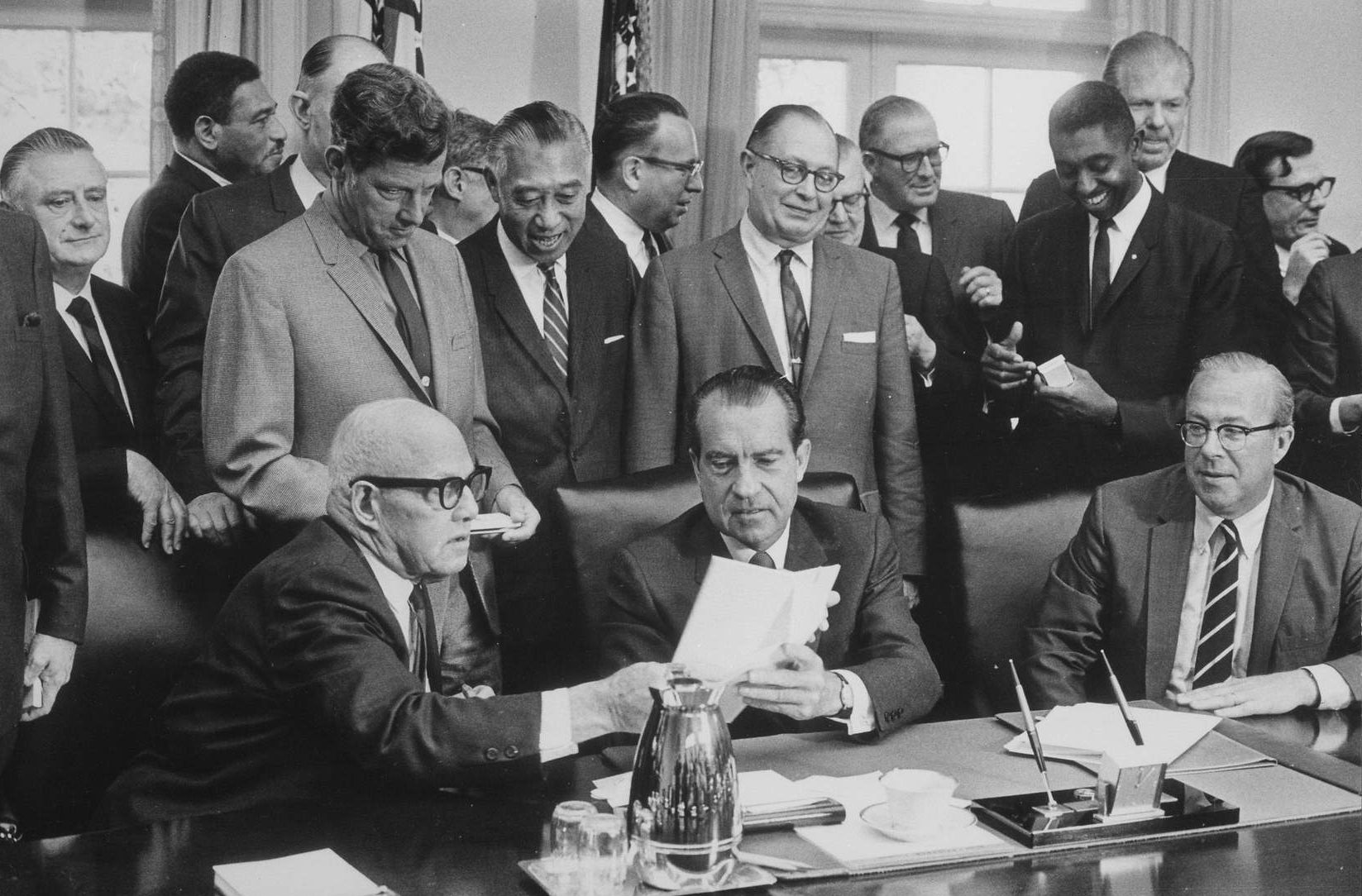
President Nixon signs an executive order (1969).
Federalism
Federalism is a distribution of power that requires a balancing act. The Founding Fathers were not in favor of an overzealous federal government; rather, they intended that the state governments would be equally strong. Both the federal and state governments needed to be supreme within their own jurisdictions. You can see federalism in practice throughout your daily life. You receive mail regulated by the federal government, you pay for items with money minted by the federal government, and you are protected by a military that is maintained by the federal government. You receive goods that are shipped from different states and are regulated by state governments, you drive on roads that are maintained by state governments, and you can obtain a driver's license regulated by a state government. These are just a few examples of our system of federalism. Can you think of any other examples of federalism in your everyday life?